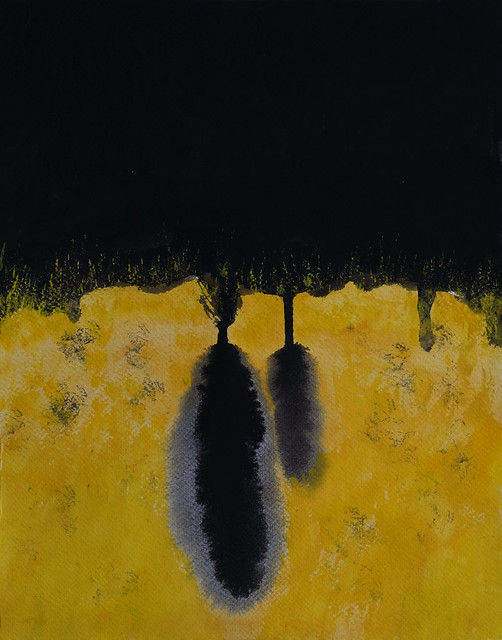
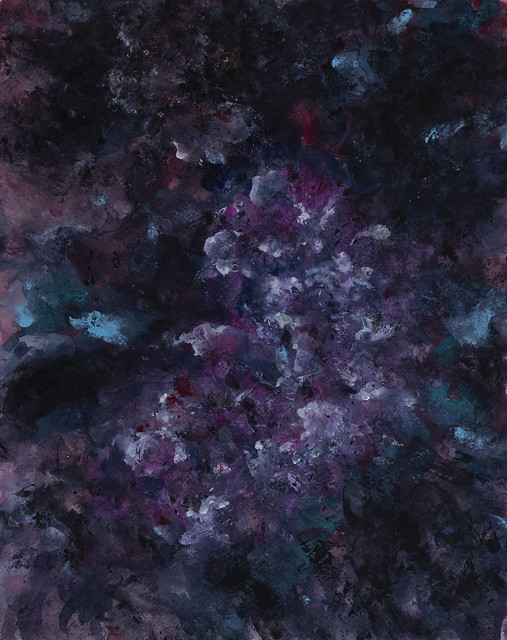
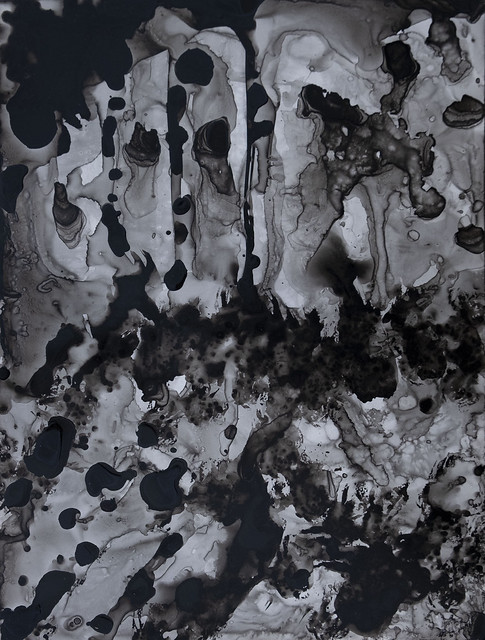
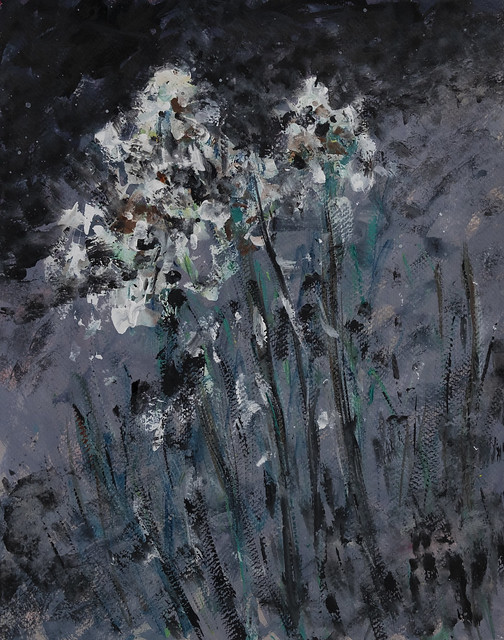
I have been working on a series of paintings with "white dress(es)" motif for quite a while and recently, I extended my effort to include some installation/mixed-media endeavors. My most complete effort in this new field was a work titled "Stringed White Dresses - An Installation", completed in March 2013.
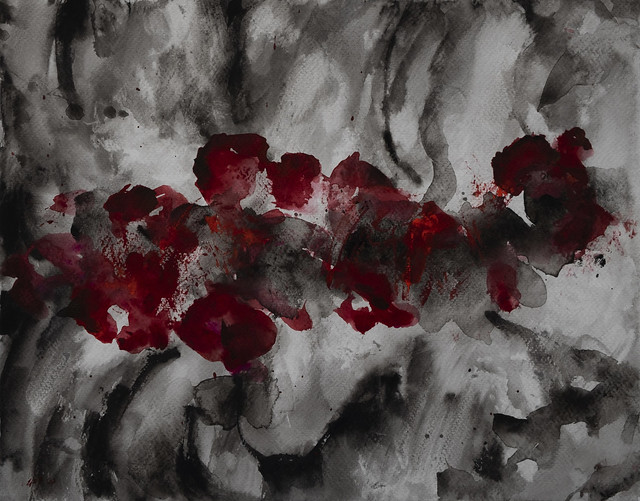
Using some rather square and unyielding origami white dresses, pasted onto twines who in turn were attached to a wooden frame, I created a subtle contrast between orderly and disarray, manifested in the disordered formation of those white dresses. To enhance the contrast and drama, I affixed to the frame a background of colored ink drawing - mostly in black, with dashes of muted red. When I started to get excited about this project, I recorded part of the creating process on video. Below are the video clip and the finished piece:
Though I was happy with and proud of the resulting work, I didn't pin much hope on this piece which was really an experiment. Yet, I was curious enough to see other people's reactions to it so I submitted it for publication and in April, it was included in Pomona Valley Review, Issue 7, published by Cal Poly Pomona.
I was quite encouraged by this acceptance and entered it for the ArtSlant 4th 2013 Showcase competition, in mixed-media category. Last week, I was informed, and then saw the result online, that it had won the award.
That made it the fourth win in ArtSlant's Showcase competitions.
ArtSlant is the #1 Contemporary Art Network with worldwide arts calendars, artitsts, reviews and online art sales of originals and prints.
I am quite pleased and more than a bit amused by its success. A new direction? Maybe. The "White Dress" series will continue, for sure.
Gondola in front of Collezione Peggy Guggenheim, Venezia
When I visited Venice last October, the high water repeatedly threatened to derail my plans, and on the day when we visited a cluster near Punta della Dogana, including Peggy Guggenheim Collections and Basilica di Santa Maria della Salute, the water and wind were quite threatening, so we only saw the sculpture "Boy With Frog" on the very tip of Punta della Dogana from the safe distance and missed the frog held by the boy entirely. It was an intriguing enough a sculpture viewed from the back and though I was very curious about what to see in the front, I didn't want to be swept into the lagoon and believed that I could come back someday to see it again. However, that turned out to be a wishful thinking.
According to BBC News, that iconic sculpture "Boy With Frog" by American sculptor Charles
Ray, would be removed.
Work has begun to take
away a controversial statue depicting a naked boy with a frog in a part
of ancient Venice, Italian media report.
The artwork, by US sculptor Charles Ray, will be replaced by a lamp-post at the tip of the Punta della Dogana. The decision has angered some art lovers who argue that it shows a failure to embrace challenging, contemporary work. But city officials say the sculpture was always intended to be temporary.
Boy with Frog, which is gleaming white and 8ft (2.5m) tall,
has occupied the tip of a triangular piece of land that separates the
Grand and the Giudecca canals for almost four years... It shows a boy holding up a frog by one leg and gazing at it.
In its place will be a reproduction of the original lamp-post... The old-fashioned landmark was thought to be more in keeping
with the surrounding architecture, BBC Rome correspondent Alan Johnston
reports.
Some animal-lovers also argued that the image of a boy holding the frog upside down was cruel, our correspondent adds.
But a piece in La Stampa newspaper criticised Venice's
council, saying "administrative cowardice" had won out over real
culture.
Defending its decision, the council said the sculpture had
been considered temporary and Venice had a fine record of welcoming and
exhibiting modern art.
Dogana, the dividing point between
S. Marco basin, the Canale della Giudecca and the Canal Grande, and its imposing building, the former Dogana de Mar (Sea Customs Post), and the adjacent majestic Basilica di Santa Maria della Salute, was huge and dramatic, particularly viewed from a certain distance, as we approached it from the vaporetto (water bus), and the ever shifting images were quite amazing:
Dogana de Mar (Sea Customs Post) and Basilica di Santa Maria della Salute
Up close, with a tall mast ship mooring nearby, the site was rather romantic and becalming, as we carefully picked our way on the flooded pavement towards the tip of Punta della Dogana.
The wind was strong, the water was choppy and part of the tip was under water already. As waves constantly lapped towards a few brave tourists who pressed forward, I stood in the safe zone and took some snapshots of the boy behind his back, thus missed the frog dangling in the boy's right hand.
Boy With Frog, by Charles Ray, outside the Punta della Dogana
Thanks to outdoorPDK, I am including this photo below so my readers can have better understanding of this sculpture. It was a beautiful one, albeit undeniably controversial.
Moving away from the tip of Punta della Dogana, we saw another unforgettable sculpture, a very somber "Vater Staat" (2010) by Thomas Schütte, in front of the grand Basilica di Santa Maria della Salute.
Vater Staat by Thomas Schütte, 2010, in front of Basilica di Santa Maria della Salute
To me, the most memorable feature inside the Basilica was its huge geometric patterned floor under the huge rotunda. Endlessly fascinating.
Basilica di Santa Maria della Salute, Venezia, 15 October
There were several wonderful sculptures, shrines, and paintings; however, this visit took place near the end of our trip and by then I was suffering art saturation, therefore my memory of those artworks was somewhat dim. Thanks to these photos below, I can remember their subtle splendor.
Basilica di Santa Maria della Salute, Venezia, 15 October
Uhrturm, Schloßberg, Graz (left) and Hauptbahnhof, Graz
Leaving the Renaissance city Graz, Austria, the city I called the City Without Entrance, and Exit
was an adventure itself. We left Graz via Klagenfurt, Villach, Austria, then Udine, Italy to arrive at Venice, on 10 October 2010. The highlight of these two bus rides was the part passing through the Julius Apls from Villach and Udine.
Once we had departed from Graz, our trip became very smooth. Though it was gray and we were traveling amongst the mountains, the road condition was excellent and any safety concern dissipated.
Between Graz and Klagenfurt, Austria
It took only two hours to arrive at Klagenfurt. We followed another bus into the Hauptbahnhof and that was our bus from Klagenfurt to Venice. All Austrian cities were clean and orderly.
Hauptbahnhof Klagenfurt, Austria
We had ten minutes to change bus. The bus driver also checked our passports against his list. For both rides, we had purchased our seats right above the driver, so as to have a good view. The reservation cost only three euros each. Below was our bus, resting at Villach, Austria, our next stop before entering Italy.
Klagenfurt-Villach-Undine-Venedig bus, Villach, Austria
Hauptbahnhof Villach, Austria
From Villach to Udine, Italy, we traveled through some beautiful scenery, part of the Julius Alps formation. We saw impressive pastures, villages and cliffs. The pictures I took may present it as somewhat monotonous but in reality it was far from it.
Julische Alpen (Julius Alps) between Villach and Udine, Italy
The border between Austria and Italy was very plain, like a simple roadside rest stop in the US.
Austria-Italy Border
The rocky formation continued for a long stretch and we passed some large quarries just before we came upon the fertile fields near Udine, in the Friuli-Venezia Giulia region of Italy.
Julische Alpen (Julius Alps) between Villach and Udine, Italy
Now, the landscape started to take on more warm hue of the Italy we associated with. The villages and towns took on a warmer tone as well. More Mediterranean.
Near Udine, Italia
Udine, Italia
Near the end of the day, we finally arrived at Veneto region, and we made a quick stop at Mestre Stazione, Venezia. We were told not to get off the bus at all.
Veneto, Italia
Mestre Stazione, Venezia
Then we left the mainland behind, and traveled upon a man-made bridge in the lagoon, leading to the islands part of Venice. It was amazing to be on the bridge, or viaduct, seeing water on both sides was and then the familiar landmarks emerged in the far distance.
Approaching Tronchetto, Venezia
Arriving Tronchetto, Venezia
Tronchetto was the final stop of the bus. From there, we were to switch on a commuter light rail to go to Stazione Santa Lucia, which was the main train station in Venice.
Tronchetto, Venezia, 10 October
The light rail traveled on a bridge looked like a gigantic whale bone. Very beautiful. The trip cost only a Euro.
Rail track connecting Stazioni Tronchetto and Santa Lucia, Venezia
Getting off the light rail, we dragged our luggage through a lovely bridge with translucent pavement so we could almost see the water underneath, and finally arrived at Stazione Santa Lucia.
Ponte della Costituzione & Stazione Venezia Santa Lucia
We walked onto the plaza in front of Santa Lucia, and saw in front of us the imposing San Simeone Piccolo. Naturally, we knew grander sights
were to come.
San Simeone Piccolo, viewed from Santa Lucia, Venezia, 10 October
Prokofiev's score was enchanting and often ravishing; however, that does not guarantee a success - many years ago, I sat through a very dull Romeo and Juliet, set to his brilliant score, in the same War Memorial Opera House, presented by the usually glorious SFBallet. Based on that experience, I appreciate a good choreography and staging much more. Ballet is more than flawless steps and beautiful music, it also needs to be a good theater and tell a coherent story. Therefore, we must be grateful to Mr. Wheeldon for creating this magical new ballet, which was co-commissioned by SFBallet and Dutch National Ballet, who presented the world premiere in Amsterdam last December. According to the program, Wheeldon created this ballet working with dancers from both companies
simultaneously, having one company's dancers visiting other company to rehearse and incorporating their thoughts into the creative process.
Christopher Wheeldon is an English international choreographer of contemporary ballet.
In 1991, Wheeldon joined the Royal Ballet, London; and in that same year, he won the Gold Medal at the Prix de Lausanne competition. In 1993, at the age of 19, Wheeldon moved to New York City to join the New York City Ballet. Wheeldon began choreographing for the New York City Ballet in 1997, while continuing his career as a dancer. He retired as a dancer in 2000 in order to focus on his choreography. In recent years, he had emerged as one of the very best ballet choreographer of our time.
This new Cinderella was not as grand as those old Russian Imperial story ballets by Marius Petipa, or as glistering as abstract ballets by George Balanchine. Its style though grand at time, was predominantly intimate, warm, consoling, and also fun and hilarious. It rooted deeply in classical ballet tradition, but was also thoroughly modern, in its new twist of the story and characters, and the steps and gestures of modern dance incorporated organically into the classical ones by Wheeldon, and with the modern stage crafts. However, as inventive and wonderful it was, there was a bit of wanting in the transcendent dancing. Perhaps the production was more successful in terms of theater than pure dance. Sadly, this is more or less the norm nowadays. Maybe next Alexei Ratmansky's all Shostakovich ballets in next season will brought us back the the glory similar to The Jewels by Balanchine.
This production was heightened by the amazingly animated living breathing tree, which grew up from the grave of Cinderella's mother, by the famous San Francisco born, New York based puppeteer, Basil Twist, who had created some unforgettable effects for plays, operas and ballets. It was a character in its own right, grand, magical and flashy, but readily to yield to the dancing characters in due time. The whole show was an enveloping smile-inducing enchantment.
Below is a video trailer posted on SFBallet's website:
Since yesterday was the US premiere, there was much excitement. Before the show, apparently there was a party and you can see some one dressed up to the ninth arriving at the opera house, waited by uniformed crew by the entrance:
Besides the ball, there was the usual "Meeting the Artist" event before the show, and the principal dancer Rubén Martín Cintas was interviewed. Cintas would dance the role of Cinderella's father in several performances during this run.
Meet the Artist Rubén Martín Cintas before the performance
Theater curtain before the performance
All the principals dance superbly and despite the drawback that he was not as personally endearing as Taras Domitro, who as the Prince's friend Benjamin was the personification of innocent charm and noble grace, Joan Boada won us over with his precise steps and his understated ardor, and his final pas de deux with Cinderella was sublime. Maria Kochetkova's Cinderella was strong, not easily cowed, and always understanding, forgiving. Her Cinderella was also full of life and was a fun person to be with despite much adversaries in her young life. Kochetkova's dancing was joyous, though not overtly extravagant and that suited Boada's Prince perfectly. The main pairs' collective strength was their deep understanding of each other and life, and the understatement of their personality and performance.
Outright brilliance, though necessarily silly time to time, belonged to the stepmother and the two stepsisters. I was very grateful that they were danced by brilliant and beautiful ballerinas, whose ugliness lay mostly in their actions, rather than often caricatured looks in many other productions, in which they were also often danced by men in drags. Here, they danced their outrageous and intricate silly and fun steps, particularly those of the daughters, brilliantly by Katita Waldo, Sarah Van Patten and Frances Chung. Chung's character of the younger stepsister Clementine was bullied into being a mean sister to Cinderella and once she found her young love in the adoring and adorable Domitro's Benjamin, she emerged a very sympathetic figure and won our blessing for her good fortune. As for the tougher sister Edwina, we can see that she would step into her mother's shoes more easily than those of Cinderella's.
The audience was absolutely enchanted by the performance and had to fight against the urge to applaud ever so often, because the musical and choreographic structures demanded a continuous flow. At the end of each of the three acts, audience was truly gratified for the opportunity to cheer prolongedly.
City Hall, seen from the balcony of the opera house during the intermission
Excited crowd during Intermission
Here are some images of last night's curtain calls:
Curtain call of the principal dancers - Maria Kochetkova, Joan Boada, Frances Chung, Taras Domitro and Sarah Van Patten
Curtain call of the choreographer Wheeldon and production team
SFBallet announced that "All Performances SOLD OUT!
Limited standing room tickets are available. There will be no rush tickets sold for this production."
Catch it if you can. Or do yourself a favor and try to see it next season, which will include another run of this enchanting work.