Showing posts with label History. Show all posts

Monday, August 17, 2015

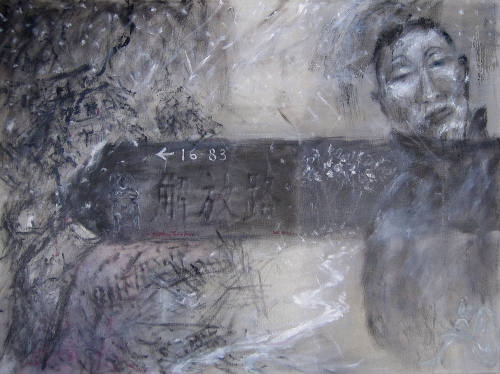
Featured Painting "Liberation Road"

My most accomplished painting to date is a portrait of an old woman, Grandma (2003), while its companion painting, Liberation Road (2010), is my most personal one.

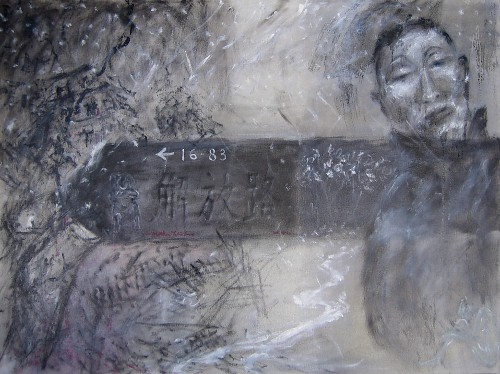
Liberation Road / 解放路 / Befreiungstraße, Oil on Canvas, 18" x 24", Completed in 2010
Liberation Road / 解放路 / Befreiungstraße
Oil on Canvas
18" x 24"
Completed in 2010

 17 Paintings Completed in 2010 (part 2 of 2)

This painting was based on a photo of my paternal great great grandmother, or maybe great grandmother, I do not really know for sure. She was a very elegant woman with a knowing look and her photo had often haunted me and caused me to wonder what had happened to her, to her family, to her descendants in the ensuring years - all those endless upheavals, wars, famine - human suffering of all kinds, from the end of the imperial time, the republican era and culminated in the so-called revolution in the mid-twentieth century. Furthermore, this painting also touched on the traumatic experiences my parents and my sibling and myself suffered in the iron grip of the Chinese Communist Party, or any totalitarian regime, even to this very day.

The left side of the painting showed ruined houses and railroads, balancing the right side of the portrait of my dignified grandmother. The horizontal road sign bisecting the painting read "Liberation Road", yet at the end of the arrow, we saw a sorrow-stricken person, helplessly rested his/her head on the knees, anything but liberated. There was a similar figure, at the lower right of the painting, echoing this figure, in the same posture, though in profile.

I made this painting to pay tribute to my elegant ancestors who had striven to achieve personal enlightenment and successes and later suffered precisely for their achievements in the hands of the anti-intellectual and self-righteous puritanical Communist Party. By surrounding my great grandmother with ruins and other suffering people, I tried to demonstrate the scope of the destruction in the wake of the Communist Party.


In order to show both the complete picture and its details as the "camera" panning across the canvas, I incorporated two video clips into one single final video and they can be played simultaneously. I deliberately kept my left clip static, so as to show the complete painting, while the right clip demonstrate the details, exactly as the video above.


Originally posted on matthewfelixsun.com

Other Related posts on Art · 文化 · Kunst:
- My Featured Work - Portrait Painting "Grandma"
- Featured Painting "The Song of Orpheus"
- Featured Oil Painting "White Dress"
- Featured Oil Painting “Father and Son”
- Featured Oil Painting "The Triumph of Saint George"

Monday, April 8, 2013

My Shifting Views of Margaret Thatcher and Ronald Reagan

Speaking of Margaret Thatcher and Ronald Reagan in late 1980s through early 1990s in China, the prevailing response was unbridled admiration. This was my personal perspective at the time as well.  After all, it was the time repressive Communism, bluntly criticized by Thatcher, Reagan and Pope John Paul, seemed to be crumble and the whole world was running towards a more entrepreneurial and individualistic system, the opposite of what China had been for many decades, therefore, the broad gestures from aforementioned leaders were hugely popular in China and they offered Chinese people hope.

We were utterly ignorant of what Thatcher and Reagan's highly controversial domestic policies and their adverse effects on the societies as communities, such as the inequality and other wrongs came along with their hallmark laissez-faire capitalism.  We saw them as the embodiments of personal and societal freedom, as brave warriors facing down the Communism evil.  Besides, televisions, black and white and later colored, brought them to our humble adobes, and their film-star glamor seduced the whole generation of Chinese people, who were so used to seeing poker-faced politicians and all other the individuals had been dressed like the same working ants in cheap blue Mao suits till only a couple years ago and no good sense of style had emerged yet.

We cared if they were friendly towards China and Chinese people or not; we cared if they were to help to defeat the Soviet Union or not.  We cared for their entrepreneurial and free market doctrines, the opposite to the failed collective economic policies which had been plaguing China for decades.  We cared not, however, if the qualities of their universities suffered, like the great University of California.

Therefore, how could a bewitched Chinese not to love Thatcher?  And how could they not be loved by their own fellow citizens?

The first dissonance I heard came in the late 1980s, when I studied language tapes recorded in the UK, with a scene of young people protesting against Thatcher.  I was utterly bewildered.  Why was she so hated?  Didn't she beat down the hugely ineffective and cumbersome rules, busted the hated union leaders, smashed the wasteful welfare states, and opened the way for sweeping privatization and deregulation?  Shouldn't she be lauded for all those achievements instead?

Only after I'd lived in the US long enough, and had witness the destructive force of those laissez-faire capitalism policies of Thatcher and Reagan brand, and the consequent hugely indecent, and ever-larger wealth inequality in the society, that I realized why their policies and their legacies were not so golden, as I once had believed, and then I understood why they were considered controversial, at the least.

Of course, they had achieved much and not all of their policies were wrong; therefore let me just say that they both were political giants, who had cast long shadows.


Margaret Thatcher - Capitalism and a Free Society

Related posts on Art · 文化 · Kunst
- Remembering Mao's Death
- Tragedies of Our Time

Tuesday, January 3, 2012

One Percent in Medieval Europe

One percent and the rest 99 percent have been in the news often lately but it is still hard for one group to image the lifestyle of the other.  What would we say of the 1% population in the US?  What do they own?  What do they do?  Investors/gamblers?  Entertainers?  Athletes?  I could never image what they do in their own time.  The divide was too wide to see across.

However, I got a glimpse of those one percent in medieval France.  Reading "A Distant Mirror - The Calamitous 14th Century" by Barbara W. Tuchman, I encountered a paragraph describing the group people on top of the economical/social ladder:
Not all nobles were grands seigneurs like the Coucys[1].  A bachelor knight, possessor of one manor and a bony nag, shared the same cult but not the interests of a territorial lord.  The total ranks of the nobility in France numbered about 200,000 persons in 40,000 to 50,000 families who represented something over one percent of the population.
The total population of the US today is 312,795,638 (U.S. Census Bureau estimate, 3 January 2012).  Therefore, the 1% of the US population is about 312,800 and if we used the same household size as used by Tuchman, we had 62,560 to 78,200 household in the top 1%.

However, I was not comfortable with that estimate because the household number was decidedly smaller nowadays.  In order to be more accurate, I did more search online and compiled some information here:

CNN Money said that "there were just under 1.4 million households that qualified for entry. They earned nearly 17% of the nation's income and paid roughly 37% of its income tax.  Collectively, their adjusted gross income was $1.3 trillion. And while $343,927 was the minimum AGI to be included, on average, Top 1-percenters made $960,000."

Washington Post had such analysis:
Taken literally, the top 1 percent of American households had a minimum income of $516,633 in 2010 — a figure that includes wages, government transfers and money from capital gains, dividends and other investment income.

That number is down from peak of $646,195 in 2007, before the economic crisis hit, all adjusted to 2011 dollars, according to calculations by the Tax Policy Center. By contrast, the bottom 60 percent earned a maximum of $59,154 in 2010, the bottom 40 percent earned a max of $33,870, while the bottom 20 percent earned just $16,961 at maximum. As Annie Lowrey points out, that gap has grown wider over time: “The top 1 percent of households took a bigger share of overall income in 2007 than they did at any time since 1928.” (And in New York City, it’s even more skewed: the top 1 percent have an average of $3.7 million in income.)

When you look at the disparity in net worth, things look even more skewed. Wealthier Americans have assets — in home equity, stocks and other investments — that generally outstrip their cash income. Average wealth of the top 1 percent was almost $14 million in 2009, according to a 2011 report from the Economic Policy Institute. That’s down from a peak of $19.2 million in 2007.

By contrast, the poorest households were experiencing declines in net worth even before the recession hit. In 2007, the bottom 20 percent of households had an average (negative!) net worth of –$13,800 in 2007, which fell further to –$27,200 in 2009. Altogether, “average wealth of the bottom 80 percent was just $62,900 in 2009 — a dropoff of $40,900 from 2007,” EPI writes. That means the wealthiest 1 percent held an average of 225 times the wealth of the average median household in 2009 — a ratio that was 125 in 1962.
In this advance e- or i- age, the people who sit at the bottom of social and economical ladder may not look and work like dumb beasts literally as in the Middle Age, but their miseries are not dissimilar to those in the medieval time.

The misery of those poor people in the Dark Age were exacerbated by the nobles who disregarded their "social contract".  According to Tuchman in her book, "the object of the noble's function, in theory, was not fighting for fighting's sake, but defense of the two other estates and the maintenance of justice and order.  He was supposed to protect the people from oppression, to combat tyranny, and to cultivate virtue - that is, the higher qualities of humanity of which the mud-stained ignorant peasant was considered incapable by his contemporaries in Christianity, if not by its founder."

I am not championing the absolute wealth equality.  Rather, I want to point out that the rich have many social obligations as those nobles in the medieval time.  They need to care for and protest the poor, to defend civil liberty and oppose political and religious persecution and promote art and literature, etc.  Our one-percenters have failed rather terribly just as the latter-day knights and the nobles.  And we know what happened to them eventually when their greed became utterly uncontainable.


Image source: Wikipedia, courtesy of CJ DUB 

[1] Coucy was in the forefront of action, tied as he was to both France and England. Coucy was a French noble, but he married Isabella, the eldest daughter of Edward III of England. - Wikipedia

Friday, December 9, 2011

Disorienting Timeline

Recently I read several books on Renaissance artists and I was quite disorientated by the timeline of the world history.

I had quite good education when I grew up in China and we studied both Chinese and world histories but these two strands of history lines remain disjointed and when I am confronted with historical events or figures from these two spheres, they often have struck me different senses of remoteness.

For example, the nine crusades took place from 1096-1272, during those time, China was called Song Dynasty (960-1279), which was a time the Chinese saw the prosperous trades, commerce and arts, yet constantly losing lands to the northern nomadic nations.  Song was conquered by the Mongolian.  To me, Song Dynasty didn't not invoke the romantic knight culture permeated in the ballads and epic poems such as La Chanson de Roland, or Orlando Furioso.  Rather, it was a period of familiar and tangible, a period of craftsmanship and petty bourgeoisie, not dissimilar to the Renaissance period in Europe.  We understand the joy and pain of those Chinese folks, but have hard time to understand those strange etiquette of the knightly courts and the reining ladies.

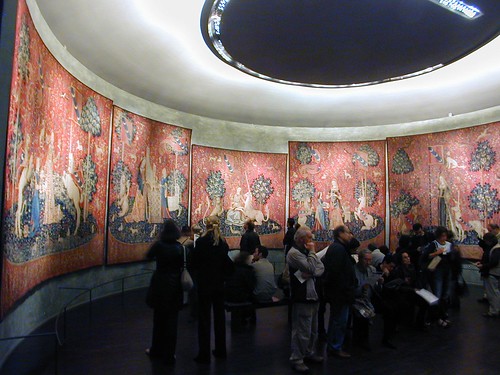
Musée National du Moyen Âge: Lady and the Unicorn

The Italian Early Renaissance occurred during 1400-90 and the High Renaissance took place in the period of 1490-1530, when China was called Ming (Dynasty) (1368-1644), which was second to the last.  Since I have learned so many dynasties and their stories preceding to it, Ming Dynasty was almost a modern time to me.  Because my knowledge of western history was confined to the ancient Greece, Roman, and a bit of Medieval time, the Renaissance time was assigned to a more ancient time frame in my mind.
The Baroque era in the west took place in the period of 1600-1700.  Thinking of Bach, Mozart.  They were relatively ancient figures.  Yet, again, in China, the last Dynasty Qing came into existence from 1644.  Comparing to all those long and varied stories of the proceeding dynasty, Qing Dynasty (1644-1911) was almost intimate to many Chinese.

This sense of confusion does not dissipate with my increasing familiarity with western history.  The more details I learn, the more confused I got.  This confusing sense actually is quite enriching.

Xi'an_5846_500
City wall dated from Ming Dynasty, Xi'an, China

Sunday, September 4, 2011

China - Five Thousand Years Old? No, One Hundred!

Whiling reading Shakespeare's Henry IV, Part II and the historical background essays, I was struck by the tenacity of many usurpers or claimants's efforts in establishing their kinship connections to earlier and legitimate rules, or invented such blood connections.  Without exception, they all styled themselves the Kings of England, and not as a King of York, or King of Lancaster.  Dynasties changed with their family names, but the Kingdom was always England.  England's monarchs can be trace back to 927 A.D.

This is decidedly different from the historical events took place in the land now called China.

People often believe that the history of China is four thousand to five thousand years old.  In a sense, it is correct - the land and people and its continuous, predominant culture can be traced back as far as four to five thousands years ago.  However, during those ancient and imperial times, the concept of China didn't exist.  The land the emperors of various dynasties ruled, gradually grew into the size and shape largely overlapping with current China, was simple called the world (天下).  The succeeding dynasties had no connections to one another except for the land and the people they ruled.  The emperors were the Emperors of Qin, Emperors of Han, Emperors of Tang, Emperors of Ming, and Emperors of Qing, etc., but never Emperor of China.  As a matter of fact, a new dynasty always made great effort to sever any connections, if existed, from the ones they superseded.  The one they replaced was inevitably bad and must be condemned and destroyed and never to be spoken of in any good light.  It was purely incidental that they ruled the same land and people.  Inevitably they claimed their mandates from the Heaven to rule the earth.  The world belonged to their houses.  They didn't need consent to rule from the people lived in that land.  They owned the world and only the by their grace that the people live.

China, (in Chinese 中国), means Middle or Central Country.  This term was used as early as more than two thousand years ago.  However, at that time, it simple meant capital.  Many kingdoms and empires in that land had mentioned themselves as Middle Kingdom, mostly in an egotistic way.

Flag of the Republic of China 1912-1928
China, was really a modern concept came into existence with the overthrown of the last dynasty (Qing) and the birth of the Republic of China in 1911.  When the Republic of China was founded in January 1912, its national flag had five color stripes (red, yellow, blue, white and black), representing the five main ethnic groups - Han, Manchu, Mongol, Muslim Hui and Tibetan.  The land was called China, instead of the World.  The president was the President of China, not the President of the World.  Arguably, the concept of China was a one-hundred-year-old modern concept.

To modern Chinese people, politicians and scholars alike, whoever ruled that land and the people lived on that land, was considered part of the history of China, including the period the land and people was conquered by foreigner invaders and the majority Han was treated slightly better than slaves, such as during the entire Mogol's (Yuan Dynasty) and the early Manchu's (Qing Dynasty) rules.  Chinese generally proudly took pride in their ancient and continuous history and unbroken governance from legendary time through dynasties and republics.  That really bends the truth a bit.  Those conquered periods were really like the conquered Poland during World War II, which at that time, as the political entity, ceased to exist, though the land was still the same land, and the people were still the same Polish people.  Or to imagine that Japan had succeeded in conquering China and called it its province, even if the Japanese capital moved from Tokyo to Beijing or Shanghai.

Of course, in ancient times, the term China had been used in other part of the world to refer to many ancient Chinese dynasties, or the land and the people.  But it was merely a point of reference.  It didn't have the geopolitical meaning in it.  Some people called that land china, other called it silk or tea.

The history in that vast land is long.  But China as a political concept, is still very young.

Friday, August 12, 2011

Granting Voting and Other Human Rights to Corporations

People tend to criticize Republicans for not being compassionate.  How wrong they are!  The Republican are expanding their compassion much further than average human being could have imagined - they are making overture to grant human rights to corporations, including voting right for sure.

In January 2010, by citing First Amendment and granting free-speech right traditionally associated to human beings to the corporation, Supreme Court rejected limits on corporate spending on political campaigns [Washington Post]:
A divided Supreme Court on Thursday swept aside decades of legislative restrictions on the role of corporations in political campaigns, ruling that companies can dip into their treasuries to spend as much as they want to support or oppose individual candidates.

In a 5 to 4 decision, the majority cast its ruling as a spirited defense of the First Amendment, concluding that corporations have the same rights as individuals when it comes to political speech. Corporations had been banned since 1947 from using their profits to endorse or oppose political candidates, a restriction that the justices ruled unconstitutional.
And now, the compassion from the Republic Party just keeps growing.  Republican's presidential candidate, former Governor of Massachusetts Mitt Romney made news by publicly, unequivocally claiming that corporations are people.  Bravo, Mitt!

Below is the New York Times story on Mitt Romney's assertion during his Iowa campaign:
“We have to make sure that the promises we make in Social Security, Medicare and Medicaid are promises we can keep, and there are various ways of doing that,” Mr. Romney said. “One is, we can raise taxes on people.”

“Corporations!” the protesters shouted, suggesting that Mr. Romney, as president, should raise taxes on large businesses.

“Corporations are people, my friend,” Mr. Romney responded, as the hecklers shouted back, “No, they’re not!”

“Of course they are,” Mr. Romney said, chuckling slightly. “Everything corporations earn ultimately goes to people. Where do you think it goes?”

It was a telling, unscripted moment for Mr. Romney likely to be replayed on YouTube. In an instant, he seemed to humanize himself by pointedly squabbling with the group of hecklers, showing flashes of anger and defying his reputation as a sometimes stilted, unfeeling candidate.

But at the same time, he seemed to reinforce another image of himself: as an out-of-touch businessman who sees the world from the executive suite.
Well, though I surely don't know where the money corporations take in go, I do think Romeny's compassion should not be brushed aside easily.  After all, America is a born-again evangelical Christian nation, isn't it?

Therefore, I heartily endorse Romney's assertion, and demand on granting all human rights to corporations, and most important, the voting rights.

However, it is a bit tricky, logistically, to have corporations to vote and to stand in as candidates.  But, we are a resourceful bunch; if we cannot agree on the details, we can always go back to the intentions of our Founding Fathers (not Mothers for sure). 

Since our Founding Fathers' intentions were granting voting rights to property owners only, therefore, it makes absolute sense to grant the most monied entities - corporations - voting rights.   For the unenlightened, there is a term called Originalism, or, Original Intent: Originalists think that the best way to interpret the Constitution is to determine how the Framers intended the Constitution to be interpreted. They look to several sources to determine this intent, including the contemporary writings of the framers, newspaper articles, the Federalist Papers, and the notes from the Constitutional Convention itself. [http://www.usconstitution.net]

I found some background information on History.org regarding the original intent of our founding fathers:
Typically, white, male property owners twenty-one or older could vote. Some colonists not only accepted these restrictions but also opposed broadening the franchise. Duke University professor Alexander Keyssar wrote in The Right to Vote: The Contested History of Democracy in the United States:
At its birth, the United States was not a democratic nation—far from it. The very word "democracy" had pejorative overtones, summoning up images of disorder, government by the unfit, even mob rule. In practice, moreover, relatively few of the nation's inhabitants were able to participate in elections: among the excluded were most African Americans, Native Americans, women, men who had not attained their majority, and white males who did not own land.

John Adams, signer of the Declaration of Independence and later president, wrote in 1776 that no good could come from enfranchising more Americans:

Depend upon it, Sir, it is dangerous to open so fruitful a source of controversy and altercation as would be opened by attempting to alter the qualifications of voters; there will be no end to it. New claims will arise; women will demand the vote; lads from 12 to 21 will think their rights not enough attended to; and every man who has not a farthing, will demand an equal voice with any other, in all acts of state. It tends to confound and destroy all distinctions, and prostrate all ranks to one common level.

Property requirements were widespread. Some colonies required a voter to own a certain amount of land or land of a specified value. Others required personal property of a certain value, or payment of a certain amount of taxes. Examples from 1763 show the variety of these requirements. Delaware expected voters to own fifty acres of land or property worth £40. Rhode Island set the limit at land valued at £40 or worth an annual rent of £2. Connecticut required land worth an annual rent of £2 or livestock worth £40.
Now, I believe that I just proved why it is so rightful and important to voting rights to the wealthiest entities, corporations.  But why stop there?  All the human rights!

All the entitlements a human being enjoys should be extended to our dear corporation brothers and sisters, such as AIG, Lehmann Brothers, HP, Shell, Chevron, Ford, Apple, Google, Yahoo!

They ought to be able to collect social securities - if they are old enough, such as Coca Cola, etc.  But do they have to retire, aka stop being actively churning out sugared cold drink?  Maybe not.  Many social security collectors continue to earn money on the side.  Medicare and Medicaid too, if they need them.

But, naturally, they have to pay social security and medicare taxes.  Well, so be it.  We want to fair, don't we?

I would also propose that when a corporation breaks laws, causes deaths and engages in other mischeives, we ought to jail it - forbidding the corporation to practice in the term, and even impose death penalty upon it when its crime warrants such ultimate punishment - forbidding the corporate to engage in any business transactions for ever.

Also, we ought to regulate marriages of corporations, in case the corporates want to get married to each other are of same sex.  Too bad too that we can no longer legally to deny the voting rights, or any other human rights, to the poor, the colored, or the homosexuals (excluding their marriage rights to the persons they love naturally) - therefore, we have to compromise a bit on our Founding Fathers' Intentions.   This actually proves that we are not as rigid as our opponents charge us to be.  We do compromise, only on our own terms.

All these endeavors can be done.  Our country have the most resourceful lawyers if nothing else.  And all the troubles are not wasted.  How wonderful it would be if the governors in our countries are not the likes of Mr. Jerry Brown, or Mr. Mitt Romney, but Mr. Google or Mr. Fidelity!  And why stop at governors' mansions.  Corporations can occupy the White House and the chambers of Congress as well. 

Our corporations deserve every dignity and entitlement a human being enjoys. Welcome, my corporation brothers and sisters.

Tomorrow, we are to vote together. I have several tens of thousands dollars and that's how many votes I shall have; while you, you ought to have millions upon millions, and billions upon billions votes.

Hurray! We are in a truly enlightened and democratic era. The sun rises, perhaps from the west?
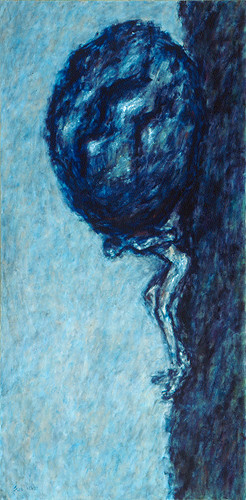
Sisyphus / 西西弗斯 / Sisyphus
Sisyphus © Matthew Felix Sun
Friday, May 27, 2011

Ashamed of Oneself - Reading Book "Never Let Me Go"

Kazuo Ishiguro's "Never Let Me Go" is a wrenching novel about cloned children created to provide vital organs for non-clones ("originals"). I just started to read the dreamily paced narration and I was shaken by an early scene took place in an "elite" school, Hailsham, for these cloned children.

There was a patroness, the Madame, visited the school several times a year. A group of young girls, led by their audacious ringleader Ruth, tried to approach the unapproachable patroness, to prove that Madame was afraid of them.  The girls approached Madame and then the narrator, Kathy remembered years later of the experience:
I'll never forget the strange change that came over us the next instant. Until that point, this whole thing about Madame had been, if not a joke exactly, very much a private thing we'd wanted to settle among ourselves... She didn't shriek, or even let out a gasp... And I can still see it now, the shudder she seemed to be suppressing, the real dread that one of us would accidentally brush against her. And though we just kept on walking, we all felt it; it was like we'd walked from the sun right into chilly shade. Ruth had been right: Madame was afraid of us. But she was afraid of us in the same way someone might be afraid of spiders. We hadn't been ready for that. It had never occurred to us to wonder how we would feel, being seen like that, being the spiders.

Thinking back now, I can see we were just at that age when we knew a few things about ourselves -- about who we were, how we were different from our guardians, from the people outside -- but hadn't yet understood what any of it meant.

... Maybe from as early as when you're five or six, there's been a whisper going at the back of your head, saying: "One day, maybe not so long from now, you'll get to know how it feels." So you're waiting, even if you don't quite know it, waiting for the moment when you realise that you really are different to them; that there are people out there, like Madame, who don't hate you or wish you any harm, but who nevertheless shudder at the very thought of you -- of how you were brought into this world and why -- and who dread the idea of your hand brushing against theirs. The first time you glimpse yourself through the eyes of a person like that, it's a cold moment. It's like walking past a mirror you've walked past every day of your life, and suddenly it shows you something else, something troubling and strange.
When I was very little, I was precocious and more mature for my age and overtly sensitive.  I don't remember that "cold moment" of self-discovery, but I do remember the moment I had to face up the mirror, the moment I had to reveal to others the hidden secret, which I believed had marked me as unworthy, as unclean, as the spider.

The burden I'd been carrying for a few years before I started my elementary school was that my "Family Origin" (a political label assigned to individuals in Communist China, designating the person's worthiness and trust-worthiness).  "Poor Peasant" was the most desirable one, which guaranteed one the trust and favorable opinion from the authorities, while the most evil one was "Landlord", and unfortunately, I knew that I bore one.  I don't remember when I learned this bitter truth but the shame of it had weighed me down ever since.  Landlords to me were not only oppressors and exploiters, they were also inevitably, as depicted in literature and movies, lazy, mean-spirited, dirty, ugly and uncouth.  I believe that I was more ashamed of carrying such identification for the latter reasons.  That might be the first time my vanity was deeply wounded. 

Then, there was a most welcome change.  "Bad" family original, such as "Landlord", or "Rich Farmer", were change into different labels, less damning.  Our family label "Landlords" became "Revolutionary Cadres".

I don't have clear memory of my reaction to this news -- either my memory failed me, or I blocked it out deliberately.  My mother told me that once our Residence Registration Book was returned to us, with the "Landlord" label crossed out, and "Revolutionary Cadre" filled in, I held the book with both hands, brimmed with joy, and couldn't stop dancing!

Finally, I was able not to link myself to landlord.  What a relief it was.  However, my happiness was shattered quickly.  Soon, it became clear to me that "Poor Peasants" remained "Poor Peasants", "Middle-Lower Peasants" remained "Middle-Lower Peasants".  Anyone had family origin of "Revolutionary Cadre" was just simple evil "Landlord" in disguise.  Everyone knew that as a fact.  A "Revolutionary Cadre" was just as untrustworthy as a "Landlord".

The shame returned.  Once again, I was convinced that I was a bad person, unclean and needed to be watched out by others.  Therefore I felt the urge to hide this information. 

But I had no way to hide it.  As a matter of fact, the very first question I was asked, when I started my elementary school, was "What is your family origin?"

That was my "cold moment", or "chilling moment".  Actually, I believe that I felt extremely hot.  I really wished either the world or I would disappear.

According to my teacher, who confided to my mother, not unsympathetically, that I, though obvious to her, knew the answer, blinking my eyes, made quick mental calculations, and mumbled something like "I don't know", which was not uncommon amongst her pupils.

She knew immediately what my answer would be and moved on to ask her next pupil.

I have experience many embarrassing and shameful moments in my life but that one was the one most traumatic.

Ironically, I just read a short memoir by my father, who stated that since his family didn't have much land, therefore, his family classification changed time to time, bounced amongst Rich Farmer, Landlord and Middle-Lower Peasant.  My father claimed that he didn't want to be caught telling a lie, hence, he always claimed that his family background was the worst kind, Landlord.

The burden I shouldered for so many years might not even a real one.  That was life.

PS: A couple years after that "cold moment", people paid less attention to "Family Origin" and I ceased to worry about it altogether, though the ungainly image of Landlord continue to make me wince and somewhat ashamed to be associated with such a group of people.

Liberation Road / 解放路 / Befreiungstraße
Liberation Road Completed in 2010


Devastating Novel "The Land of Green Plums" by Herta Müller
- Molotov's Magic Lantern: A Journey In Russian History by Rachel Polonsky and Some Journeys of My Own
- David Malouf's Ransom
- Review of "As Above, So Below" by Rudy Von B. Rucker
- Banned Books in Mao's China

Thursday, January 6, 2011

"Political Correctness" Running Amok?

I have complained about caprices of some translators often, when they made edits to the books they worked on.  Now, this practice has encroached the books written in English and would be marketed to the American readers.  Julie Bosman reported for New York Times that Publisher Tinkers With Twain.

She reported that a new edition of Adventures of Huckleberry Finn to be release the edition in February by NewSouth Books, a publisher based in Alabama is to replace the word "nigger" by "slave," 219 times in all.  The book also substitutes "Indian" for "injun."  She reported that:

Alan Gribben, a professor of English at Auburn University at Montgomery, approached the publisher with the idea in July.  Mr. Gribben said Tuesday that he had been teaching Mark Twain for decades and always hesitated before reading aloud the common racial epithet, which is used liberally in the book, a reflection of social attitudes in the mid-19th century.

"I found myself right out of graduate school at Berkeley not wanting to pronounce that word when I was teaching either 'Huckleberry Finn' or 'Tom Sawyer,'" he said. "And I don't think I'm alone."

"I'm by no means sanitizing Mark Twain," Mr. Gribben said. "The sharp social critiques are in there. The humor is intact. I just had the idea to get us away from obsessing about this one word, and just let the stories stand alone."

The news set off a storm of angry online commentary, scolding the publisher for "censorship" and "political correctness," or simply for the perceived sin of altering the words of a literary icon. Twain admirers have turned his hefty “Autobiography of Mark Twain,” published last year, into a best seller. 

Some English teachers were less than thrilled about the idea of cleaning up a classic.
"I'm not offended by anything in 'Huck Finn,'" said Elizabeth Absher, an English teacher at South Mountain High School in Arizona. "I am a big fan of Mark Twain, and I hear a lot worse in the hallway in front of my class."

Ms. Absher teaches Twain short stories and makes "Huck Finn" available but does not teach it because it is too long — not because of the language.

"I think authors’ language should be left alone," she said. "If it's too offensive, it doesn’t belong in school, but if it expresses the way people felt about race or slavery in the context of their time, that's something I’d talk about in teaching it."

To criticize this attempt as "Political Correctness" running amok is actually quite mild.  Looking deeper, one can detect something more sinister.  This new edition attempts to re-write history by hiding some ugly truths of our nation's most wrenching past, the truth made some of us uncomfortable, particularly to those who don't want to be reminded that using derogatory terms was once social norm and don't welcome any reminder of that and would be gladly to pretend that those ugly truths never existed, not here anyway.  By substituting words, the publisher is denying readers, particularly less informed young ones, a piece of crucial information.  By looking away from our heinous history, we would have missed a great opportunity to educate people of our history and our values.

If such trends continue, I wouldn't be surprised that one hundred years from now one, people would claim that slavery has never existed in the U.S., as some people, be it in Germany, Iran or America, who have been trying to deny the occurrence of the Holocaust.

Sunday, March 15, 2009

Civil Union, Marriage and Holy Matrimony

Recently, quite a few readers of the San Francisco Chronicle have suggested that all marriages should be called "civil unions," whether same-sex or opposite-sex, unless they are blessed by religious organizations. This is a dead-wrong proposal. Marriages, historically, in many cultures have always been civil actions, without religious content or implication. They were mostly social, often financial contracts. This supposedly progressive proposal to call all marriages "civil unions" will replace the discrimination against same-sex couples with discrimination against non-religious couples. Civil Union as a category was created as a compromise to accommodate same-sex couples and is innately a secondary class term. In these modern days, in order to respect and protect the rights to all members of the society, we should continue to call the marriages recognized by civil society and government "marriages," while those blessed by the religious organizations can be called “Holy Matrimony” as they have been for a very long time. This is far better than demoting the marriages of my grandparents and my parents into second class ones.