Showing posts with label Anselm Kiefer. Show all posts

Friday, January 13, 2012

My Favorite SFMOMA Collections

I have been to many museums, exulted or less glamorous, local or overseas.  I savor my memories of many visits to those museums and time to time relive the moments when I encountered a piece made the strongest impression on me.  I am going to write about those museums I have been to, with two pieces from each museum.  These works I pick don't have to be the "best" or the most renown, but they are to be truly my favorites.

Starting with the obvious museum - San Francisco Museum of Modern Arts (SFMOMA).  My favorite of mine at SFMOMA is Die Sechste Posaune (The Sixth Trumpet), Anselm Kiefer (Donaueschingen, Germany, 1945), 1996, painting: emulsion, acrylic, shellac, and sunflower seeds on canvas, 204 3/4 in. x 220 1/2 in. (520.07 cm x 560.07 cm)


I first saw this painting many years ago at SFMOMA and wad struck by the monumentality of this piece.  It is of biblical proportion, and its painful scream was quite overwhelming.  But, the pain was like those of madrigal from the earlier time, still orderly and restraint, like a Passion Oratorio by Bach.

Underneath the black specks, the deserted fields and hills were haunted spot, with eerie beauty, as if to tell us what we have lost, or what we did not deserve.

This is a beautiful but difficult piece to stare at.  It currently is not on display.  My guess is that if people see it too often, they might have lost all their wills to live.


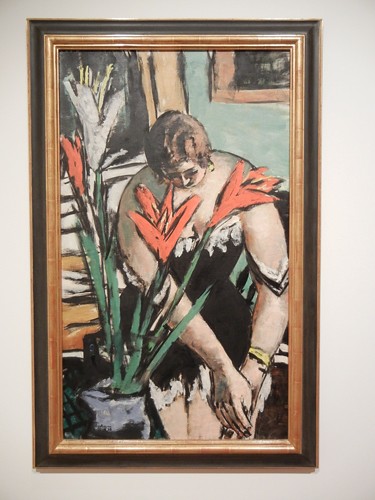
My other favorite collection at SFMOMA is by Max Beckmann (Leipzig, Germany, 1884 - 1950, New York City, New York) - Frau bei der Toilette mit roten und weissen Lilien (Woman at Her Toilette with Red and White Lilies), 1938, Oil on Canvas.

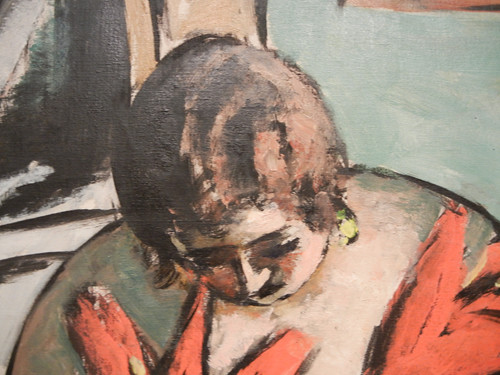
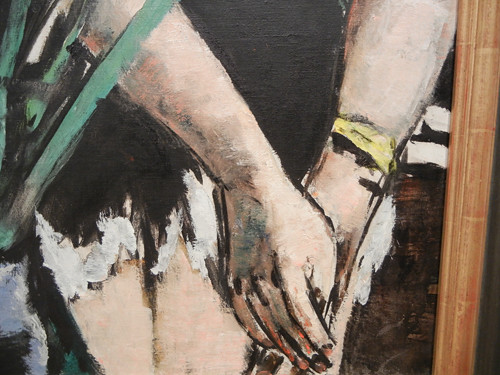
Every time when I visited SFMOMA, I would spend some time with this enchanting Frau. I have always been partial with the German painter Beckmann.  I loved not only his stark vision but his bold yet exquisite execution. I particularly love the way he used the black color to outline object and give them monumental mass.  This Frau is both a typical and an atypical of Beckmann.  It has all the trademarks of his palette, his handling of paints in the bold outlines and thin layers.  However, this quietly melancholic piece is rather quite comforting, comparing to his more enigmatic and/or apocalyptic pieces.  This Frau needs not to be afraid but to be adored.

Frau bei der Toilette mit roten und weissen Lilien (Woman at Her Toilette with Red and White Lilies), Max Beckmann, 1938, Oil on Canvas, SFMOMA _ 9631

Frau bei der Toilette mit roten und weissen Lilien (Woman at Her Toilette with Red and White Lilies), Max Beckmann, 1938, Oil on Canvas, SFMOMA _ 9633

Frau bei der Toilette mit roten und weissen Lilien (Woman at Her Toilette with Red and White Lilies), Max Beckmann, 1938, Oil on Canvas, SFMOMA _ 9635

Frau bei der Toilette mit roten und weissen Lilien (Woman at Her Toilette with Red and White Lilies), Max Beckmann, 1938, Oil on Canvas, SFMOMA _ 9634

It is interesting that my favorite works were created by German masters haunted and pained by the ravages of war.  I am afraid that I do share such of their apocalyptic point of view.  But, by admitting my love for the Beckmann above, I think it is fair to say that I still have some hope and love for humanity.


My Favorite Museum Collection Series 

>> My Favorite Museum Collection Series 2: My Favorite De Young Museum Collections


List of My Favorite Artworks in the Museums I've Visited

Saturday, April 10, 2010

Abstraction versus Representation

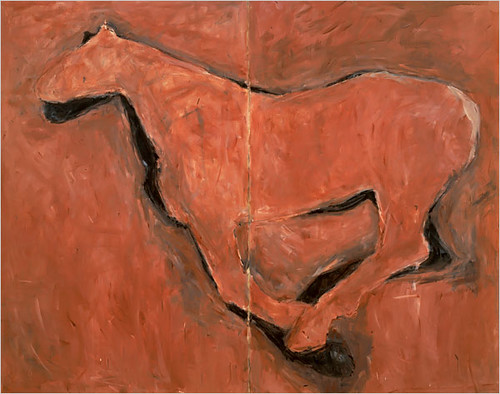
New York Times recently reported Another Painter in O’Keeffe Territory - Susan Rothenberg. Rothenberg's work actually don't automatically call Georgia O'Keeffe into mind. “We’re completely different people,” Ms. Rothenberg recently said of herself and O’Keeffe, who died at 98 in 1986. “The energy is very different.”

The article continued:

Both O’Keeffe and Ms. Rothenberg were very much part of the New York art worlds of their eras, but both turned reclusive once they adapted to life out West: O’Keeffe at Ghost Ranch, about 65 miles north of Santa Fe; Ms. Rothenberg at the 750-acre ranch about 25 miles south of here, that she shares with Mr. Nauman. (“It’s very peaceful,” Ms. Rothenberg explained. “I know very few people in Santa Fe.”)

Certainly there are major differences between the two, including their approaches to painting. “Both made serious breakthroughs” as painters, said Michael Auping, the chief curator of the Modern Art Museum of Fort Worth, where the show originated, who organized this show. “But they’re sort of polar opposites in many ways.”

“O’Keeffe’s use of abstraction was pretty radical” in the years before she turned to figurative work, he said, while “Susan reintroduced figuration in the early 1970s after abstract painting had been dominant for many decades.”

The work of both women straddles the divide between abstraction and representation, and both are best known for paintings that focus on single, figurative images...
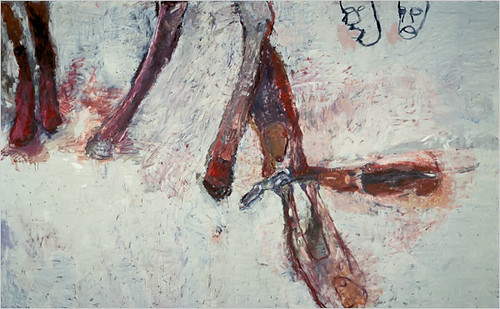
Cabin Fever by Susan Rothenberg

Dogs Killing Rabbit by Susan Rothenberg

It is very interesting that art world has gradually moved away from the absolute modernism and abstraction of 1960s and 1970s and become more representative, more lyrical and unafraid of story telling. Even grim masters like Anselm Keifer differ from Jackson Pollack in the same way, while they have very similar color palettes.

In the musical and literary worlds, the trends are similar. Classical music grew out of the tyranny of Twelve Tone doctrine (I do love Schoenberg, by the way), while literary world embraces master story tellers such as Ian McEwan, J. M. Coetzee, José Saramago, and Pat Barker.

Since I am not able to engage the pure intellectual exercise of creating profound abstract art, I am glad to be working in the period when representative art works are not sneered upon.

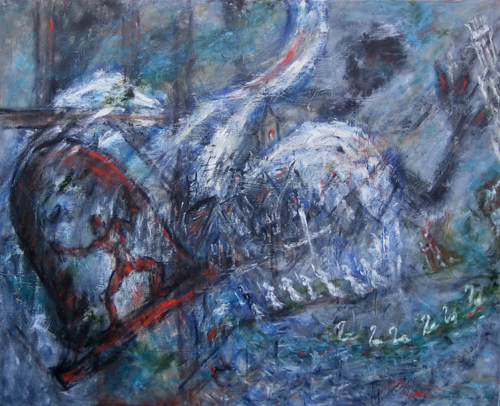
Below is my own oil painting - Bruges, Impression

Bruges, Impression / 布魯日,印象 / Brügge, Eindruck

Tuesday, March 9, 2010

Contents versus Expression

While trying to improve my art, I constantly try to concentrate on the message of my work - what does it need to say, what it is all about? In the eagerness to clarify my message, sometimes, I allow the the other aspect of painting - form to take back seat.

Last night, I heard a book review on NPR title The Gods, At Play In The House Of Mortals by Maureen Corrigan of the book The Infinities by Man Booker's Prize winner John Banville. What she said that struck me most is: "I used to put a lot of stock in an adage about writing. It went roughly like this: 'If a student says he wants to be a writer because he has something to say, discourage him. But if a student says she wants to be a writer because she likes to play around with words, well, that student may have what it takes to be a writer.'"

She continued: "I don't believe in absolutes about writing anymore: People write out of all sorts of longings and take many roundabout paths to producing good books. But I thought of that axiom as I was reading John Banville's new book, The Infinities. I often had only the dimmest idea about what Banville was trying to say in this novel, or indeed, what even happens in it. But it's clear that Banville — as a stylist whose first literary mentor, not surprisingly, was James Joyce — loves playing around with language. And his zest carries a reader over most opaque thickets here, where sound totally triumphs over sense."

Immediately, I thought about my desire of writing and desire of telling the story via painting or drawing. Am I falling the same trap Corrigan described here? Having something to say is important but then equally important is to tell it in a way which is engaging, interesting, and better still virtuosic. Without the well executed form, a message would be no better than a slogan.

I had a discussion about this radio book review with a writer friend and he, though didn't totally contradict Corrigan, warned me that I should not abandon my desire to tell a story or send a message - without them, virtuosity itself is nothing but just meaningless virtuoso display. Definitely I will pay more attention to play with paints, charcoals, pastels, crayons, etc.

The best contemporary artists, such as Anselm Kiefer, William Kentridge, and Andy Goldsworthy triumphed in both aspects, therefore they are great.

Devils' Dance / 魔鬼的舞蹈 / Teufels Tanz

Saturday, July 11, 2009

Celebrating Bastille Day - (Some) Parisian Style

According to New York Times, the departing Paris Opera general director Gerard Mortier's last commission would be a theatrical work by the German painter Anselm Kiefer (conception, mise en scène, décors et costumes, according to Opéra Bastille official website). The new work Am Anfang (In the Beginning) was composed by Jörg Widmann. It has bibilical feature and the famed Trümmerfrauen (Rubble Women), who salvaged bricks in bombed-out postwar Germany under orders from the victorious Allies.

Anselm Kiefer, without unqualification, is my most favorite living artist. I saw his astonishing retrospective at San Francisco Modern Art Museum and would love to see any of his work, no matter what media he employs.

To make things more enticing, the matinee performance on the Bastille Day will be free.

How I wish I could be there, but I have a book group meeting that day, so Paris has to wait.

Hopefully, you'll make it?