Showing posts with label German. Show all posts

Saturday, June 1, 2013

Devastating Novel "The Land of Green Plums" by Herta Müller

Herta Müller in 2007
Amrei-Marie unter
cc-by-sa3.0 und GFDL
Recently I read a devastating novel, The Land of Green Plums, by Romanian-born German writer Herta Müller (17 August 1953-), and have been haunted by the unbearable hard life she depicted unflinchingly ever since.  The original title, however, was Herztier, Heart Animal, or Heart Beast as the phrase translated by Michael Hofmann for Picador Book.  Besides being a novelist, Müller is also a poet, essayist and she was the recipient of the 2009 Nobel Prize in Literature. Born in Niţchidorf, Timiş County in Romania and her native language is German.[wikipedia]

The novel was set at the height of Ceauşescu's reign of terror and a mere daily existence was a heroic struggle, particularly for intellectuals.  The green plums were referring to omnipresent surveillance agents who chewed on those plums constantly.  Heart Animal was a living presence inside an individual the state was striving to stamp out like wildfire.  The stories she told was intentionally episodic and not always coherent and logical, thus she created a hallucinatory atmosphere and a nightmarish living environment one could not escape from.  The novel impressed me  most by its accurate depiction of seemingly inconsequential but cumulatively enormous burdens the state imposed upon individuals.  The book was a devastating read, particularly for people like me who grew up under the similar circumstances, if not as severe, and have close relatives and friends suffering the similar oppressions even now, more so than I had ever experienced, as the political situation in China gets more insufferable as the Communist Party's legitimacy gets shakier and the totalitarian regimes get lonelier.

The Land of Green PlumsThe language Müller employed was halting and haunting yet deceptively simple, and the images she conjured up hallucinatory, the morals clear, through tortuous paths. I have to quote some passages from the translated version, which would eloquently correlate all the points I just made.

Its preface was a poem by Gellu Naum (August 1, 1915 – September 29, 2001) was a prominent Romanian poet, dramatist, novelist, children's writer, and translator.[wikipedia]
   Everyone had a friend in every wisp of cloud
   that's how it is with friends where the world is full of fear
   even my mother said, that's how it is
   friends are out of the question
   think of more serious things                                             
                                     
                                        - Gellu Naum
On Page 94, Müller wrote:
I have been interrogated by Captain Pjele on his own without the dog Pjele. Maybe the dog Pjele was having a break, to eat or sleep. Maybe the dog Pjele was off in one of the building's many hidden rooms being trained, either learning something new or practicing something he already knew, while Captain Pjele was interrogating me. Maybe the dog Pjele was with the man and the canvas bag, on the tail of someone else in the street. Maybe with a different man and no canvas bag. Maybe the dog Pjele was following Kurt while Captain Pjele was interrogating me. How many men were there, and how many dogs? As many as a dog has hairs.
On Pages 121-122:
If Frau Margit spent too long reading and ate too many wafer scraps, her stomach would get so holy that she would belch as she peeled the potatoes, and then she would swear even more. Since I've known Frau Margit, holy for me means a dry, whitish crackling in the mouth that makes you belch and swear.
Finally, on Page 177:
On her wrist she had one of my father's dead wristwatches. Why do you wear if, I asked, if it doesn't work? Nobody can see that, she said, and you have one too. Mine works, I said, otherwise I wouldn't be wearing it. If I wear a watch, it makes me feel more secure, she said, even if it's not working. Then why ask me what time it is? I said.

Because that's all I can talk to you about, said Mother.
It was a most memorable book, beautiful and repulsive simultaneously.


The Orphan Master's Son


Ashamed of Oneself - Reading Book "Never Let Me Go"
- Molotov's Magic Lantern: A Journey In Russian History by Rachel Polonsky and Some Journeys of My Own
- David Malouf's Ransom
- Review of "As Above, So Below" by Rudy Von B. Rucker
- Banned Books in Mao's China

Friday, January 13, 2012

My Favorite SFMOMA Collections

I have been to many museums, exulted or less glamorous, local or overseas.  I savor my memories of many visits to those museums and time to time relive the moments when I encountered a piece made the strongest impression on me.  I am going to write about those museums I have been to, with two pieces from each museum.  These works I pick don't have to be the "best" or the most renown, but they are to be truly my favorites.

Starting with the obvious museum - San Francisco Museum of Modern Arts (SFMOMA).  My favorite of mine at SFMOMA is Die Sechste Posaune (The Sixth Trumpet), Anselm Kiefer (Donaueschingen, Germany, 1945), 1996, painting: emulsion, acrylic, shellac, and sunflower seeds on canvas, 204 3/4 in. x 220 1/2 in. (520.07 cm x 560.07 cm)


I first saw this painting many years ago at SFMOMA and wad struck by the monumentality of this piece.  It is of biblical proportion, and its painful scream was quite overwhelming.  But, the pain was like those of madrigal from the earlier time, still orderly and restraint, like a Passion Oratorio by Bach.

Underneath the black specks, the deserted fields and hills were haunted spot, with eerie beauty, as if to tell us what we have lost, or what we did not deserve.

This is a beautiful but difficult piece to stare at.  It currently is not on display.  My guess is that if people see it too often, they might have lost all their wills to live.


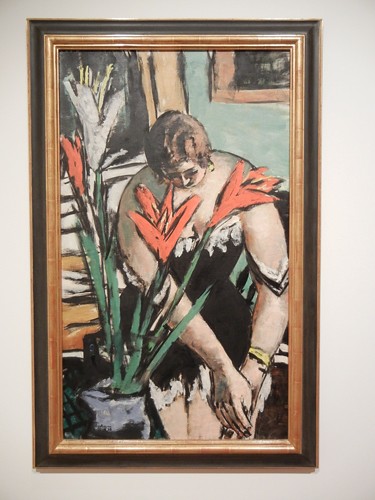
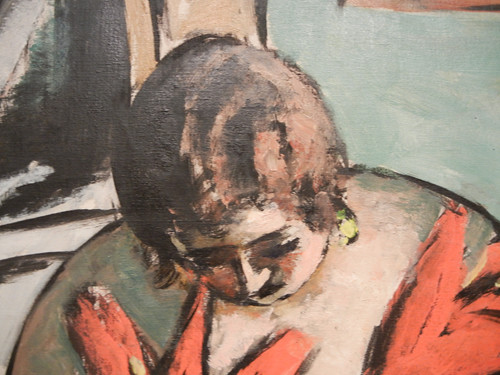
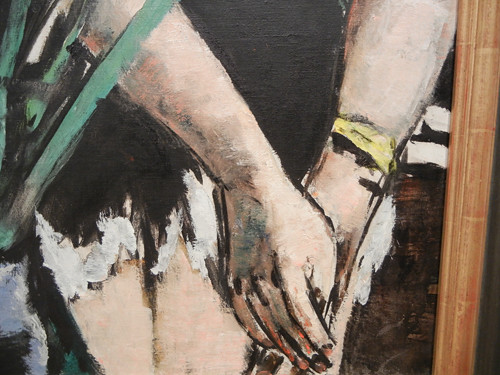
My other favorite collection at SFMOMA is by Max Beckmann (Leipzig, Germany, 1884 - 1950, New York City, New York) - Frau bei der Toilette mit roten und weissen Lilien (Woman at Her Toilette with Red and White Lilies), 1938, Oil on Canvas.

Every time when I visited SFMOMA, I would spend some time with this enchanting Frau. I have always been partial with the German painter Beckmann.  I loved not only his stark vision but his bold yet exquisite execution. I particularly love the way he used the black color to outline object and give them monumental mass.  This Frau is both a typical and an atypical of Beckmann.  It has all the trademarks of his palette, his handling of paints in the bold outlines and thin layers.  However, this quietly melancholic piece is rather quite comforting, comparing to his more enigmatic and/or apocalyptic pieces.  This Frau needs not to be afraid but to be adored.

Frau bei der Toilette mit roten und weissen Lilien (Woman at Her Toilette with Red and White Lilies), Max Beckmann, 1938, Oil on Canvas, SFMOMA _ 9631

Frau bei der Toilette mit roten und weissen Lilien (Woman at Her Toilette with Red and White Lilies), Max Beckmann, 1938, Oil on Canvas, SFMOMA _ 9633

Frau bei der Toilette mit roten und weissen Lilien (Woman at Her Toilette with Red and White Lilies), Max Beckmann, 1938, Oil on Canvas, SFMOMA _ 9635

Frau bei der Toilette mit roten und weissen Lilien (Woman at Her Toilette with Red and White Lilies), Max Beckmann, 1938, Oil on Canvas, SFMOMA _ 9634

It is interesting that my favorite works were created by German masters haunted and pained by the ravages of war.  I am afraid that I do share such of their apocalyptic point of view.  But, by admitting my love for the Beckmann above, I think it is fair to say that I still have some hope and love for humanity.


My Favorite Museum Collection Series 

>> My Favorite Museum Collection Series 2: My Favorite De Young Museum Collections


List of My Favorite Artworks in the Museums I've Visited

Tuesday, October 5, 2010

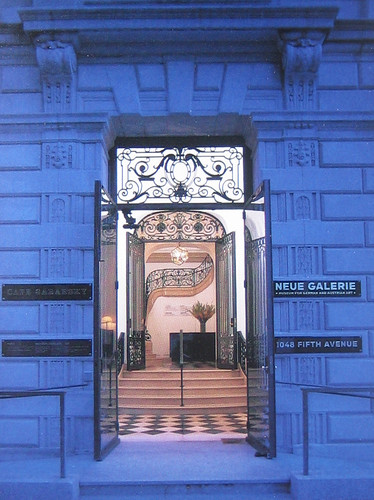
Neue Galerie New York - Austrian and German Art Gallery

Entrance to Neue Galerie New York

My last museum visit while in New York last month was Neue Galerie New York, which showcased Austrian and German art. The gallery was at the intersection of 5th Avenue and E 86th Street, only two to three blocks from the MET.

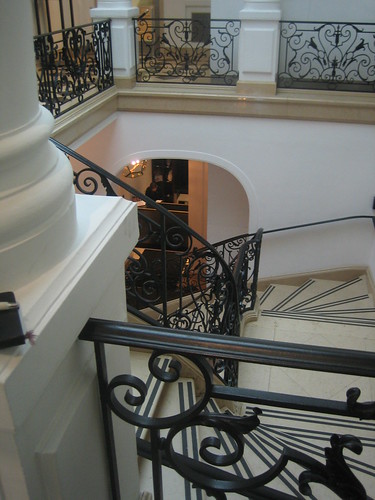
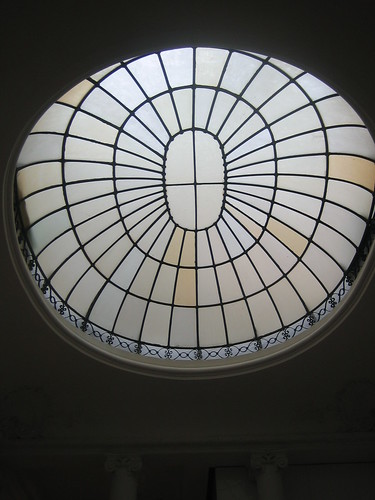
The building itself was an Art Nouveau marvel with ornate staircases and glass canopy.

Neue Galerie New York _ 8459

Neue Galerie New York _ 8460

Neue Galerie New York _ 8461

Neue Galerie New York _ 8464

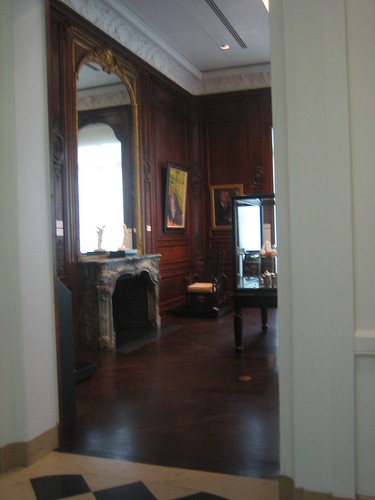
The exhibition rooms were arranged like living quarters, lending the atmosphere of in the period of early 20th century.

Neue Galerie New York _ 8462

Unfortunately, when we were there, it was between shows, again, and only two rooms open on the second floor, featuring Austrian art only.  Even so, there were much to saver still.  What we did see included quite a few works by Gustav Klimt, Oskar Kokoschka and Egon Schiele.

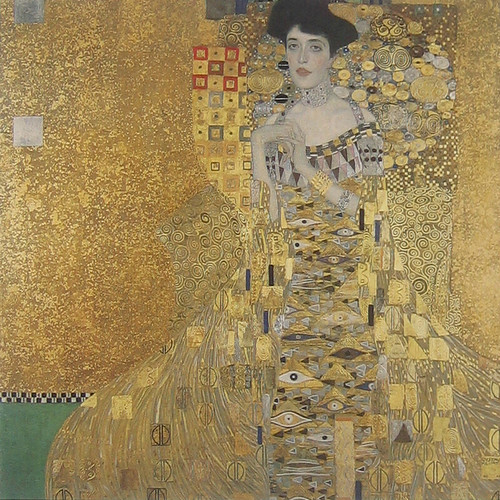
Adele Bloch-Bauer I, Gustav Klimt, 1907

The above Adele Bloch-Bauer I was singularly beautiful.  My friend Steve Masover has written about this piece extensively Gustav Klimt's portrait of Adele Bloch-Bauer: a saga and Property: thoughts on Klimt's portrait of Adele Bloch-Bauer.  The basic story around this painting was that when Adele died, she "bequeathed" it to Austria, once her husband died. Before her husband died, he was forced to flee Austria and his possessions, including this painting was confiscated.  It had been in an Austrian museum till recently, that litigation between the estate of her husband and Austrian government decided that Adele didn't own the piece at all; rather the husband did, who left the painting to his heirs, who made arrangement to sell it the Neue Galerie New York.  The Austrians were reportedly shocked by the decision.  One could easily understood.  Gustav Klimt was quintessential Austrian figure.  This painting was the height of his artistic achievement.  To lose it, was like losing its collective soul, again, and again.  Poor Austrians, they had experienced such losses so many times over.  One suspect that they might be numb.  But no.  They were lovers of art, if nothing else.

I had never been an ardent admirer of Klimt.  But, this painting, together with that I saw at the MOMA, opened my eyes quite a bit and I was able to appreciate him much more.  I reported on the MOMA visit as such:
Another painting I have been resisting till recently was Klimt. I didn't care much for Art Nouveau movement but it was by no means limited to overtly ornate images and designs. They were productions of periods for sure, but the humanity transcended its stylistic boundary.
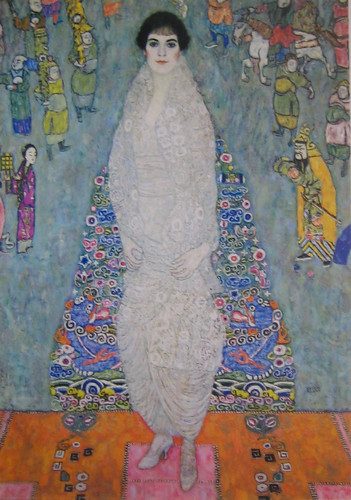
I also found Adele Bloch-Bauer I very beautiful to behold.  There were many textural details visible when examining it up close. For example, the eyes on her skirt were reliefs and his juxtaposition of simple and complex elements were both swift and harmonious, sudden by not abrupt.  The oriental elements in the below painting Bildnes Baronin Elisabeth Bachofen-Echt (Portrait of Baroness Elisabeth Bachofen-Echt) highlighted the sophistication and beauty of the sitter.  I wasn't sure about the meaning though.  Perhaps, it was better to remain oblivious in this case.

Bildnes Baronin Elisabeth Bachofen-Echt (Portrait of Baroness Elisabeth Bachofen-Echt), Gustav Klimt, c. 1914

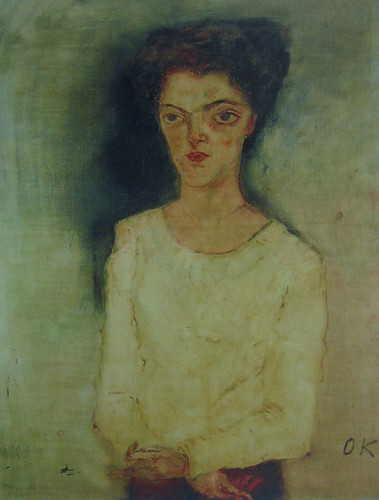
While unconventional, Klimt's central figures were still easily be identified as beauties.  Not so with those in Kokoschka and Schiele's.  Take Kokoschka's Martha Hirsch below as example.  She is no conventional beauty and could be intimidating and scary.  However, once a viewer got used to the usual contour and proportions of the figure, one could appreciate the intelligence and emotion portrayed by the artist clearly.  Subtleties were abundant as well.  The colors were beautifully contrasted and blended.  I also love the hand gestures very much.

Martha Hirsch, Oskar Kokoschka, 1909

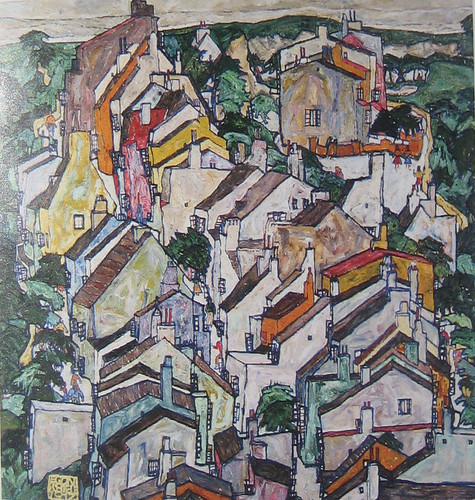
I mostly associated Schiele with striking figure paintings but this landscape below was very interesting as well.  It was bold but also was very carefully designed work, perhaps, subconsciously influenced by the Art Nouveau design.

Town Among Greenery (The Old City III) (detail), Egon Schiele, 1917

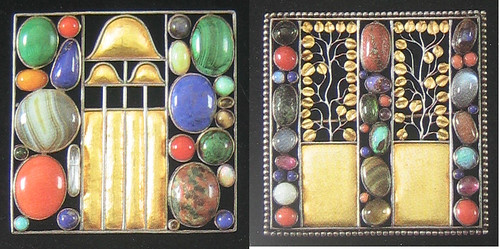
There were many incredibly beautiful Art Nouveau artifacts in the display cases.  Fanciful, barely functional and all well made.  Perhaps somewhat too much, particularly like the brooches designed by Josef Hoffmann below:

Brooches, Josef Hoffmann, 1908

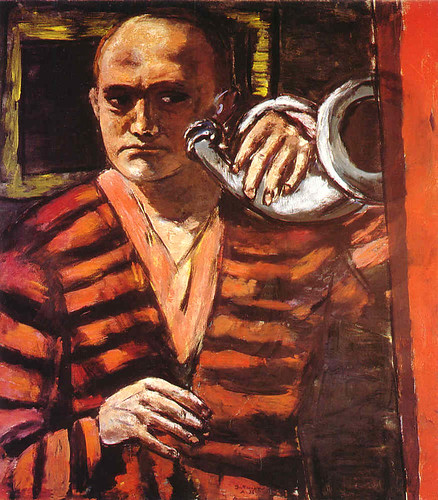
The museum was not big. There were only two exhibit floors. It seemed that the second floor shows the Austrian art while the third was for German art, therefore, I missed my chance to see some wonderful German paintings, including Max Beckmann's Self-portrait with Horn:

Self-portrait with Horn, 1938-1940, Max Beckmann
Self-portrait with Horn, Max Beckmann, 1938-1940

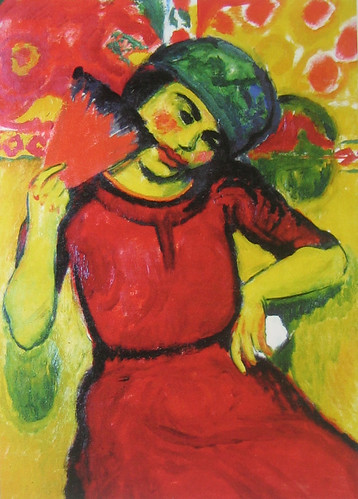
Young Woman with Red Fan, Hermann Max Pechstein, c. 1910

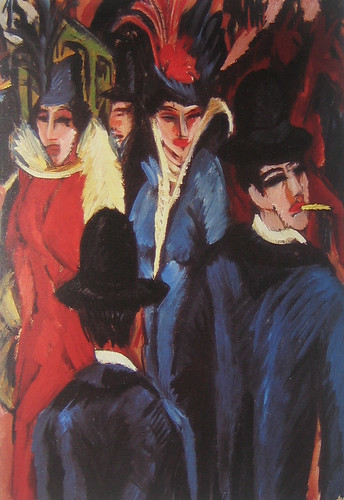
Berlin Street Scene (detail), Ernst Ludwig Kirchner, 1913-14

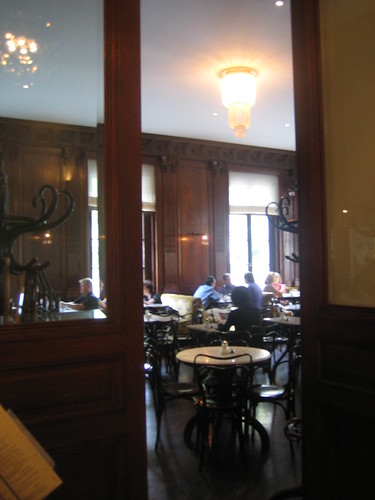
To make the experience full, the gallery has two wonderful Viennese cafes - Café Sabarsky and Café Fledermaus, meticulously decorated in the right style.  I had Kaffee mit Schlag at Café Sabarsky.  However, I didn't get customary little cookie as in Vienna. I guess meticulousness only went certain length.  But it was a beautiful cafe for sure. 

Café Sabarsky, Neue Galerie New York _ 8453
Café Sabarsky

Café Sabarsky, Neue Galerie New York _ 8457
Café Sabarsky

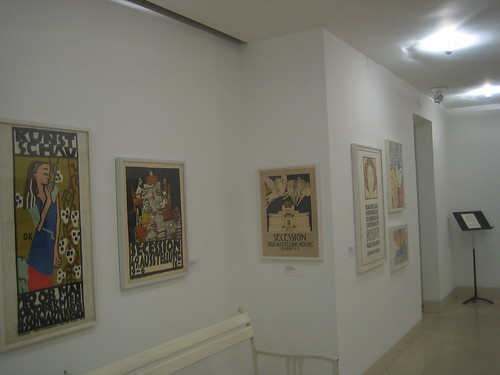
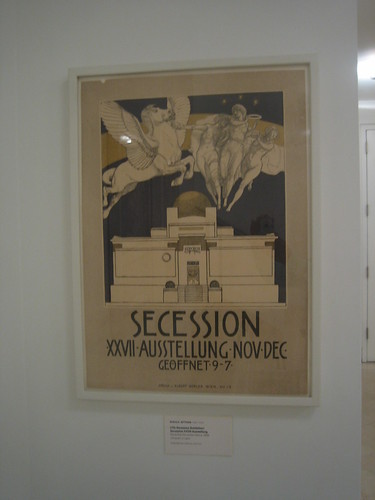
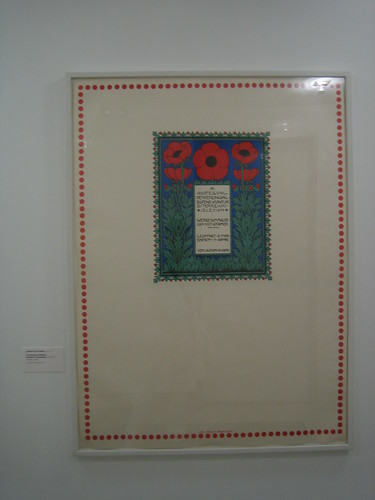
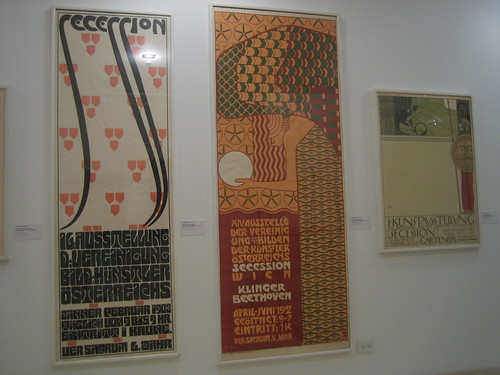
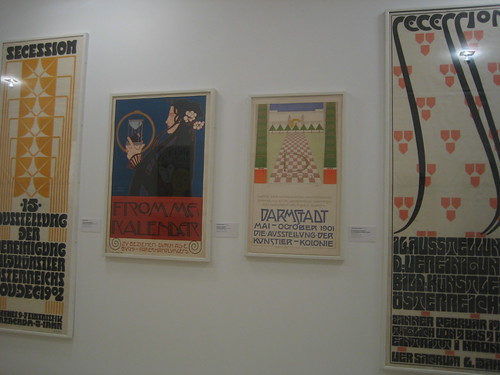
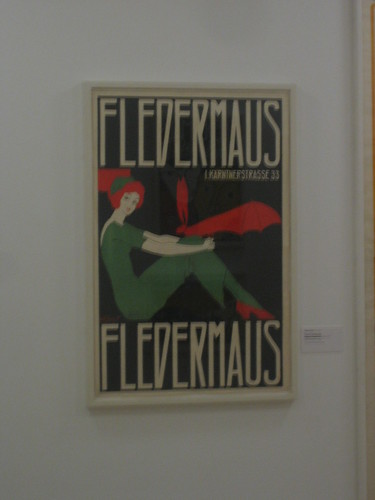
Anther cafe, Café Fledermaus, was closed during my visit. But there were many posters around the entrance to it, from the Vienna Secession period, flowery, sexy, and often quite elaborate.  Quite interesting way to round up the short museum visit.

Neue Galerie New York _ 8467
Entrance to Café Fledermaus

Neue Galerie New York _ 8469

Neue Galerie New York _ 8470

Neue Galerie New York _ 8473

Neue Galerie New York _ 8477

Neue Galerie New York _ 8478

Neue Galerie New York _ 8480

Neue Galerie New York _ 8474

Neue Galerie New York _ 8476

>> New York City Report, September 2010, Part XV: Art in Subway Station, New York City
<< New York City Report, September 2010, Part XIII: Max Beckmann's Paintings in MOMA and MET

Wednesday, July 8, 2009

My Hero Käthe Schmidt Kollwitz (July 8, 1867 – April 22, 1945)

Today is the birthday anniversary of German painter, printmaker and sculptor Käthe Kollwitz's birthday. She is one of my favorite artists, despite my aversion of her dark images when I was a child.

She was well known in China, largely due to the introduction of a very influential left wing writer, LU Xun, who was active in the 1930s. What I saw in her works, when I was little, were nothing but scary images of the hollowed eyes crazy and demonic figures. I couldn't stare at those screaming images long to contemplate the meanings and beauty hidden.

When I grew older, and more experienced, I became drawn to her works like moth dancing around fire. Her works exert an enormous influence on my thoughts and my works. Her unflinching approach to human miseries due to poverty and war, was the epitome what an artist ought do.

More than 100 years after her birth, 55 years after her death, the world has not learned the lessons from her time and ignored her eloquent and often searing accounts of the sad human conditions in the first half of the 20th century. The misery continues, therefore the duty of artists to document and to illuminate continues.


Killed in Action


Woman with Dead Child