Showing posts with label Neue Galerie New York. Show all posts

Friday, October 14, 2016

My Favorite Paintings at Neue Galerie, New York City

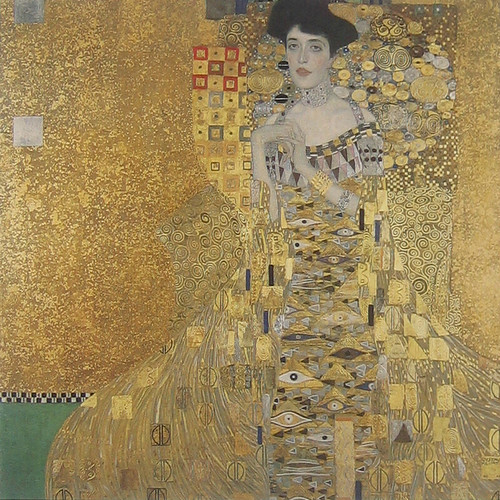
Practically a next door neighbor to the mammoth Metropolitan Museum, Neue Galerie in New York City was a modest and exquisite museum, which specializes in early twentieth-century German and Austrian art and design, and has become much wider known due to its addition of Portrait of Adele Bloch-Bauer I by Gustav Klimt, after a landmark judgement over its ownership, claimed by Österreichische Galerie Belvedere in Vienna, and the original owner's heir, resided then in the US.

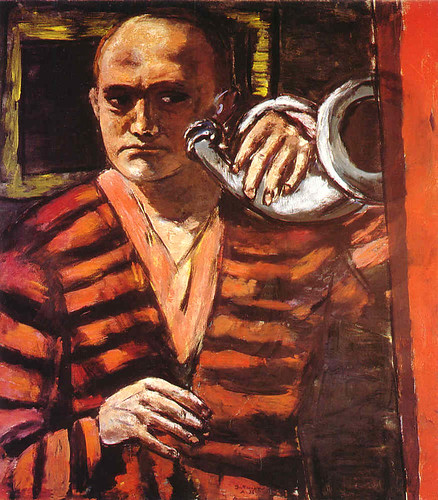
That Klimt was indeed amazing and mesmerizing; however, to me, the most engaging painting was a self-portrait by German painter Max Beckmann, Self-Portrait with Horn. This painting had all the hallmarks of this remarkable artist in his artistic maturity: bold black outlines, amazing interplay of light and shadow, clashing yet harmonious palette, economically abstracted forms and shades, somewhat stylized stiff arms and hands, and above all, an unflinching inspection of the sitter and primal emotions emitted from the painting. The artist as the subject was somber, severe, yet fearfully curious, gazing tentatively and intently into the mouthpiece of the gleaming white horn his stiff hand barely held, with his head boldly framed by the golden frames behind him on the wall, and compressed by the narrow space defined by a red partition at the right edge of the canvas — a picture of a man being challenged and confronted by unknown destiny and conditions. Though severe and slightly menacing, the painting did not depress or repel, rather embracing, due to its beautiful and warm coloration and wonderful tonal contrasts, and the rather confident and bold gaze of the sitter.

Max_Beckmann's_'Self-portrait_with_Horn',_1938-1940
Image courtesy of DASHBot [fair use]

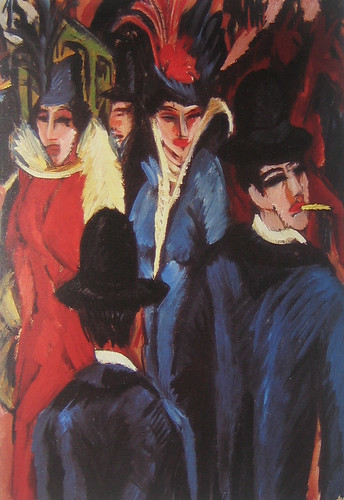
Ernst Ludwig Kirchner's Berlin Street Scene (1913) was an exercise of urban sophistication and wry irony. The painting was almost decorative, yet the seemingly elegant and harmonious existence could hardly conceal the inner angst, apathy, discontent or even contempt the people exhibited. Those stylized figures, with their fanciful dresses, particularly the head gears of those city women, telegraphed that the society Kirchner observed was perhaps both a decadent and depressing one, as however pleasant they looked, there were traces of ludicrousness and meaninglessness in them, which were equally manifested in the more broadly sketched and burdened people scurrying about in the background, and the composed, sure, and searching women in the center of the scene, and some men in the foreground who averted gazes from those glamorous women.  A wry commentary on the lack of human connection, or fluidity of genders in then Berlin?

https://upload.wikimedia.org/wikipedia/commons/d/d1/Kirchner_Berlin_Street_Scene_1913.jpg
Berlin Street Scene (1913), Ernst Ludwig Kirchner [Public domain], via Wikimedia Commons


My Favorite Museum Collection Series
>> My Favorite Museum Collection Series 141: My Favorite Paintings at Solomon R. Guggenheim Museum, New York City
<< My Favorite Museum Collection Series 139: My Favorite Paintings at The Frick Collection, New York City

List of My Favorite Artworks in the Museums I've Visited

Other Related posts on Art · 文化 · Kunst:
- Museum of Modern Art (MOMA), New York City 
- Max Beckmann's Paintings in MOMA and MET
- Gustav Klimt and Egon Schiele in Wien (Vienna)
- Sunflower Seeds by Ai Weiwei at Tate Modern, London
- Last Trip to a Museum in 2012 - The William S. Paley Collection: A Taste for Modernism at De Young Museum in San Francisco
- "The Steins Collect" Exhibit in San Francisco Museum of Modern Art (SFMOMA)
- Art in Subway Station, New York City
- Neue Galerie New York - Austrian and German Art Gallery
- Barry McGee Mural, Soho, New York 2010
- Arslan: In the Midst of a Single Breath - Dillon Gallery, New York

Tuesday, October 5, 2010

Neue Galerie New York - Austrian and German Art Gallery

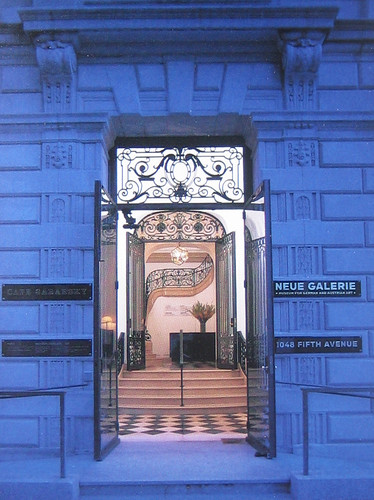
Entrance to Neue Galerie New York

My last museum visit while in New York last month was Neue Galerie New York, which showcased Austrian and German art. The gallery was at the intersection of 5th Avenue and E 86th Street, only two to three blocks from the MET.

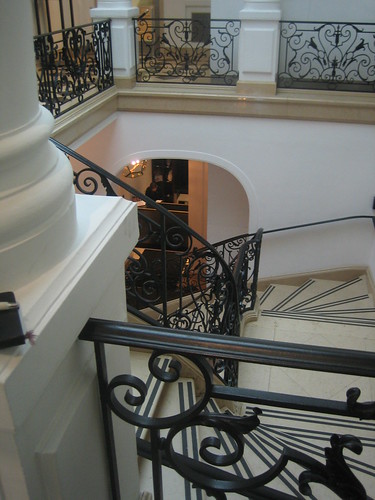
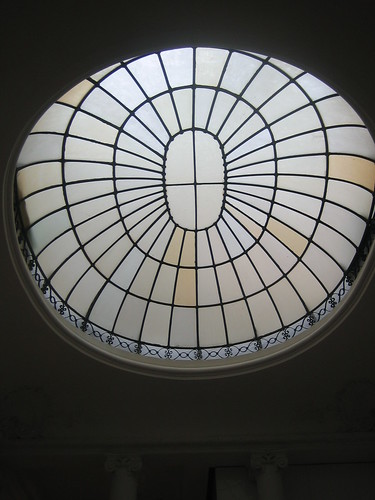
The building itself was an Art Nouveau marvel with ornate staircases and glass canopy.

Neue Galerie New York _ 8459

Neue Galerie New York _ 8460

Neue Galerie New York _ 8461

Neue Galerie New York _ 8464

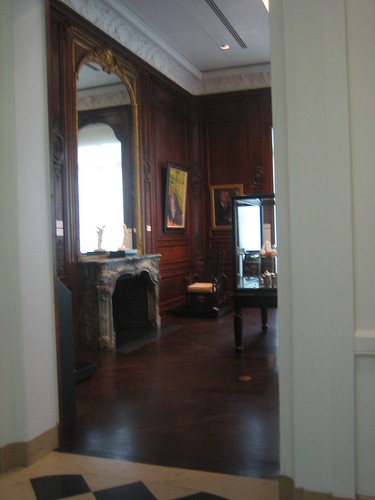
The exhibition rooms were arranged like living quarters, lending the atmosphere of in the period of early 20th century.

Neue Galerie New York _ 8462

Unfortunately, when we were there, it was between shows, again, and only two rooms open on the second floor, featuring Austrian art only.  Even so, there were much to saver still.  What we did see included quite a few works by Gustav Klimt, Oskar Kokoschka and Egon Schiele.

Adele Bloch-Bauer I, Gustav Klimt, 1907

The above Adele Bloch-Bauer I was singularly beautiful.  My friend Steve Masover has written about this piece extensively Gustav Klimt's portrait of Adele Bloch-Bauer: a saga and Property: thoughts on Klimt's portrait of Adele Bloch-Bauer.  The basic story around this painting was that when Adele died, she "bequeathed" it to Austria, once her husband died. Before her husband died, he was forced to flee Austria and his possessions, including this painting was confiscated.  It had been in an Austrian museum till recently, that litigation between the estate of her husband and Austrian government decided that Adele didn't own the piece at all; rather the husband did, who left the painting to his heirs, who made arrangement to sell it the Neue Galerie New York.  The Austrians were reportedly shocked by the decision.  One could easily understood.  Gustav Klimt was quintessential Austrian figure.  This painting was the height of his artistic achievement.  To lose it, was like losing its collective soul, again, and again.  Poor Austrians, they had experienced such losses so many times over.  One suspect that they might be numb.  But no.  They were lovers of art, if nothing else.

I had never been an ardent admirer of Klimt.  But, this painting, together with that I saw at the MOMA, opened my eyes quite a bit and I was able to appreciate him much more.  I reported on the MOMA visit as such:
Another painting I have been resisting till recently was Klimt. I didn't care much for Art Nouveau movement but it was by no means limited to overtly ornate images and designs. They were productions of periods for sure, but the humanity transcended its stylistic boundary.
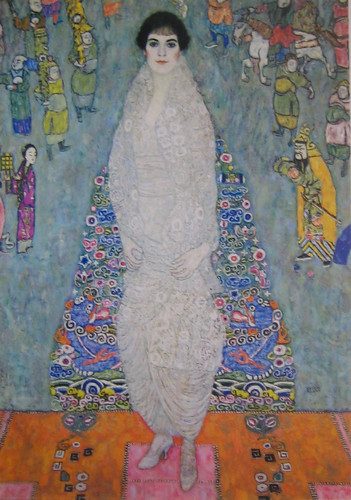
I also found Adele Bloch-Bauer I very beautiful to behold.  There were many textural details visible when examining it up close. For example, the eyes on her skirt were reliefs and his juxtaposition of simple and complex elements were both swift and harmonious, sudden by not abrupt.  The oriental elements in the below painting Bildnes Baronin Elisabeth Bachofen-Echt (Portrait of Baroness Elisabeth Bachofen-Echt) highlighted the sophistication and beauty of the sitter.  I wasn't sure about the meaning though.  Perhaps, it was better to remain oblivious in this case.

Bildnes Baronin Elisabeth Bachofen-Echt (Portrait of Baroness Elisabeth Bachofen-Echt), Gustav Klimt, c. 1914

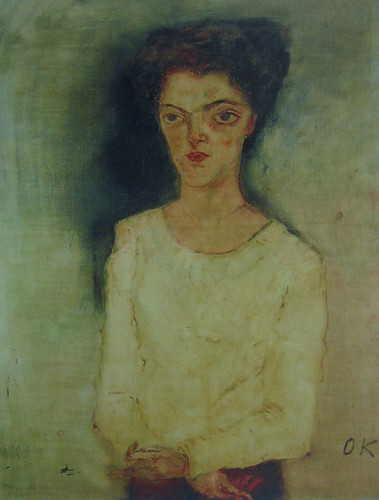
While unconventional, Klimt's central figures were still easily be identified as beauties.  Not so with those in Kokoschka and Schiele's.  Take Kokoschka's Martha Hirsch below as example.  She is no conventional beauty and could be intimidating and scary.  However, once a viewer got used to the usual contour and proportions of the figure, one could appreciate the intelligence and emotion portrayed by the artist clearly.  Subtleties were abundant as well.  The colors were beautifully contrasted and blended.  I also love the hand gestures very much.

Martha Hirsch, Oskar Kokoschka, 1909

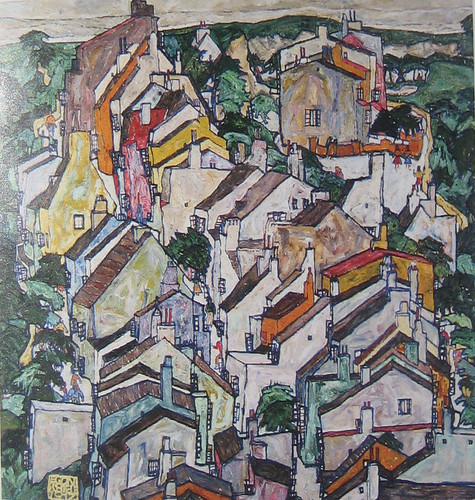
I mostly associated Schiele with striking figure paintings but this landscape below was very interesting as well.  It was bold but also was very carefully designed work, perhaps, subconsciously influenced by the Art Nouveau design.

Town Among Greenery (The Old City III) (detail), Egon Schiele, 1917

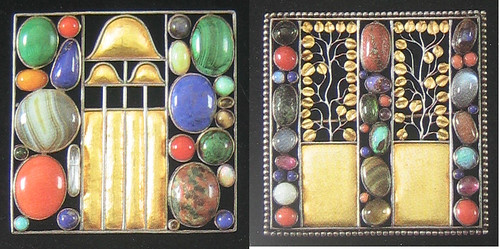
There were many incredibly beautiful Art Nouveau artifacts in the display cases.  Fanciful, barely functional and all well made.  Perhaps somewhat too much, particularly like the brooches designed by Josef Hoffmann below:

Brooches, Josef Hoffmann, 1908

The museum was not big. There were only two exhibit floors. It seemed that the second floor shows the Austrian art while the third was for German art, therefore, I missed my chance to see some wonderful German paintings, including Max Beckmann's Self-portrait with Horn:

Self-portrait with Horn, 1938-1940, Max Beckmann
Self-portrait with Horn, Max Beckmann, 1938-1940

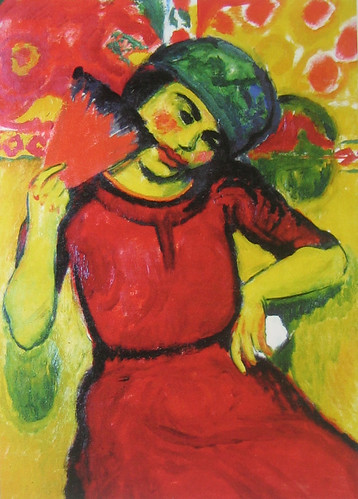
Young Woman with Red Fan, Hermann Max Pechstein, c. 1910

Berlin Street Scene (detail), Ernst Ludwig Kirchner, 1913-14

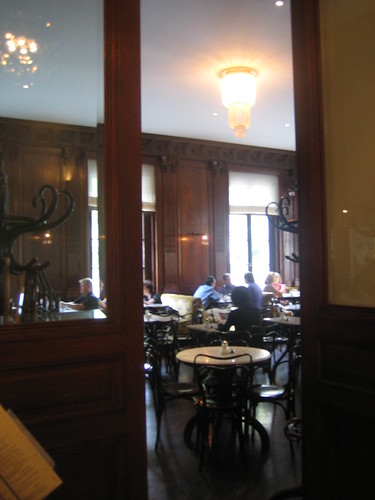
To make the experience full, the gallery has two wonderful Viennese cafes - Café Sabarsky and Café Fledermaus, meticulously decorated in the right style.  I had Kaffee mit Schlag at Café Sabarsky.  However, I didn't get customary little cookie as in Vienna. I guess meticulousness only went certain length.  But it was a beautiful cafe for sure. 

Café Sabarsky, Neue Galerie New York _ 8453
Café Sabarsky

Café Sabarsky, Neue Galerie New York _ 8457
Café Sabarsky

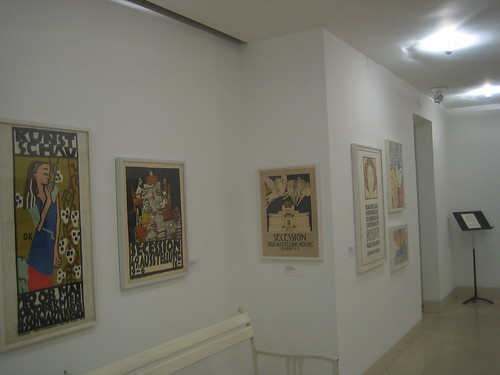
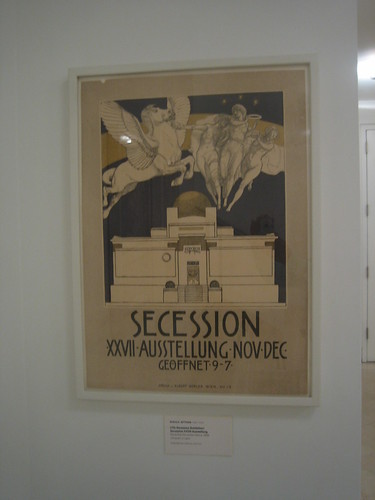
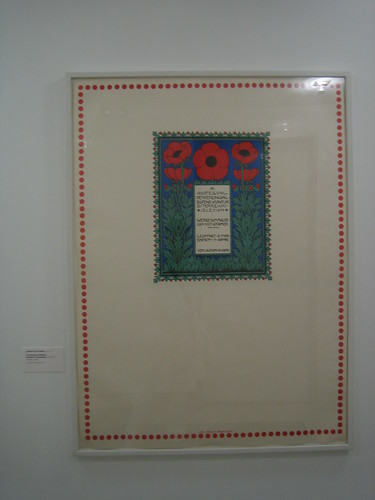
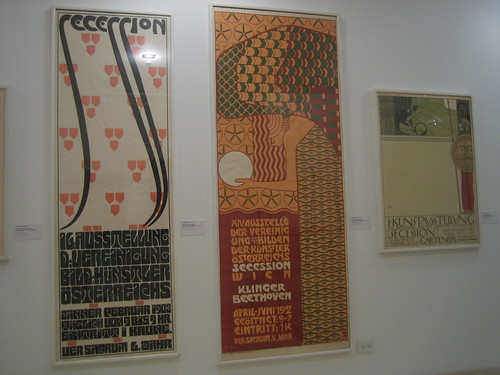
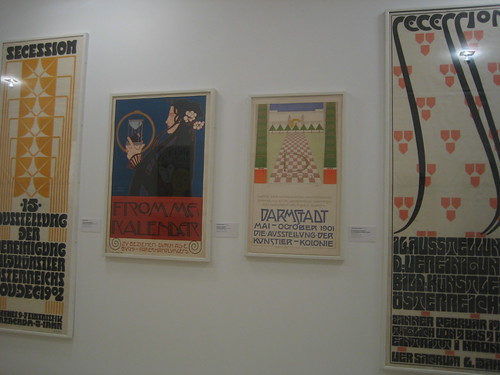
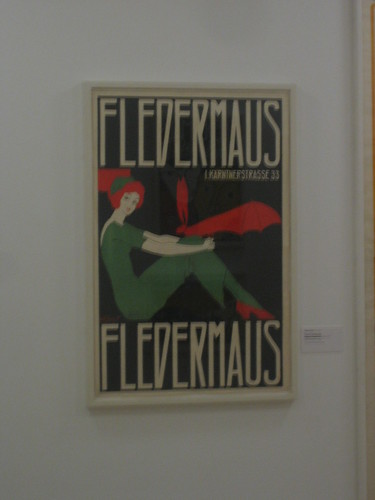
Anther cafe, Café Fledermaus, was closed during my visit. But there were many posters around the entrance to it, from the Vienna Secession period, flowery, sexy, and often quite elaborate.  Quite interesting way to round up the short museum visit.

Neue Galerie New York _ 8467
Entrance to Café Fledermaus

Neue Galerie New York _ 8469

Neue Galerie New York _ 8470

Neue Galerie New York _ 8473

Neue Galerie New York _ 8477

Neue Galerie New York _ 8478

Neue Galerie New York _ 8480

Neue Galerie New York _ 8474

Neue Galerie New York _ 8476

>> New York City Report, September 2010, Part XV: Art in Subway Station, New York City
<< New York City Report, September 2010, Part XIII: Max Beckmann's Paintings in MOMA and MET