Showing posts with label London. Show all posts

Sunday, September 2, 2012

My Favorite Paintings at Tate Britain, London

In my previous reporting in this series, I cited two paintings I liked most in Tate Modern, London.  Tate Modern is part of the Tate gallery network in Britain, with Tate Britain, Tate Liverpool and Tate St Ives.  Tate Britain was the oldest gallery in the network, opening in 1897 and houses a substantial collection of the works of J. M. W. Turner.

Turner is one of my favorite artists and amongst many of his masterpieces collected there, I loved this one below most:

 
Snow Storm - Steam-Boat off a Harbor's Mouth, 1842
Joseph Mallord William Turner (1775‑1851)
Oil on canvas
Support: 914 x 1219 mm frame: 1233 x 1535 x 145 mm

The most striking aspect of this painting is its dynamism - the vortex formed by the the fast moving waves echoing the crushing dark clouds - it was simultaneously exhilarating and disorientating. Dramatic, bold, sketchy yet subtle.  Luminous and threatening. 

The other work I like most there was by the very same Alan Davie, whose work I had cited as one of the two my favorites at Tate Modern.


Black Mirror, 1952 Alan Davie (born 1920)
Oil on board
Support: 1219 x 1219 mm frame: 1245 x 1270 x 65 mm  

Once again, his painting was draped in dark mystery, with the dominant black color bellowing like a cello.  The overwhelming blackness was made acceptable by the almost reflective white "panel" and yellow light or streaks breaking through the dark curtain.  The objects on the board were both tangible and indecipherable.  An enigma and a lovely one.


My Favorite Museum Collection Series

>> My Favorite Museum Collection Series 49: My Favorite Paintings in the Fitzwilliam Museum, Cambridge, UK
<< My Favorite Museum Collection Series 47: My Favorite Paintings at Tate Modern Gallery in London


List of My Favorite Artworks in the Museums I've Visited

Sunday, August 26, 2012

My Favorite Paintings at Tate Modern Gallery in London

The transformation from a former power plant to a one of the flashest galleries in the world, Tate Modern Gallery, along with d'Orsay in Paris, set forth an example of how to re-juvenile a blighted institution and a neighborhood.

The vast space was well utilized to showcase many huge sculptures and installations.  However, the works intrigued me most are paintings - one was Image of the Fish God (1956) by Alan Davie (born 1920) and the other one was Large Black Landscape (1946) by Jean Dubuffet (1901‑1985).

Scottish painter and printmaker Davie's Fish God (below) was a bold statement - it was both symmetrical unsymmetrical, and  simultaneously beautiful and ominous.  The imposing black block could be seen as a figure, and the white block on the left was some sort of monument or totemic symbol, and the diamond shape in middle stared at us like an all-seeing accusing eye.  Very mysterious and disturbing.


Image of the Fish God, 1956, Alan Davie (born 1920), Oil on Board, 1530 x 1219 mm

According to Tate Modern, Large Black Landscape (below) was the culminating work of a series of landscapes which Dubuffet executed in Paris between July and September 1946. 


Large Black Landscape, 1946, Jean Dubuffet (1901‑1985), Oil on Board, support: 1551 x 1186 mm frame: 1575 x 1210 x 57 mm

Despite the overwhelmingly dark shades on the board, my reaction to this painting was a quiet smile - it was very enchanting in its subtle and whimsical way.  The lovely pale sky, the flying object looking like a cross with four rounded ends, which also echoed the round sun sitting on the top of a mountain and the onion dome of a tall building.  Sliding my eye down, I found such correlations and echoes covered entire board and the beige colored lines, scraped and gouged, gave us the full gallery of daily life and fantasy.  Against the dark background, they glowed, and they were positive, comforting and was deceptively simple and beautiful.

I am not familiar with this French painter, sculptor, lithographer and writer.  Tate Modern informed the viewers that he
Moved to Paris in 1918 to study painting. Doubting the value of art and culture, stopped painting altogether 1924-33 and entered the wine trade. Made a second abortive attempt at painting 1933-7, also making masks and puppets. Began painting again in 1942 and had his first one-man exhibition at the Galerie René Drouin, Paris, in 1944. Made paintings of Parisian street scenes, people in the Metro, jazz musicians, portraits of friends, etc., with humorous, ironic imagery executed in a grotesque style akin to naive graffiti...
 The more I learn, the less I know.


My Favorite Museum Collection Series

>> My Favorite Museum Collection Series 48: My Favorite Paintings at Tate Britain, London
<< My Favorite Museum Collection Series 46: My Favorite Paintings in the Courtauld Gallery at Somerset House, London


List of My Favorite Artworks in the Museums I've Visited

Monday, August 20, 2012

My Favorite Paintings in the Courtauld Gallery at Somerset House, London

London's museum and galleries are astonishingly rich, way beyond the most prominent the British Museum and the National Gallery.  The somewhat lesser known gallery, the Courtauld Gallery at Somerset House, London, had a rich collections of Renaissance, Baroque, Impressionism, Post-Impressionism and 20th Century works, many of them iconic.

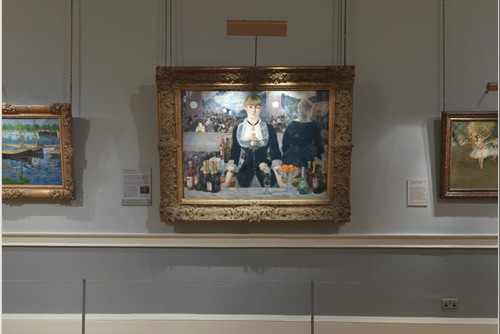
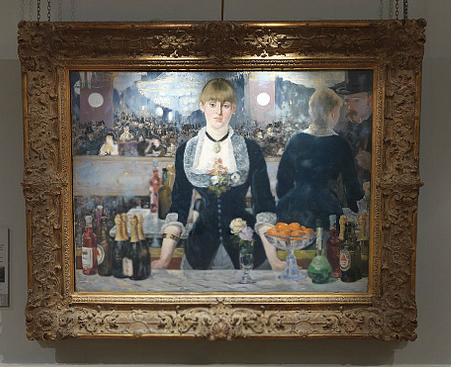
My favorite paintings there were seminal ones - one was A Bar at the Folies-Bergère, 1881-2, by Edouard Manet, and was dated as 1882; and the other one was a striking triptych by Peter Paul Rubens, The Visitation (left panel), The Descent from the Cross (center panel), and The Presentation in the Temple (right panel).  The former one was intimate and still and the other public and dramatic. 

A Bar at the Folies-Bergère, 1881-2, Edouard Manet, The Courtauld Gallery, London - 500
A Bar at the Folies-Bergère, 1881-2, Manet, Edouard, Date 1882

A Bar at the Folies-Bergère, 1881-2, Edouard Manet, The Courtauld Gallery, London

Amongst the artists often grouped together as Impressionists, I am very partial to Manet.  I appreciate him very much because he was not merely chasing a certain detached natural effects, rather, he dived deep into human psyche and that meant much more for me.  I also love the way he handled dark colors, particularly that of black, which was a true color under his brushes, instead of devoid of color in a minor hands.  His characters, elegant, lovely, but often a bit detached and melancholic, a forerunner of Edward Hopper.

In this lovely painting, in the Folies-Bergère, Paris's first music hall, had a notorious reputation as a place for men to pick up prostitutes.  One could see that the barmaid, resigned herself to the scrutinizing gazes from patrons, who we could see on the large mirror behind the pensive barmaid.  Manet also presented the back of her, through some optical trickery, and the customer she was serving.  She slim figure, tightly laced up, presented her like one of the wine bottles being offered to the patrons.  She was there, but also far away.  That absence drew us in, so did the impossible relationship between she and the mirror reflecting her back.  It perhaps was not scientifically accurate, but it gained much more through such "imperfection".


Triptych, 1611-1613, Oil on panel, Peter Paul Rubens
The Visitation (left panel), Height: 83.2 cm; Width: 30.3 cm
The Descent from the Cross (center panel), Height: 115.2 cm; Width: 76.2 cm
The Presentation in the Temple (right panel), Oil on panel Height: 83 cm; Width: 30.4 cm

The triptych above by Rubens was startlingly spectacular and emotionally charged, verged on hysteria.  The paintings were resolutely catholic and was saved from being vulgar and sentimental by the master's somber coloration and the restrain from the side panels, particularly the Visitation, which was almost charming, if one overlooked the looming storm in the background and the scarlet robe Mary wore. 


Triptych: The Visitation (left panel) and The Presentation in the Temple (right panel)

The crowning achievement of this triptych was the amazing grouping of the central characters - each had their very individual way of coping with the tragic event and the glistering twisted body of Jesus was powerful and godlike, even in its death agony.  Its weight, sliding down from the shroud, demonstrated vividly by the supporting John, whose back-bending body added intensity to the drama and his scarlet robe echoed that of Mary's in the Visitation.  Mary herself, mirrored herself in the Presentation almost in the same pose and same robe, though much softer and more worn, with much less brilliance in its color, a mother in deep sorrow, in contrast to the mother of the new born. 


Triptych: The Descent from the Cross (center panel)


My Favorite Museum Collection Series

>> My Favorite Museum Collection Series 47: My Favorite Paintings at Tate Modern Gallery in London
<< My Favorite Museum Collection Series 45: My Favorite Paintings at the Wallace Collection, London


List of My Favorite Artworks in the Museums I've Visited

Sunday, August 19, 2012

My Favorite Paintings at the Wallace Collection, London


The Wallace Collection in London was a marvelous museum boasting many superb old master and impressive French 18th century paintings, plus decorative art and a world class armory.  Comparing to the British Museum or the National Gallery, both huge institutions in London, it was much smaller but the reward was just as great.

There were so many paintings to like there and I name these two as my favorites there: 1) The Laughing Cavalier by the Dutch painter Frans Hals (1582-1666) and 2) Voulez-vous triompher des Belles? by French artist Antoine Watteau (probably 1684 - 1721).


The Laughing Cavalier, Frans Hals, The Netherlands, 1624, Oil on canvas, Image size 83 x 67.3 cm,  Object size: 112.5 x 98 x 9 cm

This flamboyant portrait by Hals was remarkable for its candid depiction of a not wholly flattering character and the amazing ways the painter depicted the endless varieties of fabrics and laces this cavalier carried in his bulk.  It was in-your-face direct and you could not avoid his presence.  You could hear his roaring laughter, you could smell the tobacco in his finery, and the smell of beer in his breath.  You could not avoid a minor confrontation from him, if after his assessing of you as a worthy adversary or someone he could trample upon without repercussion.  His humorous mustache could not disguise his hot temper and his readiness to pounce.  A cavalier through and through.  A roguish and less-than-refined kind.

For refinement, one only need to move on to the paintings by the French Antoine Watteau, who ushered in the ornate, the less severe, more naturalistic, less formally classical Rococo style of paintings.  He was also credited with inventing the genre of fêtes galantes: scenes of bucolic and idyllic charm, suffused with an air of theatricality.

His characters, always refined, always occupied an Arcadian landscape, otherworldly, elegant, including those actors and actresses in the costumes of Commedia dell'arte, whom, could be crude and crass if painted by other less quintessential French painter.  Watteau's world was often misty and mythical.  His characters, however real and naturalistically rendered, always occupied a world beyond our reach, and in our longing to join them, his works cast the spell over us and made us melancholic.  Thus, Watteau's works made great complement and contrast to those by Hals. 


Voulez-vous triompher des Belles?, Antoine Watteau, France, c. 1714-1717, Oil on oak panel, Image size 35.9 x 27 x 1.4 cm,  Object size: 35.9 x 25.9 x 0.4 cm, preserved parts of the original panel


My Favorite Museum Collection Series

>> My Favorite Museum Collection Series 46: My Favorite Paintings in the Courtauld Gallery at Somerset House, London
<< My Favorite Museum Collection Series 44: My Favorite Portraits at National Portrait Gallery, London


List of My Favorite Artworks in the Museums I've Visited

Friday, August 10, 2012

My Favorite Portraits at National Portrait Gallery, London

Whenever I think of the National Portrait Gallery in London, I remember those fantastic characters from the Tudor Dynasty.  The Tudor portraits, some of them copies of paintings by more famous artists, such as Holbein, were definitely the crown jewels of the esteemed institution; however, their artistic merits were overshadowed or overwhelmed by historical values and societal trappings - stiff fabrics and ornate jewels, etc.  Though the characters did emerge under these heavy armors, they were often aloof, demanding respect, love, fear, etc., rather than engaging the viewers. 

For personal interactions, I opt for two modern works - one was created in 1820 and the other 1911.  Interestingly, both subjects of the portraits were poets. 

The remarkable portrait of John Clare by William Hilton (1786-1839), a history painter was a very romantic one, with the sitter every inch the perfect Byronic hero.  I confess that I knew little of poetry and I knew nothing of this poet nor his painter.  However, this very English portrait immediately commanded my attention, not by the beauty of the sitter alone, but more by the penetrating intelligence and a good mix of sensuality and a thirst for life.  The execution of the painting was spontaneous, lucid and reminded me of the great Thomas Gainsborough, though less mannered and fussy.


by William Hilton
oil on canvas, 1820
30 in. x 25 in. (762 mm x 635 mm)


The 1911 portrait of Rupert Brooke by the German artist Clara Ewald (1859-1948) was startling in its directness and modernity.  Here, in broad, economical strokes, the artist created on canvas a living and breathing young man, full of vitality, intensity, charm, and even humor.  The poet's questioning gaze was directed to life, to universe altogether.  Yet, he was also very down to earth and full of humility and humanity.  He radiated, like a most healthy country lad, yet there was a kind of intelligence practically jumped off the two-dimensional surface.


by Clara Ewald
oil on canvas, 1911
21 1/2 in. x 29 in. (546 mm x 737 mm)

According to the Gallery's notes, this painting was given by the artist's son, Professor P.P. Ewald in 1972.  The artist and her family must be very proud of it.  Yet there was some controversy regarding the likeness of the sitter.  However, it didn't matter.  What mattered was that it was a remarkable portrait.

For further information, I include a paragraph from The National Portrait Gallery below: 
The young Rupert Brooke, handsome, well-bred and full of promise as a poet, sat to the German artist Clara Ewald when he was staying in Munich in spring 1911. He was not enjoying himself and missed Cambridge terribly; but fortunately he had an introduction to Ewald and made friends with her son Paul, who was studying physics at Munich University. According to Paul Ewald, 'He would come in for tea and often stay for supper. My impression was that he found it very difficult to adapt himself to Germany and that in his thoughts he lived more in Cambridge than in Munich. This he expresses himself in his letters. So, partly perhaps to cheer him up, my mother painted him.' Most of the people who had known Rupert Brooke reckoned that the result was not a very good likeness - indeed, a later version, which was presented to King's College, Cambridge, caused a great deal of controversy, not least because it was regarded by some of the dons as too effeminate. It has however become one of the images by which he is now well known, including the hat, which he borrowed for the occasion from the artist's son.


My Favorite Museum Collection Series

>> My Favorite Museum Collection Series 45: My Favorite Paintings at the Wallace Collection, London
<< My Favorite Museum Collection Series 43: My Favorite Sculptures from The British Museum


List of My Favorite Artworks in the Museums I've Visited

Saturday, August 4, 2012

My Favorite Paintings in the National Gallery, London

In 2004, I visited several art capitals in the western Europe - London, Amsterdam, Den Haag (The Hague), Rotterdam, Brugge (Bruges), and Antwerpen (Antwerp).

The great London was rich with art collections and looking back now, I marvel at the stamina and my strategic planning so essential for so many museum and gallery visits in mere three weeks, considering I wasn't there for visual art alone.  I also saw three plays in London, visited Stonehenge and wonderful Roman ruin in the Georgian city of Bath.  The more I think about it, the more I am grateful for my good fortune of having enjoyed so many visual feasts.

The most impressive painting museum in London was the National Gallery - the British Museum was more impressive in its antiquity collections.  In the National Gallery, there were much to savor and the two paintings left me the strongest impressions were a simple portrait by Giovanni Bellini and a double portrait by Jan van Eyck.

The portrait of Leonardo Loredan presented the Venetian Doge in full official regalia - lavishly yet subtly embroidered state robe and a horn-shaped hat, 'corno', which was worn over a linen cap.  The distinctive official costumes of those Venetian doges were wonderfully picturesque, as also described in my previous entry, My Favorite Paintings from Museum of Fine Arts (Budapest), while discussing a Titian's portrait of another Venetian Doge Marcantonio Trevisani, done about half-century later.  In both paintings, these fanciful costumes avoided being comical largely due to the gravitas of those severe-looking Doges themselves.


Doge Leonardo Loredan, 1501-2, Giovanni Bellini 
Source: wikipedia
Public Domain

Bellini's Doge, in contrast to Titian's glowing yellow, dressed in silvery robe and looked much cooler and more metallic, but no less sumptuous.  He was as sharply profiled, wearing a similar hawkish determined expression.  He looked somewhat younger, due to the cleanly shaved chin, and without the later Doge's sadness and apparent compassion.  Bellini's Doge was more meditative, still and pensive, deeply in his own thoughts, private but not secretive and one felt no need to fear for this magnificent prince.  As a matter of fact, Bellini made him quite rigid and stiff in the armor like robe, resembled a puppet doll.  Was that the true status of that particular Doge? 

This work was painted in the style of sculpture busts popular at the time. Bellini, famous for his portraits, helped advance this art form in Venice.  Despite the sculptural inspiration and rigid facial and wardrobe structures, this Doge was also fully human, thanks to the detailed depiction by the marvelous painter.  Every detail was perfectly defined, from the tiny highlights in his eyes, to the fine threads on the embroidered silky robe.  And thanks to the painter's keen observation and his ability to reveal a hidden humanity of the sitter, who was under obvious strict social constraints.  The painting was very pleasing to viewer's eyes with its contrasting yet harmonious palettes - warm yellow glow of the figure and cooler but rich looking blue/green flat background.  It was an unforgettable piece of art.  A bit mannered, or simply stylish, one could argue.

If the Bellini's sitter looked a bit strange, the below masterpiece by Jan van Eyck was like a study of strangeness or hallucination albeit a beautiful and delicate one.

The portrait of Giovanni di Nicolao Arnolfini and his wife, an "official" double portrait of the couple, was not a wedding portrait, as often assumed.  It was simply the record of their prosperous and faithful married life. With their very pleasing doll-like or elvish figures, alabaster skin tone and expressionless faces and impossible anatomy and proportions, they were an enigmatic couple and very endearing.

Arnolfini, a member of a merchant family from Lucca, Italy, lived in Bruges, Belgium, had an obviously materially comfortable life. The couple are shown in a well-appointed interior, in front of a large canopied marriage bed to the right.  In the middle of the painting, above their joined hands, there was a large chandelier and a convex mirror fantastically painted with every possible details, and perhaps more.

In contrary to another common believe, the wife was not pregnant.  She simply held up her full-skirted dress in the contemporary fashion, with her hand resting on her belly, definitely gave it an illusion of a swell.  But she was simply showing off her yards after yards trimmed finery.  This painting was inundated with such visual illusions.
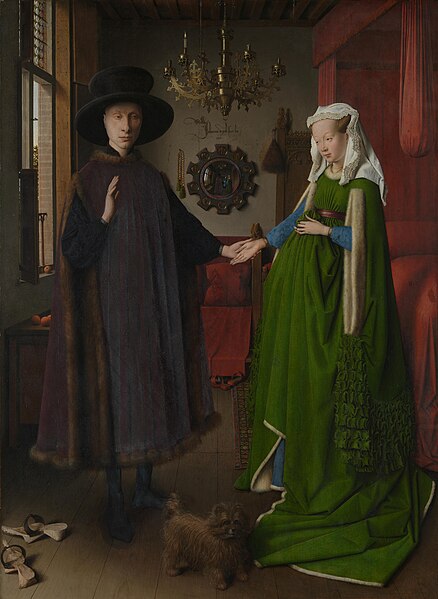

The Arnolfini Portrait, 1434, Jan van Eyck
Source: wikipedia
Public Domain

The painter signed with ornate Latin on the wall, translated as 'Jan van Eyck was here 1434', above the convex mirror.  The mirror reflected the backs of the couple and another two figures in the doorway. One may be the painter himself.  Arnolfini raised his right hand, perhaps as a greeting.

Source: wikipedia
Public Domain
This painting boasted endless wonderful details, almost all of them carried some symbolic meanings, such as the companion dog as a symbol of faithfulness and love, the fruits on the window ledge stood for fertility and the fall from Paradise, and even the discarded slippers signified the sanctity of marriage.

Van Eyck gave us a painting with a luminous and almost reflective surface and many subtle effects of light - direct or diffused, such as the gleaming brass chandelier and the reflection on the mirror.  He achieved this by applying layer after layer of translucent thin glazes. This painting held us in spellbound with the amazingly precise depictions of the array of differentiated textures and surface appearance of so many objects, all with intense glowing colors.

Art historian Craig Harbison pointed out to us that this painting "is the only fifteenth-century Northern panel to survive in which the artist's contemporaries are shown engaged in some sort of action in a contemporary interior. It is indeed tempting to call this the first genre painting - a painting of everyday life - of modern times".

The final footnote to this painting was that after seeing this unforgettable painting of material wealth and opulence, I saw a large print of it in our hotel lobby in Bruges.  Our hotel was called Hotel Lucca, formerly the Lucca warehouse, built originally by none other than the very same Giovanni di Nicolao Arnolfini.

A most delightful coincidence.


My Favorite Museum Collection Series

>> My Favorite Museum Collection Series 43: My Favorite Sculptures from The British Museum
<< My Favorite Museum Collection Series 41: My Favorite Paintings from Museum of Fine Arts (Budapest) (Szépművészeti Múzeum)

List of My Favorite Artworks in the Museums I've Visited

Wednesday, August 1, 2012

Chinese People's Olympics Apathy

Four years ago, when Beijing was hosting the Olympic Games, most Chinese people were extremely excited and proud of their coming of age party, a party so grand that no one would dare to challenge ever after.  That country poured grotesquely large amount of money into the Games and duly stunned the rest of the world for its brutal efficiency and the brutishly stunning spectacle of the Opening Ceremony.

Four years later, the 2012 Olympic Games is well underway in London, Great Britain, yet many Chinese people seem to have decidedly much less enthusiasm and even apathy towards the Olympics.

According to some Chinese language media, and through talking to my family in China, I recognized the striking change of attitudes.  One clear reason was the location and distance.  In 2008, China hosted the Olympics in Beijing for the first time; while now it is in the faraway London, where most Chinese have never seen and will never have the chance to visit.  However, people also have lost some interests in the gold medals which they used to counted ounce by ounce four years ago with the greed like an Harpagon, the titular character of The Miser (L'Avare) by Molière.

Four years ago, many of them firmly believed that the Olympics would be the panacea of all social woes, as promised by the government.  Yet, four years later, they discovered, that after a storm, cities were still flooded (see images below from Beijing in July 2012). Yet, despite the huge amount of money spent on infrastructures, the list of sorrow stories goes on: High speed trains still crash; food/milk/medicine are still poisonous; officials are still corrupt; people still have trouble in paying for education, medicine and even tomb plots. 


Beijing, July 2012

The demolitions and constructions were not limited to Beijing.  After the Olympic Games in Beijing, other big cities in China competed to put on their own shows - Shanghai had its World Expo; Guangzhou hosted the 2010 Asian Games; etc. My home city, Shenyang, is preparing for the most superfluous All China Games with much demolitions and constructions, despite the fact that the city refused to pay some employees and pensioners the nationally mandated salary increases for lacking funds.  One prime example was the demolition of a 9-year-old, state-of-art, one of the largest indoor stadiums in Asia, built in the "unsuitable location" in Shenyang:


Shenyang, June 12, 2012

Regular folks continue to suffer, contractors continue to make profit and the officials continue to enrich themselves with kickbacks in the process of such demolition and construction and in the name of people.

Internationally, China is as isolated as ever, with only friends in the league of Syria, Iran, Cuba, North Korea, and perhaps Russia.  People outside China watched its phenomenal economic growth with awe and fear.  Envy played some role perhaps, but definitely a minor one.  It was Chinese government's refusal to comply by the international standards and decency keeps China outside the international community.  No window dressing Olympics could change that.

Chinese people had learned their lessons in a hard way.  At least, they have opened up their eyes.  They are saying loudly that the Opening Ceremony of 2008 in Beijing was a celebration of absolute control and absolute order, while in 2012 in London they saw a celebration of humanities.  No wonder, they are becoming more cynical and less enamored with the obvious glitter.

Monday, October 18, 2010

Sunflower Seeds by Ai Weiwei at Tate Modern, London

Chinese conceptual artist Ai Weiwei brought over 100,000,000 sunflower seeds to Tate Modern in London. In the past, Mr. Ai has produced installations, photographs, furniture, paintings, books, and films. He served as artistic consultant on the Beijing's Olympic Stadium - the Bird Nest.  After the 2008 Sichuan earthquake, he took on exposing construction problems of Sichuan schools and the follow up mal-treatments towards anyone raised issues by Chinese government.  He was also in the center of a protest by artists whose studios were seized by local government and developers without due process and he suffered a major injury and had to had a surgery performed on him in Germany.

Like many contemporary Chinese artists, Ai concentrated his energy on the trauma of the political upheavals in last several decades in China and for better or for worse, they seem obsessed with the Cultural Revolution and its aftermath.  Ai is more critical than most, when many seem hold a nostalgic view of Mao's era. His activists efforts, if distracted him from art making, seemed have deepened his thinking. His artwork has always been large scaled and now it gets even bigger. The 100 million tiny sculptures of sunflower seeds were made out of porcelain and hand-painted by skilled artisans in the Chinese city of Jingdezhen. According to Ai that he had painted three and were rejected because they were too "ugly".

Independent report that "The tiny works of art, each hand-painted in porcelain and different from all the others, are collectively called Sunflower Seeds, which is what they have been made to look like. For Ai, their maker – or, at least, the man who had them made – these have a specific significance. During the Cultural Revolution, Chairman Mao, like Louis XIV before him, had himself depicted as the sun, the faces of his 900 million sunflower people turned inexorably to his heliotropic face. At the same time, recalls Ai in an accompanying film, sunflower seeds were the one foodstuff you could be sure of finding during the frequent hungers of Mao’s reign, a token not just of survival but of sociability.

On a political level, the seeds were a symbol of repression; on a human one, they offered a rare opportunity for kindness, the sharing of a tiny plenty. In Ai's art – an art heartily disliked by the current government of the People's Republic of China, whose police have censored his work and arrested and beaten Ai himself – these two opposing sunflowers resolve into one. Sunflower Seeds is both almost pervertedly grand – 150 tons of handcrafted ceramics, covering 1,000 square metres of Tate Modern's floor to a depth of 10cm – and irreducibly simple. Each seed offers a kind of hope – of food, of kindness – and yet each is like a minute (and inedible) stone monument, so that the work is at once both lively and deathly. In those contradictions of massive numbers and individuality, of humility and grandeur, happiness and pain, Sunflower Seeds is like China itself."

Visitors are invited to walk across the surface of the work. It's a sensory and immersive installation, which visitors can touch, walk on and listen to as the seeds shift beneath their feet.  But due to health concern over ceramic dust, visitors are not allowed to walk on these sunflower seeds any more, unfortunately.


Thursday, March 12, 2009

Remembering My London Trip (2004)

The newly identified likely Shakespeare portrait, reminded me my wonderful trip to UK, along with the Netherlands and Belgium, in 2004.

Since this was my first trip to UK, I naturally visited other prominent landmarks, such as Parliament, Westminster Abbey, etc., but museums and theaters were definitely the highlights of the London visit.

On the very first day, I tried to catch the Edward Hopper retrospective, which ended that very day (5 September 2004), in the newly opened Tate Modern, metamorphosed gloriously from a former power plant. Unfortunately one of the Underground lines was closed on weekend, so it took much longer for me to get to our hotel; and when the proprietor offered a nicer room after we checked in, we were detained further. The bus we took to the museum stopped off the regular route so we had to walk a long stretch and when we breathlessly reached the window, they had just stopped selling tickets to the Hopper exhibit. The consolation was the Tate itself. Honestly I don't remember the collection much, except for some enormous sculptures in the front hall. The museum itself was a masterwork, with a breathtaking view of the Thames.

The main place for paintings was National Gallery. It had way too many treasures for me to recount. My favorite was "The Doge Leonardo Loredan" (1501-4) by Giovanni Bellini, and "The Arnolfini Portrait" or "Portrait of Giovanni (?) Arnolfini and his Wife ('The Arnolfini Portrait')" (1434) by Jan van Eyck. Incidentally, when we moved on to Brugges, Belgium in the same trip, we stayed in Hotel Lucca, built by the very same Arnolfini.


National Portrait Gallery boasted many important portraits and I was equally fascinated by their Tudor portraits and contemporary ones.


I was very moved by the Parthenon Frieze (aka Elgin Marble) Room in The British Museum. The great reading room was stunning and I looked for the footprint supposedly left by Karl Marx. The newly covered grand courtyard was visually stunning and I stayed there for a long while, as if time ceased to exist. I also loved their Babylonian and Egyptian collections. I felt disoriented after the visit.

I stumbled upon the Wallace Collection, which was the "finest private collection of art ever assembled by one family" according to their own website. I honestly, though, cannot remember a particular piece, only the general musty and mysterious atmosphere. According to Frommer's, "the art collection includes works by Watteau, Boucher, Fragonard, and Greuze, as well as such classics as Frans Hals's Laughing Cavalier and Rembrandt's portrait of his son Titus. The paintings of the Dutch, English, Spanish, and Italian schools are outstanding."

The last museum in London I visited was Tate Britain, which featured British art, particularly Turner's.

Our day trips in UK included a rain-drenched trip to Stonehenge and an excursion to Cambridge, highlighted by the mandatory punting on the Cam. The permanent collections at Fitzwilliam Museum in Cambridge contained remarkable antiquities from ancient Egypt, Greece, and Rome. Again, I cannot pinpoint any specific piece of work. I only remember that I felt exhausted and exulted.

In other cities, besides fine arts, cathedrals and cemeteries, I might go for classical music. In London, I went for drama. It was Olympic year in Greece so we were blessed with two remarkable plays by by Euripides -- Iphigenia at Aulis at Royal National Theatre and Hecuba at Donmar Warehouse. The former was good and it was wonderful to see one play at Royal National Theatre but the later was an experience as remarkable as the opening night of Spring Festival in Prague, with President Václav Havel in attendance. I rank Hecuba as the best drama experiences I ever had, period. It turned out that the actress Clare Higgins won Laurence Olivier Best Actress Award for this portrayal. I had never heard of Donmar Warehouse before but a little searching yielded some information: Since 1992, Donmar original productions have received 27 Olivier Awards, 17 Critics' Circle Theatre Awards, 9 Evening Standard Awards, as well as 12 Tony Awards from eight productions transferring to Broadway (wikipedia.com).

I had a certain trepedation when I approached Shakespeare's Globe Theatre for Measure for Measure by Shakespeare. Kitsch! I was afraid. Jesters opened the curtain and trumpets rang out. Kitsch! I murmured. It turned out to be a nice surprise. It was a high quality performance, not the tourist trap at all. A few hours' standing and looking up the raised stage tired me, though in our general standing "seats" I did feel that I had experience a little bit resembled those of the great Elizabethans.

I was surprised that I loved London more than I cared to admit. The Queen was in Scotland for her summer holiday therefore she didn't deign to receive me. Alas.