Showing posts with label England. Show all posts

Sunday, September 9, 2012

My Favorite Paintings in the Fitzwilliam Museum, Cambridge, UK

The Fitzwilliam Museum in Cambridge was the last major museum I visited in the United Kingdom in 2006.  It was founded in 1816 and is the art and antiquities museum of the University of Cambridge. Naturally, an institution as ancient as this would have amazing collections and my expectation was fully met.

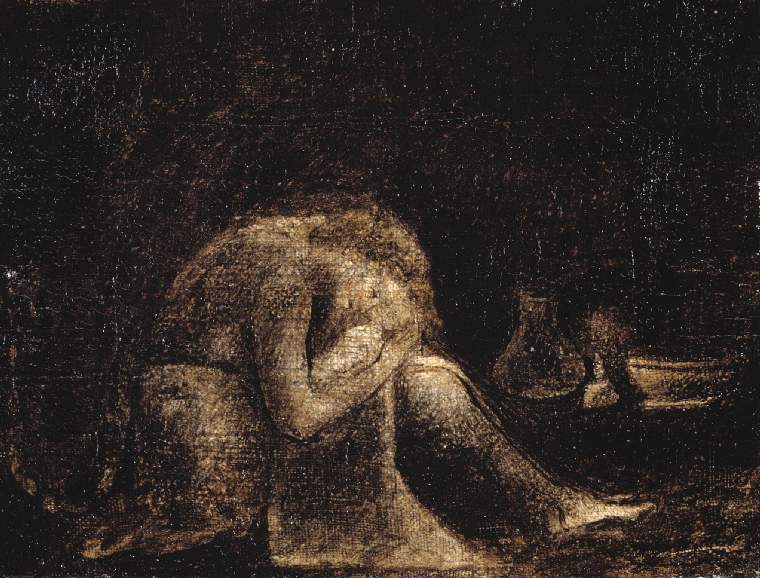
Yet, amongst its endless arrays of antiquities from all corners of the world, and paintings by many great masters, I was most affected by a very small monochromatic painting, titled Agnes (below), painted by an artist named I didn't know - Catherine Blake.


Agnes, tempera on canvas, circa 1800, height: 14 cm, width: 15.3 cm
Catherine Blake, British, 1762-1831 

Online search yielded that Catherine Blake was indeed related to the more famous Blake, William.  Wikipedia informed us that "Catherine Blake (née Catherine Boucher) (1762–1831) was the wife of the poet, painter and engraver William Blake (1757–1827), and a vital presence and assistant throughout his life as an artist.

What moved me most by that painting was that it was incredibly sincere, touching, a bit scary and immensely beautiful, despite its obvious gloom.  It was done with tempera but looked more like an etching or a drawing; I have no argument with this fact, because my paintings are often monochromatic and I truly appreciate its dark psyche and the draftsmanship undisguised by display of colors.

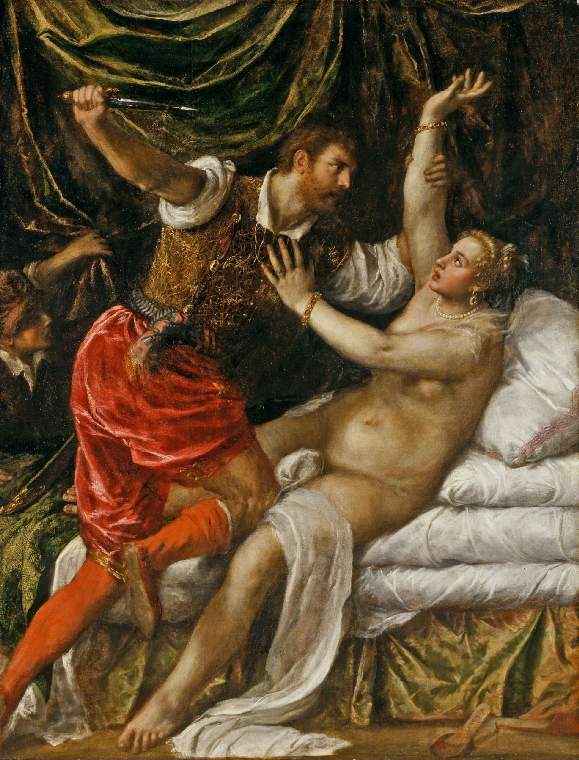
To cure the melancholy this painting plunged me into, I turned to the colorist Venetian master Titian for a cure.  Well, it was a painting about a tragic affair, but it was so stylized and so beautiful to behold, that one ought to be forgiven to feel joyous in front of this enchanting painting, a painting with graceful figures, lovely nude, ravishing colors and wonderful composition. 


Tarquin and Lucretia, oil on canvas,  circa 1571, height: (canvas): 188.9 cm, width: (canvas): 145.1 cm
Tiziano Vecellio (Titian) (1488/1490-1576

The horror Lucretia suffered, actually, got heightened once viewers looked pass the surface beauty and dived deep into the situation the master depicted, and that made this painting, beyond its beauty, profound.


My Favorite Museum Collection Series

>> My Favorite Museum Collection Series 50: My Favorite Paintings at Rijksmuseum, Amsterdam
<< My Favorite Museum Collection Series 48: My Favorite Paintings at Tate Britain, London


List of My Favorite Artworks in the Museums I've Visited

Saturday, August 4, 2012

My Favorite Paintings in the National Gallery, London

In 2004, I visited several art capitals in the western Europe - London, Amsterdam, Den Haag (The Hague), Rotterdam, Brugge (Bruges), and Antwerpen (Antwerp).

The great London was rich with art collections and looking back now, I marvel at the stamina and my strategic planning so essential for so many museum and gallery visits in mere three weeks, considering I wasn't there for visual art alone.  I also saw three plays in London, visited Stonehenge and wonderful Roman ruin in the Georgian city of Bath.  The more I think about it, the more I am grateful for my good fortune of having enjoyed so many visual feasts.

The most impressive painting museum in London was the National Gallery - the British Museum was more impressive in its antiquity collections.  In the National Gallery, there were much to savor and the two paintings left me the strongest impressions were a simple portrait by Giovanni Bellini and a double portrait by Jan van Eyck.

The portrait of Leonardo Loredan presented the Venetian Doge in full official regalia - lavishly yet subtly embroidered state robe and a horn-shaped hat, 'corno', which was worn over a linen cap.  The distinctive official costumes of those Venetian doges were wonderfully picturesque, as also described in my previous entry, My Favorite Paintings from Museum of Fine Arts (Budapest), while discussing a Titian's portrait of another Venetian Doge Marcantonio Trevisani, done about half-century later.  In both paintings, these fanciful costumes avoided being comical largely due to the gravitas of those severe-looking Doges themselves.


Doge Leonardo Loredan, 1501-2, Giovanni Bellini 
Source: wikipedia
Public Domain

Bellini's Doge, in contrast to Titian's glowing yellow, dressed in silvery robe and looked much cooler and more metallic, but no less sumptuous.  He was as sharply profiled, wearing a similar hawkish determined expression.  He looked somewhat younger, due to the cleanly shaved chin, and without the later Doge's sadness and apparent compassion.  Bellini's Doge was more meditative, still and pensive, deeply in his own thoughts, private but not secretive and one felt no need to fear for this magnificent prince.  As a matter of fact, Bellini made him quite rigid and stiff in the armor like robe, resembled a puppet doll.  Was that the true status of that particular Doge? 

This work was painted in the style of sculpture busts popular at the time. Bellini, famous for his portraits, helped advance this art form in Venice.  Despite the sculptural inspiration and rigid facial and wardrobe structures, this Doge was also fully human, thanks to the detailed depiction by the marvelous painter.  Every detail was perfectly defined, from the tiny highlights in his eyes, to the fine threads on the embroidered silky robe.  And thanks to the painter's keen observation and his ability to reveal a hidden humanity of the sitter, who was under obvious strict social constraints.  The painting was very pleasing to viewer's eyes with its contrasting yet harmonious palettes - warm yellow glow of the figure and cooler but rich looking blue/green flat background.  It was an unforgettable piece of art.  A bit mannered, or simply stylish, one could argue.

If the Bellini's sitter looked a bit strange, the below masterpiece by Jan van Eyck was like a study of strangeness or hallucination albeit a beautiful and delicate one.

The portrait of Giovanni di Nicolao Arnolfini and his wife, an "official" double portrait of the couple, was not a wedding portrait, as often assumed.  It was simply the record of their prosperous and faithful married life. With their very pleasing doll-like or elvish figures, alabaster skin tone and expressionless faces and impossible anatomy and proportions, they were an enigmatic couple and very endearing.

Arnolfini, a member of a merchant family from Lucca, Italy, lived in Bruges, Belgium, had an obviously materially comfortable life. The couple are shown in a well-appointed interior, in front of a large canopied marriage bed to the right.  In the middle of the painting, above their joined hands, there was a large chandelier and a convex mirror fantastically painted with every possible details, and perhaps more.

In contrary to another common believe, the wife was not pregnant.  She simply held up her full-skirted dress in the contemporary fashion, with her hand resting on her belly, definitely gave it an illusion of a swell.  But she was simply showing off her yards after yards trimmed finery.  This painting was inundated with such visual illusions.
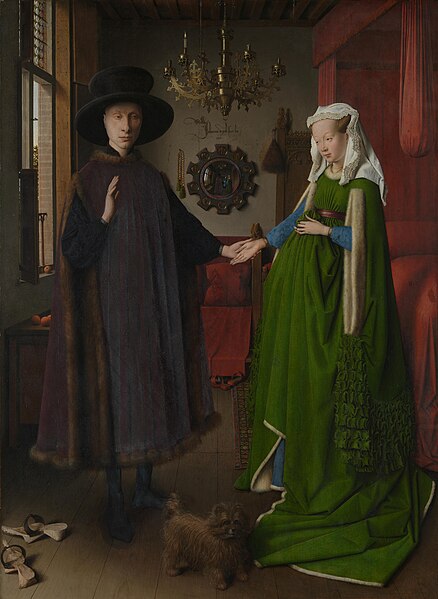

The Arnolfini Portrait, 1434, Jan van Eyck
Source: wikipedia
Public Domain

The painter signed with ornate Latin on the wall, translated as 'Jan van Eyck was here 1434', above the convex mirror.  The mirror reflected the backs of the couple and another two figures in the doorway. One may be the painter himself.  Arnolfini raised his right hand, perhaps as a greeting.

Source: wikipedia
Public Domain
This painting boasted endless wonderful details, almost all of them carried some symbolic meanings, such as the companion dog as a symbol of faithfulness and love, the fruits on the window ledge stood for fertility and the fall from Paradise, and even the discarded slippers signified the sanctity of marriage.

Van Eyck gave us a painting with a luminous and almost reflective surface and many subtle effects of light - direct or diffused, such as the gleaming brass chandelier and the reflection on the mirror.  He achieved this by applying layer after layer of translucent thin glazes. This painting held us in spellbound with the amazingly precise depictions of the array of differentiated textures and surface appearance of so many objects, all with intense glowing colors.

Art historian Craig Harbison pointed out to us that this painting "is the only fifteenth-century Northern panel to survive in which the artist's contemporaries are shown engaged in some sort of action in a contemporary interior. It is indeed tempting to call this the first genre painting - a painting of everyday life - of modern times".

The final footnote to this painting was that after seeing this unforgettable painting of material wealth and opulence, I saw a large print of it in our hotel lobby in Bruges.  Our hotel was called Hotel Lucca, formerly the Lucca warehouse, built originally by none other than the very same Giovanni di Nicolao Arnolfini.

A most delightful coincidence.


My Favorite Museum Collection Series

>> My Favorite Museum Collection Series 43: My Favorite Sculptures from The British Museum
<< My Favorite Museum Collection Series 41: My Favorite Paintings from Museum of Fine Arts (Budapest) (Szépművészeti Múzeum)
List of My Favorite Artworks in the Museums I've Visited

Sunday, September 4, 2011

China - Five Thousand Years Old? No, One Hundred!

Whiling reading Shakespeare's Henry IV, Part II and the historical background essays, I was struck by the tenacity of many usurpers or claimants's efforts in establishing their kinship connections to earlier and legitimate rules, or invented such blood connections.  Without exception, they all styled themselves the Kings of England, and not as a King of York, or King of Lancaster.  Dynasties changed with their family names, but the Kingdom was always England.  England's monarchs can be trace back to 927 A.D.

This is decidedly different from the historical events took place in the land now called China.

People often believe that the history of China is four thousand to five thousand years old.  In a sense, it is correct - the land and people and its continuous, predominant culture can be traced back as far as four to five thousands years ago.  However, during those ancient and imperial times, the concept of China didn't exist.  The land the emperors of various dynasties ruled, gradually grew into the size and shape largely overlapping with current China, was simple called the world (天下).  The succeeding dynasties had no connections to one another except for the land and the people they ruled.  The emperors were the Emperors of Qin, Emperors of Han, Emperors of Tang, Emperors of Ming, and Emperors of Qing, etc., but never Emperor of China.  As a matter of fact, a new dynasty always made great effort to sever any connections, if existed, from the ones they superseded.  The one they replaced was inevitably bad and must be condemned and destroyed and never to be spoken of in any good light.  It was purely incidental that they ruled the same land and people.  Inevitably they claimed their mandates from the Heaven to rule the earth.  The world belonged to their houses.  They didn't need consent to rule from the people lived in that land.  They owned the world and only the by their grace that the people live.

China, (in Chinese 中国), means Middle or Central Country.  This term was used as early as more than two thousand years ago.  However, at that time, it simple meant capital.  Many kingdoms and empires in that land had mentioned themselves as Middle Kingdom, mostly in an egotistic way.

Flag of the Republic of China 1912-1928
China, was really a modern concept came into existence with the overthrown of the last dynasty (Qing) and the birth of the Republic of China in 1911.  When the Republic of China was founded in January 1912, its national flag had five color stripes (red, yellow, blue, white and black), representing the five main ethnic groups - Han, Manchu, Mongol, Muslim Hui and Tibetan.  The land was called China, instead of the World.  The president was the President of China, not the President of the World.  Arguably, the concept of China was a one-hundred-year-old modern concept.

To modern Chinese people, politicians and scholars alike, whoever ruled that land and the people lived on that land, was considered part of the history of China, including the period the land and people was conquered by foreigner invaders and the majority Han was treated slightly better than slaves, such as during the entire Mogol's (Yuan Dynasty) and the early Manchu's (Qing Dynasty) rules.  Chinese generally proudly took pride in their ancient and continuous history and unbroken governance from legendary time through dynasties and republics.  That really bends the truth a bit.  Those conquered periods were really like the conquered Poland during World War II, which at that time, as the political entity, ceased to exist, though the land was still the same land, and the people were still the same Polish people.  Or to imagine that Japan had succeeded in conquering China and called it its province, even if the Japanese capital moved from Tokyo to Beijing or Shanghai.

Of course, in ancient times, the term China had been used in other part of the world to refer to many ancient Chinese dynasties, or the land and the people.  But it was merely a point of reference.  It didn't have the geopolitical meaning in it.  Some people called that land china, other called it silk or tea.

The history in that vast land is long.  But China as a political concept, is still very young.