Showing posts with label Tiziano Vecellio. Show all posts

Sunday, September 9, 2012

My Favorite Paintings in the Fitzwilliam Museum, Cambridge, UK

The Fitzwilliam Museum in Cambridge was the last major museum I visited in the United Kingdom in 2006.  It was founded in 1816 and is the art and antiquities museum of the University of Cambridge. Naturally, an institution as ancient as this would have amazing collections and my expectation was fully met.

Yet, amongst its endless arrays of antiquities from all corners of the world, and paintings by many great masters, I was most affected by a very small monochromatic painting, titled Agnes (below), painted by an artist named I didn't know - Catherine Blake.
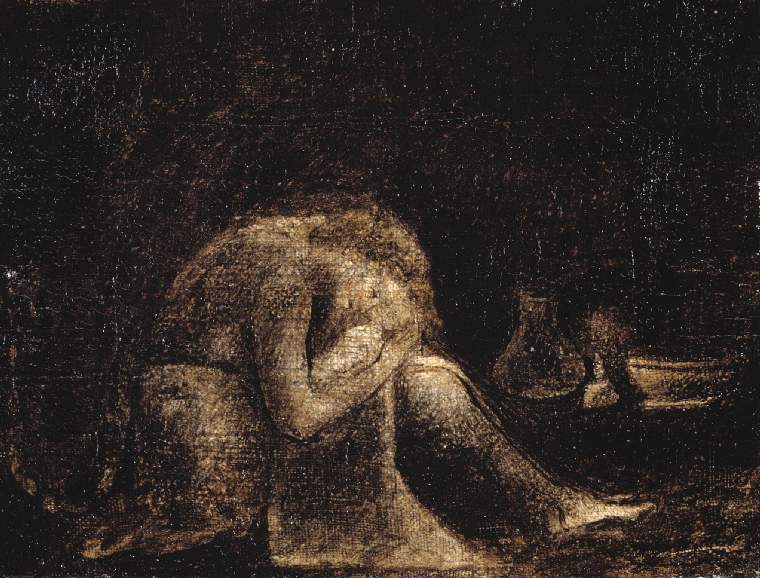

Agnes, tempera on canvas, circa 1800, height: 14 cm, width: 15.3 cm
Catherine Blake, British, 1762-1831 

Online search yielded that Catherine Blake was indeed related to the more famous Blake, William.  Wikipedia informed us that "Catherine Blake (née Catherine Boucher) (1762–1831) was the wife of the poet, painter and engraver William Blake (1757–1827), and a vital presence and assistant throughout his life as an artist.

What moved me most by that painting was that it was incredibly sincere, touching, a bit scary and immensely beautiful, despite its obvious gloom.  It was done with tempera but looked more like an etching or a drawing; I have no argument with this fact, because my paintings are often monochromatic and I truly appreciate its dark psyche and the draftsmanship undisguised by display of colors.

To cure the melancholy this painting plunged me into, I turned to the colorist Venetian master Titian for a cure.  Well, it was a painting about a tragic affair, but it was so stylized and so beautiful to behold, that one ought to be forgiven to feel joyous in front of this enchanting painting, a painting with graceful figures, lovely nude, ravishing colors and wonderful composition. 
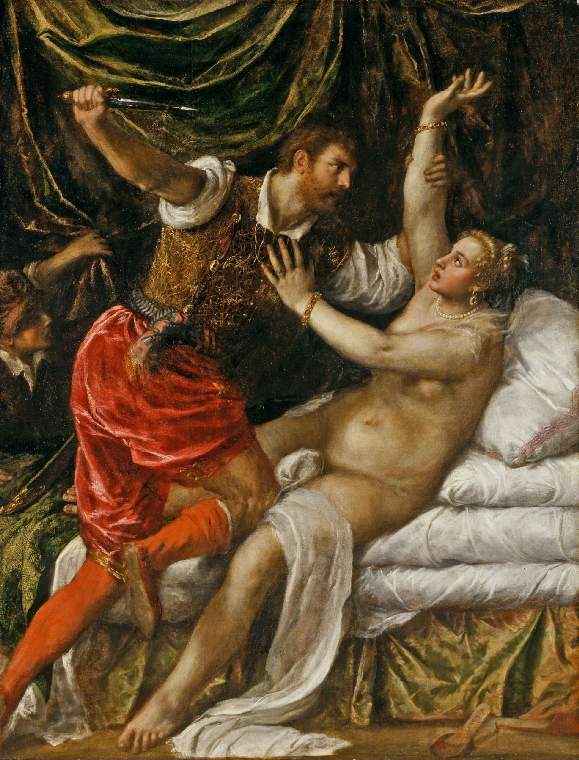

Tarquin and Lucretia, oil on canvas,  circa 1571, height: (canvas): 188.9 cm, width: (canvas): 145.1 cm
Tiziano Vecellio (Titian) (1488/1490-1576

The horror Lucretia suffered, actually, got heightened once viewers looked pass the surface beauty and dived deep into the situation the master depicted, and that made this painting, beyond its beauty, profound.


My Favorite Museum Collection Series

>> My Favorite Museum Collection Series 50: My Favorite Paintings at Rijksmuseum, Amsterdam
<< My Favorite Museum Collection Series 48: My Favorite Paintings at Tate Britain, London


List of My Favorite Artworks in the Museums I've Visited

Tuesday, July 31, 2012

My Favorite Paintings from Museum of Fine Arts (Budapest) (Szépművészeti Múzeum)

The cosmopolitan capital of Hungary had a wonderfully unique atmosphere and if I had not been there for a wedding, I surely would have enjoyed the lovely city more.  Even so, between rehearsals, pre-wedding reception and the ceremony itself, I managed to savor a little bit of the city, including the rich Museum of Fine Arts (Budapest) (Szépművészeti Múzeum).

As one of the former twin capitals of dual monarchy, the Austro-Hungarian Empire, Budapest had accumulated a huge heritage of world art.  The two most impressive works I saw there were masterpieces by Titian (Tiziano Vecellio) and Anthony van Dyck, two giants in the art history.

The portrait of the Venetian Doge Marcantonio Trevisani, showed a sharp looking old man in understated sumptuousness. His gaze, directly towards the viewer, was a bit sad, with tear in the eyes.  His lips drew back, as if holding back some secret or concern.  His right hand, clinching a silk handkerchief, reinforced the discomfort of his own thoughts or state of mind.  Despite the detailed depiction of his embroidered golden cape and funny-looking Doge's cap, and his rich maroon-colored velvet rope, we could hardly tear our eyes away from his penetrating and compassionate gaze. According to the museum's website, the original painting was destroyed in the fire of 1577. "The Budapest work is an autograph replica or variant after the burnt painting. As in all of his portraits, Titian fulfils the requirements of representation, while he equally concentrates on the accuracy and suggestivity of the characterisation. With a painting technique based on the combined effect of colour and light, the Venetian master is able to depict the living, breathing man."


Portrait of the Doge Marcantonio Trevisani, c. 1553, oil on canvas, 100 × 86.5 cm
Titian (Tiziano Vecellio), (c. 1489 - 1576)

Anthony Van Dyck, using the techniques and sharp observation not dissimilar to those of Titian, gave us a double portrait below with dizzying virtuosic forces - particularly the myriads shades of black and grey on the beautiful yet stern looking silky dresses of the sitters, and the silly yet undeniably delicate laces and cartwheel ruffs.


Portrait of a Married Couple, c. 1620, oil on canvas, 112 × 131 cm
Sir Anthony van Dyck, (1599 - 1641)

Again, despite all these external marvels, we found the two sitters very real.  Their show of wealth was honoring their rich married life together, in the most pious way.  Their hands holding together, symbolized their sanctified vow.  Their facial expressions were characterful - he was solicitous, while she anxious, almost in fear.  She sat in the armed chair stiffly, shrank a bit, with obvious discomfort, while he put left arm around her to provide some support, as if preventing her from falling into pieces.  Their posture demonstrated both their relationship on personal level and the accepted, rather strict social structure.  Yet, despite all the constrictions and the overt somberness, there was tranquility from the landscape on the left and warm from red curtain on the right of the canvas, behind the solid mass of the old couple, in the center of the canvas and fill it up almost completely.

And this concluded my journey to the old Austro-Hungary Empire in 2002.


My Favorite Museum Collection Series

>> My Favorite Museum Collection Series 42: My Favorite Paintings in the National Gallery, London
<< My Favorite Museum Collection Series 40: My Favorite "Sculptures" at the Imperial Crypt (Kapuzinergruft), Vienna


List of My Favorite Artworks in the Museums I've Visited