Showing posts with label Dynasty. Show all posts

Wednesday, March 20, 2013

Famed Terracotta Warriors and Their Intriguing Successors

San Francisco Asian Art Museum is parading a small formation of eight famed terracotta warriors and two horses from the mausoleum of Qin Dynasty's first emperor, Qin Shihuang (259-210 BCE), in Xi'an, China.  The eight warriors are the the maximum number allowed to travel here en bloc and in this museum, it formed the core of the special exhibit "China's Terracotta Warriors: The First Emperor's Legacy" (February 22 - May 27).

Eight warriors can hardly represent the massive underground armies the crazed emperor assembled but they at least can provide a passing glimpse of that awesome and fearful spectacle.  Asian Art Museum informed us:
Imperial leader. Fearsome tyrant. Military genius. Avid anti-intellectual. Obsessive star-gazer. Enduring mystery. The First Emperor, Qin Shihuang (259-210 BCE) was all these things and more. His storied legacy is rich with enduring achievements, including the unification of China under centralized imperial rule, brilliant military systems and advanced engineering and assembly production. He is also reputed to have burned scores of books, buried scholars alive and achieved widespread domination through devastating bloodshed.

First unearthed in 1974, the underground burial complex of the First Emperor is a revelation for the ages, an astonishing discovery on par with Egypt’s mummies and elaborate tombs. Contemporary observers continue to be enthralled by his legacy, and it is through this ongoing interest that the First Emperor did indeed achieve immortality. This exhibition includes ten figures—a representative sample of the actual army, which is estimated to include more than 7,000 life-sized figures and over 10,000 weapons.
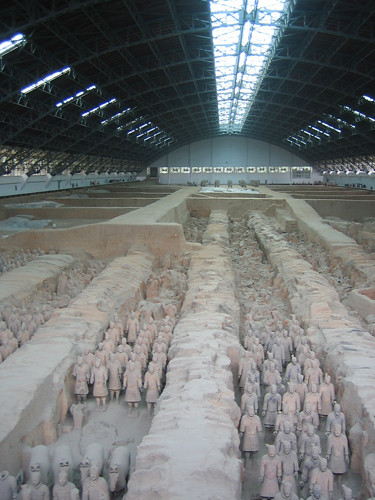
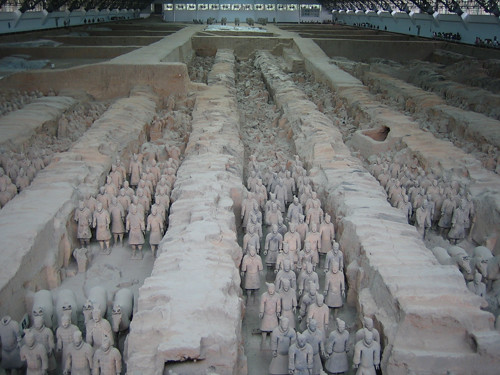
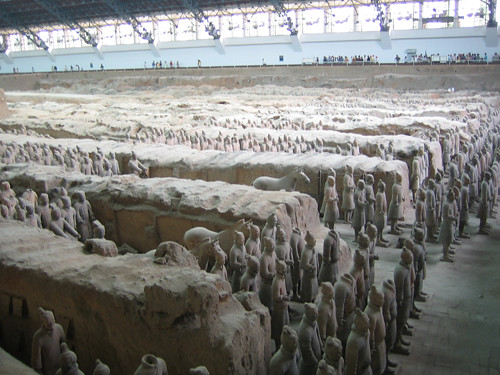
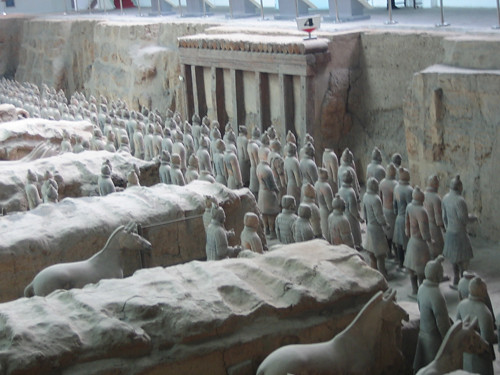
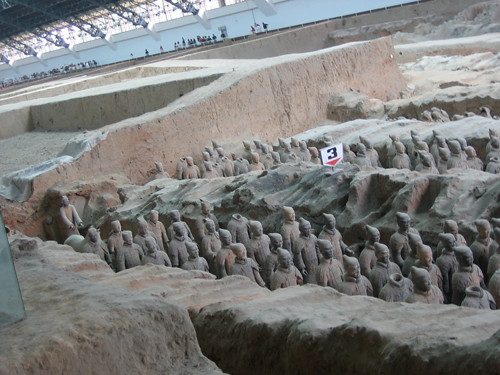
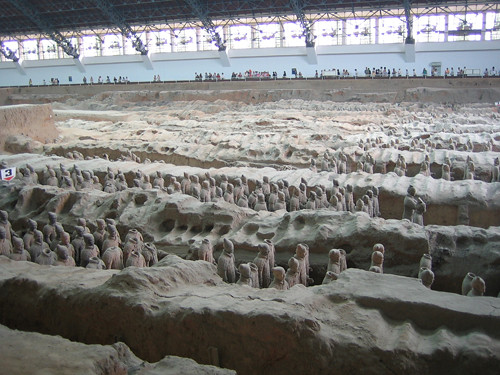
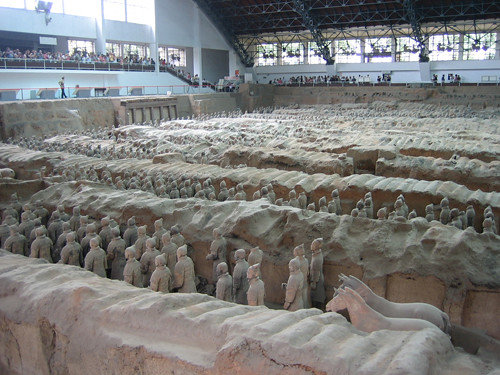
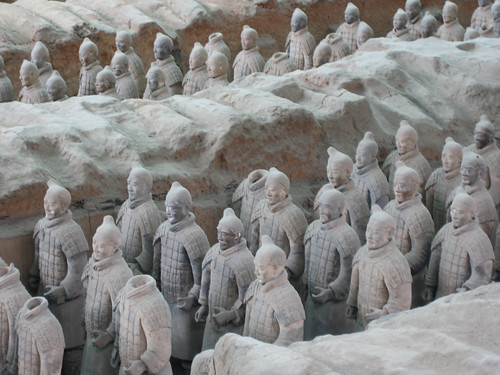
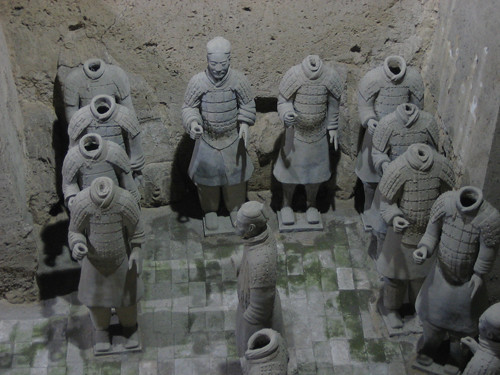
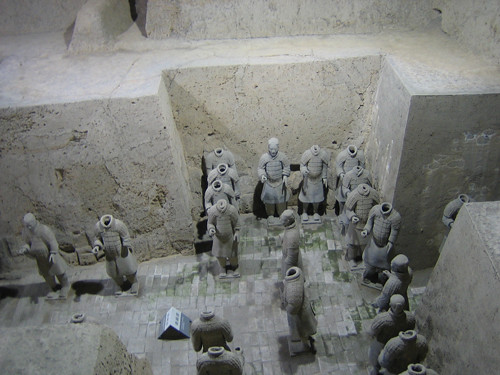
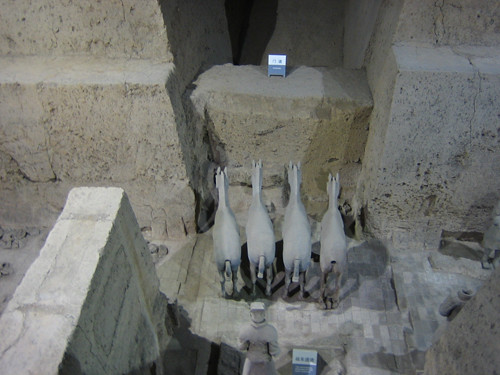
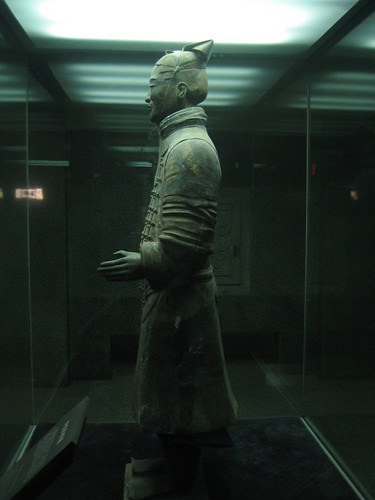
Bear in mind that the excavation sites and the half-buried warriors, horses, and chariots in Xi'an are only a portion of the vast mausoleum site, whose full extent has not been fully mapped out.  In 2007, I had the chance to visit the excavation site and those on display were truly astonishing, in their sheer numbers and the refinement and individuality of those warriors and horses, obviously modeled after real living creatures. They were also painted yet almost completely fainted with only traces of pigments remained, just like those ancient Greek marbles, and more satisfyingly beautiful to me.  Below are sample pictures I took during that trip:

IMG_4944 - Terracotta Warriors in Qin Shi Huang's Tomb, Xi'an, China, 2007

IMG_4945 - Terracotta Warriors in Qin Shi Huang's Tomb, Xi'an, China, 2007

IMG_4960 - Terracotta Warriors in Qin Shi Huang's Tomb, Xi'an, China, 2007

IMG_4968 - Terracotta Warriors in Qin Shi Huang's Tomb, Xi'an, China, 2007

IMG_4970 - Terracotta Warriors in Qin Shi Huang's Tomb, Xi'an, China, 2007

IMG_4971 - Terracotta Warriors in Qin Shi Huang's Tomb, Xi'an, China, 2007

IMG_5016 - Terracotta Warriors in Qin Shi Huang's Tomb, Xi'an, China, 2007

IMG_5021 - Terracotta Warriors in Qin Shi Huang's Tomb, Xi'an, China, 2007

IMG_5050 - Terracotta Warriors in Qin Shi Huang's Tomb, Xi'an, China, 2007

IMG_5049 - Terracotta Warriors in Qin Shi Huang's Tomb, Xi'an, China, 2007

IMG_5048 - Terracotta Horses in Qin Shi Huang's Tomb, Xi'an, China, 2007

IMG_5034 - Terracotta Warriors in Qin Shi Huang's Tomb, Xi'an, China, 2007

Despite that I have seen them in situ, I still plan to visit Asian Art Museum and for those who haven't seen them in Xi'an, I strongly encourage you to take the advantage of inspecting them up and close, more so than you could do in Xi'an.

The mausoleum in Xi'an was amazing yet it was topped a few days later in Xianyang, a smaller city nearby, in the same Shaanxi Province.  There, I visited the mausoleum of an emperor from the next dynasty, Han, Emperor Jing of Han (188 BC – 141 BC).
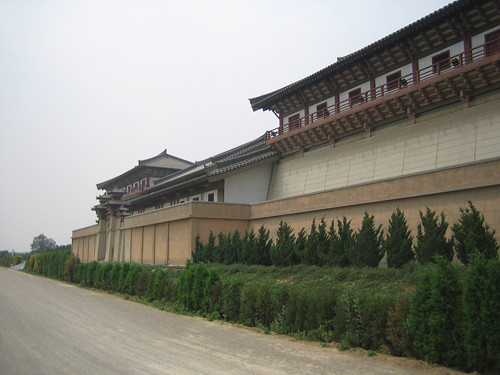
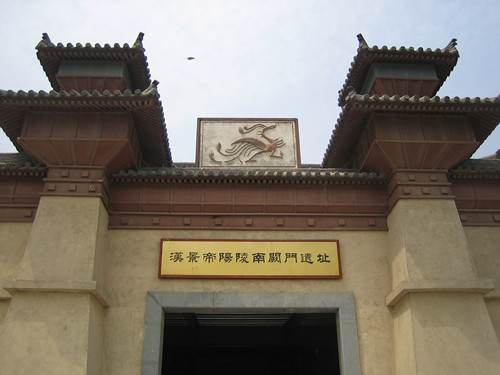
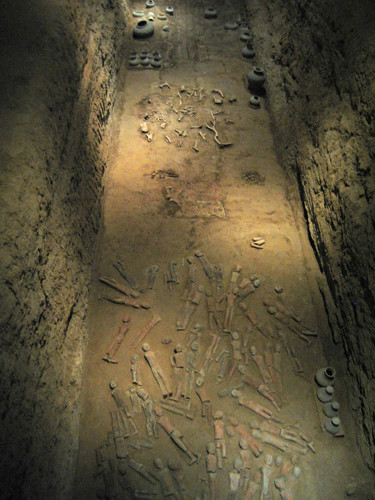
IMG_6015 - Emperor Jing's Tomb, Han Dynasty, Xianyang, China, 2007

IMG_6010 - Emperor Jing's Tomb, Han Dynasty, Xianyang, China, 2007

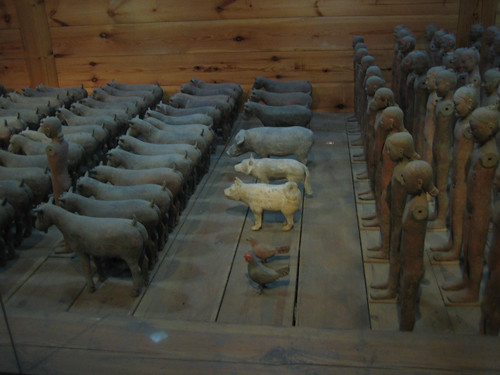
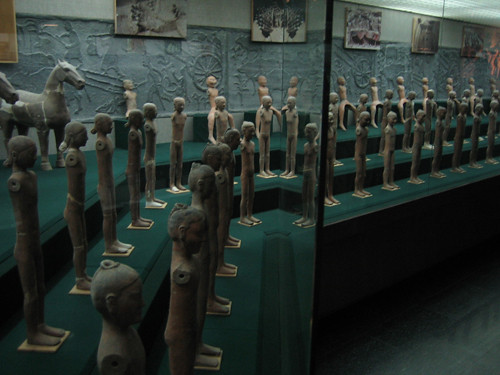
Either because Han Dynasty was less prosperous due to long drawn-out wars, or its emperors were less megalomaniac, none of its emperors' tombs or mausoleum match the scale of the "First Emperor's".  Even the underground guards were not really warriors and war horses, but court personnel and domesticated animals, and in a much reduced scales, about 1/3 or 1/4 of the real size, as seen in Emperor Jing's mausoleum in Xianyang.  Emperor Jing of Han was an important figure in Chinese history.  Wikipedia described his thus:
Emperor Jing of Han (188 BC – 141 BC) was an emperor of China in the Han Dynasty from 156 BC to 141 BC. His reign saw the limit and curtailment of power of feudal princes which resulted in the Rebellion of the Seven States in 154 BC. Emperor Jing managed to crush the revolt and princes were thereafter denied rights to appoint ministers for their fief. This move consolidated central power which paved the way for the glorious and long reign of his son Emperor Wu of Han.
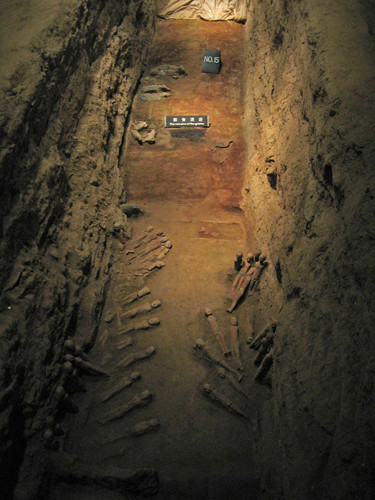
Once again, the excavated site was only a small portion of the whole burial ground.  Even so, it was impressively huge, with numerous small doll figurines half-buried.  Visitors were allowed to walk along transparent walkways and inspect those artifacts, as undisturbed as possible. 
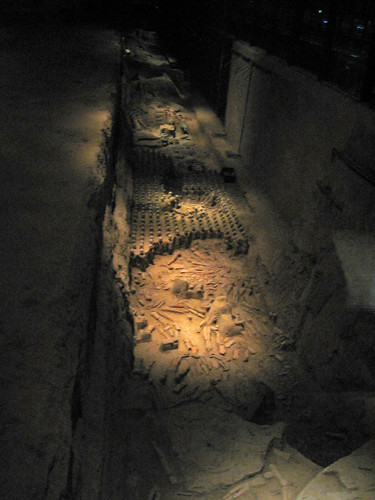
IMG_5920_m - Earthware ''sacrifices'' in Emperor Jing's Tomb, Han Dynasty, Xianyang, China, 2007

IMG_5919_m - Earthware ''sacrifices'' in Emperor Jing's Tomb, Han Dynasty, Xianyang, China, 2007 IMG_5916_m - Earthware ''sacrifices'' in Emperor Jing's Tomb, Han Dynasty, Xianyang, China, 2007

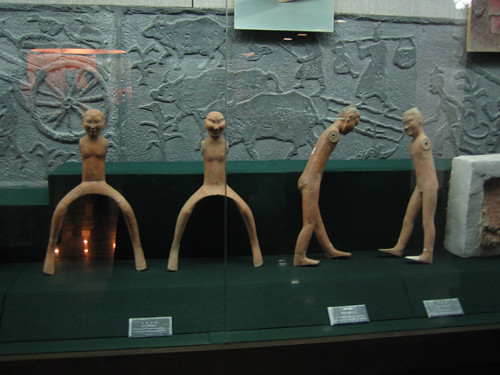
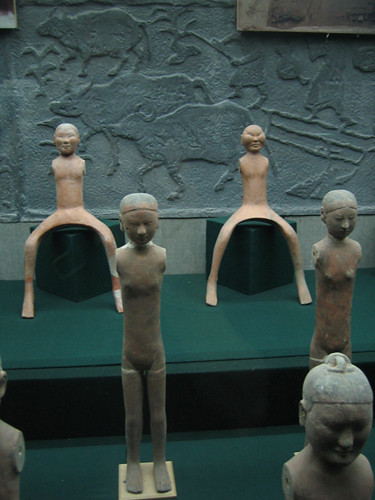
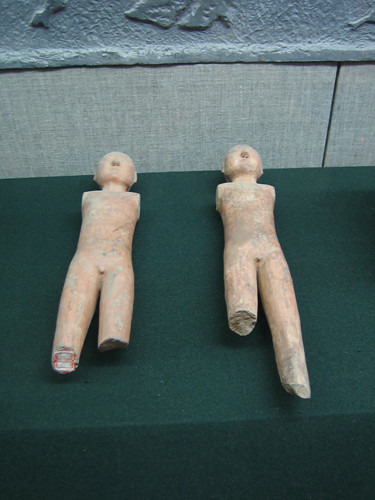
We were also able to see some of those figurines and animals in display cases with better lighting.  Those doll figurines had earthenware torsos and their wooden arms had rotten away, made them rather creepy, and I praised them over the full-sized terracotta warriors for the exoticism emitted from these mutilated figurines below:
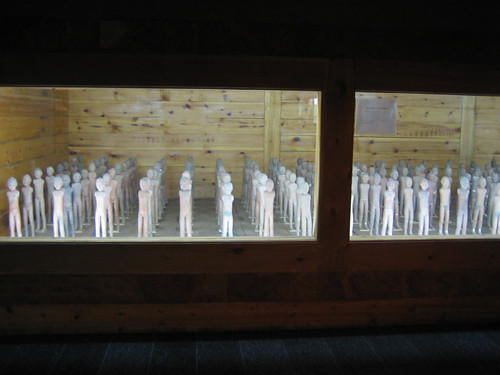
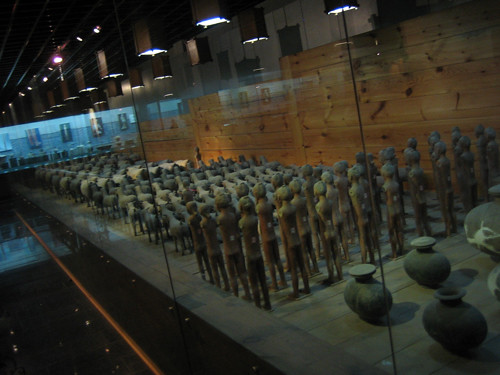
IMG_6045 - Earthware ''sacrifices'' in Emperor Jing's Tomb, Han Dynasty, Xianyang, China, 2007

IMG_6133 - Earthware ''sacrifices'' in Emperor Jing's Tomb, Han Dynasty, Xianyang, China, 2007

IMG_6130 - Earthware ''sacrifices'' and domestic animals in Emperor Jing's Tomb, Han Dynasty, Xianyang, China, 2007

IMG_6088 - Earthware ''sacrifices'' in Emperor Jing's Tomb, Han Dynasty, Xianyang, China, 2007

IMG_6064 - Earthware ''sacrifices'' in Emperor Jing's Tomb, Han Dynasty, Xianyang, China, 2007

IMG_6081 - Earthware ''sacrifices'' in Emperor Jing's Tomb, Han Dynasty, Xianyang, China, 2007 IMG_6026 - Earthware ''sacrifices'' in Emperor Jing's Tomb, Han Dynasty, Xianyang, China, 2007


Related posts on Art · 文化 · Kunst
- Last Chance to See Terracotta Warriors in San Francisco Asian Art Museum
- Weep for Ancient City Walls of Xi'an
- Ruins in Sanxingdui (Three-Star Mound) and Jinsha (Gold Sands), Sichuan, China


Sunday, September 4, 2011

China - Five Thousand Years Old? No, One Hundred!

Whiling reading Shakespeare's Henry IV, Part II and the historical background essays, I was struck by the tenacity of many usurpers or claimants's efforts in establishing their kinship connections to earlier and legitimate rules, or invented such blood connections.  Without exception, they all styled themselves the Kings of England, and not as a King of York, or King of Lancaster.  Dynasties changed with their family names, but the Kingdom was always England.  England's monarchs can be trace back to 927 A.D.

This is decidedly different from the historical events took place in the land now called China.

People often believe that the history of China is four thousand to five thousand years old.  In a sense, it is correct - the land and people and its continuous, predominant culture can be traced back as far as four to five thousands years ago.  However, during those ancient and imperial times, the concept of China didn't exist.  The land the emperors of various dynasties ruled, gradually grew into the size and shape largely overlapping with current China, was simple called the world (天下).  The succeeding dynasties had no connections to one another except for the land and the people they ruled.  The emperors were the Emperors of Qin, Emperors of Han, Emperors of Tang, Emperors of Ming, and Emperors of Qing, etc., but never Emperor of China.  As a matter of fact, a new dynasty always made great effort to sever any connections, if existed, from the ones they superseded.  The one they replaced was inevitably bad and must be condemned and destroyed and never to be spoken of in any good light.  It was purely incidental that they ruled the same land and people.  Inevitably they claimed their mandates from the Heaven to rule the earth.  The world belonged to their houses.  They didn't need consent to rule from the people lived in that land.  They owned the world and only the by their grace that the people live.

China, (in Chinese 中国), means Middle or Central Country.  This term was used as early as more than two thousand years ago.  However, at that time, it simple meant capital.  Many kingdoms and empires in that land had mentioned themselves as Middle Kingdom, mostly in an egotistic way.

Flag of the Republic of China 1912-1928
China, was really a modern concept came into existence with the overthrown of the last dynasty (Qing) and the birth of the Republic of China in 1911.  When the Republic of China was founded in January 1912, its national flag had five color stripes (red, yellow, blue, white and black), representing the five main ethnic groups - Han, Manchu, Mongol, Muslim Hui and Tibetan.  The land was called China, instead of the World.  The president was the President of China, not the President of the World.  Arguably, the concept of China was a one-hundred-year-old modern concept.

To modern Chinese people, politicians and scholars alike, whoever ruled that land and the people lived on that land, was considered part of the history of China, including the period the land and people was conquered by foreigner invaders and the majority Han was treated slightly better than slaves, such as during the entire Mogol's (Yuan Dynasty) and the early Manchu's (Qing Dynasty) rules.  Chinese generally proudly took pride in their ancient and continuous history and unbroken governance from legendary time through dynasties and republics.  That really bends the truth a bit.  Those conquered periods were really like the conquered Poland during World War II, which at that time, as the political entity, ceased to exist, though the land was still the same land, and the people were still the same Polish people.  Or to imagine that Japan had succeeded in conquering China and called it its province, even if the Japanese capital moved from Tokyo to Beijing or Shanghai.

Of course, in ancient times, the term China had been used in other part of the world to refer to many ancient Chinese dynasties, or the land and the people.  But it was merely a point of reference.  It didn't have the geopolitical meaning in it.  Some people called that land china, other called it silk or tea.

The history in that vast land is long.  But China as a political concept, is still very young.