Showing posts with label Watteau. Show all posts

Saturday, May 3, 2014

My Favorite Drawing and Painting in Musée Cognacq-Jay, Paris

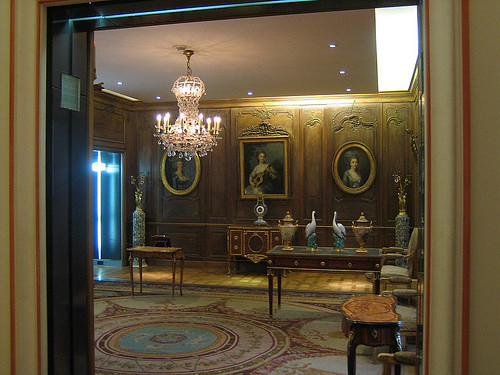
Wandering in Marais district of Paris, during my 2008 trip, I stumbled upon a small museum, the Musée Cognacq-Jay, located in Hôtel Donon, and saw some wonderful paintings and drawings by the likes of Watteau, Tiepolo, Rembrandt, Rubens, Cézanne and Degas, amongst decorative art displayed in twenty paneled rooms (four floors) in the styles of Louis XV and Louis XVI. "The collection was formed between 1900–1925 by Théodore-Ernest Cognacq (1839–1928) and his wife Marie-Louise Jay (1838–1925), founders of La Samaritaine department store." [source: wikipedia]

IMG_8980 - Musée Cognacq-Jay, Paris, 2008

What interested me most were works by Antoine Watteau, and my favorite was a study, titled Etudes de deux figures de femmes (Study of two female figures).  The line drawing was fluid, with just enough detail to give the figure a three-dimensional modeling, without overwhelming the figure with large hatching, therefore losing the trademark delicacy of the artist.  The figures were either aristocrats or actresses caught in their moonlit performances, a favored setting by this peculiar painter.

IMG_8970 - Etudes de deux figures de femmes Antoine Watteau, Antoine Watteau, Musée Cognacq-Jay, Paris, 2008
Etudes de deux figures de femmes, Antoine Watteau

My second favorite was an oil painting, a portrait of Gaspard Gevartius (an Antwerp city clerk) by Peter Paul Rubens.

IMG_8984 - Gaspard Gevartius, Peter Paul Rubens, Musée Cognacq-Jay, Paris, 2008
Gaspard Gevartius, Peter Paul Rubens

This painting is very similar to another portrait of Gevartius by Rubens, collected in Antwerpen Koninklijk Museum voor Schone Kunsten. Instead of giving him a writing table, a bust on the table represents the Roman emperor Marcus Aurelius, a source of inspiration to Gevartius on whom he also wrote an unpublished book, as seen in the Antwerp painting, this more intimate piece in Paris focused solely on the sitter's bust.  The sharp features were rendered meticulously, and the rather serious, dark or even gloomy portrait was enlivened by the rosy cheeks of the sitter and his white ruff, which though elaborate, didn't compete with the face, rather it became a clever framing device, and draw viewer's eye upwards towards the sitter's intelligent face. Here, intimacy trumps grandeur.

My Favorite Museum Collection Series
>> My Favorite Museum Collection Series 77: My Favorite Artworks in Panthéon, Paris
<< My Favorite Museum Collection Series 75: My Favorite Sculptures in le Jardin des Tuileries

List of My Favorite Artworks in the Museums I've Visited  


Other Related posts on Art · 文化 · Kunst:
- My Favorite Sculpture and Painting at Musée d'Art moderne de la Ville de Paris
- My Favorite Sculptures in les Jardins du Ranelag, Paris
- Pieter Paul Rubens (June 28, 1577 – May 30, 1640)
- My Favorite Paintings at Antwerpen Koninklijk Museum voor Schone Kunsten (Antwerp Royal Museum of Fine Arts)
- My Favorite Paintings in Cathedral of Our Lady, Antwerp (Antwerpen), Belgium
- My Favorite Paintings at the Wallace Collection, London
- My Favorite Paintings at Museum of Legion of Honor, San Francisco
- Revisiting Norton Simon Museum in Pasadena


Sunday, August 19, 2012

My Favorite Paintings at the Wallace Collection, London


The Wallace Collection in London was a marvelous museum boasting many superb old master and impressive French 18th century paintings, plus decorative art and a world class armory.  Comparing to the British Museum or the National Gallery, both huge institutions in London, it was much smaller but the reward was just as great.

There were so many paintings to like there and I name these two as my favorites there: 1) The Laughing Cavalier by the Dutch painter Frans Hals (1582-1666) and 2) Voulez-vous triompher des Belles? by French artist Antoine Watteau (probably 1684 - 1721).


The Laughing Cavalier, Frans Hals, The Netherlands, 1624, Oil on canvas, Image size 83 x 67.3 cm,  Object size: 112.5 x 98 x 9 cm

This flamboyant portrait by Hals was remarkable for its candid depiction of a not wholly flattering character and the amazing ways the painter depicted the endless varieties of fabrics and laces this cavalier carried in his bulk.  It was in-your-face direct and you could not avoid his presence.  You could hear his roaring laughter, you could smell the tobacco in his finery, and the smell of beer in his breath.  You could not avoid a minor confrontation from him, if after his assessing of you as a worthy adversary or someone he could trample upon without repercussion.  His humorous mustache could not disguise his hot temper and his readiness to pounce.  A cavalier through and through.  A roguish and less-than-refined kind.

For refinement, one only need to move on to the paintings by the French Antoine Watteau, who ushered in the ornate, the less severe, more naturalistic, less formally classical Rococo style of paintings.  He was also credited with inventing the genre of fêtes galantes: scenes of bucolic and idyllic charm, suffused with an air of theatricality.

His characters, always refined, always occupied an Arcadian landscape, otherworldly, elegant, including those actors and actresses in the costumes of Commedia dell'arte, whom, could be crude and crass if painted by other less quintessential French painter.  Watteau's world was often misty and mythical.  His characters, however real and naturalistically rendered, always occupied a world beyond our reach, and in our longing to join them, his works cast the spell over us and made us melancholic.  Thus, Watteau's works made great complement and contrast to those by Hals. 


Voulez-vous triompher des Belles?, Antoine Watteau, France, c. 1714-1717, Oil on oak panel, Image size 35.9 x 27 x 1.4 cm,  Object size: 35.9 x 25.9 x 0.4 cm, preserved parts of the original panel


My Favorite Museum Collection Series

>> My Favorite Museum Collection Series 46: My Favorite Paintings in the Courtauld Gallery at Somerset House, London
<< My Favorite Museum Collection Series 44: My Favorite Portraits at National Portrait Gallery, London


List of My Favorite Artworks in the Museums I've Visited