Yao believes there are four elements of entertainment value. "The first is visceral," she says. "Like 'Transformers.' The second is voyeurism: You're a peeping Tom. The third is vicarious experience, which is quite often love affairs. The fourth is spectacle. So I chose as the two elements of my film voyeurism - how people lived - and vicarious experience: the love affair. Then I tried to use spectacle also, with some fighting scenes to spice it up. But from day one I knew I couldn't do it as an action film, even though I know that's what sells a movie now."It is true that there is no film rating system in China and a kid can "enjoy" any scene an adult audience can see in the cinema. Sometimes I wonder if that was a deliberate decision so as to give an excuse to censor without raising any eyebrow.
Chinese censors OKd the script, but told her to be careful about the sex scene. Then when they saw the film, they cut the scene down to 10 seconds and insisted she take out all the dialogue because since they have no rating system, there may be 6-year-olds in the audience.
"What can you do?" Yao says. "You deal with the system."
This reminds me a story I read very recently: Children Watch Revealing Lingerie Show, Netizens Unfazed. The article reported a lingerie show in the open air stage with several kids gawking with wonder and puzzlement:
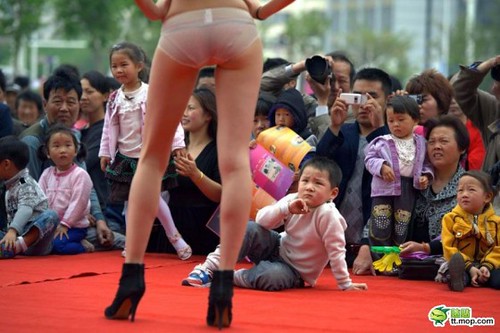
Image source: Chinasmack.com
It is very interesting to notice what they shield from children and what not. When I grew up, sex or sexy images were not even available to adults, therefore I was spared or deprived of such wonderment.
What I do remember were the whispers behind our kitchen door. My sister and I, like typical children, didn't pay much attention to our parents when they spoke in audible decibels. However, once their voices dropped to a thread, and particularly when those whispers were escaping from the closed kitchen door, my sister and I would rush in and demand to know what they were talking about.
Usually, it was my father and my mother exchanging political rumors du jour - the political campaigns and intrigues of 1970s and 1980s, dangerous stuff if my sister and I heard their whispers and started to boast them amongst our peers. What they whispered was branded by the government as 小道消息, Google translation called it Gossip, which was not accurate. Literally, it was Alley News, stories the government preferred to keep hidden from the people they ruled -- many of them could be false, but many true.
A couple years before Mao's death, the Alley News, and the attempt to weed them out was at their zeniths. The term of Alley News faded out of daily vocabulary since the eventually death of Mao in 1976.
However, the Alley News seems to have made a comeback.
The English Edition of People Daily Online reported in article, Why CPC resolutely safeguards political discipline, that
People's Daily, the flagship newspaper of the Central Committee of the Communist Party of China, released an article titled "Resolutely Safeguarding the Party's Political Discipline" on May 25, which attracted wide attention from various overseas media.The central demand from that article was that Chinese Communist Party Members
This article pointed out that the Party's political discipline is the rule of safeguarding the Party's political principles, political orientation and political line, and regulating political speech, political actions and the political stand of Party organizations and members. It is the most important discipline of the CPC. The article lists recent incidents of certain Party members and cadres who violated the Party's political discipline.
决不允许在群众中散布违背党的理论和路线方针政策的意见,决不允许公开发表同中央的决定相违背的言论,决不允许对中央的决策部署阳奉阴违,决不允许编造、传播政治谣言及丑化党和国家形象的言论,决不允许以任何形式泄露党和国家的秘密,决不允许参与各种非法组织和非法活动There you go. The Party Center admitted itself the emergence of political rumors.
(must not be allowed to spread among the masses theories and views against the Party line, must not be allowed to publish remarks in contrary the Party Center's decisions, must not be allowed to be double-faced in regard of Party Center's decisions and planning, must not be allow to fabricate, spread political rumors and speeches vilifying the Party's and the national image, and never be allowed to disclose party and state secrets any form, and must not be allowed to participate in various illegal organizations and illegal activities.)
If only the kitchen doors were large enough.


 Posts
Posts


