Showing posts with label Richard Wagner. Show all posts

Monday, June 20, 2011

Part 4, Götterdämmerung - Premiere of Wagner's Ring Cycle at San Francisco Opera

The last installment of the new Francesca Zambello production of Richard Wagner's Ring Cycle was staged as part of the cycle took place on 19 June 2011, Sunday. This particular production was unveiled for the first time in San Francisco Opera just several days ago on 5 June 2011, with the cast of:

Brünnhilde Nina Stemme
Siegfried Ian Storey
Gunther Gerd Grochowski
Hagen Andrea Silvestrelli
Waltraute & Second Norn Daveda Karanas
Gutrune Melissa Citro
Alberich Gordon Hawkins
First Norn Ronnita Miller
Third Norn Heidi Melton
Woglinde Stacey Tappan
Wellgunde Lauren McNeese
Flosshilde Renée Tatum

San Francisco Opera Ring Cycle  2011 Götterdämmerung _  3702
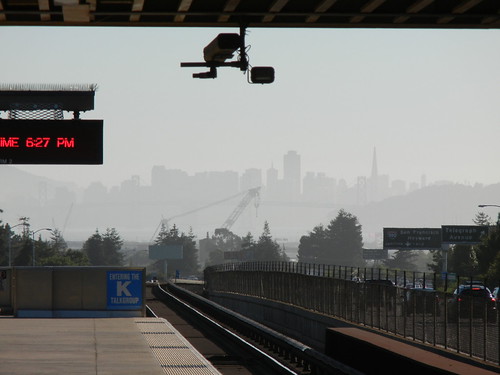
Ashby BART Station

Sunday, I went to San Francisco by BART from Ashby station, which looked rather menacing enough for the set of this masculine Ring Cycle.
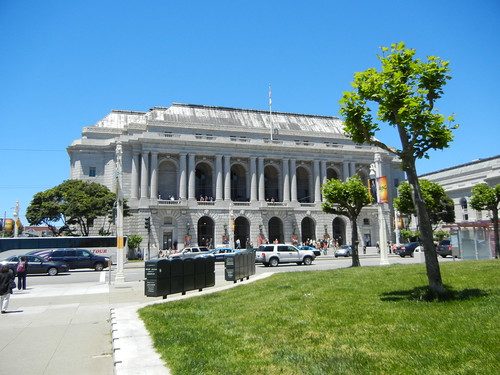
San Francisco Opera Ring Cycle  2011 Götterdämmerung _  3711
Before the Armageddon

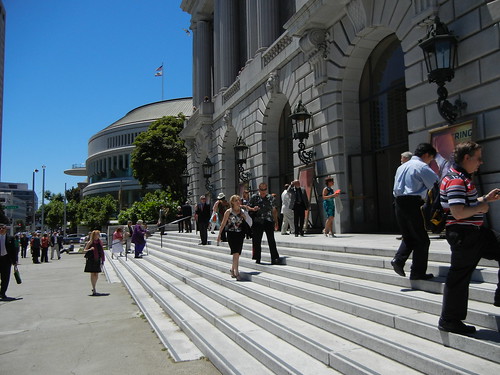
San Francisco Opera Ring Cycle  2011 Götterdämmerung _  3715
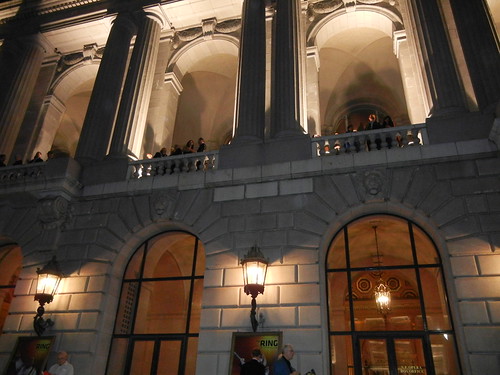
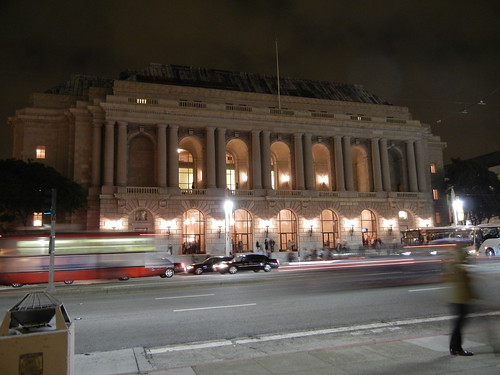
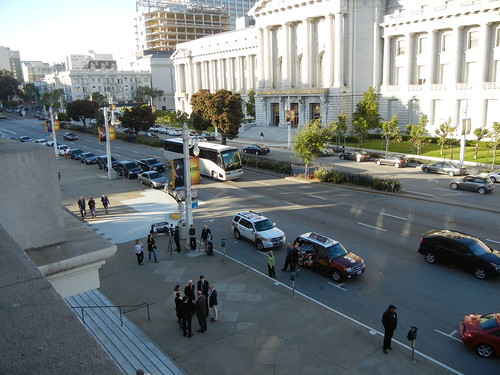
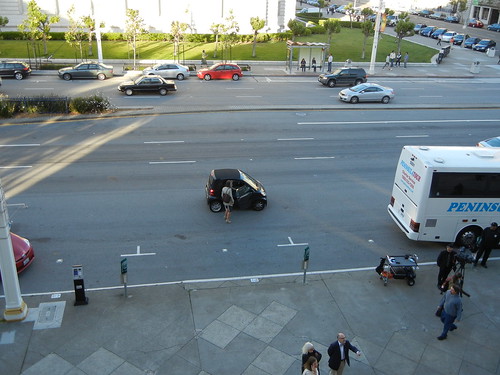
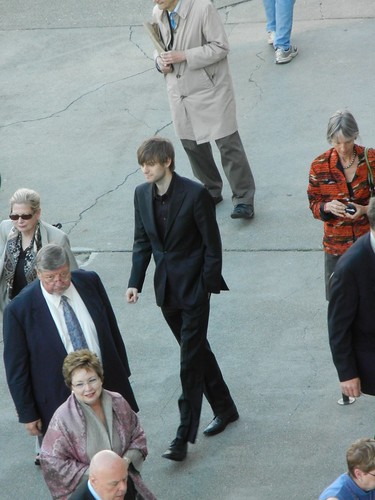
Patrons Arriving

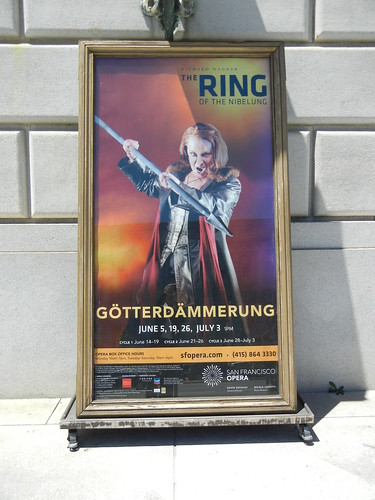
San Francisco Opera Ring Cycle  2011 Götterdämmerung _  3721
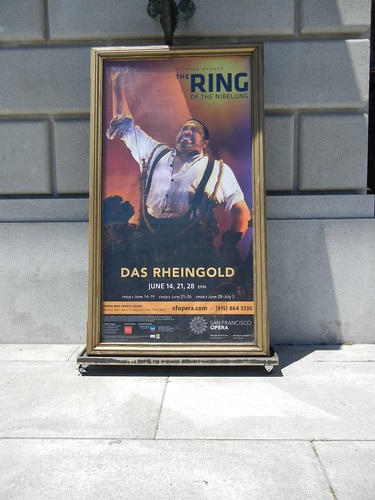
Poster


This opera is the longest one with a prologue and three acts.  It started at 1 pm and ended at 5:30 pm, when the curtain calls were over.
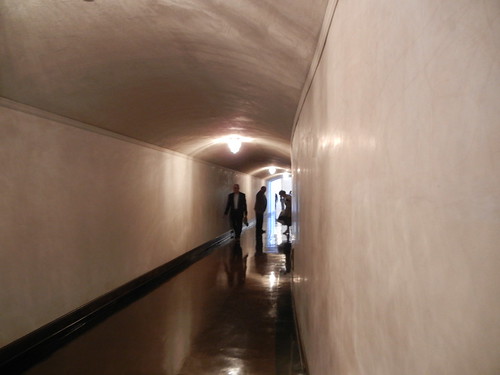
San Francisco Opera Ring Cycle  2011 Götterdämmerung _  3732
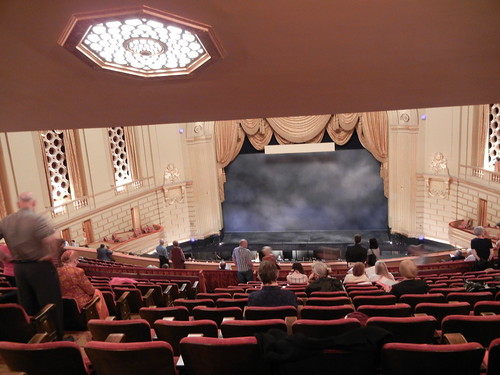
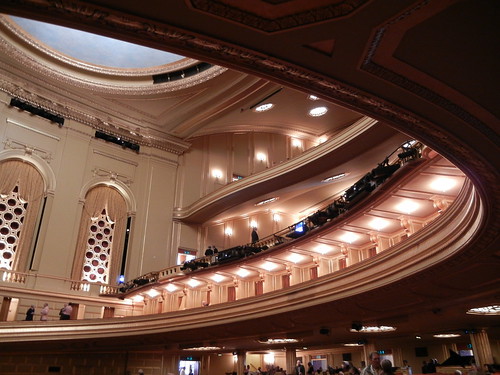
Inside the House

San Francisco Opera Ring Cycle  2011 Götterdämmerung _  3744
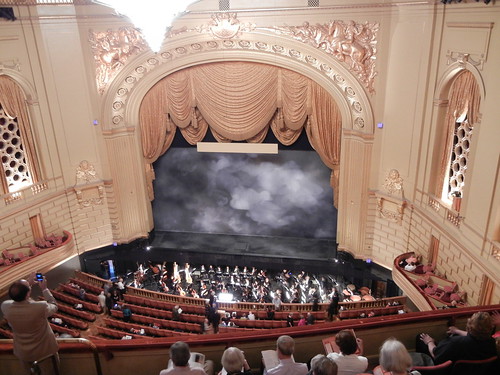
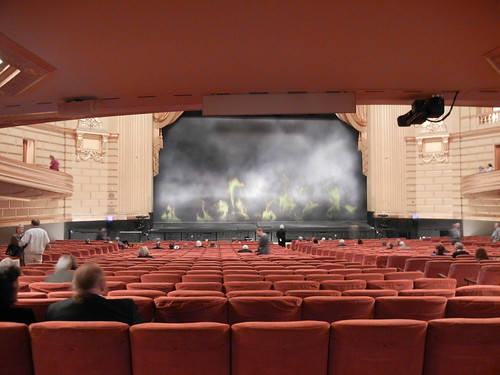
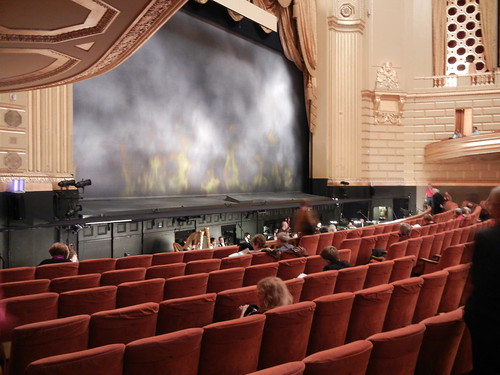
Before Curtain

San Francisco Opera Ring Cycle  2011 Götterdämmerung _  3751
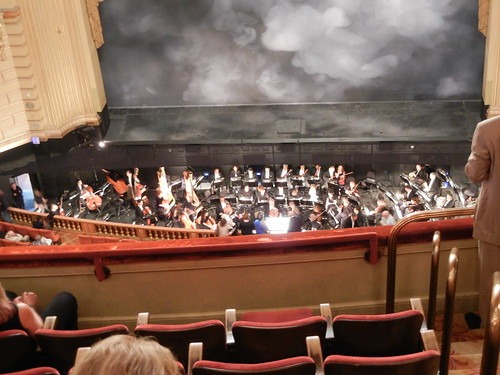
Musicians in the Pit Getting Ready for the Show

The prologue was a scene of three Norns, fate daughters of earth goddess Erda, who spin the fates of everyone, seeing the past, present and future. Here, the set was a integrated circuit board, and the Norns wear bright green coats and dark sunglasses. Instead of spinning, they attached and detached cables to the IC board, to collect or provide knowledge. An interesting idea of integrating digital age. But the idea was not fully exploited and the green coats were plainly garish. This scene should be timeless, mysterious and sad. With three overgrown frogs working out with their arm-thick cables, they were anything but timeless, mysterious or sad. They were actually farcical and the scene was played for laughter. Dramatic situation and lustrous voices wasted. All three Nors sang lustily. Miller's contralto was as formidable as Erda and I really wished I had the stamina to see Cycle 3, which would feature Melton's Sieglinde which surely would be amazing.

Act I started with another awakening scene - this time, both Siegfried and Brünnhilde, from their love-making. Another extended love-duet. Tenor Ian Storey, had very similar physical and facial structure to Jay Hunter Morris, therefore the continuity of the character of Siegfried was ensured, even though their sounds were more different than their appearances, which also made sense, because in Siegfried, he was an absolutely innocent youth, and more tenor sounding Morris provided just that. Here, after having tasted love, more expansive and baritonal Storey demonstrated his increased feelings. He sounded more heroic but less free on top. A trade off. Stemme again, sang gloriously and her statue grew immensely with every single note.

Next scene we found Siegfried's adventure took him to Gibichung Hall, where he was ensnared by Albrech's son Hagen's black magic, fell in love with Hagen's half-sister Guntrune and would capture Brünnhilde for Hagen's half-brother Gunther.  This scene was set in a sleek modern living room, without much characters.  Some large pipes looming in the background hinted at their wealth perhaps related to fossil fuel.

Hagen, sung by Italian bass Andrea Silverstrelli, was the embodiment of blackness.  His music was gloriously dark and scary.  Gerd Grochowski and Melissa Citro both sang and acted the flawed but also decent ruling brother and sister well.

Next scene, Brünnhilde was visited by her sister Waltraute (Daveda Karanas), who begged her to give the ring to the Rheinmaidens so as to save Wotan's skin.  Brünnhilde, now valued Siegfried's love more than anything and would not let go of the ring, the symbol of the love.  Valhalla, which cast her out, meant nothing for her now.  Let them perish.  They both sang magnificently but some of the physical interactions were ill-timed.  For example, Brünnhilde started to push her dear sister away, roughly, even before Waltraute asked her to give up the ring.

Then, Siegfried, disguised as Gunther, came through fire and conquered Brünnhilde and robbed her ring.  Putting his sword, Notung, in between, he would spend the night with Brünnhilde, before carry her away next day for Gunther.  Strangely, instead of laying down the sword between them and lying down, he dragged Brünnhilde off stage.  Rather unnecessary confusion.

When the Act 1 was over, it was past 3 p.m.
San Francisco Opera Ring Cycle  2011 Götterdämmerung _  3764
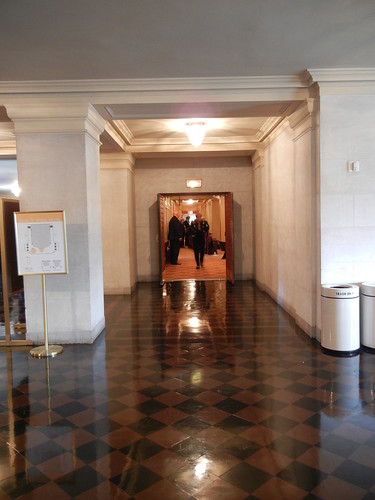
First Intermission

San Francisco Opera Ring Cycle  2011 Götterdämmerung _  3771
Intermission (Grand Tier)

Act two started with Hagen and Gutrune watching television together, in his bed.  Quite ambiguously.  It was an interesting twist.  Albrech came after Gutrune repulsed Hagen's advances and left the room, and urged Hagen to gain the Ring and its power.  Hagen asked Albrech "Der Ewigen Macht, wer erbte sie" ("Who inherits the might of the immortals?").  It was an interesting question and this question stayed with me long after the opera.

Hagen assembled his vassals - here they looked more like underlings of mafia - in act 2 to welcome Gunther's bride.  The male chorus sang lustily on and around a platform, which put many soloist on the disadvantage upstage, particularly Siegfried, and during this act, I had to stain to hear him sometimes.  Brünnhilde was dragged onto stage, in an ill-fitting gray evening gown.  Inexplicably, she was in a pair of ungainly black combat shoes, not even boots.  Perhaps, this meant to emphasis her discomfort.  Barefoot would have worked better.

The confrontation between Brünnhilde and the supposedly traitor Siegfried was epic and the revenge trio (Brünnhilde, Hagen and Gunther) was the darkest moment of the cycle and the most delicious one.  I always enjoyed this stretch the most.  However, the physical interaction was not good enough here.  They were ill-timed, tentative and brief.  Brünnhilde and Gunther barely toughed Hagen's spear before they withdrew their hands, therefore left little impact which should have been tremendous here.
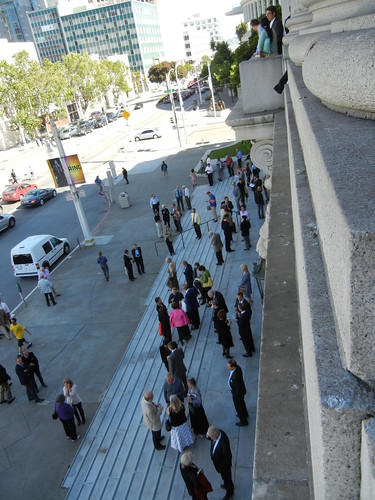
San Francisco Opera Ring Cycle  2011 Götterdämmerung _  3791
Second Intermission

Before Act 3, General Director David Gockley came up the stage.  He was met a round of gratifying applauds.  However, he was here to deliver bad news - tenor Ian Storey was vocally indisposed during Act 2, but he would sing for the rest of the performance.

Interestingly, the announcement seemed have lifted his worry, and his vocal productions were freer, clearer and more audible.

The first scene, we found Rheinmaidens, in muddied garbs, collecting garbage littered along the river.  Siegfried came during the hunt organized by Hagen, and just about to give up his ring, the Rheinmaidens made a poorly-judged threat and that put the fearless hero off and who decided to keep the supposedly cursed Ring after all.  After this scene, I started to doubt, just a bit, my earlier assertive that this production being musical.  When Rheinmaidens collected garbage, they made loud noises with their cans, plastic bottles and bags, and sabotaged their lovely singing.  To me, any uncalled for extraneous sound was an offense and should be avoided at all costs.

Hagen, Gunther and their vassals joined Siegfried.  Hagen cunningly asked Siegfried to tell his past, aided by his potion which restored Siegfried's memory of his love for Brünnhilde.  Seizing the opportunity, pushing away the interfering Gunther, Hagen stabbed Siegfried's back, the soft spot betrayed by Brünnhilde, whose love for Siegfried turned to hatred.

Back home, Gutrune longed for Siegfried's horn.  When people returned without hearing it, she panicked and Hagen sadistically presented her Siegfried's body.  She accused Hagen and Gunther of murder.  Hagen then  fought Gunther over the ring and broke Gunther's neck and lunged for the ring but Siegfried raised his hand.  Here, Zambello misfired badly.  Instead of raising his hand either threateningly, defiantly, or in refusal, when confronted by Hagen, here, Siegfried raised hand way before Hagen arrived at his side, and his hand raised at the level perfect for Hagen to reach out.  It looked at a complete surrendering.

At this crucial moment, Brünnhilde strode in, followed by Rheinmaidens.  All manfolks left the stage.  She had learned and understood everything.  She and Gutrune reconciled and their sisterhood was quite touching.  Another nice touch was the surprise and shock when Rheinmaidens learned that they were to reclaim the gold from Brünnhilde's ashes.  Here, the nihilism triumphed.  Like father, like daughter.

Following order, Guturne, Rheinmaidens and other women threw logs towards the hidden river bank at the far back of the stage, very noisily, and dumped Siegfried's body there too and dosed with gasoline.  Brünnhilde, a torch in hand, walked into the pit behind the stage, and small fire come up there.  Scrim fell down, and more flames could be seen, then the square pictures of fallen heroes collected at Valhalla, spiced up by some parts of building blocks, serenely floated down, like over-sized beautiful snowflakes, signify the destruction of Valhalla.  It was very anticlimactic.

By now, without a spectacular final denouement, it hardly mattered.  However, after seventeen hours, it would be nice to have something to be shocked or marveled at.  The pictures of those heroes were all in frontal view, unblemished. Nothing was rotated, twisted, charred, in flame or in smoke.

Then, all cleared up.  Hagen was dispatched by a garbage bag on head by the Rheinmaidens - nice touch.  They dug out that piece of golden cloth and twirled it about to symbolize the gold and an innocent child brought a young branch and planted it on stage.  Rather gratuitously.

Curtain.

The cast were met with thunderous applause.  However, Ian Storey met a little bit booing.  He came up stage gritted his teeth.  I felt it was uncalled for - he did a decent job - not on the level of Nina Stemme but a worthy partner, indisposed or not.

Conductor Runnicles was greeted with enthusiastic applauds.  We were truly blessed to have Stemme and Runnicles in this Ring Cycle.  They were standing before the second curtain, which now was lifted and revealed the entire orchestra behind it and the theater went nuts.

Nina Stemme then walked to the wing and greeted Francesca Zambello and other creative team members, who were met with applauds and quite loud booing. 
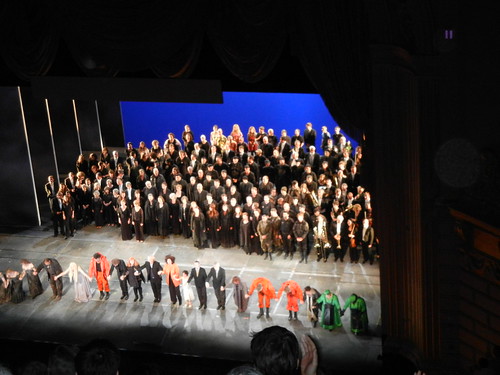
San Francisco Opera Ring Cycle  2011 Götterdämmerung _  3809
Curtain Call


Curtain Call

The booing was quite baffling.  I thought this Ring cycle, conceived by Zambello, was eloquent and interest, totally valid.   Her modernistic twist, not always coherent, was always interesting and showed respect to music and texts.

The scenery was largely not very inspired and the costumes were just passable.  The video projections between scenes were either irrelevant or too literal and I prefer a blank curtain and imagining drama in my own head.  However, it was the interaction amongst the characters and the ability to present the inner conflict, Zambello triumphed.  We should be grateful for this, in our age of Spider-Man and Cirque du Soleil.

Was this a perfect Ring?  No.  Were there rooms for improvement?  Many.  Was this a Ring for the ages?  Probably not.  Was it successful?  A resounding yes.
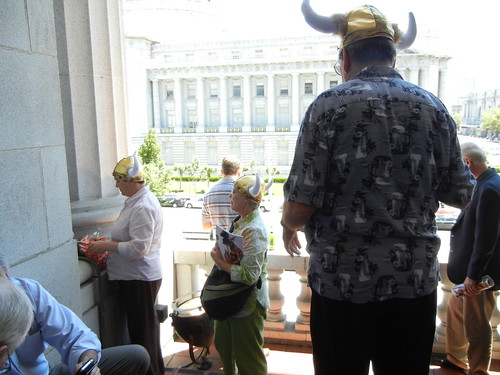
San Francisco Opera Ring Cycle  2011 Götterdämmerung _  3724
Horned Helmets Off Stage

I suspect that the people who booed Zambello et. al. either felt the production was not bold enough, and or not traditional enough - they wanted their winged helmets and breastplates.  I do wish she had pushed the envelop further.  The dubbed "American Ring", after these 17 hours, were quite inappropriate, for better for worse.  I do felt a deep relief that no "September 11" reference was made.  That would trivialize both the event and the operas.  It is essentially a universal drama, belonged to human kind.

The ending with the innocent child, didn't work for me.  Because it signified a hope which did not exist. 

Here, the question regarding who was to inherit the splendor of gods.  We?  Homo sapiens?  Considering the rapidly deterioration of the earth, I'm afraid that we were just as doomed as the occupants of Valhalla.

6:30 p.m., curtain calls ended and we filed out the theater.  Exhausted but in exciting mood.  I overhead that there was an old lady in her nineties, was in town by herself for all three cycles.  Another anecdote I heard was this would be either the 58th or 59th Ring Cycle for another audience member who was also in her or his nineties.  Perhaps they were talking about the same person.  But I wouldn't be surprised if not.
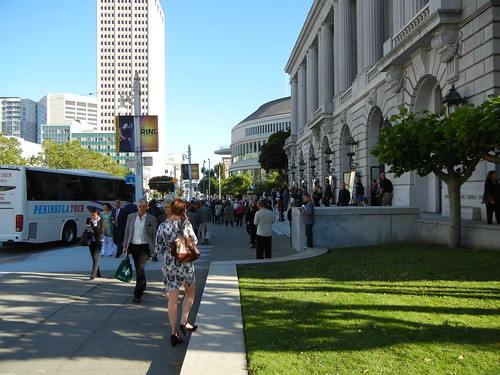

San Francisco Opera Ring Cycle  2011 Götterdämmerung _  3810
End of the Show


End of the Cycle

7:30 p.m., eight hours after I left home for the opera, I went back home.

My advice for anyone thinking about attending a Ring Cycle:  do it at least once.  Experiencing them in installments were good enough compromise but the experience of seeing these four operas in close secession was an experience with much greater impact.
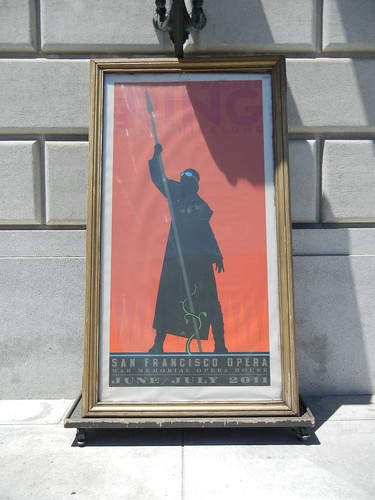
San Francisco Opera Ring Cycle  2011 Götterdämmerung _  3718
Ring Cycle Poster

San Francisco Opera's website also provided some interesting statistics regarding the Ring Cycle.  Such as:

Total number of people involved on stage / in the pit = 415
( 1 conductor + 1 director + 5 designers + 1 choreographer + 30 singers + 94 orchestra + 76 chorus + 52 supers + 115 crew + 30 music and production staff + 10 studio teachers and wranglers (not counting administrative staff, volunteers, ushers, box office staff, etc.)

Total number of animals = 12 (2 dogs, 1 bear, 1 “bird”, 1 frog, 1 serpent, 6 dead animals)
Total time to complete the Ring = 17 hours.


Related articles:
Part 3, Siegfried - Premiere of Wagner's Ring Cycle at San Francisco Opera
Part 2, Die Walküre - Premiere of Wagner's Ring Cycle at San Francisco Opera
Part 1, Das Rheingold - Premiere of Wagner's Ring Cycle at San Francisco Opera
My Experiences with Wagner's Operas

Saturday, June 18, 2011

Part 3, Siegfried - Premiere of Wagner's Ring Cycle at San Francisco Opera

The third installment of the new Francesca Zambello production of Richard Wagner's Ring Cycle was staged as part of the cycle took place on 17 June 2011, Friday. This particular production was premiered in San Francisco Opera just several days ago on 29 May 2011, with the cast of:

Siegfried Jay Hunter Morris
The Wanderer (Wotan) Mark Delavan
Brünnhilde Nina Stemme
Mime David Cangelosi
Alberich Gordon Hawkins
Fafner Daniel Sumegi
Erda Ronnita Miller
Forest Bird Stacey Tappan

Siegfried, though conceived first and was the central part of Wagner's plan, has always been just like the title character, the orphan, of the cycle - it lacks the colorfulness of Das Rheingold, lacks the thrill and familiarity of Die Walküre and doesn't have the dramatic one of the bleakest showdowns of Götterdämmerung.  Only three females characters in a long evening, and all roles were relatively speaking, brief.  Even Brünnhilde had only about 45 minutes on stage.  The main character Siegfried can also be problematic, not only for singers who is valiant enough to take it on and for directors as well.  The waking up of Brünnhilde in the final scene was really a semi-rape.

However, from the first few bars of the orchestral playing, I suspected that my opinion on this opera might change.  I always found the forging music cheesy, when I listen to recordings, no matter how exalted the performances were.  But, last night, I found that music was threatening, urgent and mystic, without an iota of cheesiness.  Kudos to the heroic effort from conductor Donald Runnicles.

In Act one, we found Siegfried, a big overgrown blond boy, handsome, brave and brutal, constantly mistreated his foster father, the ghastly drawf Mime, who was supposed to be a miserable sight, much more miserable than the rather handsome Cangelosi.  Siegfried berated Mime constantly for his cooking, for his inability to forge a sturdy enough weapon, for his ugliness, and for their different looks.  This was rather uncomfortable stuff.  In this brutal, ingratiate brat, I saw the prototype of Nazism.  Nazism, or at least Hitler, was an aesthetics tyrant and many of his crime could be traced to his vision of a world of beauty of his version, in one singular form alone.

However, prototype or not, despite the discomfort, we soon accepted Siegfried due to his innocence.  He was innocent of many things - growing up with an unsteady foster father who nagged constantly and bore no love towards Siegfried but the desire to use his as his pawn to gain the Ring, without societal companion, therefore, much of his petulance could be explained away if not embraced.  Even his eagerness to bring destruction to outside world, seen through an adolescent's lens, if not accepted today, could be understood.

The most amusing characteristics of his was his lacking of fear.  It was not the dragon he slayed taught it that but a maiden.   Which took place later, much later.

Before that, Wotan, in the guise of a wanderer, perhaps, had many confrontations, with Mime, with Albrech, and with Erda, then finally with Siegfried.  This opera charted the course of his maddening self-destruction and the feeble resist at the very end.

Duly, Siegfried forged his father's sword, shattered by Wotan, slayed the dragon (giant and one-time owner of the ring) Fafner, learned to understand the birds, shattered his grandfather's long staff, manhood, power and meaning of existence, woke up his aunt Brünnhilde, and half-persuaded and half-forced Brünnhilde to accept him as her man.

Clearly the innocence and fearlessness of Siegfried were his most commendable features but they were also what would doom him in the future.  What guaranteed his unfitness to be the free agent to free the world from  the power or curse of the Ring was his lacking of wisdom.  A holy fool, however holy, is still a fool.  Adorable one or not.

The music was glorious throughout but the long expositions in Acts one and two cried out for a large pair of scissors for Wagner.  Only if he had learned some fear.  But it was this megalomaniac approach made his operas such fascination.  Perhaps, he was being rather crafty, or extremely confident that after have exhausted us with three hours music, the sight of Brünnhilde would be just as rapturous to us as to Siegfried.  And we did.  The scene two of Act three, the awakening of Brünnhilde and their love-rape duet was glorious.

The best singing came from Nina Stemme's Brünnhilde - after had waited for four hours, it must be a relief to be part of the action.  Jay Hunter Morris, took over from the originally announced Ian Storey, who was recovering from an illness and would only sing in Götterdämmerung, went through the punishing evening honorably.  At times if his tone was less than heroic and clarion, it should be forgiven.  He hit all the notes capably and rather beautifully, and most times was clearly audible, and even raised his singing several notches higher when sang along with Stemme, and that was a quite a wonderful achievement in itself, considering the pit was open one, not the covered one Wagner had in mind when the opera was composed, and the brighter, louder sound of modern orchestra therefore harder to compete.

Delavan's singing was at times patchy - one moment barely audible and next rafter shaking - perhaps one day's break was not enough for him to recover.  He did best during confrontation with Erd and Siegfried in the later scene.  Overall, it was still a memorable and commendable performance. 

Erda was sang potently again by Miller and the Tappan chirped prettily as the Forest Bird, of whom I always suspect was in league with Wotan.  Cangolesi's Mime was outstanding singer and performer as well.

The staging was wonderful, particularly during Act one, with a set of deserted industrial park or a wasteland.  The dragon was mechanical one with the real giant hidden inside.  Act Three had already-crumbled Brünnhilde's Rock and the drying-diapers like hanging square pictures of dead heroes her sisters left behind were gone.  When the singers sang rapturously in the love-rape duet, the staging was rather conventional and less than inspired.  Their love, though orgasmic, was not as touching as Wotan-Brünnhilde's farewell.  But I was deeply moved by the trajectory of Brünnhilde's emotion as a mortal and reaction to Siegfried, the person she loved and knew would be her man but was not ready to accept, and Siegfried's fear in seeing a woman for the first time and his hope of seeing his mother and consequent disappointment and dejection.

One more pleasant thing to report is the well-calibrated manner and bearing of Jay Hunter Morris and the innocent and brutal Siegfried.  Not for a single moment he embarrassed himself with any silly imitation of a teenage.  He even gained our sympathy and emerged as a likeable and loveable one.  He was still a brute, but he was our brute.  Quite a feat.

Zambello, by concentration on myriads emotions of humans, gods, giants and dwarfs, made this long evening a powerful experience.

During the second intermission, at 9:50 p.m. three hours twenty minutes after the show started at 6:30 p.m., I heard an elder gentleman asked his wife why she wouldn't get ready to go down and go home.  She answered: "Honey, there is another act to go."  The show ended around 11:30 p.m.

In the end, do I like the opera better?  Yes, I think so.  I understand the many mini-confrontations much better and many detailed verbal exchanges are more meaningful, withe the memory of visual aides.

Sunday's performance would be even longer.  It would be an Everest to scale, not only for performers, but audience as well.


San Francisco Opera Ring Cycle  2011 Siegried _ 3616
Before the Show

San Francisco Opera Ring Cycle  2011 Siegried _ 3619
Standees Waiting to Enter the Theater

San Francisco Opera Ring Cycle  2011 Siegried _ 3620
Poster

San Francisco Opera Ring Cycle  2011 Siegried _ 3623
Before Curtain

San Francisco Opera Ring Cycle  2011 Siegried _ 3636
Before Curtain

San Francisco Opera Ring Cycle  2011 Siegried _ 3634
Before Curtain

San Francisco Opera Ring Cycle  2011 Siegried _ 3643
First Intermission

San Francisco Opera Ring Cycle  2011 Siegried _ 3647
Second Intermission

San Francisco Opera Ring Cycle  2011 Siegried _ 3648
Second Intermission

San Francisco Opera Ring Cycle  2011 Siegried _ 3672
Second Intermission

San Francisco Opera Ring Cycle  2011 Siegried _ 3679
After the Performance

Related articles:
Part 4, Götterdämmerung - Premiere of Wagner's Ring Cycle at San Francisco Opera
Part 2, Die Walküre - Premiere of Wagner's Ring Cycle at San Francisco Opera
Part 1, Das Rheingold - Premiere of Wagner's Ring Cycle at San Francisco Opera
My Experiences with Wagner's Operas
Wednesday, June 15, 2011

Part 1, Das Rheingold - Premiere of Wagner's Ring Cycle at San Francisco Opera

Last night, I attended the premiere of new production of Richard Wagner's Ring Cycle (Der Ring des Nibelungen) at San Francisco Opera (SFO)'s home theater - War Memorial Opera House. The producer of the new production is Francesca Zambello and it was once again conducted by former SFO's Music Director (1992-2009) Donald Runncles, currently the General Music Director of the Deutsche Oper Berlin since August 2009 and Chief Conductor of the BBC Scottish Symphony Orchestra since September 2009.

The first night, an overall excellent one, was the first of the four parts of Ring Cycle -- Das Rheingold, which was presented in this production at San Francisco Opera a couple years ago and I did attend that performance.  

The star was once again, the orchestra.  Runnicles is definitely one of the best, if not the best Wagnerian conductor of nowadays.  Every outing of his Wagner performance is an event.  Surely.

There were four scenes and only the Nibelheim scene was truly wonderful.  The Rheinmaiden scene was not magical and the adobe of the gods pre-Valhalla was rather non-descriptive but not offensive.  The production and direction was interesting and intriguing most of the time and it was musical and that was a tall order already.

The scene change was rather loud and between Scene 3 and 4, patrons clearly heard someone snapped: "Hurry up!"  All these noises competed mightily with the wonderful music interlude and was very regrettable.  Perhaps unavoidable, if we don't want to be saddled with an unit set.

The costume was bad, lighting excellent.

Singing was uniformly good.  The best singing was from Stefan Margita as Loge.  His voice was the sweetest one I ever heard on this stage.  Ronnita Miller impressed with her rich contralto as all-knowing earth goddess Erda.

The giants were wonderful as well, so was Gordon Hawkins as Alberich and David Cangelosi as Mime.

As for staging, I still have mixed feelings towards Zambello's effort.  Fricka's characterization still offended.  She was a frumpy Hausfrau, rather than a goddess in the statue of Hera or Juno.  She should not be a shrew.  She sounded reason.  Though I do like the more emphasized intimacy and closeness of Fricka and Wotan in that period of their life.  However, it was just not magic, mythic and cosmic enough.  For example, both Rheingold and Tarnhelm were represented by flimsy and cheap looking cloth.  Better solutions ought to be found.

Some changes of the staging took place, for better or for worse.  When Alberich showed his ring to his slaves, instead of running away in terror, this time, the slaves retreated in orderly formation, though screamed appropriately.  Odd and the menace was diminished.

The ending still had the cruise ship gangway leading to Valhalla but less offensive this time.  Perhaps the boldly colored floor and rainbow colored sky screen helped.  I also like the black-clad Rheinmaids' reappearance at that moment.  Cannot remember if it was new or not.  Don't remember them last time.

The thunder accompanying Donnor's hammer swing was louder, but still out of sync.  The little flame ejected very briefly from the two ends of the hammer was still pathetic.  Better do without.

Again, Loge's struggle with Alberich as a toad was badly staged again.

Overall, a wonderful evening.  However, I did regret more that I didn't catch the previous Ring Cycle production here by Nikolaus Lehnhoff.


Below are the cast and production team:

Cast

Production Credits

Conductor Donald Runnicles
Director Francesca Zambello
Set designer Michael Yeargan
Costume designer Catherine Zuber
Lighting designer Mark McCullough

Below are several pictures and videos I took before and after the performance:

San Francisco Opera Ring Cycle  2011 Das Rheingold _ 3466
Waiting at Oakland's Rockridge Station for Bay Area Rapid Transit (BART) train to San Francisco

San Francisco Opera Ring Cycle  2011 Das Rheingold _ 3471
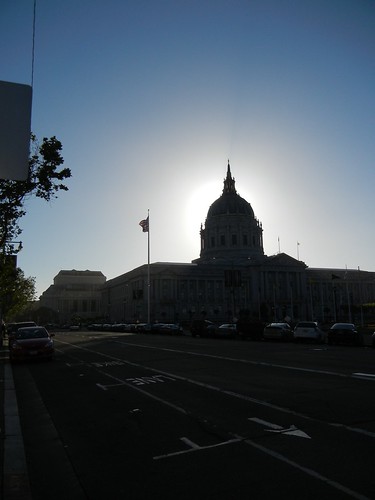
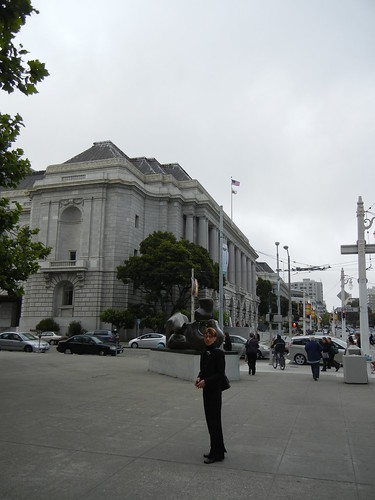
Towards the opera house - San Francisco City Hall is in front of Memorial Opera House

San Francisco Opera Ring Cycle  2011 Das Rheingold _  3713
Poster

San Francisco Opera Ring Cycle  2011 Das Rheingold _ 3473
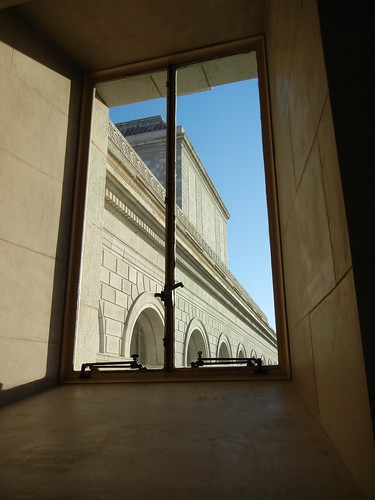
View from the Balcony (San Francisco City Hall)

San Francisco Opera Ring Cycle  2011 Das Rheingold _ 3483
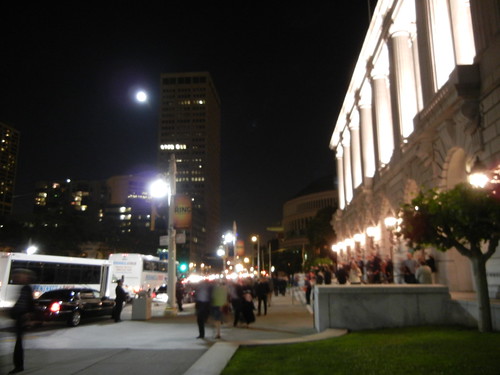
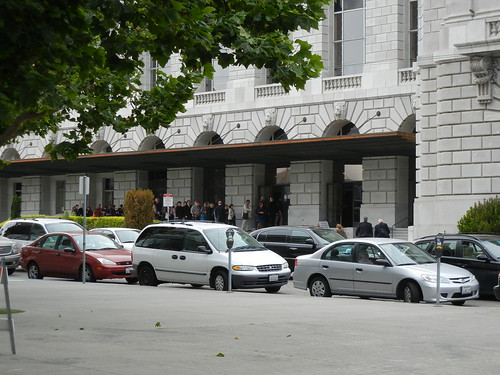
Patrons arriving at San Francisco Opera (War Memorial Opera House)


Patrons arriving at San Francisco Opera House


Patrons arriving at San Francisco Opera House

San Francisco Opera Ring Cycle  2011 Das Rheingold _ 3485
Glamorous Patrons

San Francisco Opera Ring Cycle  2011 Das Rheingold _ 3477
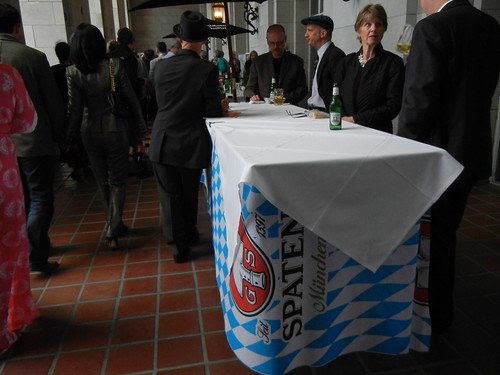
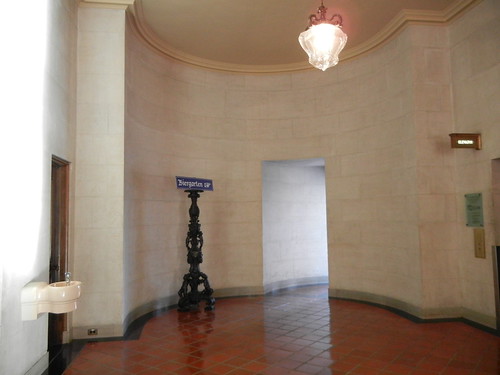
Way to the Biergarten

San Francisco Opera Ring Cycle  2011 Das Rheingold _ 3475
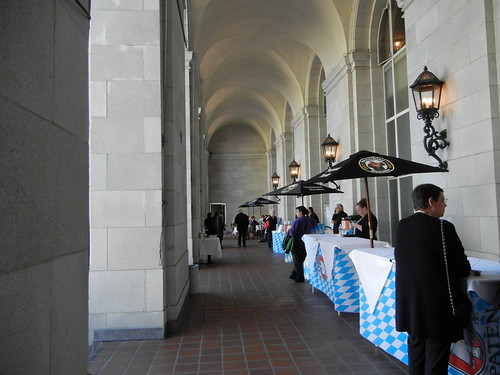
Biergarten on the balcony

San Francisco Opera Ring Cycle  2011 Das Rheingold _ 3478
Where the scenery machines are

San Francisco Opera Ring Cycle  2011 Das Rheingold _ 3487
Two and an half hours later

Related articles:
Part 4, Götterdämmerung - Premiere of Wagner's Ring Cycle at San Francisco Opera
Part 3, Siegfried - Premiere of Wagner's Ring Cycle at San Francisco Opera
Part 2, Die Walküre - Premiere of Wagner's Ring Cycle at San Francisco Opera
My Experiences with Wagner's Operas
Tuesday, June 14, 2011

My Experiences with Wagner's Operas
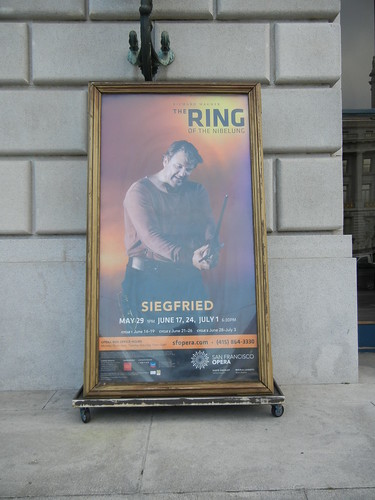
Tonight, the eagerly awaited new Francesca Zambello production of Richard Wanger's Der Ring des Nibelungen will be presented as a cycle for the first time, in San Francisco Opera (SFO)'s home theater War Memorial Opera House.  I am eager to experience the sound waves conjured up by the most wonderful Wagnerian conductor active, Donal Runnicles, the former Music Director of SFO, and hear the amazing singing of Nina Stemme's Brünnhilde.

I have seen the first and second installments of this new production in previous seasons and am looking warding to experiencing my first ever Ring as a cycle.

By the end of the Ring Cycle, I would have seen all mature Wagner operas but one - Lohengrin, which I had thought as the very likely candidate for my first ever Wagner experience, because it was most popular, most lyrical, most accessible, most italianate and less expensive.  But fate determines otherwise.  Lohengrin will come to San Francisco in October and November 2012, and surely it will be conducted by current Music Director of SFO, Nicola Luisotti.  That means I would have heard all mature Wagners conducted by Runnicles except for Lohengrin.  Regrettable.  Very regrettable - even though this does not mean Luisotti's Lohengrin would be bad.  Just not by Runnicles.

My very first live theater Wagner experience, instead of Lohengrin, was Parsifal, his final work, a ceremonial piece can be very static and boring.  But that afternoon, was one of the most exciting theater experiences of mine.  The music was incredibly hypnotic and the singing was most excellent.  The staging, a modernist, in a post apocalyptic setting, was both beautiful and devastating.  I truly enjoyed the tenor, Christopher Ventris as Parsifal and soprano Catherine Malfitano as Kundry, a female wandering Jew character.  However, my standing ovation went for the German bass Kurt Moll, who sang Gurnemanz, and make his often tedious long soliloquy incredibly flowing, eloquent and moving.  His deep voice rolled out and filled the vast hall like the resonant of rich bell.  It was a vocal phenomena seldom experienced.  The villain Klingsor was sung wonderfully by Tom Fox.  Malfitano was a wonderful actress and her struggling out of cocoon was hard to forget.  Equally unforgettable was the agonize of the old king Titurel and menacing knights against their over lord Amfortas to unveil the holy grail despite the physical pain it caused him.

Another most memorable Wanger night was not in SFO but in San Francisco Symphony.  It was a semi-staged Der fliegende Holländer, conducted by Michael Tilson Thomas (MTT).  The abstract sails adorned the concert hall and the music waves whipped up by MTT was overwhelming.  The Senta was sung by once reining Brünnhilde, Jane Eaglen.  When she sang that role here more than 10 years ago, I wasn't ready to commit myself to the vigorous demand of a Ring and also missed Deborah Voigt as Sieglinde, and the Wotan of James Morris.

The singing was decent enough that night but not at the same level as that of Parsifal.  But that Parsifal was a legendary afternoon and this was mere excellent.

I also saw Der fliegende Holländer at SFO, featuring Nina Stemme as Senta, in a very weird production, the sort alienated former General Director Pamela Rosenberg, whom I was suspicious of at the beginning and loved and missed dearly in the end.

Before Rosenberg's arrival, I saw Wagner's only comedy, Die Meistersinger von Nürnberg, in a very attractive traditional production and the long afternoon went rather briskly.  The young couples were attractive, Robert Dean Smith and Janice Watson as Walther and Eva, Catherine Keen and Michael Shade as Magdalena and David.  Main character Hans Sachs was sung capably but somewhat routinely by the great James Morris.  The most wonderful singing and acting came from Thomas Allen, a renowned Eugene Onegin and Don Giovanni, in an against-type role of Beckmesser and René Pape as Pogner, Father of the heroin Eva.

Rosenberg presented a David Hockney production, Tristan und Isolde, with Thomas Moser and Christine Brewer in the title roles.  Fascinating night and wonderful music making.  Unfailingly great conducting from Runnicles and wonderful singing from Moser and Brewer.  Brewer has been called a great Wagnerian soprano of our generation but the maddening fact is that she has sung very little of Wagner despite her obvious talent.  So far, the only staged Wagner operas she has sung was this Tristan und Isolde.  She was engaged by the Metropolitan Opera for Brünnhilde in their now retired production but had to cancel due to knee surgery.  So far, her diary shows no plan of any Wagner opera and that is a shame.

The current Music Director of SFO, David Gockley, surprised me with the presentation of Tannhäuser, in a rather daring production, debunking my suspicion of his being too conservative and too timid.  The evening was dominated, properly by tenor Peter Seiffert in the title role, along side with Runnicles, needless to say.

Then came the new Zembello Ring Cycle.  She is a director I admire but do not love.  I found her ideas often are intriguing but less daring.  The Rheingold had good moments, particularly the scary miner scene but otherwise largely disappointing.  The Rheinmaiden scene was not beautiful or magical, the cruise ship entrance to Valhalla was a let down and the sputtering thunder of Donner was comical.  The characterization of the main gods were wrong as well.  They seemed weak already at the beginning of the Cycle.  The downfall of the great is a tragedy.  The downfall of a dwarf is not.

The best singing came from Stefan Margita as the oily Loge.  Mark Delavan's Wotan and Jennifer Larmore's Fricka were all right but not very impressive.  Larmore was famous for Rossini and Baroque repertoire and it was very startling to read her name in the cast list.  Apparently, her voice or her ambition has changed so much and she has been engaged to sing the notoriously difficult Lady Macbeth in Genève next year.

Last season, I heard Die Walküre, repeating the experience of some wonderful and some awkward moments as in Das Rheingold.  I dislike the video projection during prelude or overture very much.  Everything the visual images were trying to say, one could hear in the notes.  They were purely distracting.  Act I stage image was not good.  When Siegmund and Sieglinde embraced, the full moon at the background was quite juvenile.  The Ride of the Valkyries was excitingly staged but I am not taken by the Amelia Earhart garbs.  I also find the confrontations between Wotan and Fricka, Siegmund and Brünnhilde less well presented.  Fricka was still too much a shrew in the former, and in the latter, it was distracted by dreaming-walking zombies in the background.

The singing was wonderful - Siegmund (Christopher Ventris), Sieglinde (Eva-Maria Westbroek) and Fricka (Janina Baechle) were all great and above all Nina Stemme (Brünnhilde).  The Wotan by Mark Delavan was honorably sung but not a great one.

The third and fourth installment of this new production, Siegfried and Götterdämmerung, have both been premiere several days ago to rave reviews. 

We are to have a new Siegmung, Sieglinde and Fricka.  I am eager to hear Anja Kampe's Sieglinde and feel sorry to have to miss Heide Melton's assumption in Cycle 3.  I don't have stamina for two cycles.  My consolation is that I would hear Melton's glorious voice at least in the role of Third Norn.  I was eager to hear the originally announced Frick of Larissa Diadkova, whom I'd heard as a shattering Amneris in Aida at SFO, but she had canceled due to personal reasons.

Alas, a ring can never be perfectly round.


Related articles:
Part 4, Götterdämmerung - Premiere of Wagner's Ring Cycle at San Francisco Opera
Part 3, Siegfried - Premiere of Wagner's Ring Cycle at San Francisco Opera
Part 2, Die Walküre - Premiere of Wagner's Ring Cycle at San Francisco Opera
Part 1, Das Rheingold - Premiere of Wagner's Ring Cycle at San Francisco Opera