Showing posts with label San Francisco Ballet. Show all posts

Saturday, May 4, 2013

Christopher Wheeldon's Brilliant Cinderella at San Francisco Ballet

Yesterday, San Francisco Ballet (SFBallet) presented the US Premiere of Christopher Wheeldon's new ballet, Cinderella, to the music by Sergei Prokofiev.

Prokofiev's score was enchanting and often ravishing; however, that does not guarantee a success - many years ago, I sat through a very dull Romeo and Juliet, set to his brilliant score, in the same War Memorial Opera House, presented by the usually glorious SFBallet.  Based on that experience, I appreciate a good choreography and staging much more.  Ballet is more than flawless steps and beautiful music, it also needs to be a good theater and tell a coherent story.  Therefore, we must be grateful to Mr. Wheeldon for creating this magical new ballet, which was co-commissioned by SFBallet and Dutch National Ballet, who presented the world premiere in Amsterdam last December. According to the program, Wheeldon created this ballet working with dancers from both companies simultaneously, having one company's dancers visiting other company to rehearse and incorporating their thoughts into the creative process.

Christopher Wheeldon is an English international choreographer of contemporary ballet. In 1991, Wheeldon joined the Royal Ballet, London; and in that same year, he won the Gold Medal at the Prix de Lausanne competition. In 1993, at the age of 19, Wheeldon moved to New York City to join the New York City Ballet. Wheeldon began choreographing for the New York City Ballet in 1997, while continuing his career as a dancer. He retired as a dancer in 2000 in order to focus on his choreography. In recent years, he had emerged as one of the very best ballet choreographer of our time. 

This new Cinderella was not as grand as those old Russian Imperial story ballets by Marius Petipa, or as glistering as abstract ballets by George Balanchine.  Its style though grand at time, was predominantly intimate, warm, consoling, and also fun and hilarious.  It rooted deeply in classical ballet tradition, but was also thoroughly modern, in its new twist of the story and characters, and the steps and gestures of modern dance incorporated organically into the classical ones by Wheeldon, and with the modern stage crafts.  However, as inventive and wonderful it was, there was a bit of wanting in the transcendent dancing.  Perhaps the production was more successful in terms of theater than pure dance.  Sadly, this is more or less the norm nowadays.  Maybe next Alexei Ratmansky's all Shostakovich ballets in next season will brought us back the the glory similar to The Jewels by Balanchine. 

This production was heightened by the amazingly animated living breathing tree, which grew up from the grave of Cinderella's mother, by the famous San Francisco born, New York based puppeteer, Basil Twist, who had created some unforgettable effects for plays, operas and ballets.  It was a character in its own right, grand, magical and flashy, but readily to yield to the dancing characters in due time.  The whole show was an enveloping smile-inducing enchantment.

Below is a video trailer posted on SFBallet's website:


Since yesterday was the US premiere, there was much excitement.  Before the show, apparently there was a party and you can see some one dressed up to the ninth arriving at the opera house, waited by uniformed crew by the entrance:
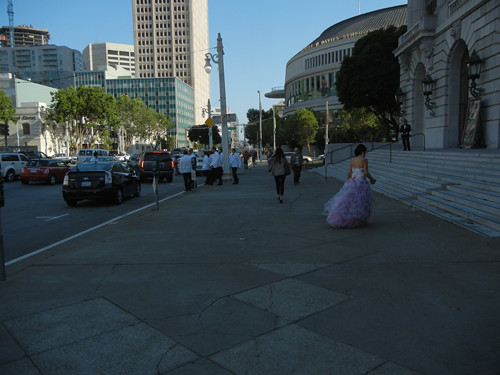
US Premiere of Cinderella by Christopher Wheeldon, San Francisco Ballet, 3 May 2013 _ DSCN6669

Besides the ball, there was the usual "Meeting the Artist" event before the show, and the principal dancer Rubén Martín Cintas was interviewed.  Cintas would dance the role of Cinderella's father in several performances during this run.

US Premiere of Cinderella by Christopher Wheeldon, San Francisco Ballet, 3 May 2013, Meet the Artist Rubén Martín Cintas before the performance _ DSCN6682
Meet the Artist Rubén Martín Cintas before the performance  

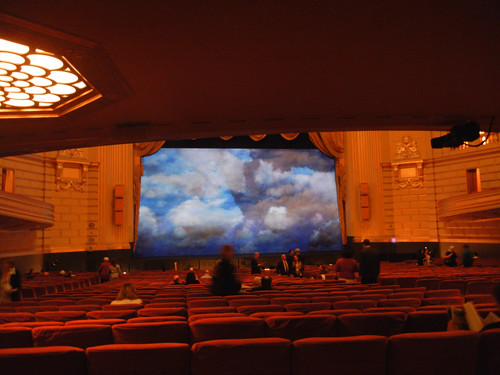
US Premiere of Cinderella by Christopher Wheeldon, San Francisco Ballet, 3 May 2013 - _ DSCN6689
Theater curtain before the performance

All the principals dance superbly and despite the drawback that he was not as personally endearing as Taras Domitro, who as the Prince's friend Benjamin was the personification of innocent charm and noble grace, Joan Boada won us over with his precise steps and his understated ardor, and his final pas de deux with Cinderella was sublime. Maria Kochetkova's Cinderella was strong, not easily cowed, and always understanding, forgiving.  Her Cinderella was also full of life and was a fun person to be with despite much adversaries in her young life.  Kochetkova's dancing was joyous, though not overtly extravagant and that suited Boada's Prince perfectly.  The main pairs' collective strength was their deep understanding of each other and life, and the understatement of their personality and performance.

Outright brilliance, though necessarily silly time to time, belonged to the stepmother and the two stepsisters.  I was very grateful that they were danced by brilliant and beautiful ballerinas, whose ugliness lay mostly in their actions, rather than often caricatured looks in many other productions, in which they were also often danced by men in drags.  Here, they danced their outrageous and intricate silly and fun steps, particularly those of the daughters, brilliantly by Katita Waldo, Sarah Van Patten and Frances Chung.  Chung's character of the younger stepsister Clementine was bullied into being a mean sister to Cinderella and once she found her young love in the adoring and adorable Domitro's Benjamin, she emerged a very sympathetic figure and won our blessing for her good fortune.  As for the tougher sister Edwina, we can see that she would step into her mother's shoes more easily than those of Cinderella's.

The audience was absolutely enchanted by the performance and had to fight against the urge to applaud ever so often, because the musical and choreographic structures demanded a continuous flow.  At the end of each of the three acts, audience was truly gratified for the opportunity to cheer prolongedly.

US Premiere of Cinderella by Christopher Wheeldon, San Francisco Ballet, 3 May 2013 - Lit City Hall _ DSCN6705
City Hall, seen from the balcony of the opera house during the intermission
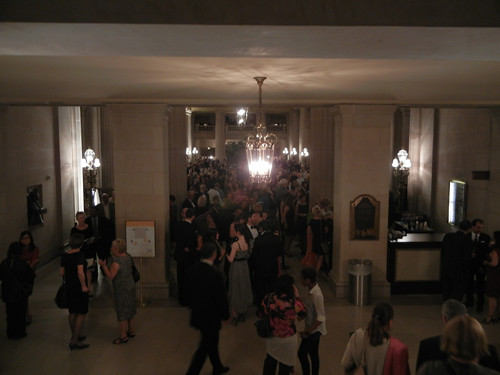
US Premiere of Cinderella by Christopher Wheeldon, San Francisco Ballet, 3 May 2013 - Intermission _ DSCN6712
Excited crowd during Intermission

Here are some images of last night's curtain calls:
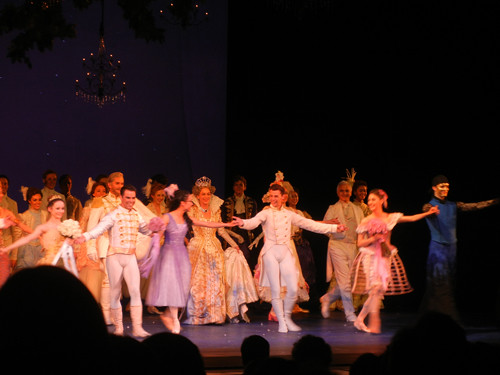


US Premiere of Cinderella by Christopher Wheeldon, San Francisco Ballet, 3 May 2013 - Curtain Calls _ DSCN6717
Curtain call of the principal dancers - Maria Kochetkova, Joan Boada, Frances Chung, Taras Domitro and Sarah Van Patten

US Premiere of Cinderella by Christopher Wheeldon, San Francisco Ballet, 3 May 2013 - Curtain Calls _ DSCN6723
Curtain call of the choreographer Wheeldon and production team


SFBallet announced that "All Performances SOLD OUT! Limited standing room tickets are available. There will be no rush tickets sold for this production."

Catch it if you can.  Or do yourself a favor and try to see it next season, which will include another run of this enchanting work.


Related posts on Art · 文化 · Kunst
- Teatro La Fenice di Venezia (La Fenice Theatre in Venice)
- San Francisco Ballet Banners
- Three-Course Cultural Feast - Tetzlaff, Amour and Nijinsky
- San Francisco's Swan Lake
- Rethinking Hans Christian Andersen's "The Little Mermaid"
- Theater Experiences in Wien (Vienna)
- High Romanticism - German Tenor Jonas Kaufmann's Recital in Berkeley
- Angelic Voice - Philippe Jaroussky at Hertz Hall, UC Berkeley 

Tuesday, February 19, 2013

Three-Course Cultural Feast - Tetzlaff, Amour and Nijinsky

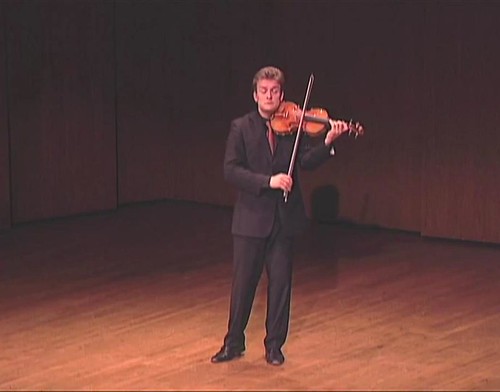
Last week, I attended three incredible cultural events - two live performances and one cinema, all were very stirring and thought-provoking in their distinctive ways, starting with a relative becalming night at Berkeley's First Congregational Church, on February 12, Tuesday, a solo violin recital by German artist Christian Tetzlaff, under the aegis of  Cal Performances.

Several years ago, I had heard Tetzlaff performing Brahms' Violin Concerto with San Francisco Symphony and was deeply impressed by his austere musicianship and for this recital, he offered something both familiar and more readily accessible, to me, (Bach and Ysaÿe), and something off the beaten track and more challenging (Kurtág and Bartók.  Of these music, I found Kurtág and Bartók most satisfying, perhaps due to the unfamiliarity and my joy of hearing these strange music fresh.  Kurtág's music consisted of strings of short fragments but very eloquent and coherent, and quite lyrical  Tetzlaff's virtuosity of playing these challenging music was extremely impressive, yet, what impressed even more was the stylistic accomplishment he demonstrated for the entire evening, and his seriousness, his unflagging concentration and intensity, though his playing was not without lighthearted humor at the appropriate moments.  He produced beautiful and sweet, and sometimes very unusual tones but these sounds all served a purpose, the coherent statement of the music.  His piano, pianissimo playing would live on forever.

The programed pieces he played were:
  • Eugène Ysaÿe - Sonata for Violin in G minor
  • György Kurtág: "A choice" out of Signs
  • Johann Sebastian Bach - Sonata for Violin in C major
  • Béla Bartók - Sonata for Violin
After the exhilarating but somewhat challenging program (even for some audience), he awarded us with a flashy Paganini 16, which and the lullaby of the “Heartbeat” movement from Bach’s A-Minor Sonata.

As for me, I'll start to listen to Kurtág when I paint.

Christian Tetzlaff plays Bach

On Friday, I finally made time to see the much talked-about film Amour written and directed by Michael Haneke, who had made many unforgettable films such as Caché, The Piano Teacher, and The White Ribbon.

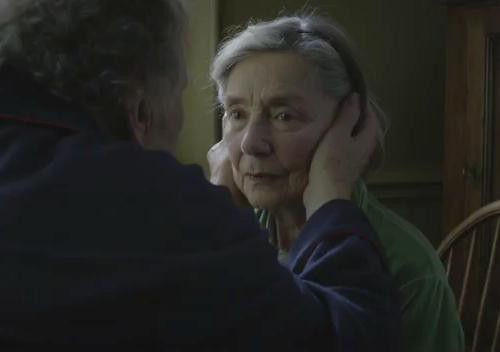
Amour, a story on love and death, was a beautiful movie, confidently made and very difficult to watch.  It stared at the difficult situation one is bound to face at certain time, unflinchingly, and the result was wrenching but not depressingly so.  We took comfort in the humanity and obvious love the main characters, a cultured old Parisian couple, demonstrated in front us, gesture by gesture, syllable by syllable.

Amour by Michael Haneke

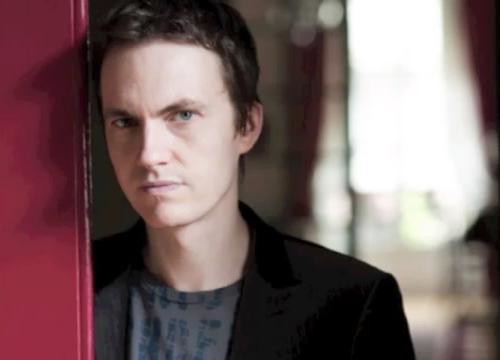
Since the main character was a piano teacher, we had several glimpse of her star pupil, the real-life great pianist, Alexandre Tharaud, who played himself in a very natural way and I kept wondering if this was his life story or not but was reluctant to find out.  One way or another, it wouldn't change the perception of this great movie about love and death in old age.  And if it was not Tharaud's teacher's story, it would be other people's stories. 

Was the movie depressing?  No.  Disturbing?  Yes; but a must-see.

Alexandre Tharaud in Amour

On Sunday, 17th, I dived into one of the most disturbed mind and heart of a great dancer - Vaslav Nijinsky, via the modern ballet by John Neumeier, who had created many modern classics and was touring with his Hamburg Ballet, as part of the regular season program offered by San Francisco Ballet.

I was very grateful to be able to see any full-length ballet created by John Neumeier.  If his ballets were not as pure balletic as those from Imperial Russia, they were unfailingly probing and intense, such as his dark-hued The Little Mermaid presented in San Francisco several seasons before.

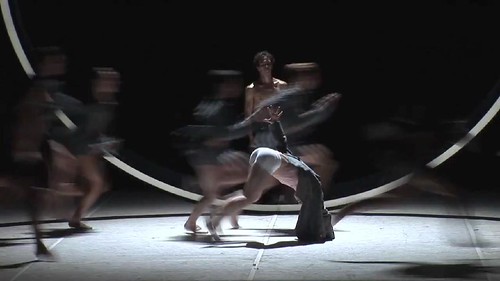
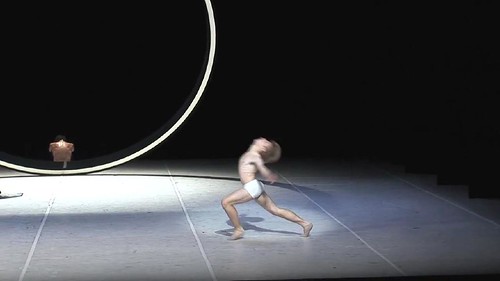
The first act of the ballet mostly concentrated on Nijinsky's life and creative experience, with many of his famous roles invoked by various dancers, juxtaposing with important people in his tumultuous relationships.  It was often amusing but somewhat prosaic.  Act two led us into his troubled inner world, with his mind descending to madness while the exterior world was a living hell of World War I.  I found the corps of soldiers and the solo turns of the pathetic Petrushka unbearably moving.  Another great creation was the shadow of Nijinsky (in white brief in the pictures below), whose surreal, insistent and twisted presence put both Nijinsky and the audience on edge.  The hallucination went on and on and I was utterly exhausted and became impatient for it to be over, despite the amazing dance on stage.  The gesture and motif did become repetitive and eventually monotonous.  Perhaps, that was by design?  The music of Chopin, Schumann, Rimsky-Korsakov and Shostakovich were played with thrilling brilliance.

Nijinsky by John Neumeier - Hamburg Ballet in San Francisco 3
Nijinsky by John Neumeier - Hamburg Ballet in San Francisco

Nijinsky by John Neumeier - Hamburg Ballet in San Francisco 2
Nijinsky by John Neumeier - Hamburg Ballet in San Francisco

What an exhaustive week, and what an extraordinary week. 


Related posts on Art · 文化 · Kunst:
- Angelic Voice - Philippe Jaroussky at Hertz Hall, UC Berkeley
- High Romanticism - German Tenor Jonas Kaufmann's Recital in Berkeley
- A Striking Film - "The White Ribbon"
- Rethinking Hans Christian Andersen's "The Little Mermaid"

Sunday, February 6, 2011

Story Ballet or Not?

Yesterday, I attended San Francisco Ballet's performance of three pieces - two established masterpieces and a new commission work's world premiere run.  The former two are Symphonic Variations choreographed by Frederick Ashton, set to music by César Franck, and Symphony in C choreographed by George Balanchine, set to music by Georges Bizet.  The new work was RAkU, choreographed by Yuri Possokhov and set to a commissioned score by Shinji Eshima. 

It was a richly rewarding afternoon at the theater.  Many years ago, after attending a gala performance by the visiting Bolshoi Ballet, I decided not to attend any plotless ballet performances.  However, I was persuaded to attend a performance of Balanchine's Jewels and concluded not I was not against plot-less ballet, rather I did not like gala performances of highlights from various works and seemingly randomly grouped together to earn applause.  That kind of demonstration seems brainless and purely showy.

A well choreographed abstract ballet, however, can convey a full spectrum of drama and emotions and without the fussy trapping of background stories and sometimes obligatory mime to move plot along, they can be even more evocative and satisfying, such as these two abstract pieces, particularly the Symphony in C.  Tiit Helimets led large cast in both pieces and was truly godlike, either in movement or stood still.

This said, I still love see dance as drama, therefore, I still love story ballet and was eager to be satisfied by RAkU.  It was an intense piece and wonderfully danced by Yuan Yuan Tan, Damian Smith, and Pascal Molat.  The music was very dramatic and intense, as well as haunting and beautiful.  The scenery and costume design were superb as well.  The choreography was good, except for a couple rather cliched hand gestures assigned to the love-mad monk who set a temple on fire.  What was less than fully satisfying was the story.  The plot was not clear as if the princess returned love to the monk or not and what triggered the final dénouement. The timing of the appearance of the Prince's ash was when the confusion started.  If it appeared a bit early or late, it would have cleared the plot very much and added layers of human emotions, follies and fragilities.  As it is, it was not a story well told and reduced the psychological insight.

If tell a story, it must be well told.  Otherwise, abstraction would be preferred.

That said, I'm eager to attend Winter Dreams and Coppélia later this season.

Monday, March 29, 2010

Rethinking Hans Christian Andersen's "The Little Mermaid"

little meraid

Last night, I attended the last performance of San Francisco Ballet’s “The Little Mermaid” of this season.

The Little Mermaid was choreographed by Hamburg Ballett Director and Chief Choreographer John Neumeier, which was a rethinking of of Hans Christian Andersen’s 1836 tale by the same name. It completely discarded the saccharine cobwebs deposited by Disney machine. Instead, it was a stark and even brutal take of the incomprehension between clueless outsiders and oblivious insiders, and the sorrow of unrequited love.

There was a new character - The Poet, who, like his creation the Little Mermaid, was hopelessly in love with his friend/Prince. The characters of the Prince and the Princes were a little opaque and less sympathetic than one expected, which seemed have robbed the pathos and nobility of Little Mermaid and The Poets's love. Their love for The Prince seemed more foolhardy. Perhaps this was precisely the truth of modern time.

There were fantastic performances from five principal dancers - Yuan Yuan Tan (Mermaid), Tiit Helimets (Prince), Sarah Van Patten (Princess), Damian Smith ( Poet) and Davit Karapetyan (Sea Witch). Tan has always been amazing in modern works and this otherworldly creature showcased her talent like no other roles. The moment she discovered her legs was astoundingly virtuoso and her devastation after the wedding and her failed attempt to kill the Prince rended one's heart. Helimets was every bit of a prince, but I was not sure about the golf club and golf ball he was made attached to. In a vague sense, it reminded me of the bow in Swan Lake. But the bow led to his discovery of the Swan Queen yet here, it served as a comic macho bravado and insensitivity. Another sign of modern time? The Princess was neither good nor bad, simply a pale creature. Despite the limitation of the role, Van Patten lend her grace to the stage. As the lovelorn Poet, Damian Smith created a character full of agony and sense of inferiority yet never lost his dignity. Karapetyan was appropriately monstrous and scary.

In the end, he and his creation (The Little Mermaid) found strength in each other and entered a higher plane of spirituality.

The music by Lera Auerbach was vividly colorful. During the intermission, for a brief moment, I thought the musicians in the pit was practicing for Prokofiev's Romeo and Juliet.

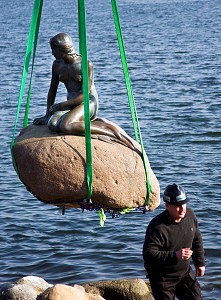
Incidentally, the bronze statue of the little mermaid was removed from the shore in Copenhagen on March 25, 2010 heading to the Shanghai World Expo.

According to the program, this story of Andersen was very autobiographical. Therefore, this universal love of the Little Mermaid is the evidence of power of the transcendent creation.

Little Mermaid

This ballet was commissioned to commemorate the 200th anniversary of the birth of Andersen. The US premiere of it was highly anticipated and extremely well received. Let's hope that San Francisco Ballet will bring it back in the future seasons.

Monday, January 25, 2010

San Francisco's Swan Lake

Yesterday afternoon, I attended the matinee performance of Swan Lake at San Francisco Ballet. This version was was choreographed by artistic director Helgi Tomasson and was debuted last season. San Francisco Ballet's website states:
Artistic Director and Principal Choreographer Helgi Tomasson’s Swan Lake, which debuted to sold-out houses last season, receives an encore presentation in 2010. Featuring lavish costumes and scenery and Tchaikovsky’s breathtaking score, this timeless story of transcendent love showcases the depth of the Company, from its principal dancers to the corps de ballet.
The principal dancers are Yuan Yuan Tan, Casey Held (guest artist from Het National Ballet in Amsterdam) and Damian Smith, all proved elegant, powerful and expressive. Soloist Hansuke Yamamoto stepped in for principal dancer Vitor Luiz in the Peasant Pas de Trois and he and partners displayed an amazing bravura and playfulness. It seemed to me the biggest number of the afternoon, and seemed no other numbers lasted as long and the proportion of the ballet seemed strangely realigned. Cygnet episode was blessedly not too cute.

The performance was swift and moving and the live music was full of life and colors. Yet, it was not completely successful. The mixed period costumes, though nice to look at, confuses. Rotbart had not much to do and the Tutor and his by play with children was embarrassingly silly. The famous 32 fouettés en tournant was reduced to 25. Most damaging, however, was during the palace scene when a huge staircase took over the half-upstage and the dancers could only dance in drastically reduced area. At the end of that scene, the staircase rose rapidly. The production team really should have lifted it up after majoy entrances are finished and cede the floor to the dancers as soon as possible. Another thing was not right to me was the way too literal projections of swans, be on the lake or in the sky. It took the magic off the show.

The prologue, mimed out in front of scene curtain was again, very pedenstrian and it should either more stylized or cut off altogether.

The production is big, but not emotaionlly grand. It is new but nothing really re-imagined.

According to San Francisco Chronicle's review of Saturday's performance,
Tomasson's staging strips the mime passages down to the barest minimum. This withholding of motivation and suppression of context imparts a "greatest hits" aura to this "Swan Lake" that seems to rebuke the entire narrative tradition. Despite the fact that this version runs over 2 1/2 hours, it seems terribly rushed.
All those said, I would not hesitate to recommend this production. The last performance will be at 2:00 pm on 31 January.

Another highly expected production is the U.S. premiere of Little Mermaid by John Nuemeier, an American active as Director of Hamburg Ballet. The music is by Lera Auerbach. According to SF Ballet's website, Little Mermaid

Featuring an original commissioned score by renowned composer Lera Auerbach, Neumeier’s contemporary version of The Little Mermaid is a haunting tale of two divergent worlds: the serenity and simplicity of underwater life and the complex, often flamboyant lives of humans. The mermaid heroine travels through both worlds, enduring torment because of her committed love for a prince—but through her own strength in the end—transcends.

Please Note: This critically acclaimed production focuses on the deeper, mature themes of the original story and is not recommended for younger children.

The performance dats are from 20 March through 28 March. Don't deny you the chance to see the ballet by the one of the most exciting living choreographers.