Monday, July 12, 2010

First Time Italian Renaissance Sounded in My Ear

The first time I heard the pronunciation of Italian Renaissance (in Chinese) with my own ears was a watershed moment for me.

I had read about Renaissance at that time but this word had never entered into the vocabularies of the people I had any conversation with. The sound of Italian Renaissance (Yi-Da-Li Wen-Yi-Fu-Xing Shi-Qi) sounded like the best wine to my years.

I was in elementary school but had been a veteran of museum and art exhibition going, thanks to my well-educated parents, and particularly my father, who was working in the province culture bureau, therefore, we were able to visit galleries, museums, movies, theaters, dances at least weekly, if not more. However, most of the exhibitions were in the line of socialist realism, which became boring rather quickly and I was never too enamored with sweaty steel mill workers or peasants. The relieves from all these are in the form of pastoral landscape and idyllic lies didn't really existed in then China, and those relieves soon grew into banality.

One can imagine how I responded when suddenly I was confronted with artworks (reproductions, alas) from Italian Renaissance time. It was a special exhibit hosted in Liaoning Province Fine Art Museum in Shenyang. I believe that the show was curated by Italian Culture Ministry and though all the works were reproduction only, mounted in lightboxes, like the advertising boxes we see daily now, they really shook me to the core at an impressible age.

Liaoning Gongye Zhanglanguan

Those images truly opened my eyes and I was absolutely smitten by masterpieces originated in Florence, Vatican, Rome, Padua, Milan, etc. Finally, I was gratified to know that beyond the banality existed something of true beauty.

At that humble time, I never thought that I might have chance to see many of these amazing works with my own eyes! Such as the Birth of Venus by Botticelli in Uffizi!
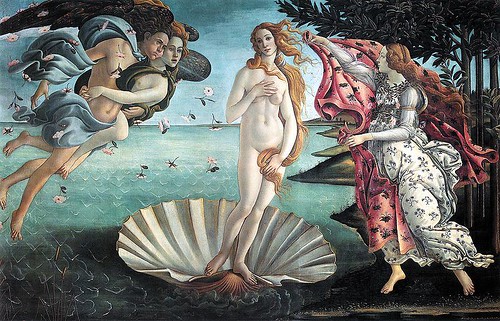
Birth of Venus, Sandro Botticelli, c. 1486
The Birth of Venus, c. 1486, by Sandro Botticelli, collection of Uffizi Gallery, Florence

Saturday, July 10, 2010

Scientific Art Authentication

A while ago, a allegedly Leonardo da Vinci drawing surfaced. It looked beautiful and if it was indeed done by Leonardo, then it was a sensational discovery and a happiest addition to the world art gallery. Its authorship was, however, disputed. But not long, a fingerprint was discovered on the drawing which matched a fingerprint on a proven Leonardo drawing. Case settled. Or did it?

Three days ago, I opened my new New Yorker magazine and was drawn to a long article:
The Mark of a Masterpiece - The man who keeps finding famous fingerprints on uncelebrated works of art by David Grann.

The beginning of the article related how the work was proven to be a Leonardo's work and briefed readers the process it was employed. Then, I saw the reproduction of the drawing. It was an excellent reproduction, much better then the ones I saw on newspaper before and online (another argument for keeping printing). I admired the drawing greatly and savored its beauty. However, I was suddenly disturbed by something I saw - though the draftsmanship was undeniably superb, something was off. The single braid of the figure, a beautiful young woman, had a strange spatial relationship to her shoulder and neck. Instead of in the middle of the neck, it was on the same plane as her left shoulder. It looked strangely out of place. I showed it to a writer friend of mine, and he said that it looked like two works pieced together. Anyway, this put serious doubts in my mind regarding the authorship of this still beautiful drawing.

Reading on, I realized that David Grann had doubts of his own and he proceeded to tell us his doubts and told us stories how the scientific authenticator, Peter Paul Biro, was suspected of planting fingerprints on other paintings he had authenticated.

It's not conclusive but enough doubts raised.

It was a fascinating article and reads like a detective novel.

But, the main argument I want to make here is not on the authenticity of the work - that should be left to Leonardo specialists who had or will have the opportunity to examinate it closely.

Instead, I want to comment on relying on science to determine an artwork's authorship and its value.

Instead of appreciating beauty, the scientific authenticator treated the art creation as a subject and whenever the authorship is established, the value of the work, market value, not artistic value too. This process is both precise and chilly. Even silly.

Granted, artists themselves are brandings and sometimes I am guilty of judging an artwork by its authorship too. But I have been trying to judge by what I see, how it pleases me. I am not shy of criticizing certain works by my favorite artists if I don't like, and will not hesitate to praise some better efforts by some artists I don't care for in general. Artists are not machines and they cannot create consistently masterpieces. Every work would be evaluated and assessed individually. This is not to say that a grade B Leonardo shouldn't be valued higher than a grade B second or third rate modern day artist. A Leonardo is a Leonardo which carries a special weight of history.

Scientific findings can help us to determine measurable facts, but not to determine values. And then there is pseudoscience. Neither genuine nor pseudoscience is a good judge on artistic achievements.

It is hard thing to be both subjective and objective in evaluating the artistic value of an artwork but it is also necessary. Do we need a scientist tell us what to worship? I don't.

Since I used this particular drawing as the starting point of my argument, I include the image of the drawing and several videos related to the process below:

La Bella Principessa - Attributed to Leonardo da Vinci (Italian, 1452-1519)


Monday, July 5, 2010

Artists in Movies, Plays and Operas

A new play - Red about painter Mark Rothko (1903-1970) was a recent hit in London and New York. Portraying artist, particularly painters and sculptors, particularly the working process, though easier than novelists, might be just as hard as portraying composers and poets.

Alfred Molina and Eddie Redmayne in Red at the Donmar Warehouse

However, there have been many successful efforts, particularly as motion pictures.

The most recent popular success was The Girl with Pearl Earring on Johannes Vermeer (1632-1675), both due to the wildly popular novel it based on and the mesmerizing beauty of Vermeer's work.

Another recent effort from France Séraphine portrayed self-taught French painter Séraphine Louis, known as "Séraphine de Senlis" ("Séraphine of Senlis") (1864-1942), who painted in naïve style. The movie garnered great reviews and definitely I will seek it out.

The most original and daring work to me is Caravaggio on the life of Michelangelo Merisi da Caravaggio (1571-1610) by the Derek Jarmin. His film was as sensual as the works of the master.

Other recent notables on the life of artists include

- Little Ashes on painter Salvador Dalí (1904-1989) and poet Federico García Lorca (1898-1936)
- Pollock on Jackson Pollock (1912-1956)
- Vincent & Theo on Vincent Van Gogh (1853-1890)
- Carrington about a British artist Dora Carrington (1893-1932)
- Hua Hun (Soul of Painting) depicted the strange story of a Chinese woman painter Yuliang Pan (1899-1977)
- Frida on iconic Frida Kahlo (1907-1954)
- The Agony and the Ecstacy about Michelangelo di Lodovico Buonarroti Simoni (1475–1564)
- Goya's Ghosts on Francisco José de Goya y Lucientes (1746 – 1828)

One of my favorite such movies was not a bio-pic rather a documentary on the philosophy and the process of the great artist Andy Goldsworthy (born 1956): Rivers and Tides: Andy Goldsworthy Working with Time

Lastly, the great German painter Matthias Grünewald or "Mathis" (as first name), "Gothart" or "Neithardt" (as surname), (c. 1470 – 1528) was created for operatic stage by composer Paul Hindemith - Mathis der Maler. The opera has not been presented as frequently as it should be but as least the melodic symphony Mathis der Maler is well known. Other painters in operas are the Tosca's lover Cavaradossi, Marcello in Puccini's La bohème and the Painter in Berg's Lulu.

Saturday, July 3, 2010

WYSI(n)WYG - What You See Is (Not) What You Get

An internet error added more spice to my argument that one must not always trust one's own eyes, as reported in my blog posted on 1 July, A Picture Is Worth a Thousand Words - However, Should You Trust It?

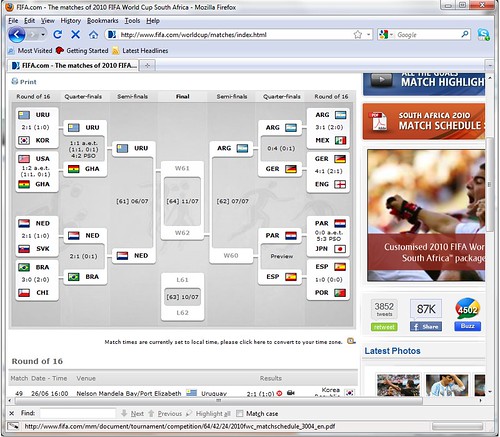
FIFA, the international governing body of football (if you insist, soccer), not only couldn't produce competent referees, failed on their website today as well. After Germany defeated Argentina in the quarter-final match (4:0), FIFA erroneously placed Argentina's flag as the team who advanced on its schedule page.

Of course, the mistake was corrected later on, but the evidence remains:

FIFA's Mistake

Sometimes, what you see is NOT what you get, shall we call it WYSInWIG?

David Malouf's "Ransom"

I just finished reading David Malouf's brilliant novel Ransom. It opened with the sadness and anger experienced by Achilles and King Priam after the death of Patroclus and Hector. The book then related the well know story from a new angle, telling how King Priam came to the decision to the the thing never done - to approach the killer of his son as a father, not a royal figure, and ransom for the body of his son. It described in vivid but economical details how he reached such decision and how he went on the night journey, accompanied by an old mule carter hired from the market. The story threw open window to the entrapped people (both Achilles and Priam and the people they represent, the Greeks and the Trojans) who tried to untie the knots history and gods bound them to, with comforting or tragic results. The book was short but it never felt slim rather epic and visionary in every way. The beauty of the languages make me chew them over and over, and I could hear music and see clear pictures at many turns of the phrases.

It is a perfect source material for a painting, or a cartoon for tapestries. I also believe that it can be a great foundation for an opera à la Benjamin Britten's Curlew River, sparse yet intense, orderly yet dissonant. Perhaps a composer like Hans Werner Henze (Die Bassariden, Das Floß der Medusa, Elegie für junge Liebende, L'Upupa und der Triumph der Sohnesliebe), Harrison Birtwhistle (The Mask of Orpheus, The Minotaur), or even Jake Heggie (Dead Man Walking, To Hell and Back, Moby-Dick) should take a look at this?

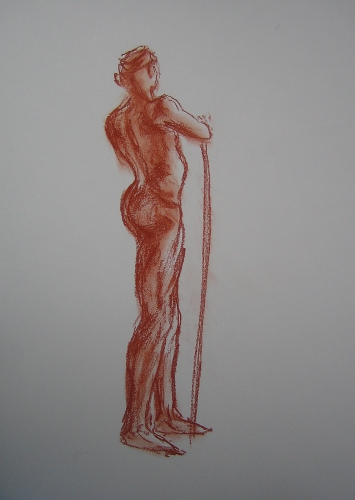
Matthew Felix Sun's Live Drawing_1373


Devastating Novel "The Land of Green Plums" by Herta Müller
Ashamed of Oneself - Reading Book "Never Let Me Go"
- Molotov's Magic Lantern: A Journey In Russian History by Rachel Polonsky and Some Journeys of My Own
- Review of "As Above, So Below" by Rudy Von B. Rucker
- Banned Books in Mao's China

Thursday, July 1, 2010

A Picture Is Worth a Thousand Words - However, Should You Trust It?

People used to say that "A picture is worth a thousand words". It is still valid, however, a hard question must be asked: "Should we trust it?"

Adobe has done itself pride in providing the best image processing and manipulating tools. Their newest version of Creative Suite is a true wonder. According the video embedded below, one can use it insert, remove objects at will, and bend the limbs or superimpose images in almost anyway you fancy. The tool is powerful for designers but can be deadly to journalism.

After viewing the video, I will never trust images put forth as newsworthy photos. In the past, I always approached images with careful deliberation. Now, it is on an entirely different plane.

Finally, we are entering the new monstrous era worthy of a Frankenstein, I'm afraid.

Thank you Adobe, and thanks a lot!