Showing posts with label Anniversary. Show all posts

Wednesday, August 4, 2010

SFMOMA's 75th Anniversary Show

SFMOMA is celebrating its 75th anniversary. My visit to the 75th Anniversary Show confirmed my impression of this important yet provincial institute.

SFMOMA has accumulated a relatively impressive body of works from many important artists but the depth is rather shallow. The main draw to the locals in this anniversary show mostly lie on their relatively unknown collections, such as a semi-abstract Pollock and a very early Picasso. Interesting works by Max Ernst, Paul Klee to Elmer Bischoff and Eva Hesse were included as well.

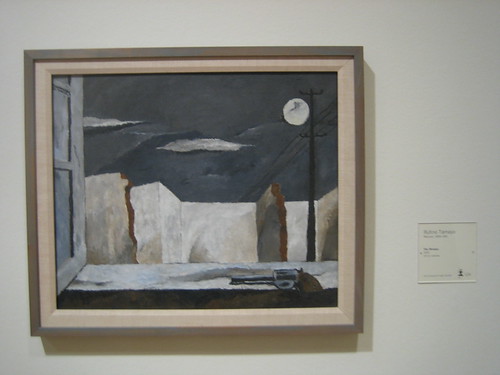
I love The Window by Rufino Tamayo below. The handing of the paint is masterly and the atmosphere was economically created. The pistol on the window sill added several layers of emotions.
IMG_6713
The Window, 1932, Oil on canvas, Rufino Tamayo 1899-1991

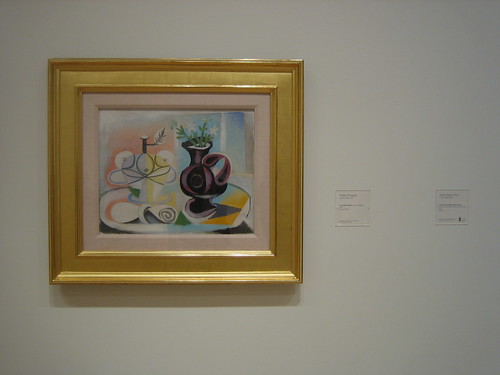
This piece of Picasso is quite whimsical and can be mistaken for a Matisse or a Paul Klee. Rather too decorative for my taste but is interesting to I'm still glad to learn that aspect of the Spanish master.
IMG_6714
La Cruche fleurie (Jug of flowers), 1937, Pablo Picasso 1881-1973

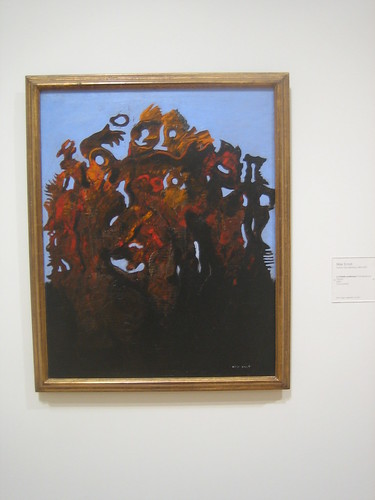
I haven't gotten much chance to see a Max Ernst and was delighted to encounter the La famille nombreuse (The Numerous Family). The twisted world can be applied to nowadays easily. The misery of human kind is timeless and universal.
IMG_6716
La famille nombreuse (The Numerous Family), 1926, Max Ernst 1891-1976

A dozen of small formatted Paul Klee from the Djerassi Collection were included and many of them are very beautiful indeed:
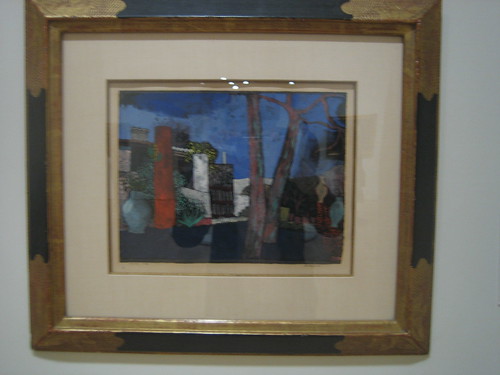
Mazzaró, 1924, Gouache and watercolor on paper mounted on board // 75th Anniversary Show, SFMOMA _6717
Mazzaró, 1924, Gouache and watercolor on paper mounted on board, Paul Klee 1879-1940
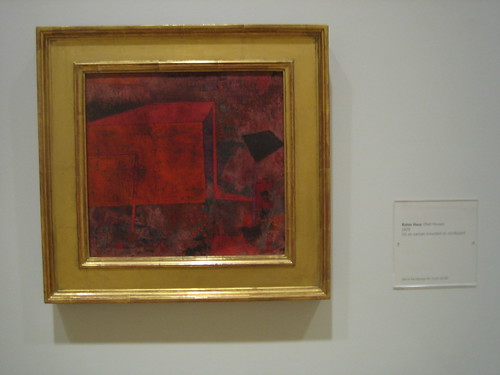
IMG_6719
Rotes Haus (Red House), 1929, oil on canvas mounted on cardboard, Paul Klee 1879-1940
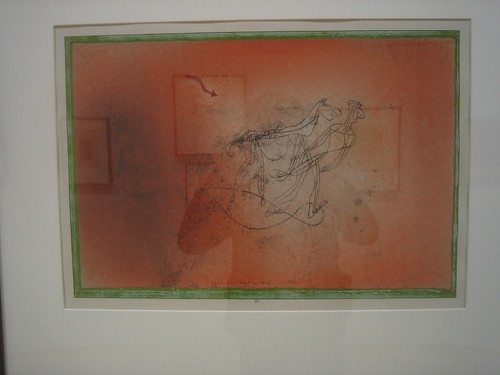
IMG_6721
Pferd und Mann (Horse and Man), 1925, Oil transfer, ink, and watercolor on paper mounted on board, Paul Klee 1879-1940

A painting by Clyfford Still almost constituted a companion piece the the aforementioned Max Ernst.
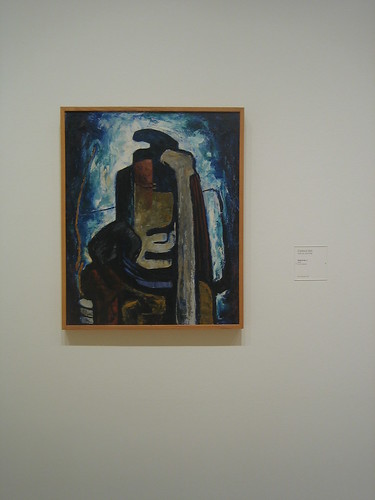
IMG_6725
Clyfford Still 1904-1980

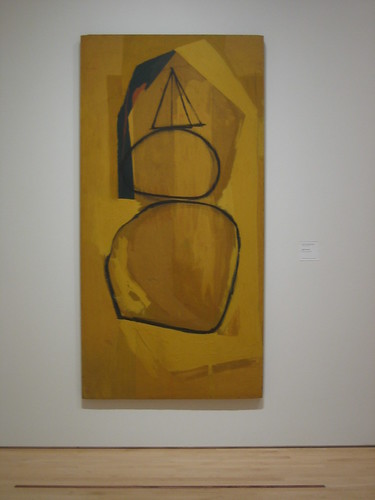
I usually don't care much for geometrical pattern play. But the piece by Robert Motherwell has much more to offer and the color palette was quick subtle and delicious. I love it very much.
IMG_6726
Untitled (Figuration), 1948, Oil and sand on Masonite, Robert Motherwell 1915-1991

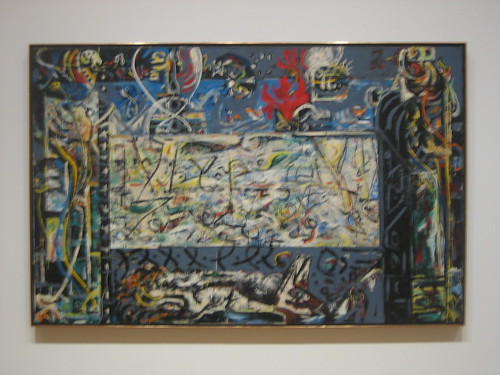
Jackson Pollock was represented by this semi-abstract work. It has a very rich palette which is quick different from what he was best known for. Yet, the universally accepted mastery of his later period didn't take of the luster of this earlier one.
IMG_6728
Guardians of the Secret, 1943, Oil on canvas, Jackson Pollock, 1912-1956

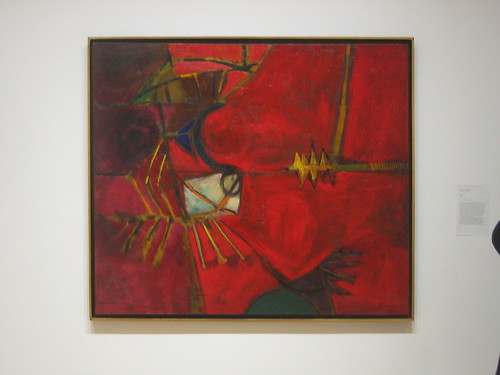
Elmer Bischoff provided us another rich painting. The vibrant and rich red colors were literally dancing in front of my eyes. However, the dance is not the kind of joyous expression. It was sliced and smudged by many bold and intrusive strokes. A world has gone mad again.
IMG_6731
Untitled, 1948, Oil on canvas, Elmer Bischoff 1916-1991

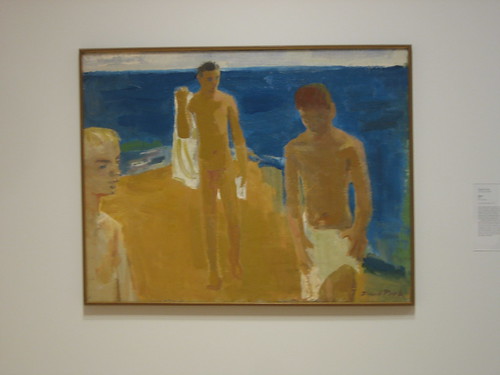
Coming out of Germanic gloom, we were comforted by idyllic seaside picture of The Bathers by David Park. The high view point, stylized figures and beautifully contrasted color blocks elevated this painting above hidden eroticism or pictorial pleasantry.
IMG_6736
Bathers, 1954, Oil on canvas, David Park 1911-1960

More stylized is the abstract sculpture by Eva Hesse. It is orderly yet free. It contains a universe. Dignified and sober. All Apollonian. Sans Dionysian?
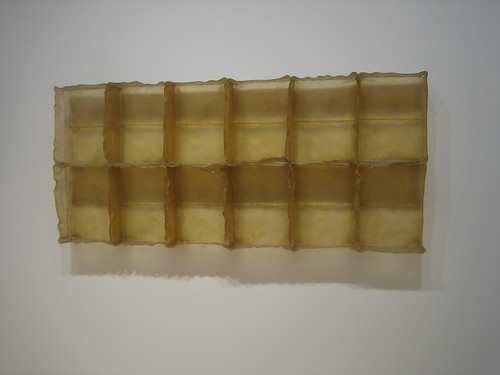
IMG_6737
Sans II, 1968, Fiberglass and polyester resin, Eva Hesse, 1936-1970

This is a very interesting survey of SFMOMA's endeavors over seventy-five years. With the addition of the amazing Fisher Collection, SFMOMA is poise to the a heavy weight amongst contemporary art museums.

Tuesday, August 3, 2010

Introduction to Fisher Collection and the 75th Anniversary Exhibit at SFMOMA

Last Saturday, I visited San Francisco Modern Art Museum for the Calder to Warhol: Introducing the Fisher Collection exhibit. There are 160 pieces from the 1,000 plus Fisher Colletions on display. There were many impressive works and the profile and prestige of SFMOMA will increase dramatically once a new wing is build for this incredibly rich modern art collection.

Several of my favorite artists are included and I am glad that I am able to share a sample of their works here:

IMG_6588
Alexander Calder 1898-1976

I love Agnes Martin's subtle sense. All her works exuded delicacy and mystique.

Night Sea, 1963, Agnes Martin // Calder to Warhol: Introducing the Fisher Collection, SFMOMA _6601
Night Sea, 1963, Oil and gold leaf on Canvas, Agnes Martin 1912-2004

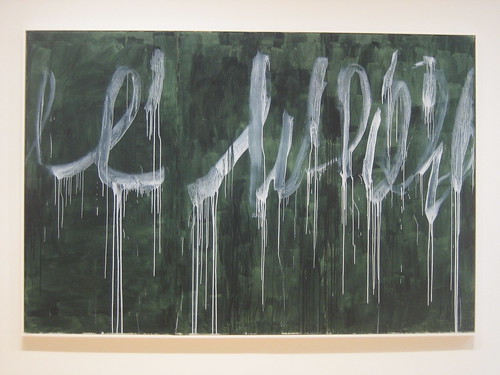
Cy Twombly's abstract paintings worked like landscape. The 1971 Untitled [Rome] demonstrated his mastery perfectly. The endless strokes of the crayon looped like layers and layers of grass and the shapes and depth of the work was simply amazing.

Untitled [Rome], 1971, Cy Twombly // Calder to Warhol: Introducing the Fisher Collection, SFMOMA _6611
Untitled [Rome], 1971, Oil-based house paint and crayon on canvas, Cy Twombly 1928-

IMG_6612
Note I, from the series III Notes from Salalah, 2005-7, Acrylic on wood panel, Cy Twombly 1928-

The explosive energy and great color harmony on Lee Krasner's Polar Stampede was incredible.

IMG_6602
Polar Stampede, 1961, Oil on canvas, Lee Krasner 1908-1984

Georg Baselitz, on the other hand, dazzled the viewer with brutal force and beauty.
Elke im Lehnstuhl (Elke in Armchair), 1976, Georg Baselitz // Calder to Warhol: Introducing to Fisher Collection, SFMOMA _6619
Elke im Lehnstuhl (Elke in Armchair), 1976, Oil on canvas, Georg Baselitz 1938-

Several large formatted works by Sigmar Polke were all amazing. I like the one below most:
IMG_6626
The Spirits That Lend Strength Are Invisible I (Tellurium Terrestrial Material), 1988, Sigmar Polke, 1941-2010

Though I was never a fan of Warhol, I had to concede that his Mao was incredibly rich and beautiful, made more disturbing by the subject of the work, the cr
Mao, 1972, Silkscreen ink on canvas, Andy Warhol, 1928-1987 // Calder to Warhol: Introducing to Fisher Collection, SFMOMA _6630
Mao, 1972, Silkscreen ink on canvas, Andy Warhol, 1928-1987

Several Richard Serra were included and the simplicity of the work below was the most beguiling.
IMG_6643
Richard Serra, 1939-

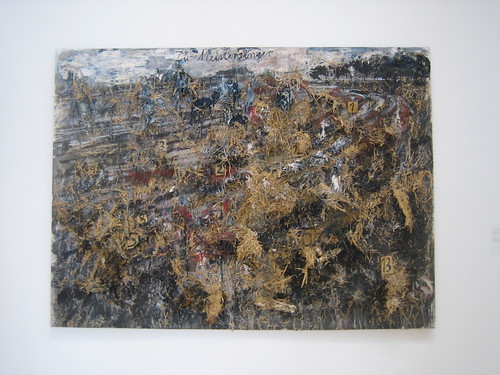
Lastly, I was treated by several large works by the great Anselm Kiefer. Amongst the living artists, Andy Goldsworthy creates a universe, while Anselm Kiefer decimates a universe. Every piece of his included was an incomparable masterpiece.

IMG_6650
Welundlied (Wayland's Song), 1982, Anselm Kiefer 1945-

IMG_6651
Die Meistersinger, 1982, Anselm Kiefer 1945-

Sulamith, 1983, Anselm Kiefer 1945-

IMG_6664
Unternehmen Seelöwe (Operation See Lion), 1983-84, Anselm Kiefer 1945-

IMG_6661
Margarethe, 1981, Oil and straw on canvas, Anselm Kiefer 1945-

There were also witty and whimsicle works. I love this sculpture in the cafe:
IMG_6694

Sometimes, visitors contributed to art creation:

Calder to Warhol: Introducing to Fisher Collection, SFMOMA -- Inspecting "Blue Green Black Red" by Ellsworth Kelly, 1996, oil on canvas _6639

Finally, I rate the most haunting piece as the eleven-minute video "Passage" by Shirin Neshat:


Passage, 2001, Single-channel video projection with sound, 11:30 min., Shirin Neshat, 1957-


The show ends on September 19, 2010. Don't miss it!

SFMOMA is also showcasing its own collection in their The 75th Anniversary Show. I'll discussion that exhibit in my later entry.

Monday, March 1, 2010

Frederick Chopin Museum Opened in Warsaw on His 200th Birthday


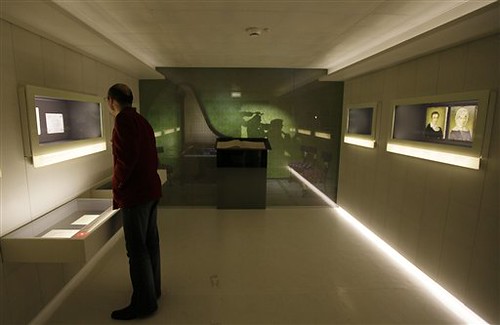
Frederick Chopin Museum opened today in Warsaw, on the 200th birthday of the great polish composer.

Amongst the artifacts, visitors can see the last piano that Chopin composed on, a death mask made after he died of possible tuberculosis and a lock of his brown hair.

The museum is located in the center of Warsaw, where infant Chopin moved in from a nearby country estate, and spent the first 20 years of his life before moving to Paris.

Many of the artifacts related to the romantic composer, such as letters were destroyed by women he was romantically involved with while others in the World War II.

Since 1899, Polish authorities has been gathering musical scores, sketches and other objects connected to Chopin, which are are priceless in terms of emotional value.

The museum is arranged thematically with spaces devoted to different aspects of his life. The final room is devoted to his death on Oct. 17, 1849 at age 39. It contains a plaster death mask taken of Chopin's face. On display are also invitations to his memorial service in Paris, as well as a lock of his brown hair treasured by his family.

The museum is housed in the stately Ostrogski Palace, home of the Fryderyk Chopin Institute, in the center of Warsaw.

Sunday, November 8, 2009

Wall and Wall

It is 9 November, 2009 in Berlin now. Twenty years ago, the Berlin Wall fell:


Today, the Great Wall still stands firm:


What a painful reminder it is to those who struggled and are struggling behind the bamboo curtain!