Showing posts with label Baroque. Show all posts

Saturday, June 30, 2012

My Favorite Paintings at the National Gallery (Schwarzenberg Palace) in Prague

I must confess that Prague itself was a living museum and the uniqueness and beauty of it overshadowed any artwork I saw in its museum.  However, it's National Gallery (Schwarzenberg Palace (Schwarzenberský Palác)) did collect some important and quite moving paintings, particularly those with dark and nationalistic works, documenting the endless struggle of the great nation.

The National Gallery in Prague had several locations, each host a specific group of collections.  Here in Schwarzenberg Palace, the collection was labeled as "Baroque in Bohemia - Permanent Exhibition of the Collection of Old Masters of the National Gallery in Prague".

Schwarzenberg Palace was a renaissance building, located near the Prague Castle, built between 1545 and 1576 for the Prague Count Jan Lobkowicz the Younger, and for that reason it was originally called the Lobkowicz Palace. The castle passed to the emperor then Petr Vok z Rožmberka, and the Schwarzenberg family, who owned the palace from 1719 until 1948.

My first favorite painting there is a diptych featuring four Saints - Wenceslas,Vitus, Sigismund and Adalbert, by Bartholomaeus Spranger (21 March 1546 – August 1611), a Flemish Northern Mannerist painter, draughtsman, and etcher.  The somewhat stiff poses of these saints gave these four figures an other-worldliness and timelessness.
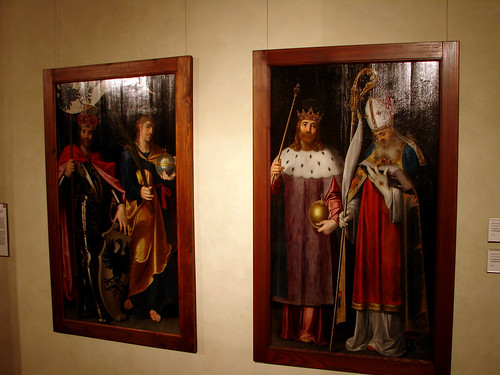

Saints, Wenceslas, Vitus, Sigismund and Adalbert (after 1585)
Bartholomaeus Spranger (21 March 1546 – August 1611)

My second favorite was "Portrait of a Man" by Karel Škréta (1610 – July 30, 1674), a Czech Baroque painter.  Though produced rather early, the verisimilitude of this work was quite astonishing and the contrast between light and dark created a symphony of light, though in a minor key.
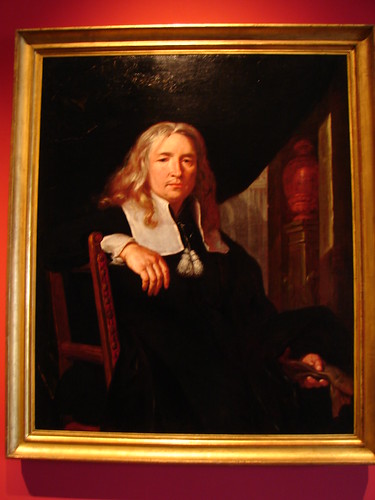
Portrait of a man (after 1640)
Portrait of a man (after 1640) 
Karel Škréta (1610 – July 30, 1674)

Finally, I must include a picture of the building - a marvelous palace with wonderfully characterful façade. 
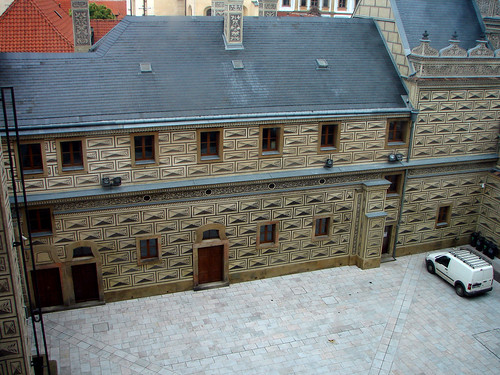
DSC01133


My Favorite Museum Collection Series

>> My Favorite Museum Collection Series 37: My Favorite Sculpture and Painting at Strahov Monastery, Prague
<< My Favorite Museum Collection Series 35: My Favoritate Sculptures on Karl's Bridge, Prague


List of My Favorite Artworks in the Museums I've Visited

Sunday, October 30, 2011

Angelic Voice - Philippe Jaroussky at Hertz Hall, UC Berkeley

Philippe Jaroussky,
2011 Misteria Paschalia Festival,
Kraków Philharmonic
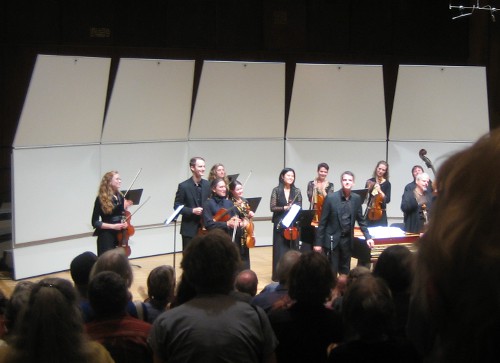
French countertenor Philippe Jaroussky joined Apollo's Fire, a Baroque orchestra founded in 1992 and based in Cleveland, for a concert of music by Handel and Vivaldi this afternoon as a Cal Performances presentation at Hertz Hall, University of California, Berkeley, in a journey through the gamut of human emotions, as experienced through the roles created for the great castrato singers of the 18th century.

The program included: Handel: Chaconne from Terpsichore (Il pastor fido) • Arias from Oreste, Imeneo, Il Parnasso in Festa and Ariodante • Handel/arr. Sorrell: Prelude in A major for Solo Harpsichord • Vivaldi: Violin Concerto in E-flat major, Op. 8, No. 5, "Tempesta di Mare" • Arias from Catone in Utica, Giustino and Tito Manlio • Vivaldi/arr. Sorrell: Concerto Grosso "La Follia" ("Madness") • Allegro from Concerto Grosso in D major.

Cal Performances is often praised for presenting local debut performances by top talents from all over the world, especially the recital series of classical music, such as mezzo-soprano Cecilia Bartoli, and tenor Jonas Kaufmann. Last year, I attend the more heroic voiced Kaufmann recital at the larger Zellerbach Hall, the more ethereal voiced Jaroussky graced us at the more intimate Hertz Hall. 

Jaroussky had been singing in the Baroque repertoire for a long time and has long been praised highly for his angelic voice and his keen musicality.  His performance in Hertz Hall confirmed such reputation and I state again that I had never heard a sweeter voice before.

More crucially, unlike the reputation associated with the voice type of countertenor, Jaroussky had good amount of coloration at his disposal therefore his sing was never monotonous or glassy.  His agile voice was very impressive in the Handel and Vivaldi's pyrotechnics but he was also able to invest the music with true emotions, firm and focused tone, and wonderful flexibilities.  He was also able to connect with audience in an immediate way and any doubts due to the unfamiliarity with Baroque era dissipated as soon as he let his voice ripple through the hall.

All of his offerings - seven announced arias and three encores (The three encores were an aria by Porpora, "Venti, turbini" from Händel's Rinaldo, and "Ombra mai fu" from Händel's Serse) were of highest quality but I enjoyed the most was the slow and soulful music such as the Handel recitative and aria Ho perso il caro ben for Orfeo from Il Parnasso in Festa, mourning the death of his beloved Euridice and the romance encore.  He simply convinced me that Orfeo should sound just like him, nuance after nuance.

He was full of grace, not only in his bearings but in his willingness to share the stage.  The Apollo's Fire treated the delighted audience several music in various emotions and was greeted just as enthusiastically. 

Philippe Jaroussky at Hertz Hall, 30 October 2011 _ 0615

Pity that San Francisco Opera never saw fit to engage starts like Bartoli, Kaufmann and Jaroussky.  Would it be nice to have a Vivaldi opera staged for the talents like Jaroussky and Bartol?


Philippe Jaroussky - Opium (Mélodies Francaises) - EMI Classics


Philippe Jaroussky - Carestini: Story of a Castrato - EMI Classics