Showing posts with label Belgium. Show all posts

Tuesday, December 22, 2015

My Featured Painting: Dichotomic "In Distant Country"

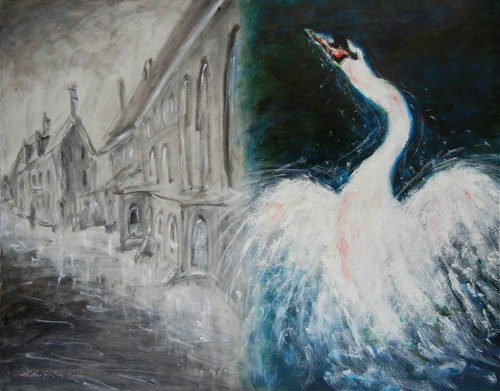
One of my paintings selected in a recent exhibition at Berkeley Central Arts Passage, Today's Artists Interact with Major Art Movements from the Renaissance to the Present, is a painting of part cityscape and part animal figure study.

In Distant Country / 在遙遠的国度 / In fernem Land  
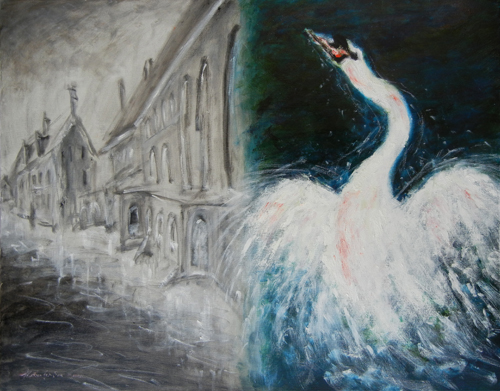
In Distant Country / 在遙遠的国度 / In fernem Land
Oil on Canvas
22″ x 28"
Completed in 2011

The left side of the painting, in shades of washed-out gray, depicts the Old St. John's Hospital, an 11th-century hospital in Bruges, Belgium while the right side zooms in one of the omnipresent swans and the symbol of that ancient city, painted in intensely saturated rich hues. I conceived this painting while visiting Bruges, when I was quite intrigued and even moved by the stark contrast of immobile and somewhat faded history and threadbare nobility, and the living creatures full of grace, energy and slight menace.

Furthermore, I named this title to ensure that the German title In fernem Land is the first line of the most celebrated aria by the title character in Wagner's opera Lohengrin, a mysterious knight arrived in a boat drawn by a swan, narrating his mythical original and his frustrated hope by lacking of faith he demanded from a woman he loved and rescued, whose child-ruler brother was turned into that swan and his disappearance had triggered a chain of events.

The medieval building and the medieval story interwoven, the purity and menace of this lofty bird, along with the historical baggage of Wagner, conspire to add extra meanings to this rather deceptively simply painting.

Originally posted on matthewfelixsun.com

Other Related posts on Art · 文化 · Kunst:
- Featured Painting "Progression"
- Featured Painting "Liberation Road"
- My Featured Work - Portrait Painting "Grandma"
- Featured Oil Painting “Father and Son”
- Featured Oil Painting "The Triumph of Saint George"
- Video Presentation of Oil Painting "Progression"

Friday, January 25, 2013

My Favorite Paintings at Antwerpen Koninklijk Museum voor Schone Kunsten (Antwerp Royal Museum of Fine Arts)

My day trip to Antwerp, after the Cathedral of Our Lady, where we saw amazing Rubens panels, included Rubens' House and the grand Koninklijk Museum voor Schone Kunsten (Antwerp Royal Museum of Fine Arts), which boasted some masterpiece paintings of several centuries.

My favorite painting in this museum was a fifteen century painting, Madonna Surrounded by Seraphim and Cherubim, a stylish, otherworldly, actually very strange presentation of the Virgin, the Child and some strangely devilish red Seraphim, juxtaposed with equally sinister deep ultramarine blue Cherubim. All the figures were highly stylized and looked like plastic dolls, almost ghoulish; yet with very precise and delicate lines, Maria and Jesus, with their perfectly rounded head and her breasts, one of which exposed, were ultimately quite subtly ravishing, pale, pensive, accepting, frail yet steely,  Their tone of pearl gray, brilliantly set off against the elements meant to be supportive and comforting but here not without an under current of menace. Utterly unforgettable.


Madonna Surrounded by Seraphim and Cherubim
Jean Fouquet
1452, oil on panel, 94.5 x 85.5 x 1.2 cm

My second favorite painting there was another strange piece - this time it was the situation but not the presentation - Venus Frigida by Peter Paul Rubens, whose figures were just his usual Rubenesque, confident and glowing, even in distress.


Venus Frigida (Frozen Venus)
Peter Paul Rubens
1614, oil on panel, 145.1 x 185.6 x 38 cm


Here, the love goddess Venus and her son Cupid, stripped of their protections, shivered in the cold, with their naked bodies exposed to the cruel element.  Her back to the viewer, showing us her rather muscular physic and he hovering underneath her gauzy veil, shrank to a cute ball, on top of her discarded arrows.  It was a funny situation and I wanted to laugh out loud ticked by the sight of the suffering Cupid, cuter than usual, but her accusing eyes stopped me from being insensitive.  Even a goddess with a muscular back, she was suffering and it called for compassion.  A satyr approached them, with his cornucopia filled with delicacies.  Perhaps, as a follower of Bacchus, he was trying to reignite the fire of life in the them; or he was about to take advantage of the vulnerable two.  Venus's turned away head might be a rebuke to his advancement.  His dark and untidy appearance dramatically contrasted to the refined shapes of Cupid and Venus, adding spices to the drama, so did the stormy dark landscape to the left and the bare tree trunks to the right.


My Favorite Museum Collection Series

>> My Favorite Museum Collection Series 61: My Favorite Paintings at Musée de l'Orangerie, Paris  
<< My Favorite Museum Collection Series 59
My Favorite Paintings in Cathedral of Our Lady, Antwerp (Antwerpen), Belgium


List of My Favorite Artworks in the Museums I've Visited  

Saturday, January 19, 2013

My Favorite Paintings in Cathedral of Our Lady, Antwerp (Antwerpen), Belgium

We had only a day trip to Antwerp, whose art scene was dominated by the great Flemish painter Peter Paul Rubens.  In one of several stops, the Cathedral of Our Lady (De Kathedraal), we saw several of his great panels.  Most ambitiously conceived and marvelously executed were two triptychs, which were my favorites in this great house of worship and temple of art.

Both triptychs depicted the crucial moment of Jesus's life cycle - The Elevation of the Cross (1610) and The Descent from the Cross (1612-1614) - moment before and after his death - the subject matters hardly need explain.


The Elevation of the Cross (1610)


The Descent (Deposition) from the Cross (1612-1614), Visitation (Left), Presentation (Right)

The most impressive aspect of these panels was the dynamism of the central panels.  Everything, everyone was animated, on the move, actively engaged in a vivid, moving drama.  It seemed that subtracting any muscle would have caused the collapse of the whole mass of people and object centering on the passive and immobile Jesus.  There were large swaths of colors surrounding the parlor of Jesus.  Another wonderful contrast of the artistic decision.  Rubens' figures were fully modeled and differentiated and characterized.  One felt that one could tell who they were and what they had done and what they were to become. 

There were some continuity between these two triptychs - both Jesus or Jesus and his throe cut across the enormous panels diagonally, adding the sense of dynamism.  Unsettled.  Dangerous.  The side panels of "Elevation" were the continuation of the central panel, sad and moving, while the side panels of "Descent", both calm and happy, described before and after Jesus's birth - the Visitation and the Presentation, adding poignancy to his agonizing death.

As a renown colorist, Rubens gave us a combustion of varied yet subtly harmonized colors.  The achievement of his through these two triptychs alone were monumental.


My Favorite Museum Collection Series

>> My Favorite Museum Collection Series 60: My Favorite Paintings at Antwerpen Koninklijk Museum voor Schone Kunsten (Antwerp Royal Museum of Fine Arts)
<< My Favorite Museum Collection Series 58: My Favorite Sculpture and Painting at Church of Our Lady, Bruges


List of My Favorite Artworks in the Museums I've Visited

Thursday, December 6, 2012

My Favorite Sculpture and Painting at Church of Our Lady, Bruges

Bruges, Belgium, so-called Bruges-la-Morte, according to the novelist Georges Rodenbach, in reality was nothing but dead, particularly during its commercial height several hundreds years ago, when it was one of the most vibrant and presperous cities in the world.  It was during those golden years, Bruges acquired one of its most valuable treasures - a marble statue of Virgin and the Child by no other than Michelangelo, a centerpiece of the great cathedral of the city - Church of Our Lady, or Onthaalkerk Onze Lieve Vrouw Brugge, which became my favorite artwork from that cathedral during my visit in 2006.

This statue was brought back to to Bruges by its merchant during Michelangelo's life time - the only one left Italy had such distinction.  It was bought by Giovanni and Alessandro Moscheroni (Mouscron), from a family of wealthy cloth merchants in Bruges, for the price of 4,000 florin.  This piece, belonged to the subtle and/or subdued sculptures by Michelangelo, such as Pieta, David, versus others more energetically charged with tension, such as the Bound Slaves.  This Madonna was becalming, soothing and comforting, despite the sad fate awaiting on the mother and son.  The child, larger than normal, was thoughtful, vulnerable yet composed and even confident, seemingly only dependent out of courtesy to his mother.  Maria was serene and without much facial expression.  Nothing was stirred, no one was surprised.  There was a great simplicity to this marvelously modeled statue which was also deceptively simple looking.  Even the sea shell canopy was very subdued and humble, rendered the throne rather homey.  The mother and son were so softly sculpted and so real that one expected them to stretch and moved about from their time-imposed, several hundred years' immobility.


Madonna by Michelangelo
Source: ArtMechanic via Wikipedia


My second favorite work there was a triptych by an unknown artist, in the late-medieval fashion, with golden plate halos and golden border decorations, and in the style of Flemish Primitives, with the typical Flemish rural landscape and rigid or ornate figures in impossible contortions.  The most striking aspect of these panels were the rich colors the artist(s) employed.  Vivid, rich, sparkling and harmonious.  Old fashioned, in a most lovely and assertive way.  Unforgettable.


Deposition of the Cross; anonymous
United States public domain tag


My Favorite Museum Collection Series

>> My Favorite Museum Collection Series 59:
My Favorite Paintings in Cathedral of Our Lady, Antwerp (Antwerpen), Belgium
<< My Favorite Museum Collection Series 57: My Favorite Paintings in The Memling Museum The St. John's Hospital in Bruges


List of My Favorite Artworks in the Museums I've Visited


Friday, March 18, 2011

Oil Painting "In Distant Country" Completed

Last Wednesday, I completed a painting I'd been working on for several months:

In Distant Country / 在遙遠的国度 / In fernem Land

I was first struck by a vision of stark contrast between muted landscape and saturated world and my desire to capture this contrast brought to my trip to Bruges, Belgium, where beautiful city landmark buildings glistered in the sun but quite muted at night.  My morning trip to the canal to greet "my" swans etched these impression to my mind and they serve a perfect model for my painting.

The title of this painting is a phrase from Richard Wagner's Lohengrin "In fernem Land". In this aria, mysterious knight Lohengrin related his background. He came to Brabant, on chariot pulled by a swan, to defend a wrongly accused maiden Elsa.  Somehow, the medieval story of Lohengrin, with the mythic characters abundant, felt quite right for my painting depict a medieval town, with its eternal swans, despite the fact that Bruges is not in Brabant's proper, but very close.

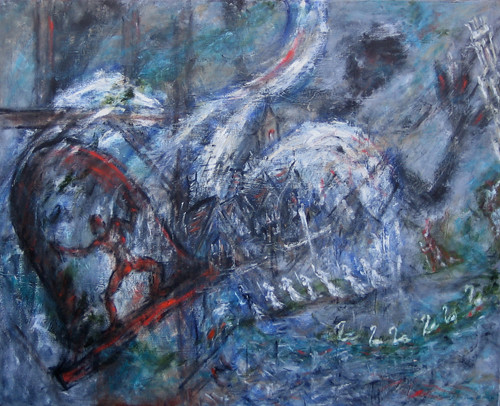
This paining can also be viewed as a companion piece to my "Bruges, Impression" which was completed in 2009:

Bruges, Impression / 布魯日,印象 / Brügge, Eindruck

Sunday, June 28, 2009

Pieter Paul Rubens (June 28, 1577 – May 30, 1640)

Yesterday, I observed the death of a genius - Michael Jackson, today I want to honor the birth of another - Pieter Paul Rubens (June 28, 1577 – May 30, 1640), whose name was employed by some art historians to describe the epoch he belonged to - the Age of Rubens.

Rubens was introduced to me early on, along with other old masters, such as da Vinci, Titian and Rembrandt, primarily through well-produced large format calendars. Those were the only chances I had to behold decent reproductions of seminal western artworks.

Many years later, not only have I accumulated many prints and books featuring those artworks, but I also had many opportunities to view these miracles with my naked eyes.


His staggering series - The Marie de' Medici Cycle, a series of twenty-four paintings commissioned by Marie de' Medici, wife of Henry IV of France, with twenty-one of the paintings depict Marie's own struggles and triumphs in life and the remaining three are portraits of herself and her parents, occupied a gigantic hall in the Louvre. They were such Herculean works that it took monumental concentration and Stamina to view the entire cycle in one go. Every time I went back to the Louvre, I would seek them out to admired and contemplate. This series is particularly fascinating since the life and achievement of the heroine was rather pallid.

In a large cathedral in Antwerp, I had seen his great Passion altar pieces, which somehow survived the Iconoclasm. Even a non-religious person as I, was deeply moved by his stunning composition and execution. Yet, since most of his work were only sketched by him, and subsequently executed by many assistants and apprentices, his cartoons for such paintings and tapestries were even more valued by many, including me, who appreciate the lucidity of these supposedly rough and unfinished works.


He was a successful diplomat and shrewd businessman and his villa - Rubenshuis in Antwerpen was a happy testament that financial success could be avail to a true great artist, however rarely.


On his birthday, 28 June, I remember the titan of the past.