Showing posts with label The Visitation. Show all posts

Saturday, January 19, 2013

My Favorite Paintings in Cathedral of Our Lady, Antwerp (Antwerpen), Belgium

We had only a day trip to Antwerp, whose art scene was dominated by the great Flemish painter Peter Paul Rubens.  In one of several stops, the Cathedral of Our Lady (De Kathedraal), we saw several of his great panels.  Most ambitiously conceived and marvelously executed were two triptychs, which were my favorites in this great house of worship and temple of art.

Both triptychs depicted the crucial moment of Jesus's life cycle - The Elevation of the Cross (1610) and The Descent from the Cross (1612-1614) - moment before and after his death - the subject matters hardly need explain.


The Elevation of the Cross (1610)


The Descent (Deposition) from the Cross (1612-1614), Visitation (Left), Presentation (Right)

The most impressive aspect of these panels was the dynamism of the central panels.  Everything, everyone was animated, on the move, actively engaged in a vivid, moving drama.  It seemed that subtracting any muscle would have caused the collapse of the whole mass of people and object centering on the passive and immobile Jesus.  There were large swaths of colors surrounding the parlor of Jesus.  Another wonderful contrast of the artistic decision.  Rubens' figures were fully modeled and differentiated and characterized.  One felt that one could tell who they were and what they had done and what they were to become. 

There were some continuity between these two triptychs - both Jesus or Jesus and his throe cut across the enormous panels diagonally, adding the sense of dynamism.  Unsettled.  Dangerous.  The side panels of "Elevation" were the continuation of the central panel, sad and moving, while the side panels of "Descent", both calm and happy, described before and after Jesus's birth - the Visitation and the Presentation, adding poignancy to his agonizing death.

As a renown colorist, Rubens gave us a combustion of varied yet subtly harmonized colors.  The achievement of his through these two triptychs alone were monumental.


My Favorite Museum Collection Series

>> My Favorite Museum Collection Series 60: My Favorite Paintings at Antwerpen Koninklijk Museum voor Schone Kunsten (Antwerp Royal Museum of Fine Arts)
<< My Favorite Museum Collection Series 58: My Favorite Sculpture and Painting at Church of Our Lady, Bruges


List of My Favorite Artworks in the Museums I've Visited

Monday, April 16, 2012

My Favorite Art Works at Santa Maria Novella, Firenze

Santa Maria Novella, the first great basilica in Florence, Italy, and is the city's principal Dominican church, was the last stop of my art pilgrimage in my only trip to Italy in 2000.  After all those amazing museums and churches, including two side trips to Sienna and Venice, this amazing church and its adjoining cloister still had much to impress me, particularly the great frescoes by Gothic and early Renaissance masters.

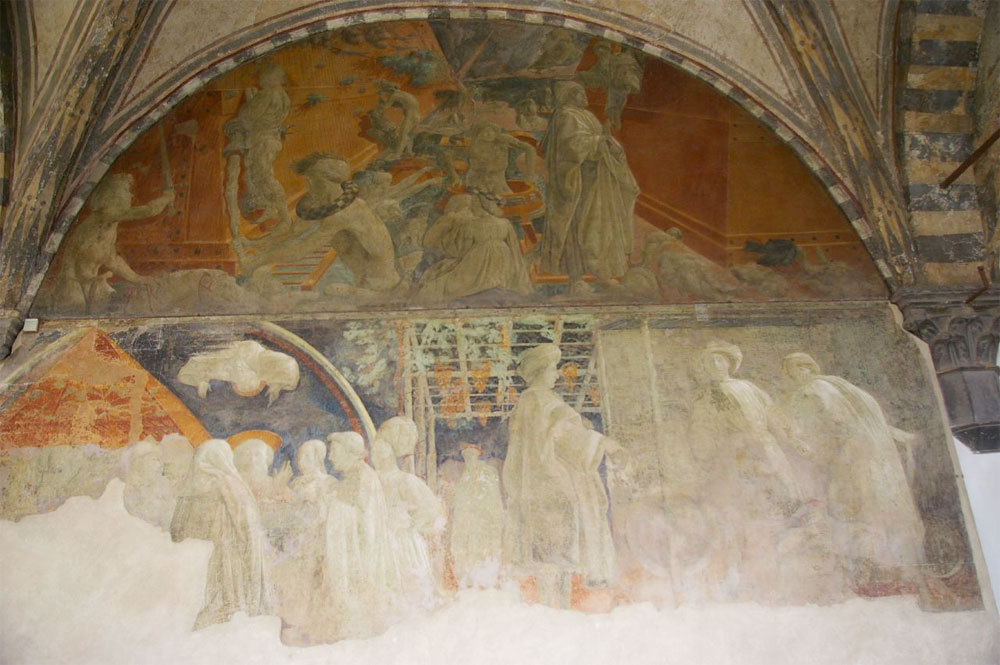
The most striking one was "Scene from the life of Noa (Noah)" by Paolo Uccello in Green Cloister:


Green Cloister
Paolo Uccello - Scene from the life of Noa

Here, many figures, in forms like ivory relief, congregated in the less well-preserved lower panel, seemingly preparing for the deluge, orderly, almost in a trance.  In the upper lunette, people are much more animated and the strangely converged perspective emphasized it even further.  There was a great sense of the collapsing of time and space, seemed that the entire human history was condensed into that moment and one was moved to by the agonizing event.

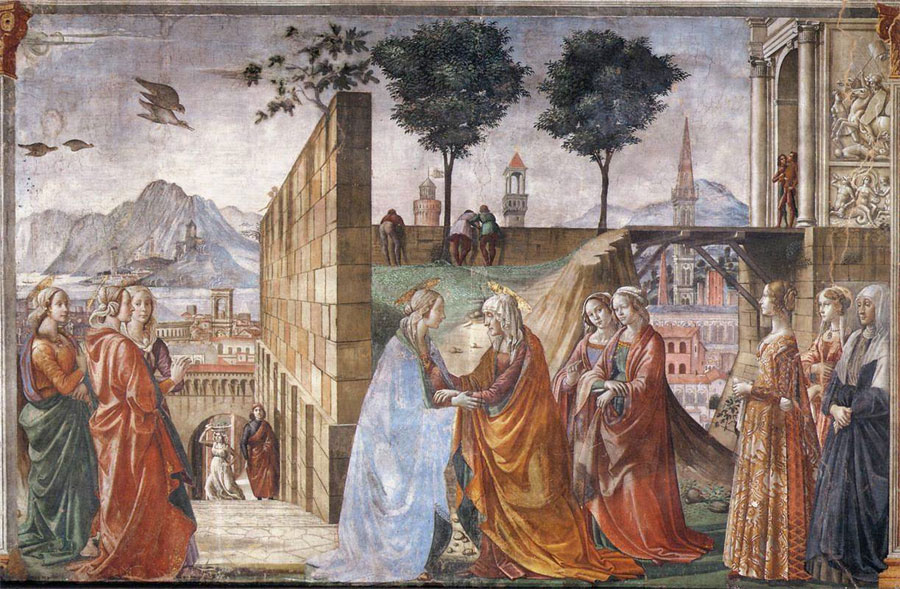
And then what a balm to the troubled soul it was to view the tranquil scene of "The Visitation" by Domenico Ghirlandaio in the Tornabuoni Chapel (below).  


Tornabuoni Chapel
Domenico Ghirlandaio
The Visitation

This Visitation, between the pregnant Mary and Elizabeth pregnant with John the Baptist was a poignant scene, with an inevitable sadness undertone.  Here, Ghirlandaio gave us a tableau which had all those elements but also strangely comforting and idyllic.  Elizabeth and Mary, held each other's hands, in tender emotion, as if they knew the fates of their respective son and that was the point of this picture.  The were tended by groups of young women, not unlike three graces at the two ends of the tableau - a device used to bring in more beautiful figures, and to connect the new Christian religion and the classical period, and that was also emphasized by the classical arch at the right background.  All the ladies, except for the more non-specifically clothed Mary and Elizabeth, were clearly Renaissance Italians.  The rather solemn and stately scene at the foreground was enlivened by the picturesque landscape and town's life at the background, with the charming flying birds, marvelous Mediterranean trees, and unconcerned self-absorbed folks, carrying on their own life, oblivious of the significance of the moment.

The painting was very beautiful to behold, with ravishing yet harmonious colors and figure drawings being its primary virtues.


My Favorite Museum Collection Series

>> My Favorite Museum Collection Series 27: My Favorite Paintings in Palazzo Pubblico, Sienna
<< My Favorite Museum Collection Series 25: My Favorite Artworks at Cappelle Medicee, San Lorenzo, Firenze


List of My Favorite Artworks in the Museums I've Visited