Showing posts with label Claude Monet. Show all posts

Tuesday, April 18, 2017

"Monet: The Early Years" at San Francisco Legion of Honor Fine Arts Museum

The forever popular French impressionist painter Claude Monet made his somewhat unusual appearance in San Francisco Legion of Honor Fine Arts Museum, in an exhibition titled Monet: The Early Years (February 25, 2017 through May 29, 2017), featuring his mostly engaging early paintings, some of them were already in the realm of later famed impressionism.

The first piece or pieces to greet the audience amazed us by the unusual shape of the wok(s). The ensemble had two framed pieces of different sizes, cut from the same and much larger painting. The square one on the right side, centering on two seated people at a picnic, was collected by Musée d'Orsay in Paris, titled 'Luncheon on the Grass, Central Panel' (1865–66), while the slender and tall panel on the left side, featuring back view of three people at the perimeter of the picnic, hailed from a private collection. What a fascinating family reunion. I also wondered where the "right" panel might be.
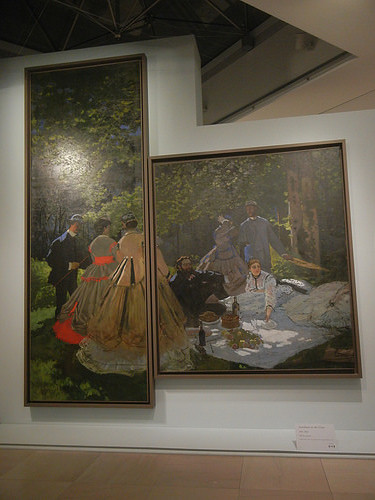
DSCN8536 _ Monet - The Early Years, Legion of Honor

The rest of the exhibition was organized in chronological order, well suited to demonstrate the development of Monet as an artist. Here, I will largely follow this arrangement, with some re-grouping according to subject matters.

In the first room, we saw some landscapes, and one can see their affinity to the works by early French greats such as Corot, and Courbet. These landscape were much weightier and earthier than his more celebrated later pieces.
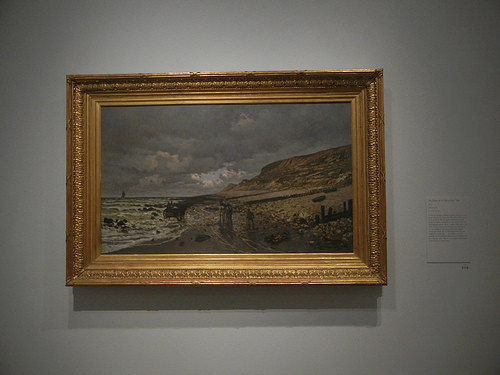
DSCN8489 _ Monet - The Early Years, Legion of Honor
The Pointe de La Hève at Low Tide, 1865. Oil on canvas, Kimbell Art Museum, Fort Worth, Texas
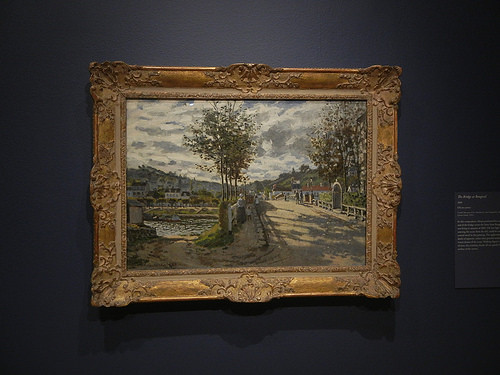
DSCN8513 _ Monet - The Early Years, Legion
 of Honor

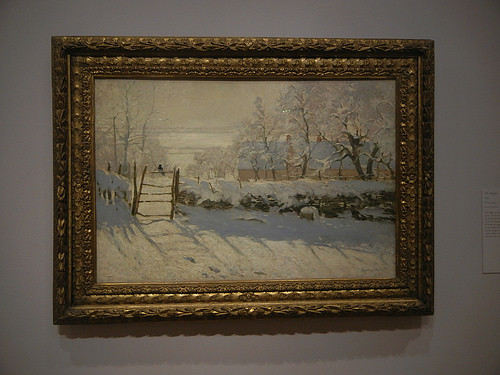
Next were some winter scenes, a genre quite different from typical impressionism works closely associated with often colorful domains under joyous and sunshine. However, even in winter, the shifting lights were clearly a main contributing factor to the sense of drama, though somewhat subdued.
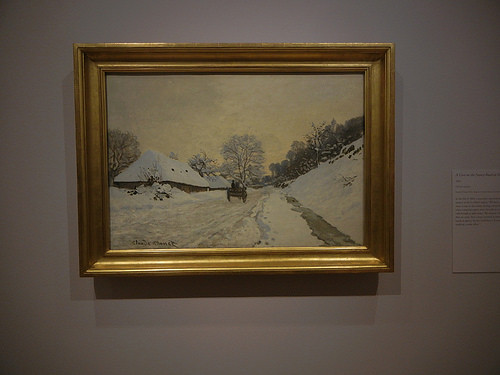
DSCN8491 _ Monet - The Early Years, Legion of Honor
A Cart on the Snowy Road at Honfleur (1865), Musée d’Orsay
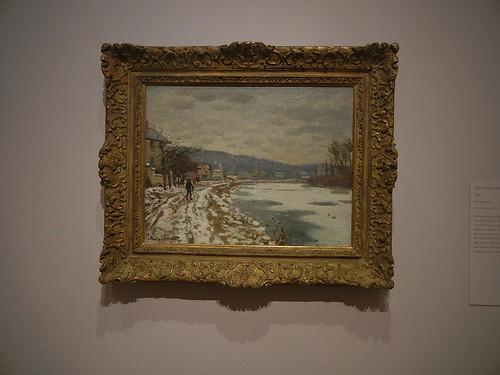
DSCN8496 _ Monet - The Early Years, Legion of Honor

DSCN8497 _ Monet - The Early Years, Legion of Honor - The Magpie
The Magpie (1869), Musée d’Orsay

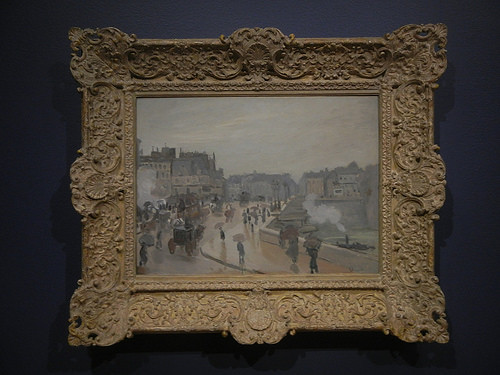
There were some paintings depicting scenes in cities, painted while Monet visited the Netherlands and UK, and those works had similar characteristics of his early landscapes.
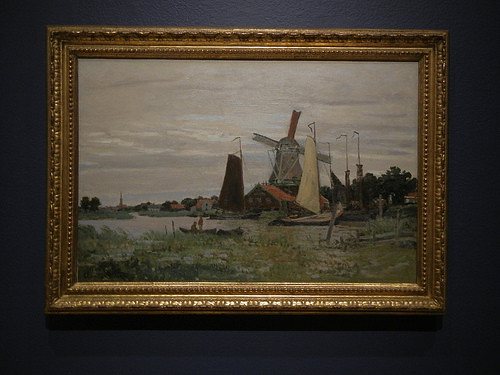
DSCN8520 _ Monet - The Early Years, Legion of Honor

But, some of the brushstrokes Monet employed had become noticeably looser and more fluid.
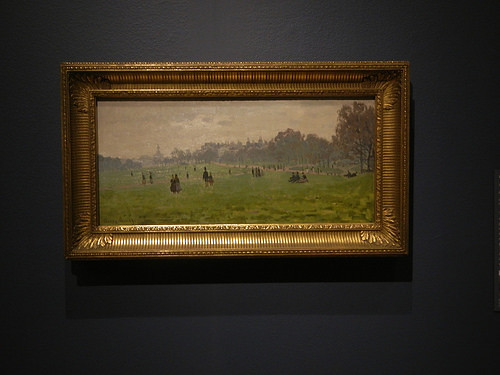
DSCN8522 _ Monet - The Early Years, Legion
 of Honor
Hyde Park, 1871, Rhode Island School of Design, Providence
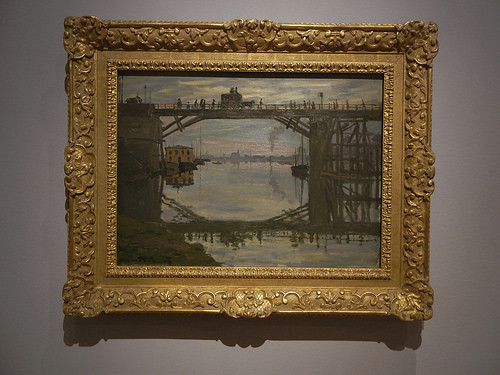
DSCN8532 _ Monet - The Early Years, Legion of Honor

DSCN8519 _ Monet - The Early Years, Legion of Honor
The Pont Neuf in Paris (1871), Dallas Museum of Art

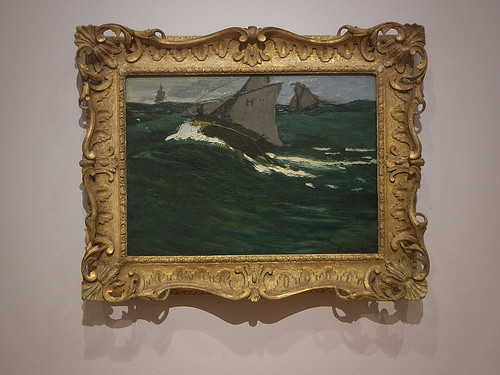
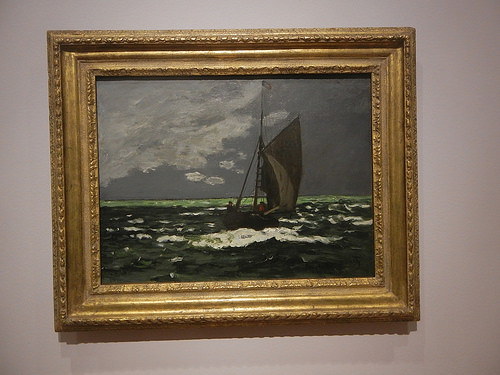
With water, Monet had his most solid footing, and the results were dynamic and engrossing. Immersed in a room full of such paintings, one felt the strong need to hold breath, in case the splashing water entered one's lungs.
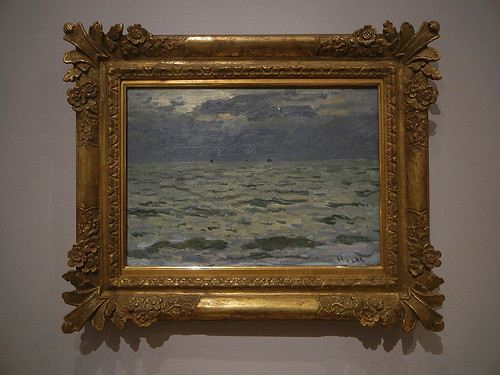
DSCN8502 _ Monet - The Early Years, Legion of Honor

DSCN8499 _ Monet - The Early Years, Legion of Honor
The Green Wave. (1886) The Metropolitan Museum of Art, New York
DSCN8500 _ Monet - The Early Years, Legion of Honor

DSCN8503 _ Monet - The Early Years, Legion of Honor

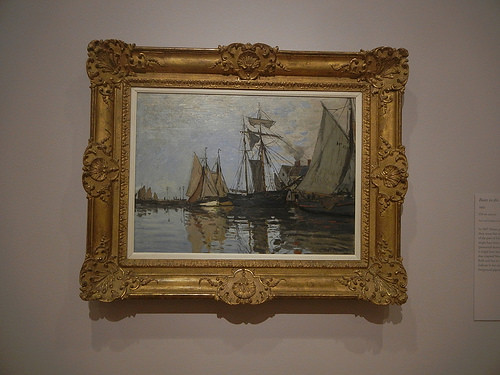
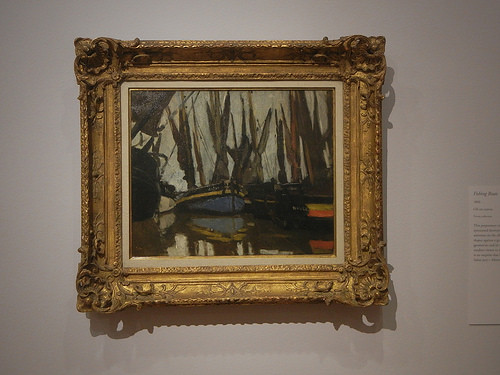
One of my favorite pieces in this show was the "Fishing Boat" below, which was rich in texture and subtle in tonal variances, and almost reached the state of abstract, which caused its rejection by an exhibiting salon, yet a virtue in the later era.
DSCN8501 _ Monet - The Early Years, Legion of Honor - Fishing Boats
Fishing Boats

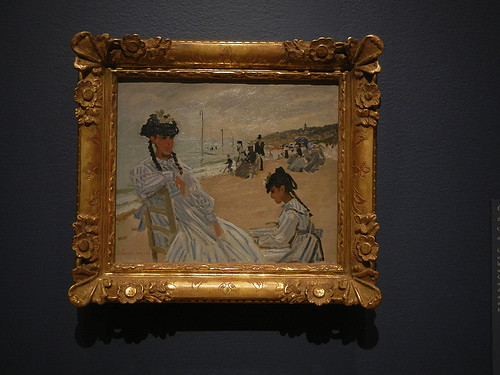
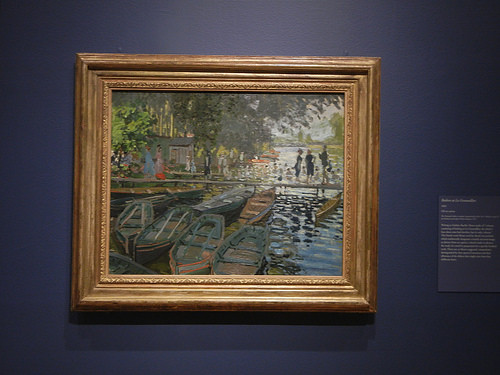
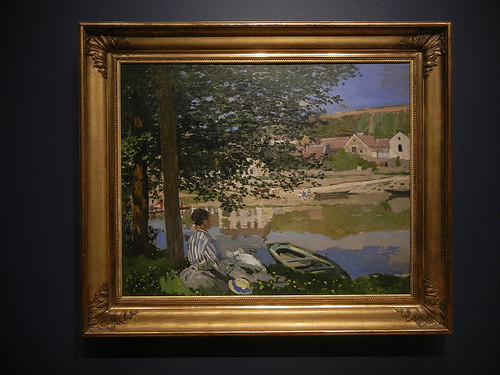
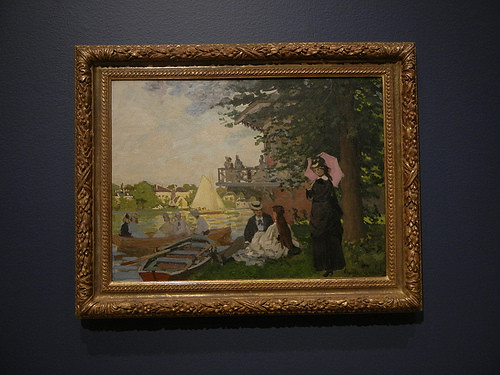
Monet's water scenes with people was always very interesting, especially the way he portrayed the slight melancholy, and the endlessly shifting patterns of water. His ability to depict still or slightly rippled water bodies was astounding, despite the fact that such way of painting had inevitably lost its novelty.
DSCN8509 _ Monet - The Early Years, Legion of Honor

DSCN8515 _ Monet - The Early Years, Legion of Honor
On the Bank of the Seine, Bennecourt (1868)
DSCN8517 _ Monet - The Early Years, Legion
 of Honor

DSCN8511 _ Monet - The Early Years, Legion of Honor - On the Beach at Trouville
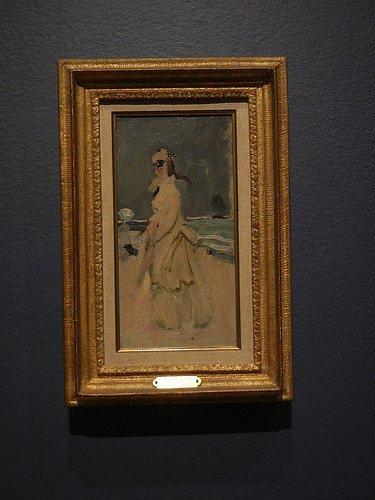
On the Beach in Trouville

DSCN8512 _ Monet - The Early Years, Legion of Honor

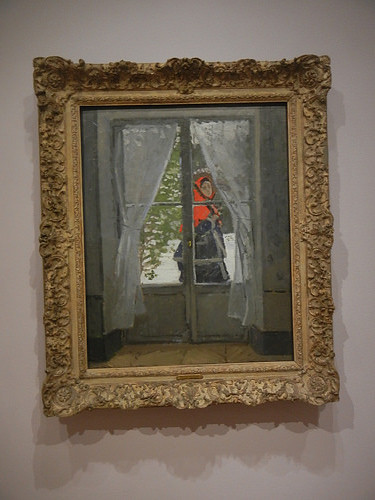
Monet didn't frequently paint people as pure portraits — most of his people were immersed in outdoor or indoor settings, and became part of the fabrics — a few such pure portraits from his early period were included in the show, and I was very taken in by a portrait of Camille Monet, who stood in snow, in her bright red shawl, turned her upper torso slightly, and timidly or inquisitively peered into the closed French door. An intriguing scene, worthy of Chekhov or Ibsen.
DSCN8490 _ Monet - The Early Years, Legion of Honor
The Red Kerchief: Portrait of Camille Monet (ca. 1868-1873), Cleveland Museum of Art 
DSCN8492 _ Monet - The Early Years, Legion of Honor
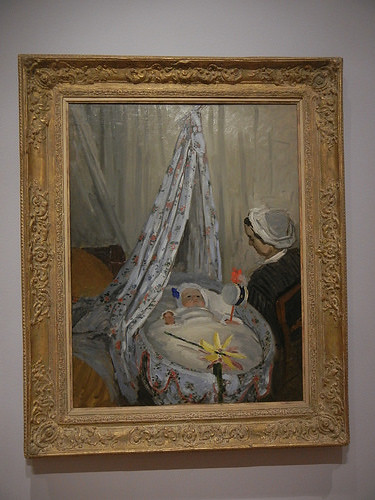
The Cradle—Camille with the Artist’s Son Jean (1867, National Gallery of Art, Washington, DC)
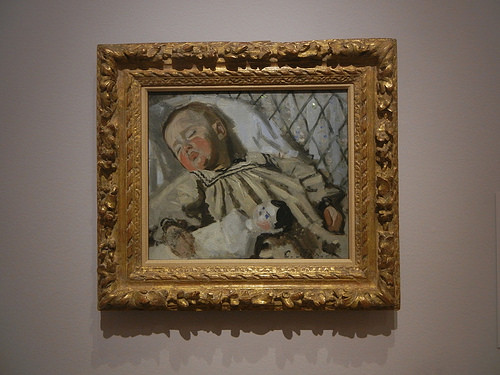
DSCN8493 _ Monet - The Early Years, Legion of Honor
Jean Monet Sleeping (1867–1868, Ny Carlsberg Glyptotek, Copenhagen)
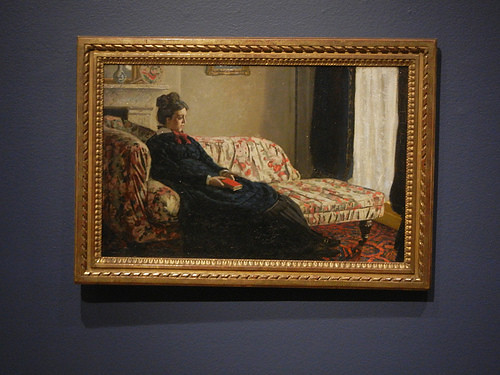
DSCN8524 _ Monet - The Early Years, Legion
 of Honor

There were also some still life paintings in the exhibit, probably as answers to friendly challenges lobbed from some accomplished painters. Or rainy day consolations for the sun-obsessed Monet.
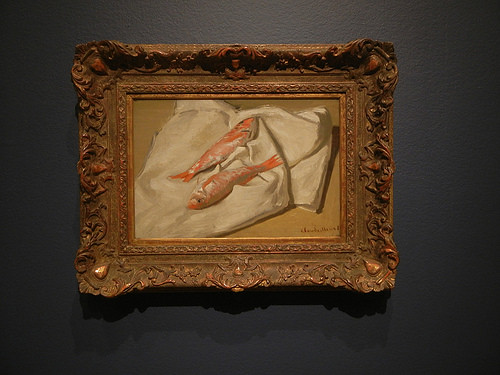
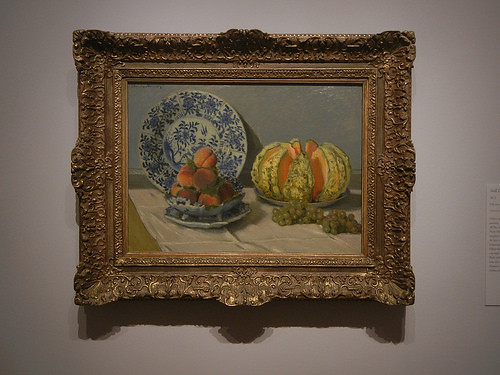
DSCN8506 _ Monet - The Early Years, Legion of Honor

DSCN8533 _ Monet - The Early Years, Legion of Honor
Still Life with Melon (1872, Museu Calouste Gulbenkian, Lisbon)


Other Related posts on Art · 文化 · Kunst:
- My Favorite Paintings at Musée Marmottan Monet
- My Favorite Paintings at Musée de l'Orangerie, Paris
- My Favorite Paintings from Musée d'Orsay, Paris
- My Favorite Paintings from Musée Picasso, Paris
- My Favorite Artworks at Musée National Eugène Delacroix, Paris
- Impressionism from National Gallery of Art (DC) in San Francisco
- Last Call - "The Girl With A Pearl Earring" in De Young Museum, San Francisco
- Modernism from the National Gallery of Art in De Young Museum, San Francisco

Friday, October 28, 2016

My Favorite Paintings at Art Institute of Chicago

One of the largest art museums in the US, the Art Institute of Chicago dazzled visitors with its vast arrays of treasures.

My favorite was Saint Martin and the Beggar by El Greco, dating back to the beginning of the 17th century. The first impression of the painting was the freshness and cleanness — the rain-washed blue sky, the gleaming white pelt of the horse, the polished face, drape and armor of the well-groomed saint, and even the taut and well-scrubbed skin of the beggar — all these gave the painting an other-worldly purity, which was also heightened by the contrast to small muddy patches, such as the brown hill under their feet, and the shadowy distant hills and forest, seen only from underneath the stallion's belly. The viewpoint was very low, thus both figures, particularly that the mounted saint, hovered large almost like a super human, yet his humble and sweet face endeared him to the viewer and managed to bring  him back towards viewers. The narrow vertical format of the painting, which was almost filled completely with these two persons and the horse, was also noteworthy and memorable.

El Greco - San Martín y el mendigo
El Greco [Public domain], via Wikimedia Commons
Saint Martin and the Beggar, 1597/1600, El Greco (Domenikos Theotokopoulos) (1541-1614)

The Art Institute was rightful to be proud of its Impressionism collections. One of the best of those was Arrival of the Normandy Train, Gare Saint-Lazare (1877) by French master Claude Monet. This painting, a bit unusual from others, was its industrial subjects and indoor setting. The steam permeated train station was awash in chilly blue light, and almost everything was off-focus due to the simmer of the heated air. Monet perfectly captured the chaos, excitement, and anxiety with the advent of modern technology and cold machinery.

Claude Monet - Arrival of the Normandy Train, Gare Saint-Lazare - Google Art Project
Arrival of the Normandy Train, Gare Saint-Lazare, 1877, Claude Monet (1840-1926) 
Claude Monet [Public domain], via Wikimedia Commons


My Favorite Museum Collection Series
>> My Favorite Museum Collection Series 144: My Favorite Paintings at Berkeley Art Museum / Pacific Film Archive
<< My Favorite Museum Collection Series 142: My Favorite Drawing and Artefact at Morgan Library & Museum in New York City

List of My Favorite Artworks in the Museums I've Visited

Other Related posts on Art · 文化 · Kunst:
- Crescat Graffiti, Vita Excolatur by Quinn Dombrowski
- My Favorite Paintings at Musée Marmottan Monet
- Museum of Modern Art (MOMA), New York City 
- Max Beckmann's Paintings in MOMA and MET
- Gustav Klimt and Egon Schiele in Wien (Vienna)

Tuesday, February 5, 2013

My Favorite Paintings at Musée de l'Orangerie, Paris

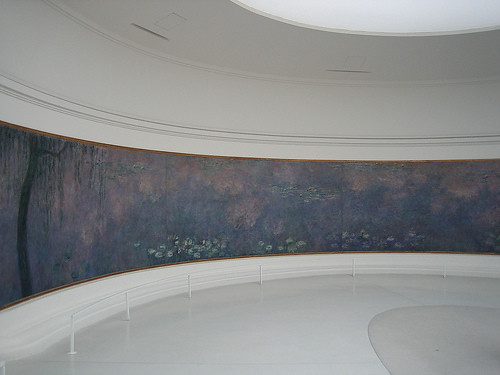
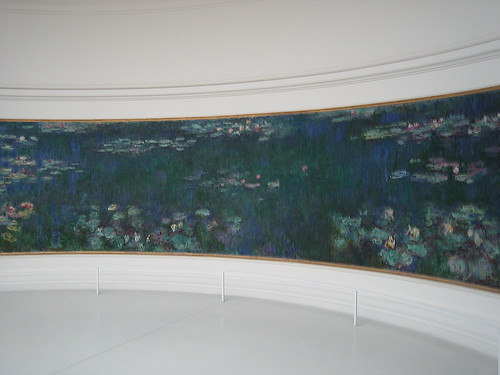
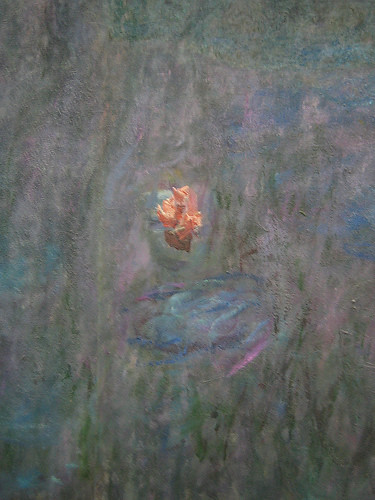
When I visited Paris for the first time in 2000, Musée de l'Orangerie was closed for renovation, therefore I missed the chance to see the large assemble of Claude Monet's Les Nymphéas (Water Lilies).  Eight years later, when I returned, I was delighted to bask in the glory in those two oval-shaped rooms, especially built to showcase this "series" Musée de l'Orangerie collected.

According to Wikipedia, "Water Lilies (or Nymphéas) is a series of approximately 250 oil paintings by French Impressionist Claude Monet (1840–1926). The paintings depict Monet's flower garden at Giverny and were the main focus of Monet's artistic production during the last thirty years of his life. Many of the works were painted while Monet suffered from cataracts."

"The paintings are on display at museums all over the world, including the Musée Marmottan Monet and the Musée d'Orsay in Paris, the Metropolitan Museum of Art in New York, the Art Institute of Chicago, etc. During the 1920s, the state of France built a pair of oval rooms at the Musée de l'Orangerie as a permanent home for eight water lily murals by Monet. The exhibit opened to the public on 16 May 1927, a few months after Monet's death. Sixty water lily paintings from around the world were assembled for a special exhibition at the Musée de l'Orangerie in 1999."

To see those glorious canvases in those two large oval rooms were an incredible experience - one felt the light danced around the room, the scent permeated in the air, the dark water absorbed all the toils and worries in the world, and gave back calm and comfort.

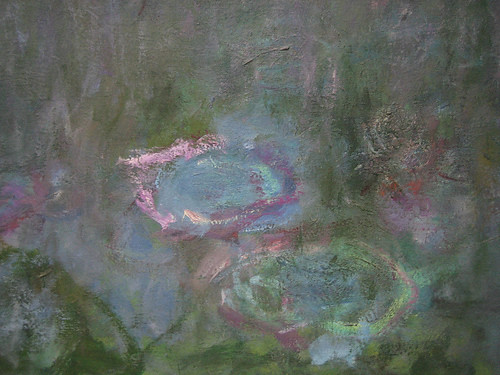
The mastery of Monet was astonishing - he didn't just created an atmosphere or brandishing his virtuosity - he created a world breathed and signed, full of life.  His brushstrokes were broad and sure, though highly suggestive, with the aid of viewers' eyes, all the details were present and palpable.  I felt that I was indeed immersed in the whispering pond.

Les Nymphéas (1), Claude Monet, Musée de l'Orangerie, Paris

Les Nymphéas (2), Claude Monet, Musée de l'Orangerie, Paris

Les Nymphéas (3), Claude Monet, Musée de l'Orangerie, Paris

Les Nymphéas (4), Claude Monet, Musée de l'Orangerie, Paris
Les Nymphéas, Claude Monet, Musée de l'Orangerie, Paris

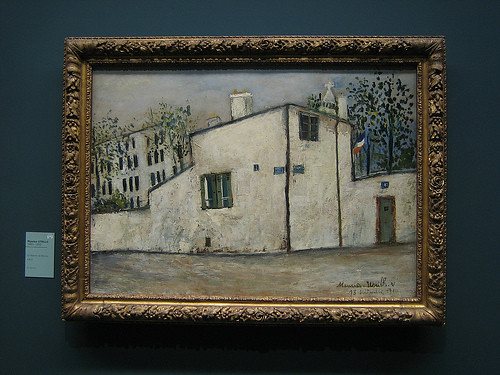
There were many other works collected by the museum, besides the Les Nymphéas.  I particularly loved a small piece by Maurice Utrillo, La Maison de Berlioz, which depicted a lone and lonely white-washed house, with deceptively plain surface which was actually full of textural details, amidst sparsely leaved young trees.  Very simple yet enchantingly if one could bear the intense melancholic undertone.

La Maison de Berlioz, 1824, Maurice Utrillo, Musée de l'Orangerie, Paris
La Maison de Berlioz, 1824, Maurice Utrillo


My Favorite Museum Collection Series

>> My Favorite Museum Collection Series 62: My Favorite Paintings at Petit Palais, Paris
<< My Favorite Museum Collection Series 60: My Favorite Paintings at Antwerpen Koninklijk Museum voor Schone Kunsten (Antwerp Royal Museum of Fine Arts)


List of My Favorite Artworks in the Museums I've Visited