Showing posts with label Fable. Show all posts

Wednesday, September 13, 2017

My Featured Painting - Wafting

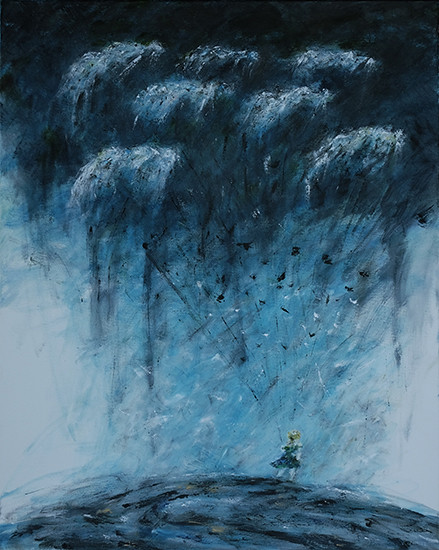
Despite some success of my 2015 painting Waft, which was recently published by Pomona Valley Review (Volume 11, Summer 2017), I clearly saw rooms for improvement, and recently I made a new version of the painting, titled Wafting — much darker and more dramatic, with additional whimsicality and humor, lent by the black flakes, resembling playful butterflies, darting above the little girl, who was, as in the 2015 version, running away from the viewer, holding strings tied to floating human balloons, all in the shape of young women dressed in pure white, against much darker and more ominous background, as if in the process of awakening or drowning. I believe that the latter effort was psychologically more penetrating and indeed a big improvement.

 Wafting / 飄 / Wandernd  
Wafting
Oil on Canvas
30" x 24"
Completed in 2017


Originally posted on matthewfelixsun.com

Other Related posts on Art · 文化 · Kunst:
- Featured Painting - Waft
- Featured Painting - A Young Frenchman
- My Featured Painting "Cascades"
- My Featured Painting "Origin"
- Featured Painting - Remembrance
- My Featured Painting "Apprehend"
- Featured Painting “Mirage” – A World of Ambiguity
- Featured Painting – “Forest Within” – When Reality Met Illusion
- Featured Painting: The March of Time

Sunday, September 25, 2011

Frog King

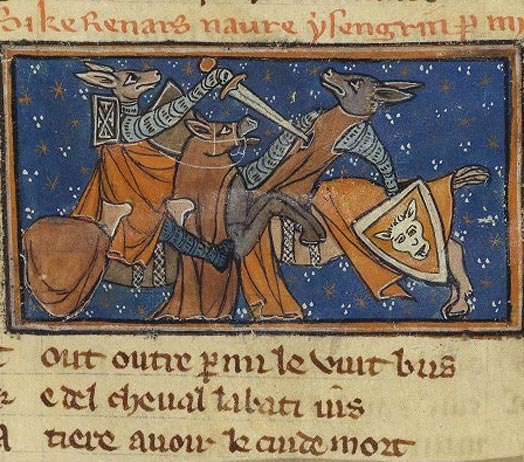
Image source: Wikipedia
Reading Shakespeare's Henry IV, Part II, I was struck by a line in Act 1, "Past and to come seems best, things present worst."  Since I read multiple books simultaneously, just as I work on multiple canvases, I just read the reference to the Frog King story in Goethe's Reineke Fuchs (Reynard the Fox).  Goethe's version of the Frog King was a truncated reference only.  For the full version, I employed my memory of childhood fables my father used to read me, such as Aesop and Krylov, both wrote "The Frogs who Begged for a Tsar or a King".

Image source: Wikipedia
It was said that in the peaceful realm of frogs, the inhabitants became bored and concerned that they ought to have a ruler.  They prayed to the god for such a ruler.  God couldn't endure their croaking therefore consented.  God sent them a piece of log and the frogs became ecstatic and started to worship the log as their ruler.  However, it didn't last long.  Soon, they became emboldened in front of the immobile king/tsar and ever so obliging ruler.  They even climbed atop of their king/tsar.  They were dissatisfied again with this do-nothing ruler.  Once again, they appealed to God.  God agreed again; but this time, he sent them a stork as their king/tsar, who hated and ate the frogs at will.  The frogs had to live in constant fear ever since.

Quite uncannily, these two references closely mirror today's reality.  For quite a while, we craved for a ruler who would give us some directions and a purpose of life.  As if our prayers had been answered, out of nowhere, came Barak Obama, striking right poses, as if ready to lead us out of wildness.  However, almost three later, we discovered, that he is but a piece of useless log.

Therefore, we croak aloud again; this time, seeking someone who would act.  Just be aware what we are wishing for.  If we had a Republican president, I guarantee, that he or she would become the merciless stork to us helpless frogs.

Pity.


Tuesday, July 20, 2010

The Arabian Nights, Fairy Tales of Brothers Grimm and Anderson

Last weekend, in a bookstore, I saw a new translation of Arabian Nights but decided not to investigate further. I have read it when I was in elementary or middle school, in Chinese translation. Several year ago, I tried to read it in English but gave it up soon.

It was not due to the qualities of either Chinese or English translation; rather, it was due to the clear images my original read conjured up and most crucial, the atmosphere it generated, which was so vivid and strong that no other way of telling the story (other version of translation, or even the original if I could read it) could bring out the magic I originally felt. The rather strange turn of phrases (Chinese translators tend to keep the original language structure, and worry less about being in idiomatic Chinese) and the very words used in those books were rather new and they were part of the magic. Probably the first time heard of witches, slaves, princes, gingerbread, swans, nettles, vampires were the time I read about them in those fantastic stories. The magic and fantasy were firmly espoused to the words I read.

There are several other books fell into this category, most of them were book I read when I was very young and have much to do magical elements, such as Fairy tales by Brothers Grimm, Hans Christian Anderson and Klyrov's Fables.

Other books I read in both Chinese and English don't pose such trouble for me -- I enjoyed reading Jane Austin, Leo Tolstoy, and Honoré de Balzac in both Chinese and English. As for Shakespeare, Chinese translation was only an approximation, and my new read of English version supplanted my old memory easily. English translations of several classical Chinese novels won't do either, such as Red Chamber's Dream - the English translation, however faithful and artful, won't convey the full multiple-layered meanings it contains.

Red Sail / 紅帆 / Rotes Segel
Red Sail
© Matthew Felix Sun