Showing posts with label Johann Wolfgang von Goethe. Show all posts

Wednesday, August 11, 2010

Young Artist's Roles in Goethe's Time

In Goethe's Italienische Reise - Erster Teil (Italian Journey, Part One), he had such entry:
Den 18. November.

Es ist wieder schön Wetter, ein heller, freundlicher, warmer Tag.

Ich sah in der Farnesina die Geschichte der Psyche, deren farbige Nachbildungen so lange meine Zimmer erheitern, dann zu St. Peter in Montorio die »Verklärung« von Raffael. Alles alte Bekannte, wie Freunde, die man sich in der Ferne durch Briefwechsel gemacht hat, und die man nun von Angesicht sieht. Das Mitleben ist doch ganz was anders, jedes wahre Verhältnis und Mißverhältnis spricht sich sogleich aus.

Auch finden sich aller Orten und Enden herrliche Sachen, von denen nicht so viel Redens ist, die nicht so oft durch Kupfer und Nachbildungen in die Welt gestreut sind. Hievon bringe ich manches mit, gezeichnet von guten jungen Künstlern.

The translation is:

It is again beautiful weather, a bright, friendly, warm day.

I saw in the Farnesina, the story of Psyche, whose colorful replicas as long as my room, then to St. Peter in Montorio, the "Transfiguration" by Raphael. All these old acquaintances, like friends that have been made in the distance through correspondence, and you can now see face to face. The communal life is something quite different, every true relationship and incongruity express themselves immediately.

There are also beautiful things of all places and ends, of which is not so much talked about , not so often scattered in the world through engraving and replicas. I bring some of these things, drawn by good young artists.

Young artists at the time of Goethe could earn some living by doing copying of masters' works and learn their craft. Alas, that time is not with us anymore. When they have iPhone, who needs an apprentice artist?
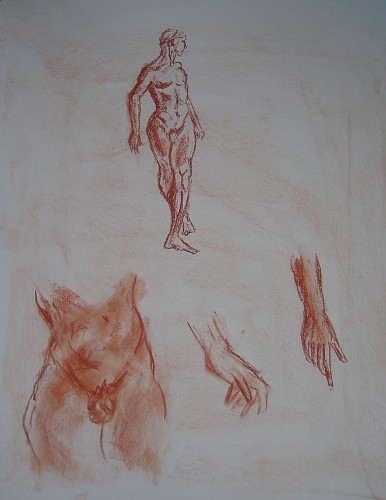
Matthew Felix Sun's Live Drawing_1367

Saturday, January 16, 2010

Art of Translation

Recently, I had certain discussions with friend regarding what constructs as a good translation.

Since I'm reading Italienische Reise by Johann Wolfgang von Goethe, I picked out the Penguin Classics English version translated by W.H. Auden as well.

Goethe wrote:
14. September

Der Gegenwind, der mich gestern in den Hafen von Malcesine trieb, bereitete mir ein gefährliches Abenteuer, welches ich mit gutem Humor überstand und in der Erinnerung lustig finde.

My direct translation reads:
"The headwind, which drove me yesterday into the port of Malcesine, prepared me a dangerous adventure, which I endured with good humor and in the memory find amusing."

W.H. Auden translated the same sentence as:
"The contrary wind which drove me yesterday into Malcesine harbour involved me in a dangerous adventure from which, thanks to keeping my temper, I emerged victorious and which highly amuses me in retrospect."
Victorious was clearly Auden's interpretation of what Goethe felt but didn't write. I actually don't believe Goethe felt victorious at all.

Interestingly, W.H. Auden wrote in the introduction to the Penguin Classics version:
"A translator, that is to say, has to assume that his readers cannot and never will be able to read the original. This, in its turn, implies that they are not specialists in his author. On the one hand, they probably know very little about him; on the other, their appetite for scholarly footnotes is probably small... The translator's most difficult problem is not what his author says but his tone of voice. How is a man who thought and wrote in German to think and write in English and yet remain a unique personality called Goethe? To offer a translation to the public is to claim that one does know how Goethe would have written had English been his native tongue, to claim, in fact, that one has mediumistic gifts, and, as we all know, mediums are often rather shady characters."
He continued:
"If the translator has really understood his author, he will be able to evoke in his own mind not only what the author has done, but also what he wanted and ought to have done."
W.H. Auden's treatise on translation is very interesting. I agree with his assertion that a translator ought to understand his author more deeply than what is conveyed by what has been written down. I also agree that it is vital to maintain the tone of the original voice. But I disagree strongly with the argument that a translation should be what the author would have written if the translated language were the author's native tongue. Instead, a good translation should be faithful to the idioms of the foreign language and the author's tone of voice, maintaining the structure of the sentences without rendering text unreadable. A tall order indeed. But it is achievable. The translator husband-and-wife team Richard Pevear and Larissa Volokhonsky set glorious examples with their scrupulously faithful translations of Tolstoy, Dostoyevsky, Chekhov, et. al.