Showing posts with label Turandot. Show all posts

Friday, October 21, 2011

Those Nasty Princesses - Turandot and Salome

Early this month, I saw my second Turandot by Giacomo Puccini.  Unlike the first time I saw it in the same production by British artist David Hockney on the same San Francisco Opera stage years ago with the truncated ending by Franco Alfano, this time, San Francisco Opera opted for Alfano's complete ending - Puccini died before he could complete his score for Turandot.  The longer ending made the transition of Turandot from an icy monster to a succumbed lover a bit more convincing, without reducing the bombastically glorious outpouring of the melody based on the "hit number" Nessun Dorma.


Luciano Pavarotti sings "Nessun Dorma"

Even so, the story of Turandot as presented by Puccini and his librettist was still a very hard to stomach and accept.  The story was simple: Chinese Princess Turandot, traumatized by a female ancestor's ravishment in the hands of invading male conquer, vowed not to surrender.  She posed three riddles for suitors - whoever solved them won her, otherwise, lost his head.  A tartar prince in exhile, Calaf won the battle and won her heart with a manly kiss.

Ridiculous stuff for sure.  However, beneath the ridiculousness and operative monstrosity, there were deeper meanings which eluded Puccini, whose specialty was small scaled daily emotion, detached from the social fabric.  His Madama Butterfly, his La bohème could be transport into any similar situation in any social and temporal setting, gaining universality but losing depth of social commentary as in Verdi or psychological insight as in Wagner. 

If it were Verdi, he would not have failed to pick out the elements of cultural clash between the female dominant, docile court of China, though hiding behind a bloody curtain, and that of the intrusive militant, male outsiders.  If it were Wagner, what a drama of battle of sexes we would have gain?  In Puccini's hand, we got a gloriously melodic opera celebrating two most insensitive protagonists on stage.  A lost opportunity, perhaps.  However, we do need our bonbons.
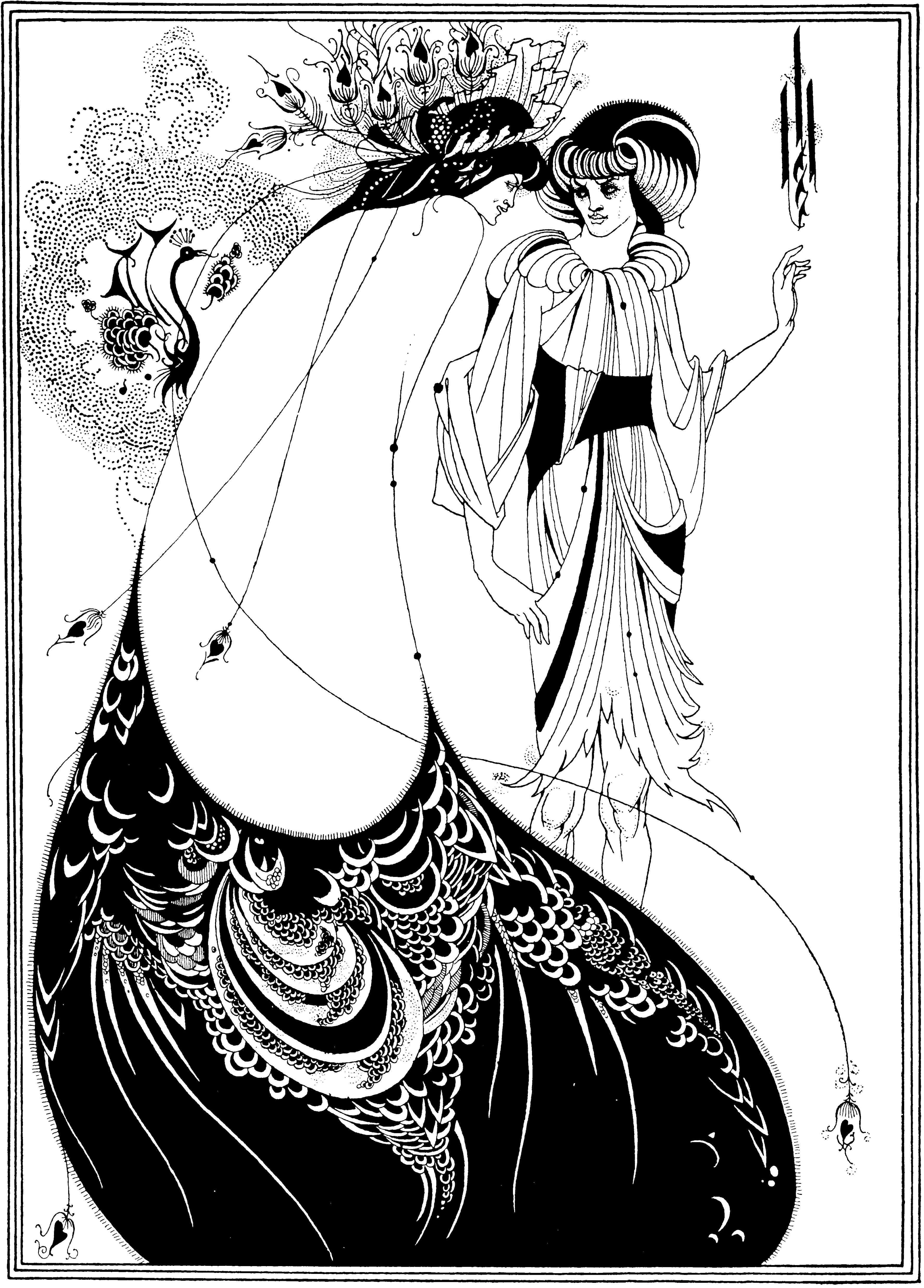
One of the illustrations Aubrey Beardsley
produced for the first English
edition of Wilde's play Salome (1894)
Watching the severed head of a losing suitor, I remembered another princess who liked to lob off head, this time, to gratify her own sexual desire - Princess Salome, courtesy of Oscar Wilde and Richard Strauss.

Awakening sexually on stage, and intrigued by the beauty of John the Baptist, who repulsed her advances, Salome demanded the head of Saint John on a silver platter and kissed the mouth of the severed head and tasted the blood.  In less than two hours time, Strauss presented us a spoiled child growing into a monstrous woman in a highly corrupted court and innocence lost.  His music was much more disturbing, way less heart tugging than Puccini's, but ultimately much, much more satisfying.

San Francisco Opera will present Turandot three more times this November - don't miss the rousing music, despite the gaudy and silly sets and costumes.


Sunday, August 28, 2011

Princess Turandot

San Francisco Opera is to open its new season with Puccini's Turandot, which was based on the great Italian dramatist Carlo Gozzi's play, which also had source from Persian.  Wikipedia stated that "Turandot is a Persian word and name meaning "the daughter of Turan", Turan being a region of Central Asia which used to be part of the Persian Empire."  The location of the story moved from Central Asian to Mongol (a 1710 fable by French scholar François Pétis de La Croix) and finally China (Gozzi, 1762).  Turandot was used as the name of the princess in Puccini's opera.

The story in Puccini's version was a deposed blind Tartar King Timur and slaved Liù came to China.  Unknown to them, his son Calaf arrived in Peking as well.  Princess Turandot, in the dark shadow of her female ancestor was brutally slain by a conquering prince, was determined not to be conquered by any male.  She posed three riddles for prince suitors.  Whoever could solve the riddles would win her and the throne, or lose his head if failed.  Calaf entered the race and solved the riddles.  In a moment of bravado, he gave Turandot another chance - if she could guess his name, he would be at her disposal.  Turandot tortured Liù for answer.  Liù, in love with Calaf killed herself and Turandot learned what love was through her sacrifice and Turandot and Calaf sang a love-duet over Liù's neglected body.

Fairy tale stuff.

I saw it once, several years ago, in the same David Hockney production, which was as fantastic as it was gaudy.  The costumes and makeups, particularly that of Turandot, was heavily influenced by the stylized Beijing Opera, and made a very poor princess - she looked definitely more like a Beijing Opera singer than a ethereal princess of China.  During imperial time, folk opera singers were no better than street beggars, social standing wise, therefore, it was quite ridiculous a sight of her to me.  No self-respecting princess in China would allow herself to dress up as a Beijing Opera Singer.  It just would not fly.


The male conquering a half-willing female with a great kiss was quite silly as well.  I also had trouble to sympathize with another little woman of Puccini, Liù, who sacrificed herself for an obvious cad.

I didn't believe that I'd see it again in the same production.  However, I had a new understanding of the opera and that made me eager to see it again.

Very recently, I realized that this is an allegory or prophecy about the history of China, written by foreigners.

Turandot can be seen as the embodiment of the Chinese people, who was keenly aware of the history of being invaded by barbaric - the Huns, the Mongols, the Manchus and the Japaneses and was determined to fend them off by all means, however cruel.

Seeing through lens of modern history, Calaf, the foreign prince suitor, can be seen as the seductive Communist ideas, personified by a Lenin, or better still a Stalin figure, who, not without struggle, conquered the half-reluctant, half-willing nation.

Or, seen through even more contemporary history, Calaf can be seen as a capitalist, say like Micheal Jackson, armed with Coca Cola, won the heart of the people of China and the feeble, aging emperor is the omnipresent portrait or bust of Mao Zedong.  For people who enjoy anachronism, a Steve Jobs armed with an iPad to tame the daughter of China is not out of line at all.

I never knew that western prophet could have such keen insight of China, and its history and people.  But I might only be dreaming.  When the opera is presented on the stage of War Memorial Opera House, it would be again, that gaudy and bombastic chinoiserie.