Friday, March 5, 2010

Overcoming Language Barrier - chinaSMACK.com

chinaSMACK was created to translate regularly popular and quirky (if not outright scandalous) news and phenomena from China’s ever-vibrant and ever-teeming BBS discussion forums, which has been more and more popular.

chinaSMACK helped to penetrate into the great mystery of modern Chinese social and cultural fog by translating original Chinese contents. chinaSMACK is arguably the first English-language blog about China featuring translated Chinese internet pop-culture phenomena, putting the thoughts and comments of actual Chinese netizens front and center.

chinaSMACK has been growing fast and it claims an average of 7,000 visitors per day.

Thursday, March 4, 2010

Artists Photo Sharing Online

I have talked about the benefit of using photo sharing sites like Flickr.com for artits. One can find out many useful information regarding how a particular image is received by the public. Flickr categorizes broadly regarding how the viewers come to the image. One can find out if people found the image through one's website, blog, image search engine or from Flickr itself. These can enable artists to adjust the tags or labels used, to align with the most commonly searched terms.

However, high viewership doesn't necessarily mean the success of the artwork. People might come to view the work for the purposes other than art appraisal.

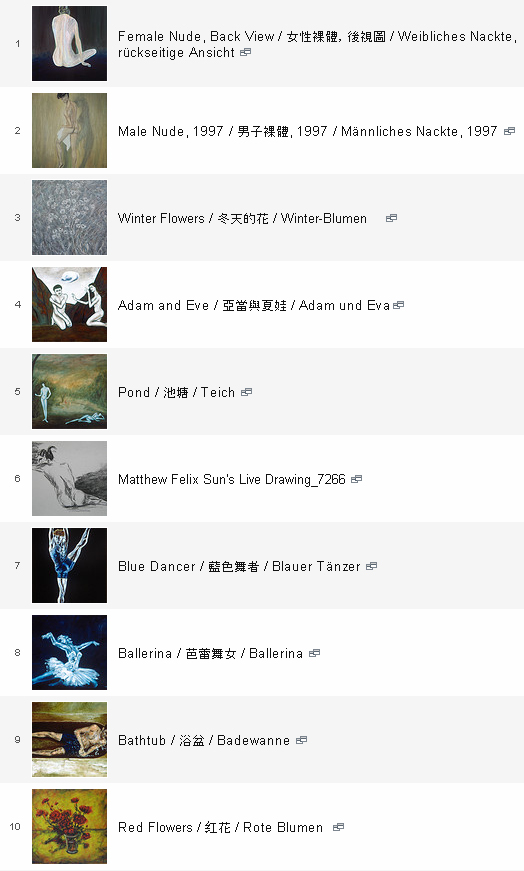
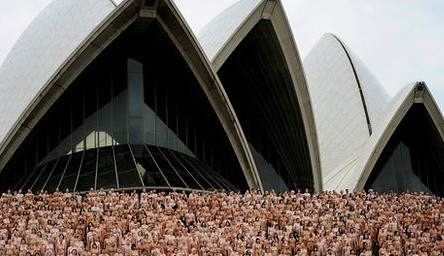
Amongst my public images, the mostly viewed image is a female nude painting, which has just overtaken the top spot from a male nude painting. The third one is a flower painting and followed by more nudes, and flowers. A few days ago, I posted and blogged a photo of 5,000 naked people gathered together in front of Sydney Opera House posing for artist Spencer Tunick. Within minutes of the posting the picture online, it was viewed 12 times. Within an hour, the hit was more than 100. Within a day, it was viewed for more than 500 times. Artists should not be carried away by the high viewership and must try to understand the motives of viewers.

Below is the snap shot of my top ten most viewed images on 3 March, 2010:

Wednesday, March 3, 2010

San Francisco Artist Georgianne Fastaia

I had the honor of showing my works with fantastic San Francisco artist Georgianne Fastaia.

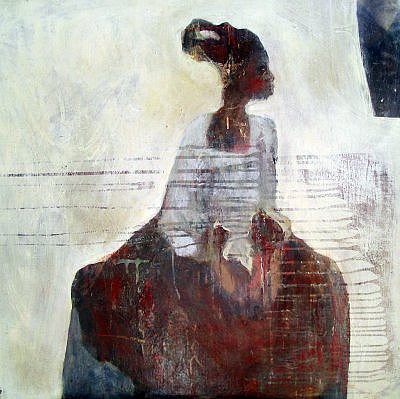
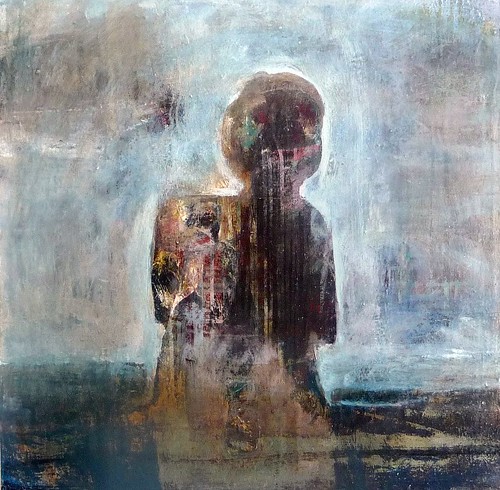
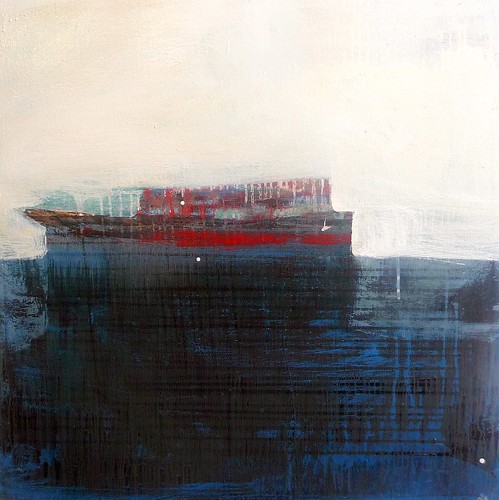
Her works - mostly figures and landscape or cityscape - have rich textures and great atmosphere. Her figures often boldly claim large portion of the canvases, giving them a sense of timeless monumentality, yet they are abruptly confronted by the edges of the canvases, making them somewhat vulnerable, therefore the complexity of the figures and the paintings palpable. I also detect sense of desolation from her landscape, not dissimilar to those by Edward Hopper, despite the obvious difference of their techniques and subject matters. This sense is particularly obvious in her works painted after Hurricane Katrina.

Below are a sample of her works I admire greatly:


Mother of Saint 36x36
Originally uploaded by georgianne fastaia


Horizon 30x30
Originally uploaded by georgianne fastaia


Twilight 48x48
Originally uploaded by georgianne fastaia

Bay Freighter 36x36
Originally uploaded by georgianne fastaia

Detailed information about Georgianne Fastaia can be found on her ArtSlant page as well.

Tuesday, March 2, 2010

Provocative Exhibits on Race: Catharine Clark Gallery & Lawrence Hall of Science

I visited Catharine Clark Gallery in San Francisco for Travis Somerville exhibit. Established in 1991, Catharine Clark Gallery, San Francisco presents the work of local, national and international contemporary artists.

According to the bio on Catharine Clark Gallery's website, "Travis Somerville was born in 1963 in Atlanta, GA. Growing up in towns throughout the southern United States and along the eastern sea board, he briefly studied at Maryland Institute College of Art, Baltimore, MD, finally settling in San Francisco where he attended the San Francisco Art Institute, CA. His large scale oil paintings on paper mounted to canvas incorporate collage and present images of political and cultural icons associated with the history of the south. His work explores the complexities of racism and serves as a point of departure for discussion about US oppression and colonial attitudes abroad."

There were collage paintings, installations, and graphic art on display. The most engaging one was the installation piece:
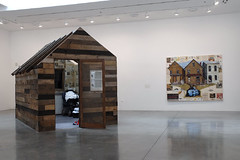
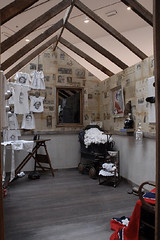

Inside this little cottage, I saw the "replicas" of old furniture, and fascinating vintage newspaper articles on the walls - with news like President Kennedy's funeral procession, the shooting of his suspected assassin, etc. Many white cottons shirts and dresses were on laundry lines and an ironing board. Black figures made of fabric -- rag dolls -- occupied places the dwellers would have been sitting. A window opened to the dark world outside, where a small cross was burning. A radio was on, playing the sound of the burning cross. It was a rather aesthetically intriguing, or even pleasing sight. Yet unholy.
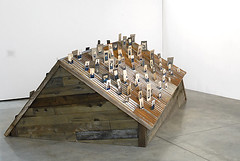
Another large installation was a roof of a submerged house. Instead of human beings, vintage photographs took their place atop the roof. The lower part of these photographs were colored in blue, representing the rising water. It evoked the memories of the sad events in New Orleans during the aftermath of Hurricane Katrina.


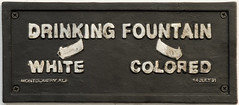
Two installations were in a similar vein. One was simpler and consisted of only two water fountains - a regular fountain for white people and a bucket for "colored." Inside the bucket I saw only dried red soil. Above the fountain and bucket was the vintage sign below:


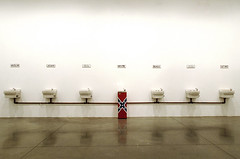
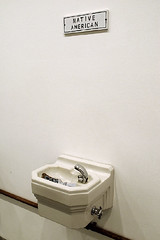
The more complicated installation had many more water fountains. In the middle was a modern day water fountain which dispenses cold water, painted in Dixie flag pattern - for white people. Three smaller fountains on each side were designated for Muslim, Black, Asian, Pacific Islander, Native American, etc. Water calmly oozed out of the seven sprouts. Inside the basin, derogatory symbols corresponded to the labels above. This installation was quite provocative.

His collages represented collapsed trees, houses, a bust of Martin Luther King, and dreams. The graphic piece was a collage of Kennedy and Obama - roughly upper left and lower half for one, the other parts for the other. I couldn't tell if it was optimistic or pessimistic. Perhaps that was what it meant to be.

This exhibition reminded me another one I saw recently at Lawrence Hall of Science at University of California, Berkeley - RACE: Are We So Different?

Race Logo

The premises of this exhibit was summarized on the official website as below:
It’s a simple truth: People are different.
Throughout history, these differences have been a source of community strength and personal identity. They have also been the basis for discrimination and oppression. This exhibit provides an opportunity to understand race from a biological, cultural, and historical perspective through engaging, hands-on science experiences; real artifacts; and videos that present people’s unique stories.
The exhibit explores key issues that relate to race including:

Skin color does not equal race.

Use a microscope to view your skin close up. Scan it and watch as your image appears on screen with skin images from dozens of other people.

Voices do not identify race.

Use a large touch-screen monitor to try to match a voice you hear to a photo you see.

We all have common ancestors.

Use a wheel to control an animated interactive map of how humans spread out from Africa to populate the world.

The Race exhibit clarified many mis-conceptions and posed many important questions. What I felt somewhat missing was an exploration of relationships amongst minority groups in the U.S. and the directions and steps one might take to build a socially just society. However, the opening of the dialogue was an important step in the right direction.

The Travis Somerville show ends on April 3, 2010 and the Race exhibit ends on May 2, 2010. I highly recommend both.

Monday, March 1, 2010

Naked Art

Last weekend, more than 5,000 people took off their clothes on the steps of the iconic Sydney Opera House to pose for Spencer Tunick, famous for his snapshots of mass nudity in public spaces. This installation was commissioned by the Sydney Gay and Lesbian Mardi Gras.

Tunick claimed: "Gay men and women lay naked next to their straight neighbours and this delivered a very strong message to the world that Australians embrace a free and equal society."

Quit a followup to my previous post - Is it Art?

Frederick Chopin Museum Opened in Warsaw on His 200th Birthday


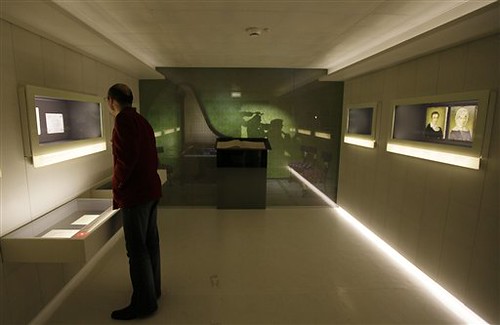
Frederick Chopin Museum opened today in Warsaw, on the 200th birthday of the great polish composer.

Amongst the artifacts, visitors can see the last piano that Chopin composed on, a death mask made after he died of possible tuberculosis and a lock of his brown hair.

The museum is located in the center of Warsaw, where infant Chopin moved in from a nearby country estate, and spent the first 20 years of his life before moving to Paris.

Many of the artifacts related to the romantic composer, such as letters were destroyed by women he was romantically involved with while others in the World War II.

Since 1899, Polish authorities has been gathering musical scores, sketches and other objects connected to Chopin, which are are priceless in terms of emotional value.

The museum is arranged thematically with spaces devoted to different aspects of his life. The final room is devoted to his death on Oct. 17, 1849 at age 39. It contains a plaster death mask taken of Chopin's face. On display are also invitations to his memorial service in Paris, as well as a lock of his brown hair treasured by his family.

The museum is housed in the stately Ostrogski Palace, home of the Fryderyk Chopin Institute, in the center of Warsaw.