Tuesday, October 5, 2010

Neue Galerie New York - Austrian and German Art Gallery

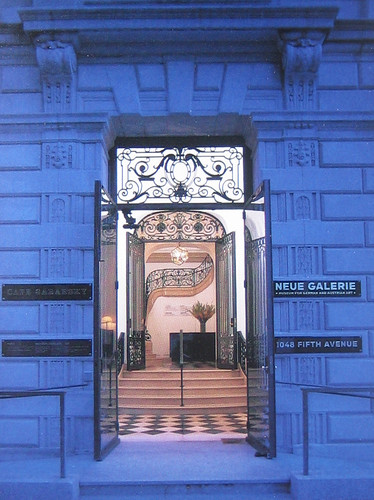
Entrance to Neue Galerie New York

My last museum visit while in New York last month was Neue Galerie New York, which showcased Austrian and German art. The gallery was at the intersection of 5th Avenue and E 86th Street, only two to three blocks from the MET.

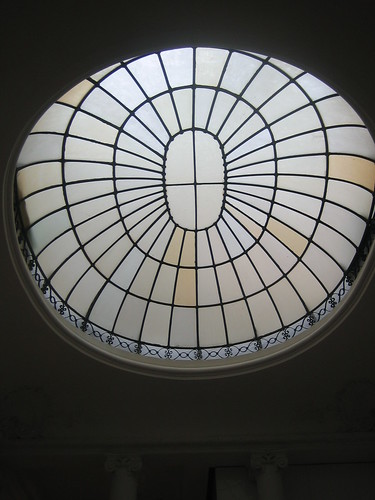
The building itself was an Art Nouveau marvel with ornate staircases and glass canopy.
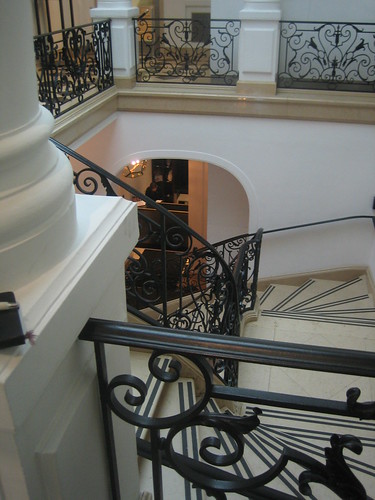
Neue Galerie New York _ 8459

Neue Galerie New York _ 8460

Neue Galerie New York _ 8461

Neue Galerie New York _ 8464

The exhibition rooms were arranged like living quarters, lending the atmosphere of in the period of early 20th century.
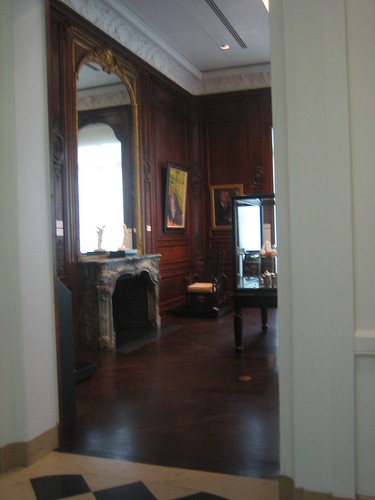
Neue Galerie New York _ 8462

Unfortunately, when we were there, it was between shows, again, and only two rooms open on the second floor, featuring Austrian art only.  Even so, there were much to saver still.  What we did see included quite a few works by Gustav Klimt, Oskar Kokoschka and Egon Schiele.
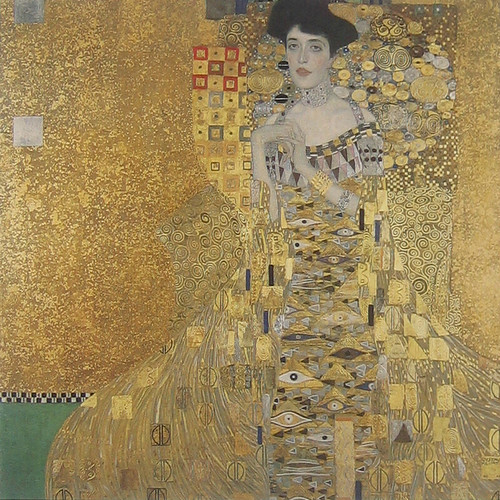
Adele Bloch-Bauer I, Gustav Klimt, 1907

The above Adele Bloch-Bauer I was singularly beautiful.  My friend Steve Masover has written about this piece extensively Gustav Klimt's portrait of Adele Bloch-Bauer: a saga and Property: thoughts on Klimt's portrait of Adele Bloch-Bauer.  The basic story around this painting was that when Adele died, she "bequeathed" it to Austria, once her husband died. Before her husband died, he was forced to flee Austria and his possessions, including this painting was confiscated.  It had been in an Austrian museum till recently, that litigation between the estate of her husband and Austrian government decided that Adele didn't own the piece at all; rather the husband did, who left the painting to his heirs, who made arrangement to sell it the Neue Galerie New York.  The Austrians were reportedly shocked by the decision.  One could easily understood.  Gustav Klimt was quintessential Austrian figure.  This painting was the height of his artistic achievement.  To lose it, was like losing its collective soul, again, and again.  Poor Austrians, they had experienced such losses so many times over.  One suspect that they might be numb.  But no.  They were lovers of art, if nothing else.

I had never been an ardent admirer of Klimt.  But, this painting, together with that I saw at the MOMA, opened my eyes quite a bit and I was able to appreciate him much more.  I reported on the MOMA visit as such:
Another painting I have been resisting till recently was Klimt. I didn't care much for Art Nouveau movement but it was by no means limited to overtly ornate images and designs. They were productions of periods for sure, but the humanity transcended its stylistic boundary.
I also found Adele Bloch-Bauer I very beautiful to behold.  There were many textural details visible when examining it up close. For example, the eyes on her skirt were reliefs and his juxtaposition of simple and complex elements were both swift and harmonious, sudden by not abrupt.  The oriental elements in the below painting Bildnes Baronin Elisabeth Bachofen-Echt (Portrait of Baroness Elisabeth Bachofen-Echt) highlighted the sophistication and beauty of the sitter.  I wasn't sure about the meaning though.  Perhaps, it was better to remain oblivious in this case.
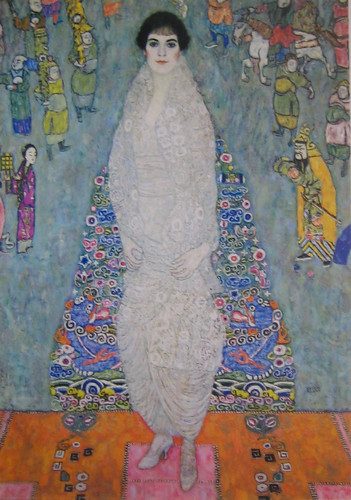
Bildnes Baronin Elisabeth Bachofen-Echt (Portrait of Baroness Elisabeth Bachofen-Echt), Gustav Klimt, c. 1914

While unconventional, Klimt's central figures were still easily be identified as beauties.  Not so with those in Kokoschka and Schiele's.  Take Kokoschka's Martha Hirsch below as example.  She is no conventional beauty and could be intimidating and scary.  However, once a viewer got used to the usual contour and proportions of the figure, one could appreciate the intelligence and emotion portrayed by the artist clearly.  Subtleties were abundant as well.  The colors were beautifully contrasted and blended.  I also love the hand gestures very much.
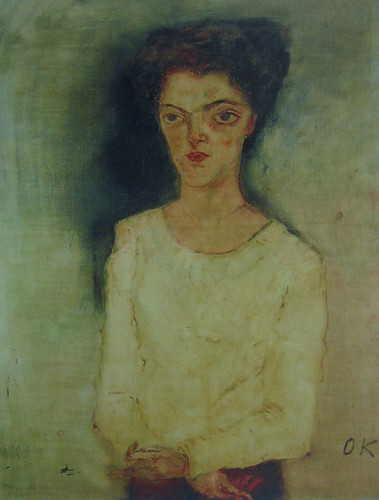
Martha Hirsch, Oskar Kokoschka, 1909

I mostly associated Schiele with striking figure paintings but this landscape below was very interesting as well.  It was bold but also was very carefully designed work, perhaps, subconsciously influenced by the Art Nouveau design.
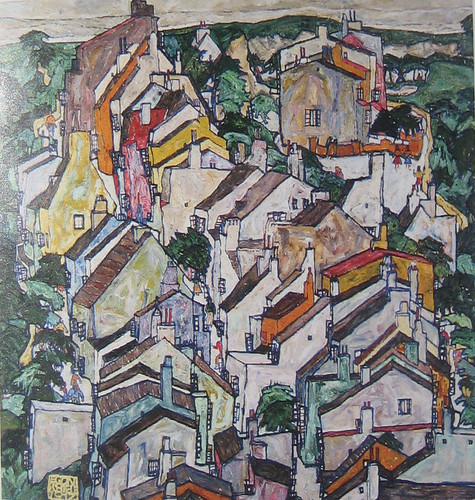
Town Among Greenery (The Old City III) (detail), Egon Schiele, 1917

There were many incredibly beautiful Art Nouveau artifacts in the display cases.  Fanciful, barely functional and all well made.  Perhaps somewhat too much, particularly like the brooches designed by Josef Hoffmann below:
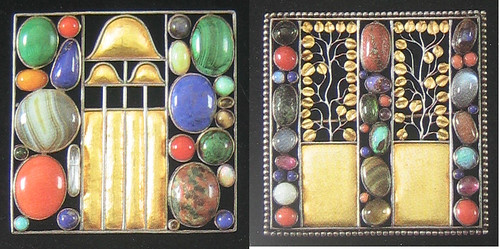
Brooches, Josef Hoffmann, 1908

The museum was not big. There were only two exhibit floors. It seemed that the second floor shows the Austrian art while the third was for German art, therefore, I missed my chance to see some wonderful German paintings, including Max Beckmann's Self-portrait with Horn:
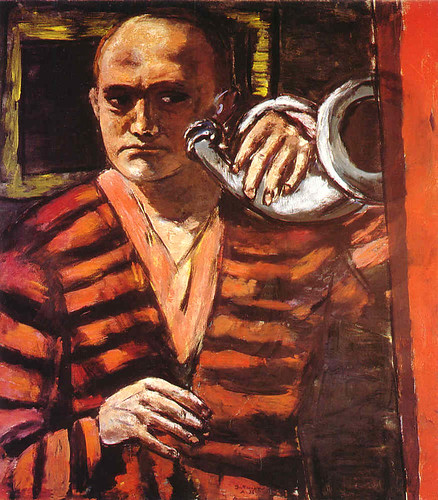
Self-portrait with Horn, 1938-1940, Max Beckmann
Self-portrait with Horn, Max Beckmann, 1938-1940
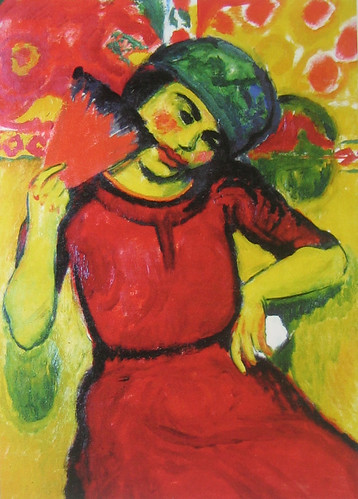
Young Woman with Red Fan, Hermann Max Pechstein, c. 1910
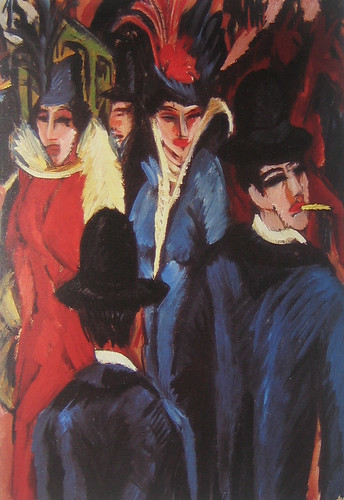

Berlin Street Scene (detail), Ernst Ludwig Kirchner, 1913-14

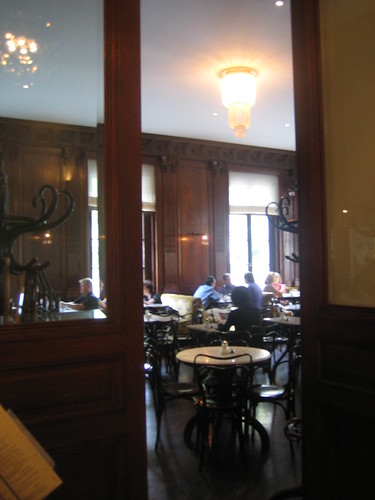
To make the experience full, the gallery has two wonderful Viennese cafes - Café Sabarsky and Café Fledermaus, meticulously decorated in the right style.  I had Kaffee mit Schlag at Café Sabarsky.  However, I didn't get customary little cookie as in Vienna. I guess meticulousness only went certain length.  But it was a beautiful cafe for sure. 

Café Sabarsky, Neue Galerie New York _ 8453
Café Sabarsky

Café Sabarsky, Neue Galerie New York _ 8457
Café Sabarsky

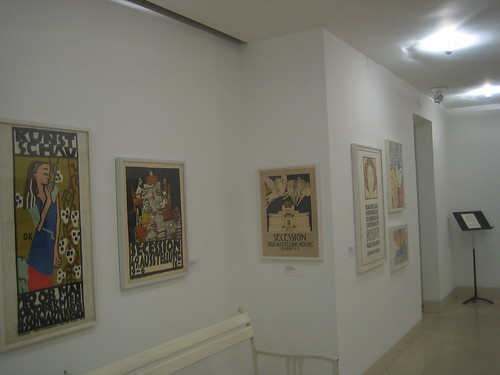
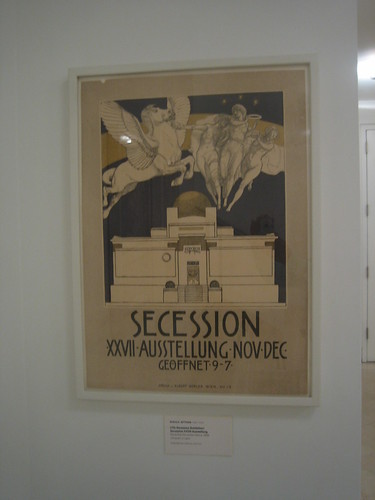
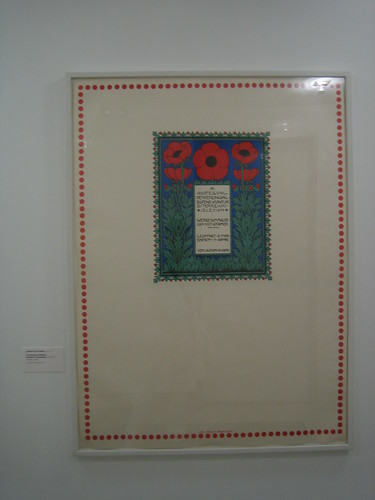
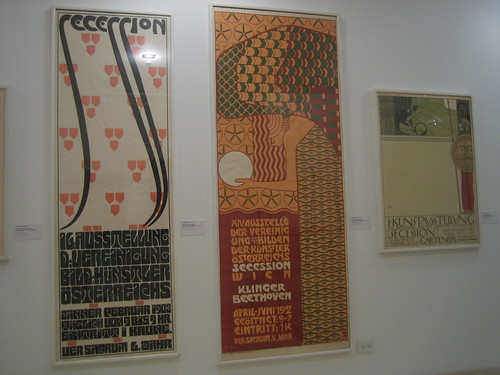
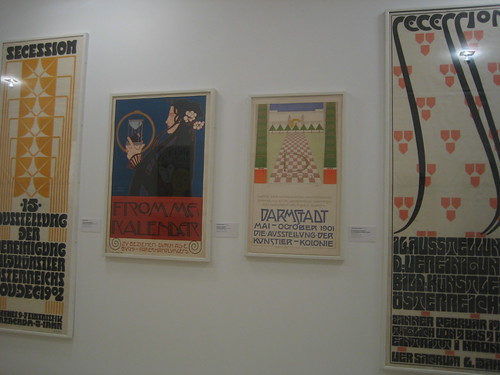
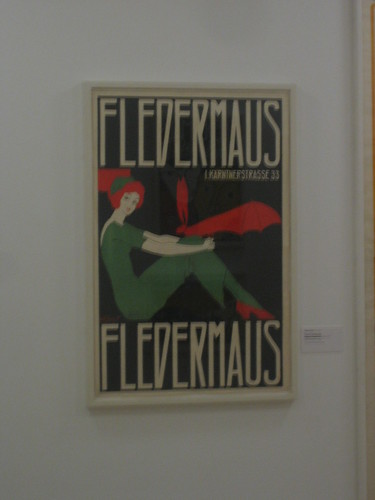
Anther cafe, Café Fledermaus, was closed during my visit. But there were many posters around the entrance to it, from the Vienna Secession period, flowery, sexy, and often quite elaborate.  Quite interesting way to round up the short museum visit.

Neue Galerie New York _ 8467
Entrance to Café Fledermaus

Neue Galerie New York _ 8469

Neue Galerie New York _ 8470

Neue Galerie New York _ 8473

Neue Galerie New York _ 8477

Neue Galerie New York _ 8478

Neue Galerie New York _ 8480

Neue Galerie New York _ 8474

Neue Galerie New York _ 8476

>> New York City Report, September 2010, Part XV: Art in Subway Station, New York City
<< New York City Report, September 2010, Part XIII: Max Beckmann's Paintings in MOMA and MET

Monday, October 4, 2010

Max Beckmann's Paintings in MOMA and MET
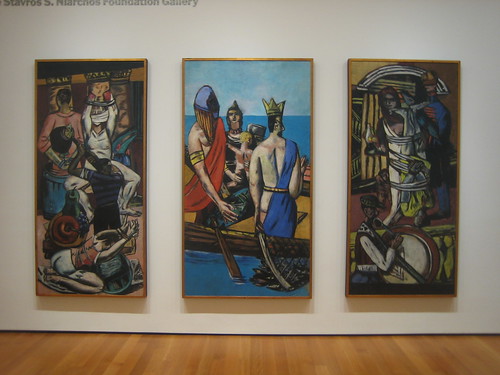
When I reported my visits to MOMA and the MET, excepting for reporting Matisse separately, and Doug + Mike Starn due to special exhibits, I also left out German born American painter Max Beckmann, whose influence on me was the greatest.  I particularly cherish his topical insight and brilliant sense of color and painterly technique.

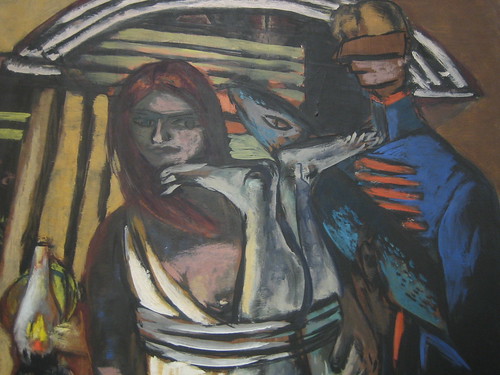
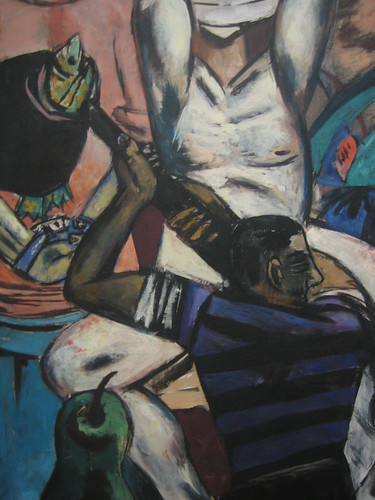
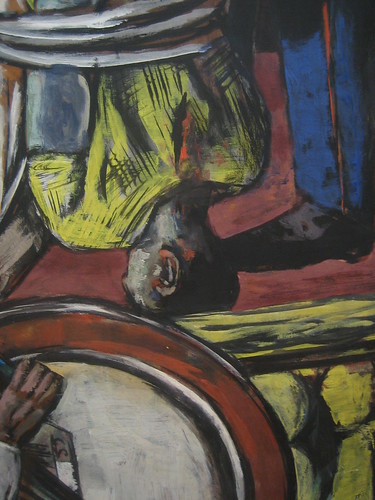
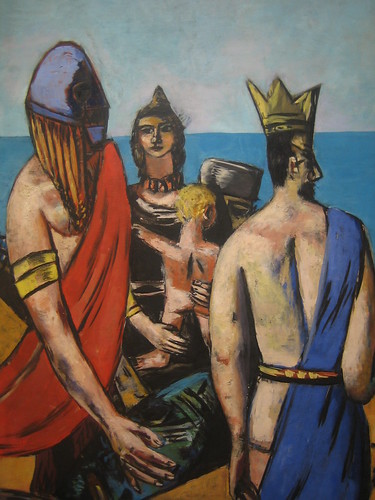
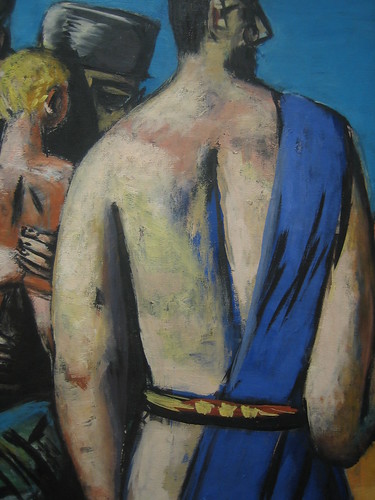
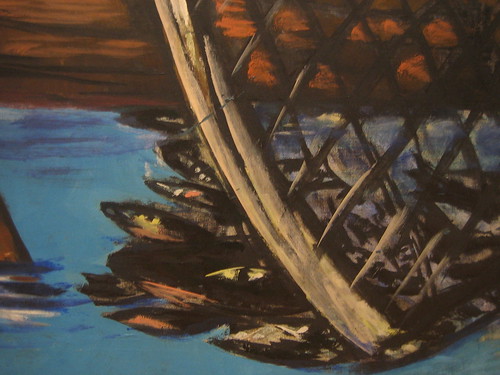
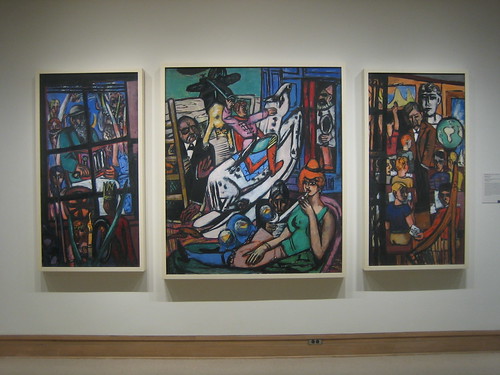
I was very glad to encounter his great triptychs again, Departure, 1933-35, at MOMA and Beginning, 1949, at the MET. 

The MOMA's catalog states such about Departure:
In the right panel of Departure, Beckmann once said, "You can see yourself trying to find your way in the darkness, lighting the hall and staircase with a miserable lamp, dragging along tied to you, as part of yourself, the corpse of your memories." The triptych is full of personal meaning, and also of mysteries. The often-appearing fish, for example, are ancient symbols of redemption, but may also connote sexuality. Perhaps the woman under torture gazes prophetically into a crystal ball—but what she seems to see is the daily paper. Men's faces are hidden: averted in the side panels, masked in the center. Is it the same couple whose fate each image tracks?

Beckmann's accounts of Departure are fragmentary, and, in any case, he believed that "if people cannot understand it of their own accord, . . . there is no sense in showing it." But the work, however elusive in its details, is clear overall: painted at a dark time in Germany (that of Hitler's rise to power), it tells of harsh burdens and sadistic brutalities through which the human spirit, regally crowned, may somehow sail in serenity. Beckmann called the center panel "The Homecoming," and said of it, "The Queen carries the greatest treasure—Freedom—as her child in her lap. Freedom is the one thing that matters—it is the departure, the new start."

Departure, 1933-35, Max Beckmann _7495
Departure, 1933-35, Max Beckmann, MOMA

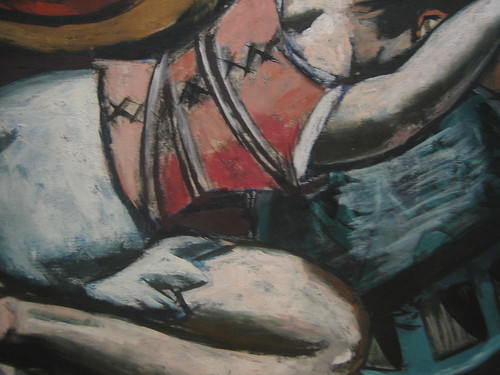
Departure (details), 1933-35, Max Beckmann _7502

Departure (details), 1933-35, Max Beckmann _7500

Departure (details), 1933-35, Max Beckmann _7501

Departure (details), 1933-35, Max Beckmann _7504

Departure (details), 1933-35, Max Beckmann _7498

Departure (details), 1933-35, Max Beckmann _7513

Departure (details), 1933-35, Max Beckmann _7503

It was very interesting to compare this, made in one of the darkest moments of human history, to that at the MET, made at the end of the nightmare and the beginning of the new growth, yet it was still hard to find hope.  Less than a nightmare, disturbing nonetheless.

Beginning, 1949, Max Beckmann _8358
Beginning, 1949, MET

MET's website says such about the above Beginning:
The theme that connects the three panels of "Beginning," the most autobiographical of Beckmann's ten triptychs, is a childhood dream. The central panel shows a playroom where a little boy in military costume brandishes a sword as he mightily rides a rocking horse. His Puss 'n Boots doll hangs upside down behind him, presumably slayed by his weapon. The noise he makes has alarmed his parents (seen at the left near the ladder), who have climbed up to inspect his attic kingdom. More prominently placed is the figure of a redheaded woman who reclines seductively, blowing blue bubbles from a pipe. Squeezed between the boy and his fantasy is an old grandmother reading a newspaper. To the left and right, on separate panels, Beckmann painted other memories from his childhood — a hurdy-gurdy grinder and a classroom with teacher and students.

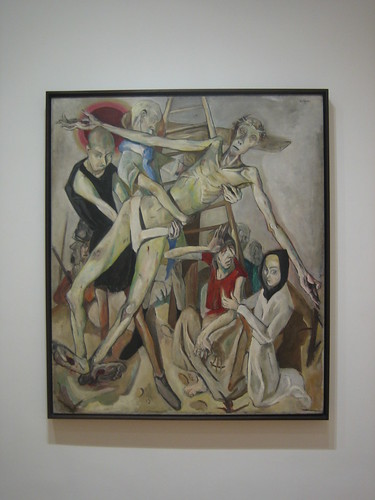
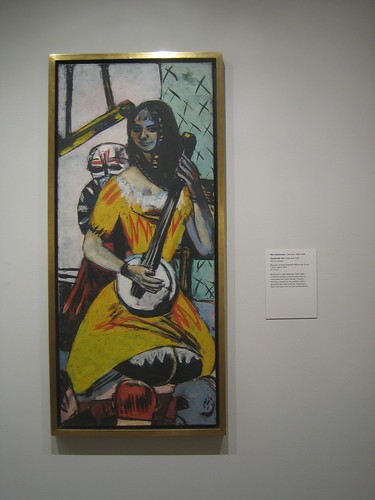
At each museum, I also saw other pieces by Beckmann: The Descent from the Cross, 1917, at MOMA, and Vaudeville Act, 1934 and 1937, at the MET:

The Descent from the Cross, 1917, Max Beckmann _7522
The Descent from the Cross, 1917, Max Beckmann, MOMA

Vaudeville Act, 1934 and 1937, Max Beckmann _8363
Vaudeville Act, 1934 and 1937, MET

I was less smitten by his works in his early period, when his palette was pale and corpse like.  I truly love his color palettes from 1930s onwards.  Take Vaudeville Act for example, the wonderful contrast of yellow and red on the dress, the black scarf between the yellow dress and pale green screen/curtain, and the blue and red color patches of the audiences webbed a world both beautifully reassuring and unnaturally otherworldly.  On surface, this is rather a jovial work, but the creepy figure with white and black face lurched behind the instrument player told us more.  What a scary world he endured and what wonderful output he gave us.

>> New York City Report, September 2010, Part XIV: Neue Galerie New York - Austrian and German Art Gallary 
<< New York City Report, September 2010, Part XII: 19th and 20th Century Art at the MET 

Saturday, October 2, 2010

19th and 20th Century Art at the MET

MET has a huge selection of European paintings from the 19th and 20th century, many of them are iconic and it was beyond believe that so many treasures are under the same roof.

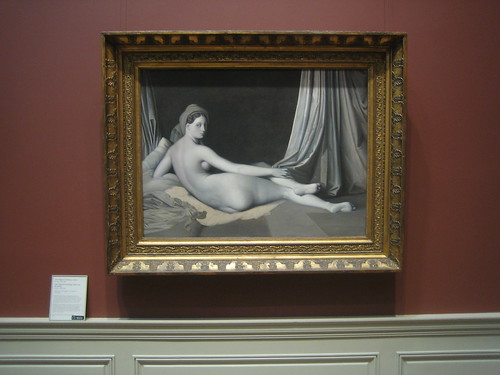
The tour of this section started with Ingres and his workshop's Odalisque in Grisaille, which I didn't remember having seen, though the version with full color was trice familiar.  It was very fascinating to see how Ingres employed the technique traced back from Renaissance Old Masters.

Odalisque in Grisaille, c. 1824-34, Jean-Auguste-Dominique Ingres and Workshop _8409
Odalisque in Grisaille, c. 1824-34, Jean-Auguste-Dominique Ingres and Workshop

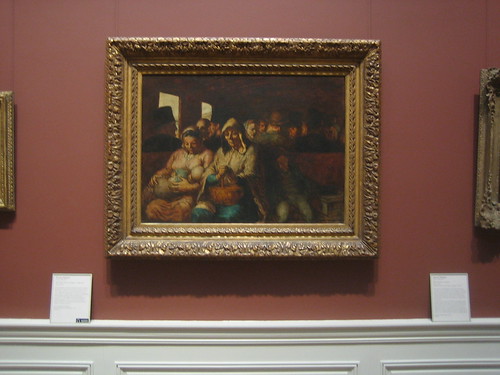
But Ingres' Opus were almost belong to the previous century and his classical world were soon superseded by those more earthy and in-your-face type of depictions of life, like The Spanish Singer by Manet and The Third-Class Carriage by Honoré Daumier. Yet, they were not manifested from thin air; rather, they carried on the traditions of Goya and Rembrandt, et al.

The Spanish Singer , 1860, Édouard Manet 
_8405
The Spanish Singer, 1860, Édouard Manet

The Third-Class Carriage, ca. 1862–64, Honoré Daumier  _8413
The Third-Class Carriage, ca. 1862–64, Honoré Daumier

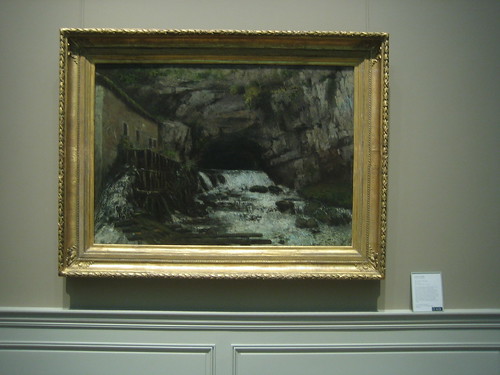
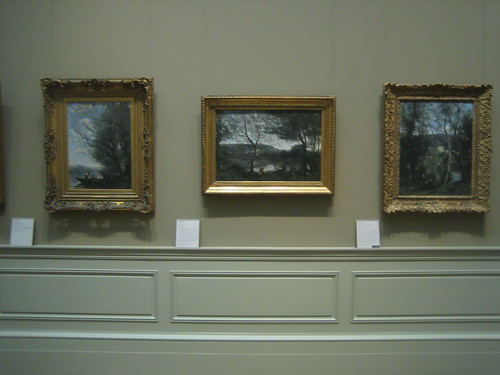
In the same unsettling way, landscape paintings made stride in France.  The best examples are those by Courbet and Corot.  Monet made landscape paintings in this style as well, before he went on to become an "impressionist".  Millet also excelled in country landscape as well.

The Source of the Loue, 1864, Gustave 
Courbet _8404
The Source of the Loue, 1864, Gustave Courbet

The Ferryman 
(left),Ville-d'Avray, c. 1865, A Woman Gathering Faggots at 
Ville-d'Avray (right), c. 1871-74, Camille Corot _8410
The Ferryman (left),Ville-d'Avray, c. 1865, A Woman Gathering Faggots at Ville-d'Avray (right), c. 1871-74, Camille Corot

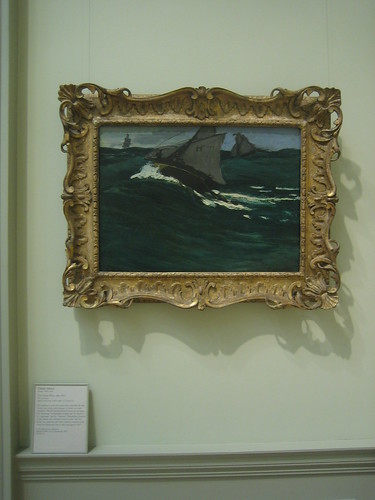
The Green Wave, after 1865, Claude Monet 
_8398
The Green Wave, after 1865, Claude Monet

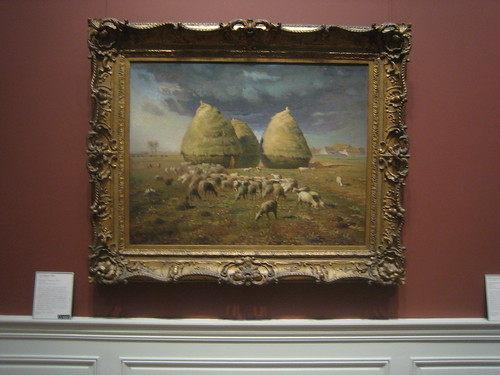
Haystacks: Autumn, c. 1874, 
Jean-François Millet _8414
Haystacks: Autumn, c. 1874, Jean-François Millet

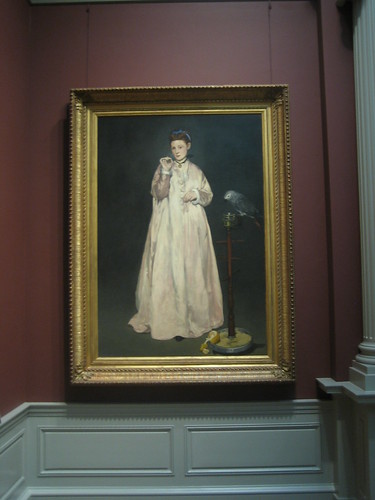
But these artists didn't neglect the human world, with the exception of Monet, who showed no interest in depicting people but Manet, Millet, Corot, plus later comers Degas, Cézanne, kept unearthing the truth of human conditions. 

Young Lady in 1866, 1866, Édouard Manet _8406
Young Lady in 1866, 1866, Édouard Manet

A Woman Reading, 1869 and 1870, Camille Corot _8411
A Woman Reading, 1869 and 1870, Camille Corot

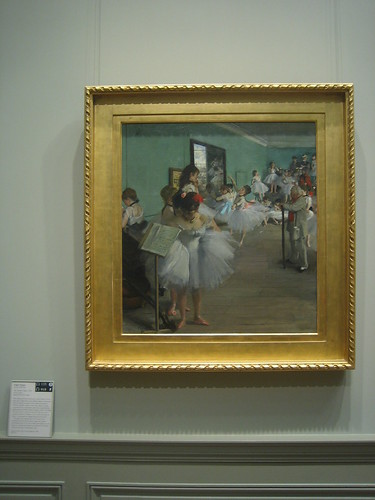
The Dance Class, 1874, Edgar Degas _8408
The Dance Class, 1874, Edgar Degas

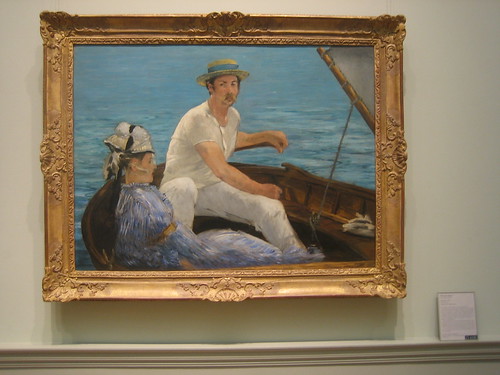
Boating, 1874, Édouard Manet  _8396
Boating, 1874, Édouard Manet

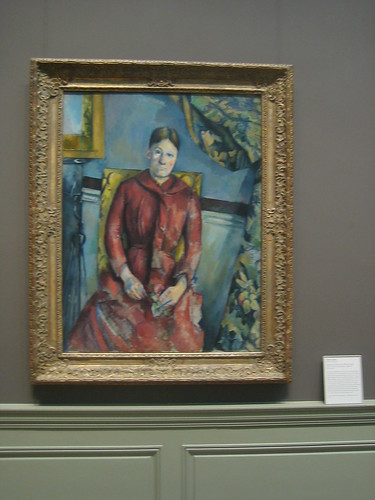
Cézanne's portraits, over the years, had evolved so much and one could see the advance of cubism in his Madame Cézanne (née Hortense Fiquet, 1850–1922) in a Red Dress dated 1888-90.

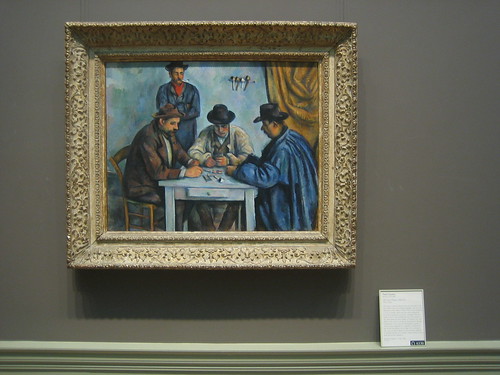
The Card Players, 1890-92, Paul Cézanne _8402
The Card Players, 1890-92, Paul Cézanne

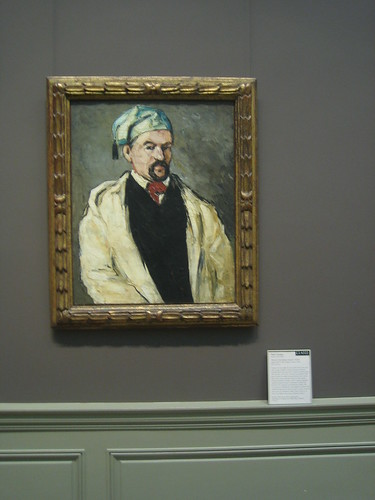
Antoine Dominique Sauveur Aubert (born 1817), the Artist's Uncle, 1866, Paul Cézanne _8401
Antoine Dominique Sauveur Aubert (born 1817), the Artist's Uncle, 1866, Paul Cézanne

Madame Cézanne (née Hortense Fiquet, 1850–1922) in a Red Dress, 1888-90, Paul Cézanne _8400
Madame Cézanne (née Hortense Fiquet, 1850–1922) in a Red Dress, 1888-90, Paul Cézanne

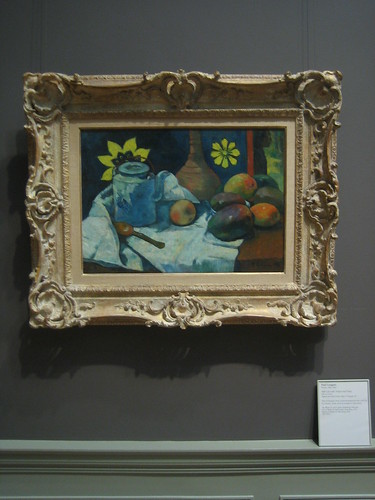
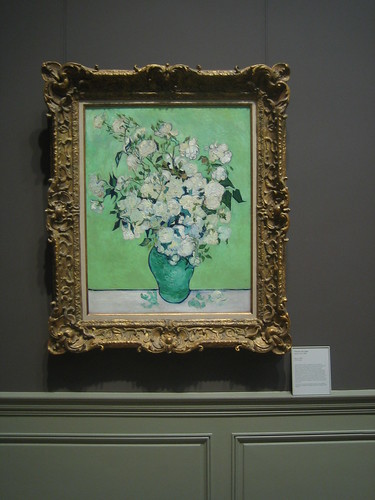
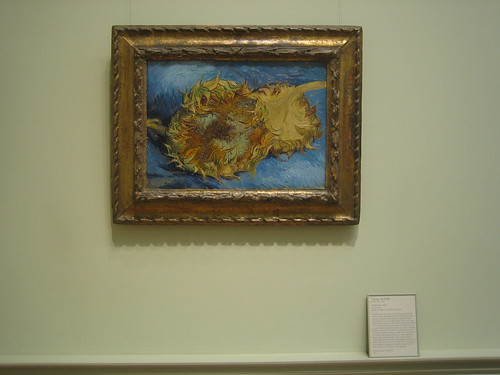
I might have missed portrait and figure paintings by Gauguin but his still life was just as energetic and bold.  Bolder still, we entered Van Gogh's world.  I included a few paintings by him - both still life and portrait, not the most familiar ones but still very well known - beautiful, and slightly edgy and unsettling.

Still Life with Teapot and Fruit, 1896, Paul Gauguin _8392
Still Life with Teapot and Fruit, 1896, Paul Gauguin

Roses, 1890, Vincent van Gogh _8389
Roses, 1890, Vincent van Gogh

Sunflowers, 1887, Vincent van Gogh_8388
Sunflowers, 1887, Vincent van Gogh

L'Arlésienne Madame Joseph-Michel Ginoux (née Marie Julien, 1848–1911), 1888-89, Vincent van Gogh _8387
L'Arlésienne Madame Joseph-Michel Ginoux (née Marie Julien, 1848–1911), 1888-89, Vincent van Gogh

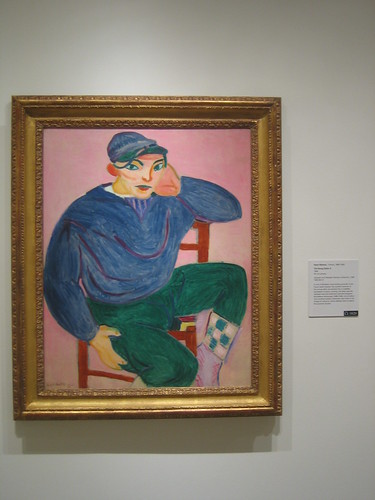
Next giants were Matisse and Picasso.  This 1906 early Matisse below definitely had obvious contrast to those included in the special exhibit at MOMA - "Matisse: Radical Invention, 1913-1917", but the connections even to his later period can be easily identified.

The Sailor II, 1906, Henri Matisse _8372
The Sailor II, 1906, Henri Matisse

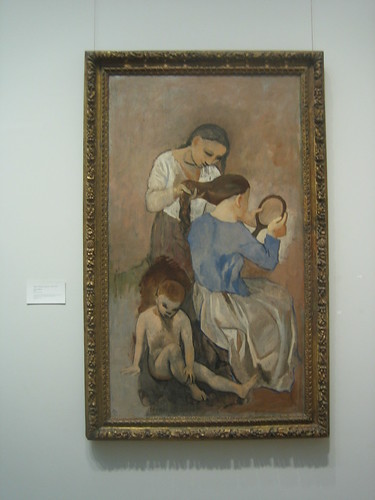
Picasso created La Coiffure in 1906 as well. It was an exciting period for sure.

La Coiffure , 1906, Pablo Picasso _8416
La Coiffure, 1906, Pablo Picasso

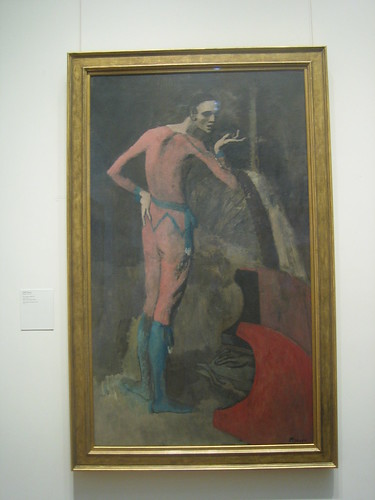
It was good to see the damaged The Actor had been repaired and were back in the gallery.  The restorers did such a wonderful job that one could not see the damages at all.

The Actor, 1904-05, Pablo Picasso _8383
The Actor, 1904-05, Pablo Picasso

There were many more wonderful works, all the way down to the end of 20th century.

The Dark Mountain, Number 1, 1909, Marsden Hartley _8382
 The Dark Mountain, Number 1, 1909, Marsden Hartley

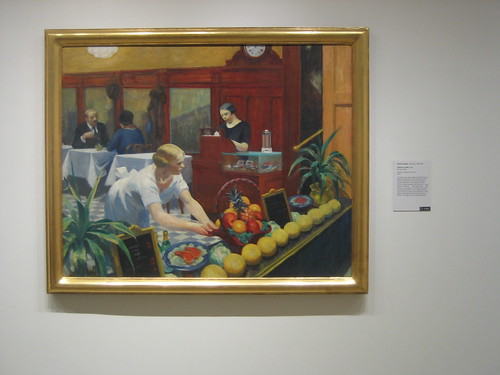
Tables for Ladies, 1930, Edward Hopper _8380
Tables for Ladies, 1930, Edward Hopper

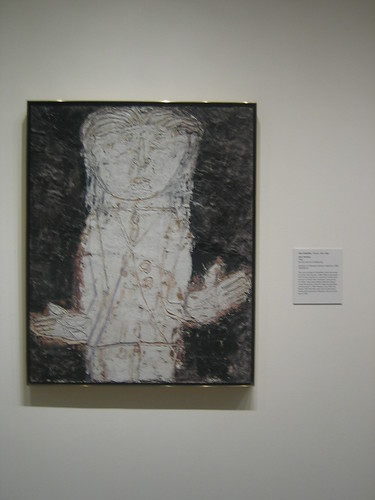
Jean Paulhan, 1946, Jean Paulhan _8376
Jean Paulhan, 1946, Jean Paulhan

Venice, Night, from Venetian Views, 1995, Howard Hodgkin _8267
Venice, Night, from Venetian Views, 1995, Howard Hodgkin

The only sculpture I stopped by to study, after many from Greek and Roman section, was a Herakles the Archer, which was dated only as 20th century:

Herakles the Archer, 20th century, Emile-Antoine Bourdelle _8269
Herakles the Archer, 20th century, Emile-Antoine Bourdelle

>> New York City Report, September 2010, Part XIII: Max Beckmann's Paintings in MOMA and MET
<< New York City Report, September 2010, Part XI: 14th - 18th Century Paintings at the MET
Friday, October 1, 2010

A Semi-Abstract Painting Finished

In the middle of busying posting my New York Museum and Gallery visits, I thought about my own artistic endeavor hard, forwards and backwards. Yet, life goes on and I moved back to my studio and picked up where I left off.

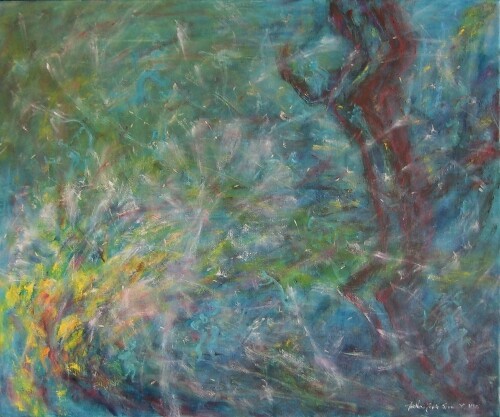
Finally, I was able to finish a semi-abstract painting.  I was mostly interested in exploring color contrasts and relations with this work, at the same time, trying to experiment with spatial vantage points.  It went even further, when I started to incorporate figures (light blue ones) in the poses can be either like we see in cartoons or in the ancient brick relief from China.  They suspend in the mid-air and in the history, ready to be blown away, thus I added elements of dandelions, which reinforces the feeling of involuntary dispersion.


Dispersion / 彌散 / Zerstreuung
Dispersion
Oil on Canvas
20" x 24"
Completed in 2010

© Matthew Felix Sun
www.matthewfelixsun.com