
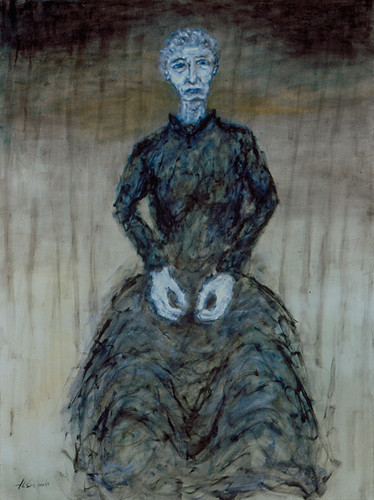
White Dresses
Oil on Canvas
22" x 28"
Completed in 2011
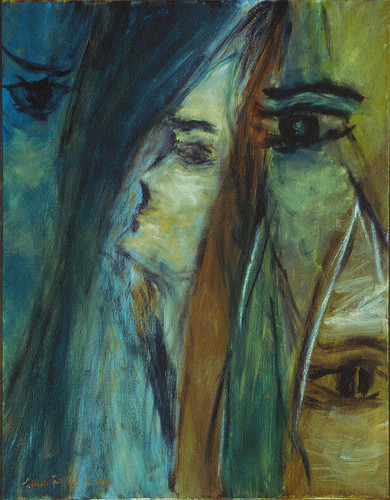
For comparison, below images is the one I completed in 2005 - White Dress:

White Dress
Oil on Canvas
20" x 16"
Completed in 2005

After two decades with Cake, McCrea has started to think about his life after the band — which might mean taking his interest in farming and gardening more seriously. "I think I want to live a little closer to the ground," he says. "There's something pretty healthy about working every day outdoors, and not being on an airplane all the time."This interview gave us a vivid picture of some very successful artists as journeymen. I'm using the term journeyman in the loosest sense. Real journeymen would have killed to achieve the level of success Cake has accomplished. However, as McCrea notices, they were not at the same celebrity level as Lady Gaga.
But for the moment, McCrea says he's content to keep playing. As for the dubious honor of making the lowest-selling No. 1 album ever, McCrea says that kind of contradiction is "perfect" for a band like Cake. "Optimism and pessimism are actually buddies sitting together on the same sofa," he says. "I mean, that's sort of what we're about."
A journeyman is a trader or crafter who has completed an apprenticeship. A journeyman was a craftsman who had fully learned his trade and earned money but was not yet a master. To become a master, a journeyman had to submit a master work piece to a guild for judgment. If the work were deemed worthy, the journeyman would be admitted to the guild as a master.From journeyman to master, in modern days, is not as well defined as before. Skills, luck and temperament. Then there are stars, and there are star of stars.
The word "journeyman" comes from the French word journee, meaning the period of one day; this refers to their right to charge a fee for each day's work. They would normally be employed by a master craftsman, but would live apart and might have a family of their own. A journeyman could not employ others. In contrast, an apprentice would be bound to a master, usually for a fixed term of seven years, and lived with the master as a member of the household, receiving most or all of their compensation in terms of food and lodging.
In parts of Europe, as in later medieval Germany, spending time as a journeyman (Geselle), moving from one town to another to gain experience of different workshops, was an important part of the training of an aspirant master. Carpenters in Germany have retained the tradition of traveling journeymen even today, although only a small minority still practice it. In later medieval England, however, most journeymen remained as employees throughout their careers, lacking the financial resources to set up their own workshops[citation needed]. In France, they were known as Compagnons.
The terms jack and knave are sometimes used as informal words for journeyman. Hence "jack of all trades, master of none"—someone who is educated in several fields of trade, but is not yet skilled enough in any to set up their own workshop as a master.
In professional sport, the term "journeyman" refers to a player who is experienced, but has yet to achieve a major success. It is a term particularly used to refer to quarterbacks in American football; players such as Trent Dilfer, Kelly Holcomb and Tony Banks are recent examples of journeymen quarterbacks. Its also used in Pro Boxing/Wrestling.
There are singers who hold an opera company together, and they’re not the ones you might think. These singers don’t star in new productions; their photos aren’t on the posters. They sing the supporting parts, the Zerlinas and Micaëlas, and when they do get leading roles, it’s often late in runs after the critics have gone home.I know it is silly to call a soprano who has sung at the Met for more than 348 times, in roles including the Countessa from The Marriage of Figaro (Le Nozze di Figaro) and Violetta from La Traviata. However, considering her lower profile, comparing to Renée Flamings and Angela Gheorghius, what consisted of her career, is not unlike a journeyman. This is not an insult, rather than a tribute to a wonderfully self-depreciating, even humble star singer and a very fine musician.
But they work steadily: the soprano Hei-Kyung Hong, one of the best and most indefatigable of these singers, has performed with the Metropolitan Opera no fewer than 348 times since her debut in 1984.
Stalwart artists like Ms. Hong are the ones ready to step in when international stars call in sick. On Wednesday, the soprano Angela Gheorghiu, citing an unspecified illness, announced that she was dropping out of the Met’s revival of Gounod’s “Roméo et Juliette,” which opened Thursday evening. She was replaced by Ms. Hong, who in true Met veteran style had gone on for another ailing Juliette back in 1996.
Ms. Hong rose to the occasion with an elegant, touching performance. Her voice is cool and slender, but the understated detail of her singing makes it feel more imposing than it is: the way she poignantly colored her farewell to Roméo at the end of the balcony scene; her dreamy murmur of his name in the bedchamber duet.
Though not the most galvanizing stage presence, she is a fine, subtle actress. It’s not easy for a 51-year-old singer to impersonate a teenager, but Ms. Hong was convincing and true, resisting every temptation to overplay. When she saw Roméo for the first time, her posture changed almost imperceptibly. She stood up taller; her gestures relaxed; she seemed to mature in front of your eyes. Her performance was full of such telling touches.
If the performance lacked a certain intensity and grandeur, it was still a pleasant night at the opera — a good way to be reminded of, and give thanks for, the quiet artistry of underappreciated singers like Ms. Hong.
On the occasion of triumphant accomplishment of evacuating 35,860 Chinese citizens from Libya, "People's Daily" on March 3rd published a long headline story "Save every compatriot's life -- a documentation of the action of evacuating Chinese citizens from Libya under the fortitude leadership of the Chinese (Communist) Party Central Committee and the State Council." This report gave rise to intense reactions, and inspired the fervent patriotic enthusiasm in readers.
Many readers called or left messages online, claimed one after another, that the evacuation act demonstrated the philosophy of Chinese (Communist) Party and government -- "people first and governing for the people", and the country's (China's) development and stability was the solid foundation for this evacuation, and (we) must cherish and firmly seize the opportunities of important strategic development.
在胜利完成35860名中国公民撤离利比亚之际,《人民日报》3月3日在一版头条位置推出长篇通讯《珍惜每一位同胞的生命——在党中央国务院坚强领导下我在利比亚公民撤离行动纪实》。这篇报道引起强烈反响,在广大读者中激发了强烈的爱国热情。
许多读者来信来电或在网上留言,纷纷表示,撤离行动彰显了中国党和政府“以人为本,执政为民”的理念,国家的发展和稳定是此次撤离行动的坚实基础,一定要珍视并牢牢抓住重要的发展战略机遇期。



 |
| Title unknown, Khaled Albassam, 1958 |
The Modern Art Iraq Archive (MAIA) is a resource to trace, share, and enable community enrichment of the modern art heritage of Iraq. Explore the works by artist, browse through related textual materials, or add your own images or stories to the archive.The website is not dissimilar to many artist community website in their visual presentation and it currently has the following categories:

 The San Francisco Chronicle just reported a story of tracing a 6 feet wide painting by Ralph Fasanella, previously displayed at the Oakland Public Library and the Oakland Museum of California. It took Laura E. Ruberto great effort to locate this "missing" art, in African American Museum & Library at Oakland, its home since 2003. Apparently, an provenance agency like MAIA is very important to help identify and catalog works of art.

 Posts
All Comments
Posts
All Comments


