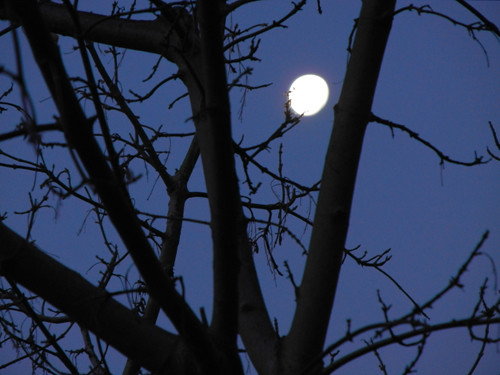
The moon invoked a feeling which was both cosmic and intimate, as even the primitives would have felt hundred of thousands years ago, when they took a break of daily chores and started to contemplate:




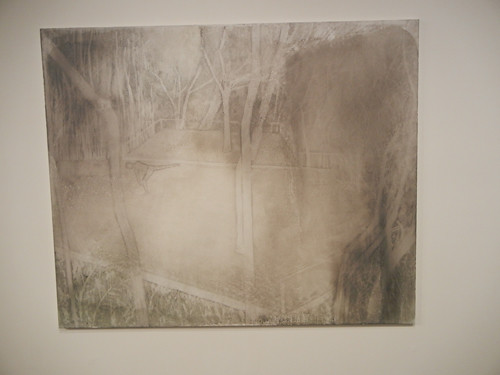
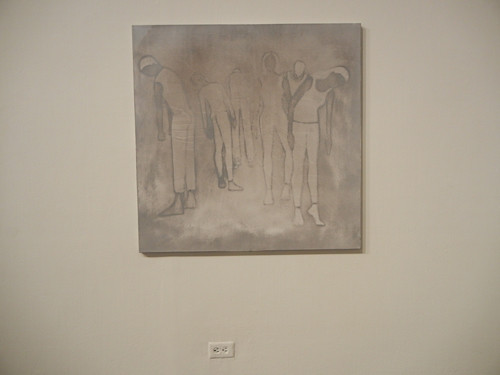
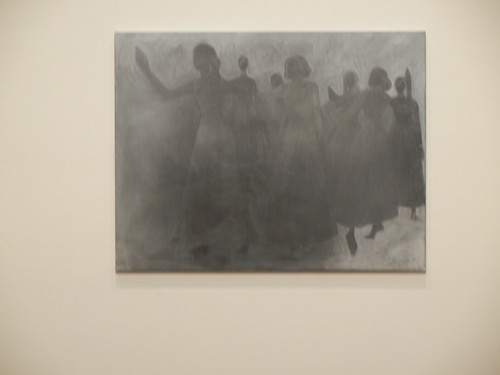
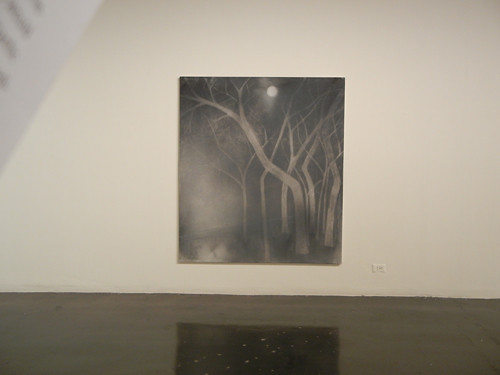
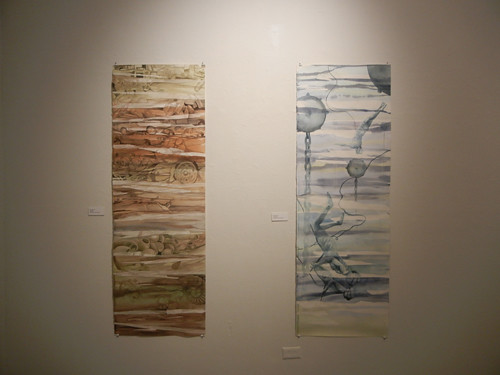
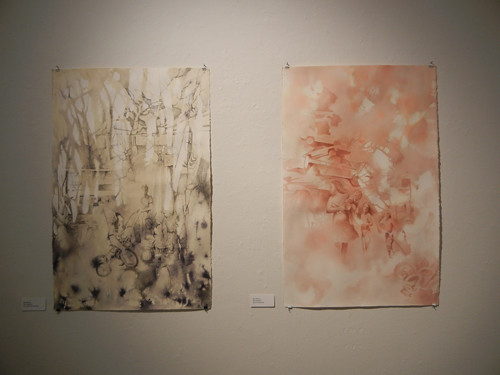
With layered washes of similarly hued watercolors, the canvases of London-based German artist Silke Otto-Knapp seem at first monochromatic, but slight changes in light or a viewer’s position reveal figures or landscapes. Conflating the mediums of painting and performance, Otto-Knapp draws from the vocabulary of abstraction to renew our engagement in the act of seeing.
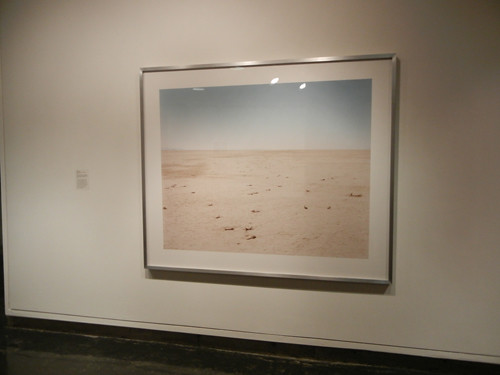
In October 1991, immediately following a catastrophic firestorm that struck the Oakland and Berkeley hills, renowned Bay Area photographer Richard Misrach ventured into the fire zone armed with his eight-by-ten-inch view camera. Working alone amidst the ruins, he roamed devastated neighborhoods, recording stark vistas and intimate details of destroyed homes. The resulting images are distinguished by Misrach’s masterful framing of his subjects: the compositions are dramatic without being sensational and incisively reveal a world transformed.


Federal authorities are investigating whether a parade of paintings and drawings, sold for years by some of New York’s most elite art dealers as the work of Modernist masters like Robert Motherwell and Jackson Pollock, actually consists of expert forgeries, according to people who have been interviewed or briefed by the investigators.Below are two of the works suspected of being forgeries, one was once attributed to Robert Motherwell and the other Jackson Pollock:
Most of the works, which have sold individually for as much as $17 million, came to market though a little-known art dealer from Long Island, Glafira Rosales, who said she had what every gallery dreams of: exclusive access to a mystery collector’s cache of undiscovered work by some of the postwar world’s great talents, including Mark Rothko and Richard Diebenkorn.
In several cases, Ms. Rosales sold the works through an art-world luminary, Ann Freedman, until 2009 the president of the prestigious gallery Knoedler & Company on the Upper East Side. Other works were sold by Julian Weissman, an independent dealer who had worked for Knoedler in the 1980s and had represented Motherwell when he was alive.
A lawyer for Ms. Rosales, Anastasios Sarikas, acknowledged that she was a target of the inquiry by the Federal Bureau of Investigation and the United States Attorney for the Southern District of New York. Mr. Sarikas said that his client had "never intentionally or knowingly sold artwork she knew to be forged."
The Knoedler gallery, which abruptly closed Wednesday after 165 years in business, has not been implicated in the investigation. But on Friday a London collector, Pierre Lagrange, who bought one of the works, "Untitled 1950" by Pollock, for $17 million in 2007, sued the gallery and Ms. Freedman, contending that it is a forgery. His forensic analysis found that two paints in the work had not been invented until after Pollock's death, the suit said.


Experts have reclassified a painting of an old man long thought to have been made by one of Rembrandts' students as having come from the hand of the Dutch master himself, after X-ray analysis revealed outlines of a self-portrait of the artist as a young man underneath.All these made very interesting read and challenge people's perceptions on the value of artworks, connecting to established brand (artists) or not.
Ernst van de Wetering of the Rembrandt Research Project cited the new X-ray scans of the painting "Bearded Old Man," in addition to stylistic analysis and circumstantial evidence in support of the conclusion.
Van de Wetering dates the small (6 by 8 inches) but emotive painting to 1630, when Rembrandt van Rijn would have been 24 years old. His reputation as a portraitist was rapidly growing and he was preparing to leave Leiden for Amsterdam, which at that time was enjoying its golden age as a major naval power.
The painting shows a man with unkempt white hair, lost in thought with just a hint of sadness.
The scans revealed what is thought to be an uncompleted self-portrait by Rembrandt underneath, though the X-rays reveal only bare outlines.
Van de Wetering said that the style and quality of the painting itself provide the strongest arguments for its authenticity, but the existence of the underlying portrait was important, too.
However, four works formerly attributed to his students - a talented group in their own right - have been reclassified as by Rembrandt since 2008, often with the help of new technology.

Charles Saatchi, the most important British art collector of his generation, has launched an incendiary attack on the buyers, dealers and curators who populate the contemporary art world and concluded that many of them have little feeling for art and cannot tell a good artist from a bad one.Mr. Saatchi definitely had some point but like it or not, this trend will not change and had not changed since Renaissance time. It was due to Da Vinci's reputation that he was invited to the French court. Artists, who have always been relying on influential patrons and dealers to make good names for themselves, will continue to struggle to establish and nature such valuable relationship, and to adept to the rules of the art-world, despite the fact that most of them would rather spend all their time and energy their studios.
He says: "It is the sport of the Eurotrashy, hedgefundy, Hamptonites; of trendy oligarchs and oiligarchs; and of art dealers with masturbatory levels of self-regard." Saatchi described the Venice Biennale, scene of the world's biggest contemporary art jamboree, as a place where these people circulate "in a giddy round of glamour-filled socialising, from one swanky party to another".
"Do any of these people actually enjoy looking at art?" asks Saatchi. "Do they simply enjoy having easily recognised big-brand-name pictures, bought ostentatiously in auction rooms at eye-catching prices, to decorate their several homes, floating and otherwise, in an instant demonstration of drop-dead coolth and wealth? Their pleasure is to be found in having their lovely friends measuring the weight of their baubles, and being awestruck."
For 30 years he has been a voracious buyer of new art and was instrumental in the success of the Young British Artists movement, buying up the best of the likes of Damien Hirst and Tracey Emin and exhibiting it at the groundbreaking Sensation show at the Royal Academy in 1997.
But Saatchi says he finds the new art world toe-curling. "My little dark secret is that I don't actually believe many people in the art world have much feeling for art and cannot tell a good artist from a weak one, until the artist has enjoyed the validation of others.
"Few people in contemporary art demonstrate much curiosity, and spend their days blathering on, rather than trying to work out why one artist is more interesting than another."
The Turner-nominated artist Louise Wilson – half of the Wilson twins – said: "Many artists and art works have now definitely become a brand in a sense and some people may well go 'I'll have a Koons and a Gucci.' You can see that happening in certain contexts so in a way he does raise some interesting observations."
The curator Norman Rosenthal said it was impossible to generalise.
"It is very difficult to make a good exhibition," he said, "and the real problem is the art world has become so huge. When Charles and I were younger and doing the world of art it used to be much easier to sort it all out."
What effect Saatchi's intervention will have on a buoyant contemporary art market remains to be seen but Sarah Thornton, the author of Seven Days in the Art World, predicted it would change little.
"This is so disingenuous of Charles Saatchi because he is selling art to these people and he is their role model. I find it shocking that he would come out and say this because his gallery has become a showroom for upcoming auction lots."
Thornton said Saatchi had made many millions selling on much of his collection. "He is feeding the people he is condemning." She put his comments down to "misanthropy".
Saatchi has had a London gallery for contemporary art since 1985 in different locations including St John's Wood, County Hall and since 2008 the former Duke of York's HQ in Chelsea.
According to the Art Newspaper's survey, in 2009 and 2010 the most visited UK show was Van Gogh at the Royal Academy followed by five shows at the Saatchi.



 Posts
All Comments
Posts
All Comments


