Sunday, June 13, 2010

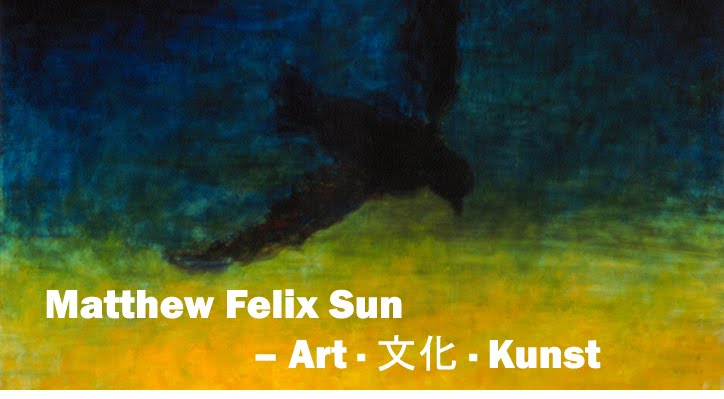
One More Ravens Painting Completed

On May 24th, I posted a newly completely painting - Ravens. That was a follow-up to a Crow painting, done in 2009. Crow was simplistic paintings and Ravens was rather stark and foreboding.

I was curious to see and struggling to created a middle ground of these two paintings - finally, I was able to finish this Dark Wings in the right position of the emotional spectrum.

Dark Wings

Friday, June 11, 2010

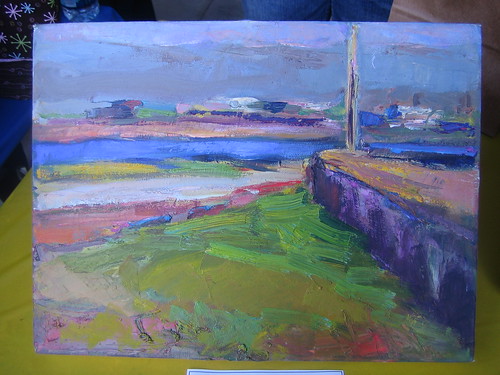
UC Berkeley Staff Showcased Art and Craft Works

Last Wednesday, staff from University of California Berkeley showcased their art and craft works during the annual "Staff Fest".

It is a feast of art and craft offerings - there are beautiful paintings, handbags, jewelry, potteries and Ikebana. Below is just a sample of these wonderful works:

IMG_4710

IMG_4708

IMG_4707

IMG_4719

IMG_4711

IMG_4716

IMG_4713

IMG_4717

Wednesday, June 9, 2010

Aren't These Chinese & Japanese Characters Art?

There are many complicated writings in Chinese characters and Japanese Kanji. Below are sample of these picturesque writings, which are like a miniature paintings themselves:

せい sei - fresh
せい sei - fresh [consists of three characters of fish]

しょう shou - large group of horses traveling in a line
しょう shou - large group of horses traveling in a line [consists of three characters of horses]

2117758261_e5d5037856
(unknown meaning) [consists of three characters of horses above a wood]

Nàng, poor enunciation due to snuffle

500px-Zhé.svg
Zhé, (unknown meaning) [consists of four characters of dragons]

Daito and means   footsteps of a dragon (Japanese)
Daito and means footsteps of a dragon (Japanese) [consists of three characters of clouds above three dragons]

Zhèng (unknown meaning)
Zhèng (unknown meaning) [consists of four characters of prosperous]

Mo 2nd reading MEANING  DEVIL WHICH SEES AND CONSUMES A PERSONS  HEART
Mó,
Devil which sees and consumes a persons heart

ハキマ

ハキマ
(unknown meaning)


藻が色

藻が色
(unknown meaning)


This Jap-only  Kanji , Ouichiza, 79 strokes
Ouichiza, [79 strokes]


A crazy character I personally saw in use is the one below, which describes a kind of noodles:

600px-Biáng_(regular_script).svg
Biáng, a kind of noodles

Biang

biang+biang+noodles

Tuesday, June 8, 2010

My "Vegetable Garden"

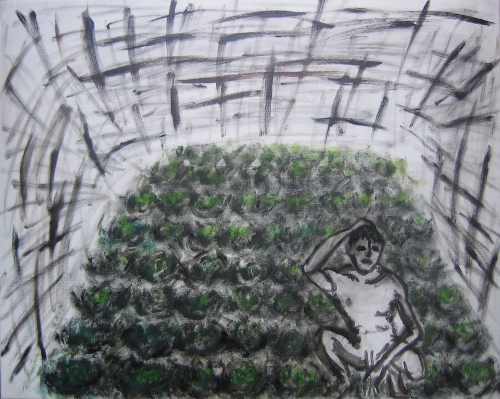
Last week, I finished one of the ten canvases I have been concurrently working on for a while. This painting depicts a bewildered and somewhat entrapped young man, naked, in a jail cell like vegetable garden, full of heads of cabbages.

Vegetable Garden / 菜园子 / Gemüsegarten

Vegetable Garden
Oil on Canvas
30" x 24"
Completed in 2010

© Matthew Felix Sun
www.matthewfelixsun.com

Sunday, June 6, 2010

Recent Exhibitions at Berkeley Art Museum

After a series of blogs about exhibitions and collections at Cantor Arts Center at Stanford University, I need to talk about the local museum - Berkeley Art Museum.

There was a very interesting photography exhibit - Assignment Shanghai. BAM's website states: "In 1946, Life magazine assigned the young photographer Jack Birns to Shanghai with instructions to document the ongoing Chinese civil war. A selection of the resulting photographs, drawn from the BAM collection, portrays the upheaval of war, societal changes, and the approaching revolution that would transform Shanghai and China forever. Birns documented the new Shanghai, with its foreign concessions and cosmopolitan attitude, and captured the clash between a nascent consumer culture, enabled by the introduction of Western goods, and the traditions of China's past."
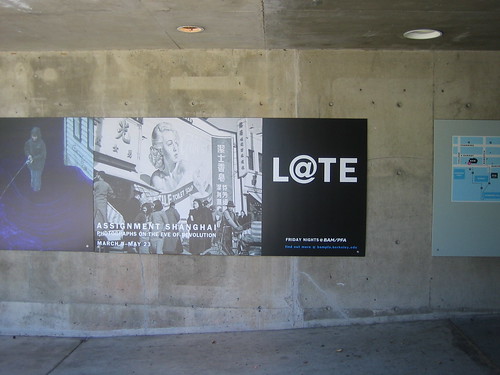
Assignment Shanghai, Berkeley Art Museum

What’s It All Mean: William T. Wiley in Retrospect presents a fifty-year survey of the work of Bay Area artist William T. Wiley's work, which took up three exhibition floors. All of his work are very complex and some of them looked quite dated while the others fared much better. I like his crazily crowded graphite and charcoal drawings, also paintings inspired by Pieter Bruegel, particularly its strange and nightmarish landscape and vibrate and daring color schemes. I don't like his superimposing Miro like bright geometrical patterns on painterly landscape. I found the contrast brought out neither drama nor conflict, but a crude message should be expressed by other better means.

Sketch for the Tower of Babloid & the Monitor, 1998; charcoal,  graphite, and acrylic, William T. Wiley
Sketch for the Tower of Babloid & the Monitor, 1998; charcoal, graphite, and acrylic, William T. Wiley
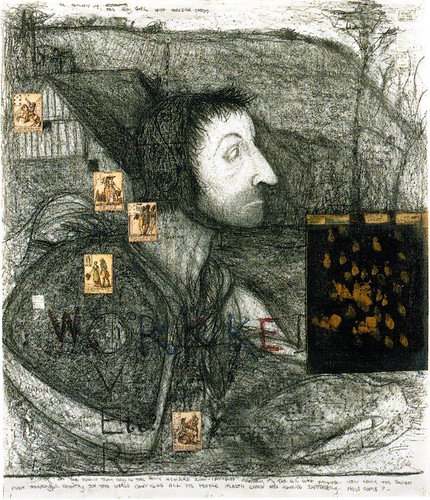
Study for Parable of the Blind, Details after Bruegel, 1994, Mixed media, William T. Wiley

After the looking back, I was glad to glance forward to No Right Angles: The 40th Annual University of California, Berkeley Master of Fine Arts Graduate Exhibition.

There are usual gimmicky works for sure but several interesting work really made strong impression on me, particularly the oil painting by Rebecca Suss: 1974, 1984, which encompass huge spatial, temporal and emotional span.
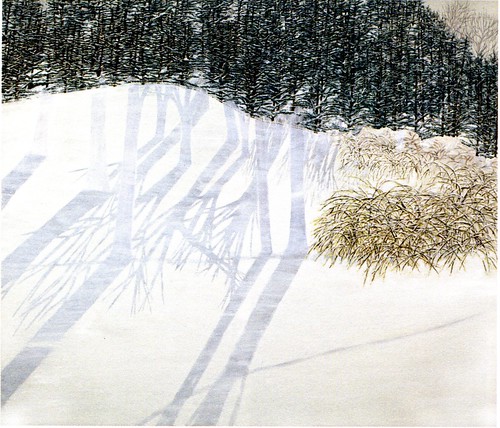
1974, 1984, Oil on Canvas, 72 x 84 in., 2010, Rebecca Suss

Finally, a most unusual piece -- a commissioned work, a hybrid of sculpture, furniture, and stage, as the new centerpiece of Gallery B, BAM’s expansive central atrium from Thom Faulders. It is part of a new vision of the gallery as a space for interaction, performance, and improvised experiences.

Again, according to BAM, "Faulders has designed a landscape of undulating forms, constructed from curved, brightly painted wood over a core of foam. Viewed from the lobby and balconies above, the piece resembles an abstracted archipelago or a rendering of breaking waves. The shifting optical experience of the work becomes spatial and tactile as you approach and climb onto it, settling in among its varied lumps and bumps. The structure offers multiple seating possibilities and focal points, providing settings for large-scale performance, intimate discussion, or solitary yet sociable relaxation. "
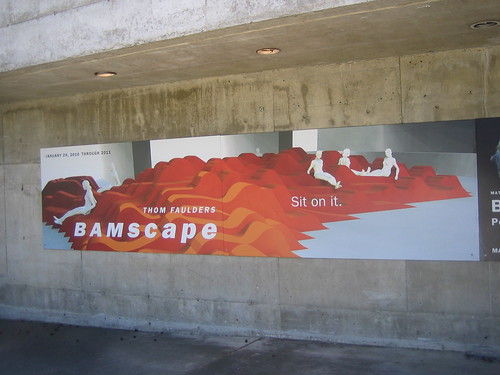
Thom Faulders: BAMscape, 2010; mixed media; 1,500 sq. ft., Berkeley Art Museum

Saturday, June 5, 2010

Invasion of 3D

Recently I came across a hilariously funny video, which changed iconic masterpiece paintings into 3 dimensional. One of the paintings is Whistler’s Arrangement in Gray and Black, also known as "Whistler's Mother", which is in San Francisco's De Young Museum right now, as part of Birth of Impressionism exhibit. After viewing this video, I sure have gained a new perspective to this famous painting. However, I'm not sure that this extra dimension is necessary.


Two dimensional art is suffering in our technology driving age. Perhaps, this 3D craze will usher in a new wave or art making, like photography did to the Impressionism?

For the conservative persons like me, we will retreat and sulk, I guess.

I also read a story about 3D in opera house/cinema. According to Gramophone magazine, Royal Opera House, Covent Garden, London is to broadcast the first opera in 3D with Bizet’s Carmen:

With all the new innovations in bringing opera to new audiences, including the high-definition cinema showings led by Glyndebourne and the Metropolitan Opera, it has been wondered for some time whether 3D might follow. Now the Royal Opera House, Covent Garden, has announced that it will be the first to follow where Avatar et al have led.

It is, however, the same 3D technology company that worked on Avatar, called RealD, which will be joining the Royal Opera House in this venture. As for which operas will be afforded the 3D treatment, the possibilities would appear to be tantalising - one can well see the talons of a louring Fafner reaching out to the viewer in Wagner’s Das Rheingold, the flamboyant choreography of Andrei Serban’s famous Turandot production, or even the repeatedly swingeing guillotine of the last scene of Poulenc’s Dialogues of the Carmelites!

In fact it will be Francesca Zambello’s staging of Bizet’s Carmen that makes opera’s 3D debut...

One has to wonder why those people go to cinema for opera presentations. For music or spectacle? I have a nightmare that all existing masterpiece paintings would be forced to undergo such 3D treatment. And all those iconic motion pictures too!

Where will the over stimulation end?