
Thursday, February 3, 2011

3D Virtual Galleries via Google


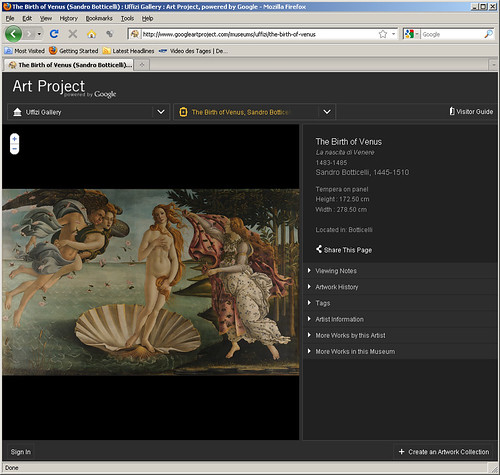
Google just revealed its 3D Virtual Galleries showcasing most lauded museums in the world and their amazing collections.

The exulted list is expanding fast and it so far has included NYMOMA, MET, Uffizi in Florence, Van Gogh Museum Amsterdam,etc.  Visitors can navigate the 3D museum space and see how the art collections are displayed in their homes, or view individual paintings in amazing details.  A mobile app can give museum visitors a real-time guide as well.
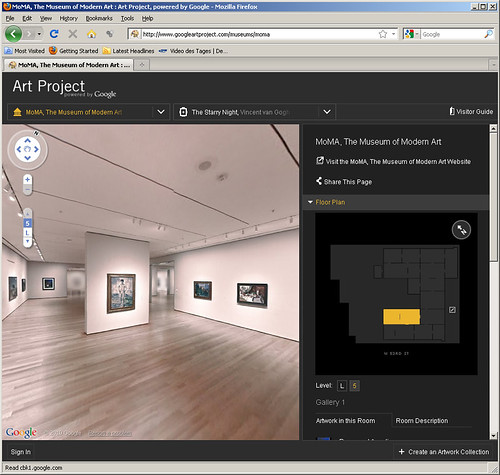
Art Project Powered by Google - NYMOMA
New York Museum of Modern Art

Art Project Powered by Google - Birth of Venus - Uffizi
The Birth of Venus - Uffizi Gallery, Florence, Italy

I suppose that this will be a new way to present two-dimensional artworks.  Incidentally, I just accepted an invitation from 3D Virtual Art Space online gallery to showcase my works.  It was only last week that I blogged about my first 3D gallery.  I've created four of such galleries and three new additions, beside the first Portrait Gallery, are below:
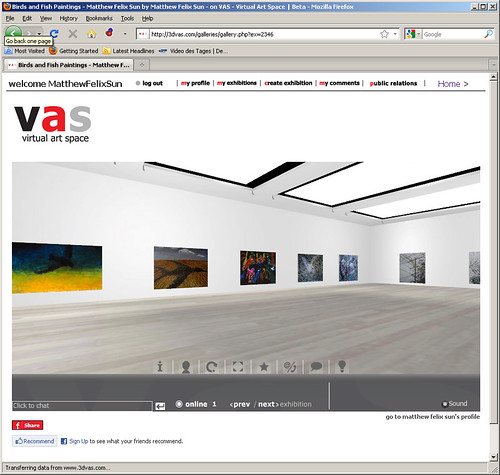
3DVas Gallery - Birds and Fish
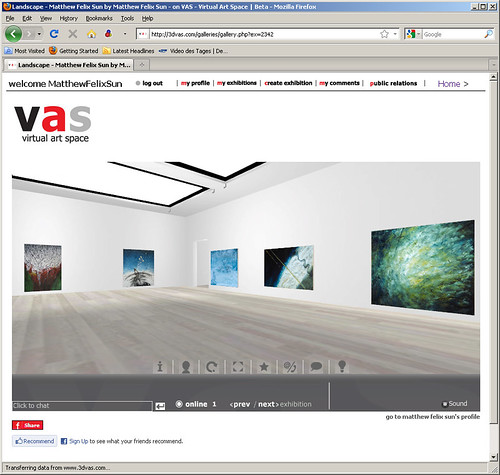

3DVas Gallery - Landscape 1
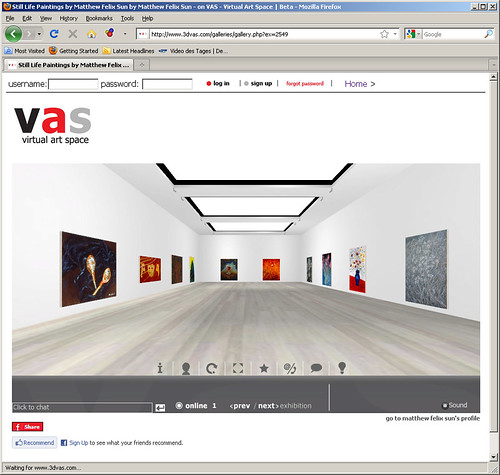
3DVas Gallery - Landscape

3DVas Gallery - Still Life

Unfortunately, 3D Virtual Art Space requires users to download a small software if not pre-installed and many are hesitating. I hope that the operation systems of computers will have an update to fix this soon.  The host ascerted that the software is absolutely safe and gave me two well known websites using this technology: NASA and Unity Fast Facts.


3DVas Gallery - Birds and Fish


3DVas Gallery - Landscape


3DVas Gallery - Still Life
(use arrow keys to navigate) For details, please read Figure and Self-Portrait Galleries on 3D Virtual Art Space (3Dvas)

Label: 3D Virtual Art Space

Wednesday, February 2, 2011

Chinese Lunar New Year (Spring Festival)

Today is the eve of traditional Lunar New Year observes in China and other regions culturally connected to that ancient civilization.

In the U.S., it is not without controversy regarding how to address that holiday.  Calling it Chinese New Year, then Koreans and Vietnamese might feel left out.  Calling it Lunar New Year, then other cultures observing their lunar new year in entirely different seasons might feel robbed too - for example, Thai lunar new year falls in April, and the Jewish lunar new year (Rosh Hashanah) is usually in September.

In mainland China, at least the time I lived there, new year is simple first day of the Gregorian calendar year and the traditional new year is usually called Spring Festival or amongst the seniors, Old Calendar New Year or Lunar New Year.  I prefer to call it Spring Festival.

It was in the U.S., that I was greeted first time during the Spring Festival time with 恭禧發財 (traditional Chinese) or 恭禧发财 (simplified Chinese), which pronounced as Gong Xi Fa Cai (Mandarin) or Gong Hey Fat Choy (Cantonese).

An internet search resulted in such explanation as what this phrase means: Gong Xi (恭禧) is congratulations or respectfully wishing one joy, Fa Cai (發財) is to become rich or to make money.  Thus, Gong Xi Fa Cai means wishing you to be prosperous in the coming year.

Well meaning for sure.  However, I had to exert strong self-control not to cringe when I was greeted thus.

For people who grew up in China, especially in families value scholarly achievement and societal contributions, such greeting is rather too mercenary and crass.

The assumption that all Chinese greet each other during lunar new year time with this phrase is false.  It has been mostly used by merchants whose life goal is making money.  People who came to the U.S. several generations ago were mostly in the lower social-economical tiers and many of them became small merchants in the U.S. in order to survive and prosper and this phrase states their collective desires perfectly.

I personally will choose not use this phrase but have learned to smile back when I heard such greeting by well-wishers.

Happy Spring Festival to all!

Spring Festival

Monday, January 31, 2011

What Song Did Pianist Lang Lang Play at White House

Chinese president Hu Jintao has visited and left behind a little background noise regarding if the Chinese born mass entertainer and pianist Lang Lang, who had "mimed" to his pre-recorded soundtrack in Beijing Olympic Stadium and recorded soundtrack for Sony PlayStation's Gran Turismo® 5, intentionally or accidentally played music insulting to the hosts, the US president and first lady.

Washington Times claimed that "The song in question originally appeared in the soundtrack of "The Battle of Shangganling Mountain," a 1956 Chinese propaganda film lauding China's alleged "triumph" over the U.S. during the Korean War. Its lyrics describe Americans as warmongering "jackals"—hardly the kind of stuff, it would seem, that’s appropriate for a state dinner."

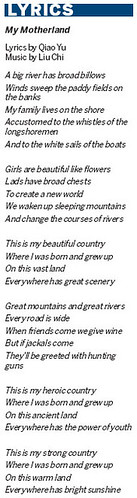
Indeed, Mr. Lang played the theme song music from 1956 Chinese movie Battle on Shangganling Mountain (aka Triangle Hill).  The song was hugely popular in China, not only because it pops up Chinese people's national pride, it's melody was also quite beautiful in the sentimental and saccharine way - considering Chinese people were used to be treated with militant songs, its popularity was easy to understand.  The movie and the song were denounced in China during Cultural Revolution, due to its petty-bourgeois sentiment and its daring to tough on human emotions.  Only after the death of Mao and the arrest of his widow, the movie and the song made a comeback and many people who lived through 1950s welcomed the song with great nostalgia, which many young people, perhaps include Lang Lang, never made connection to the song's Korean War background, despite the lyrics:

Triangle

Wikepedia gives another translation:

1.
Chorus
A great river flows, its waves wide and calm
Wind blows through rice flowers, bearing fragrance to both shores
My family live right there by the water
I am used to hearing the punters' call
And seeing the white sails on the boats

Solo
A great river flows, its waves wide and calm
Wind blows through rice flowers, bearing fragrance to both shores
My family lives right there by the water
I am used to hearing the punters' call
And seeing the white sails on the boats

Chorus
This is the beautiful motherland
This is the place where I grew up
On this expansive stretch of land
Everywhere there is wonderful scenery to behold

2.
Solo
How like flowers are the young ladies
How big and determined are the hearts of the young men
In order to usher in a new era
They've woken the sleeping mountains
And changed the face of the river

Chorus
This is the heroic motherland
This is the place where I grew up
On this stretch of ancient land
There is youthful vigor everywhere

3.
Solo
Great mountains, great rivers, a great land
Every road is broad and wide
If friends come, there is fine wine
But if the wolves come
Those who greet him have hunting guns

Chorus
This is the mighty motherland
This is the place where I grew up
On this stretch of warm and friendly land
There is peaceful sunshine everywhere

The movie segment including the song can be viewed on YouTube:


Now you can decide if there was a nationalism fever or not.

Sunday, January 30, 2011

Coca Cola, Mercedes-Benz and Yosemite

Coca Cola, Mercedes Benz and Yosemite - what do they have in common?

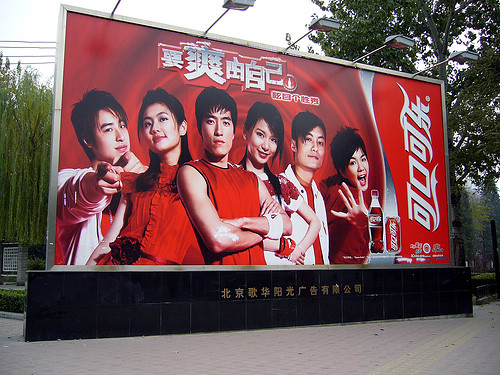
For Chinese speakers, they represent the examples of best translation.  The Chinese translations for Coca Cola is 可口可乐 (pronounced as: ke-kou-ke-le), which means delicious and cheering.  The truncated form Coke was simple 可乐 (ke-le), cheering.

Coca-Cola

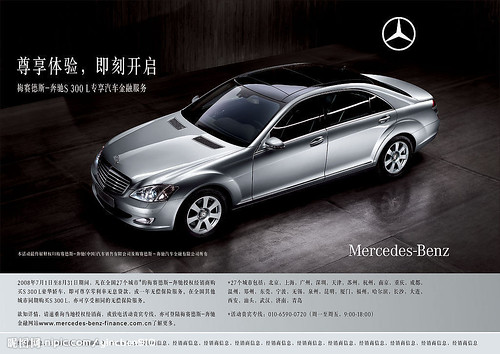
Most Chinese speakers don't know what Mercedes is but they now Benz.  The translation of Mercedes-Benz, at least in mainland China, usually leaves Mercedes out and Benz is called 奔驰 (pronounced as: ben-chi), meaning racing.  Some translations do keep Mercedes, which was simply a phonetic transliteration (梅塞德斯, pronounced as: mei-sai-de-si) with no special meanings.

Mercedes-Benz

Yosemite in Chinese is 优山美地 (pronounced as: you-shan-mei-di), which means superior mountain(s) and beautiful field(s).

Yosemite

I have discussed many times regarding what constitutes good translations.  To me, the full meaning of the original language is the essential.  As for brands, a phonetic proximity is important as well.  Besides those, if the translated language can add extra layers of wonderful meanings to merchandise brands, then the translations reach sublimity.

Friday, January 28, 2011

Eva Hesse and James Abbott McNeill Whistler in Berkeley Art Museum

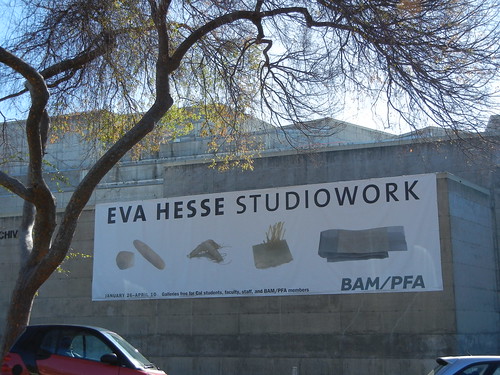
Berkeley Art Museum is exhibiting two small but fascinating shows - Eva Hesse's Studiowork and James McNeill  Whistler's graphic works.

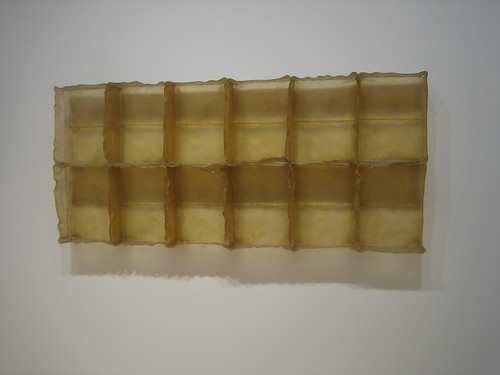
Eva Hesse _ BAC 1415

Though I am not a sculptor and have no affinity to conceptual art, I cannot deny that installations usually hold public's attention better than others nowadays, for better or for worse.  Eva Hesse's work falls into that category.  The two room exhibit Eva Hesse: Studiowork, which runs from January 26 through April 10, 2011 showcases her rarely seen small-scale works, many from Berkeley Art Museum (BAM)'s collection, according to BAM own description that they illuminate Hesse’s studio practice and capture moments of experimentation.  BAM's website describes the exhibit as below:
Eva Hesse: Studiowork features works made from a diverse range of materials, such as plaster and latex, painted wood, metal, sculp-metal (a vinyl and resin suspension of aluminum powder that could be applied over objects), fiberglass, rubber, plasterboard, cardboard, cotton, polyester resin, cheesecloth, wire, string, paper, and nets. This exhibition also includes a series of largely papier mâché works never before shown in public. Hesse’s interest in using unconventional materials and in pushing the materials to their limits—in an attempt to achieve thinness and translucency, or formlessness and density—meant that she produced works that are both fragile and subject to deterioration. These transient materials make clear the temporal dimension of art: they have time built into them. Hesse’s focused and intricate actions and hand gestures can be imagined from the evidence of their production: folding, pinning, piercing, cutting, stapling, layering, threading, wrapping, molding, and casting. Her arrangements and rearrangements of the works were also important to the making of the work.
 I was not very taken by these small works, except for several translucent small objects made of perhaps fiberglass, grouped together on top of a large, square platform.  They are like living creature and breath serenely.  Otherwise, I didn't find the show very engaging.  Comparing to her 1968 Sans II below, these objects look unfinished, perhaps that precisely they were and hold more interest for curators and researchers rather than general public.

Sans II, 1968, Fiberglass and polyester resin, Eva Hesse, 1936-1970 // 75th Anniversary Show, SFMOMA _6737
Sans II, 1968, Fiberglass and polyester resin see at 75th Anniversary Show, San Francisco Museum of Modern Art

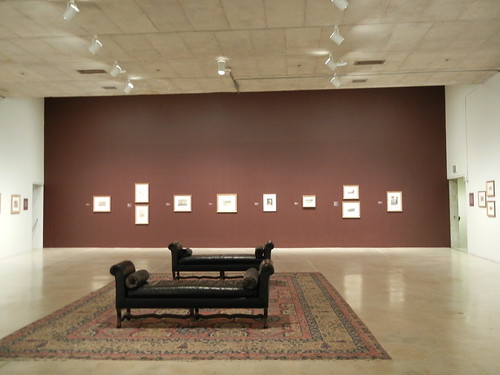
The other exhibit I stopped to see was Indeterminate Stillness: Looking at Whistler, which runs from January 26, 2011 - April 17, 2011.  This exhibition, celebrating Sharon and Barclay Simpson’s gift to BAM/PFA of seventy-six prints by James McNeill Whistler, looks at how Whistler subordinated Realism to the Modernist concerns of design, color, and tonal variation.

Whistler _ BAC 1412
Again, BAM informed the public that "James McNeill Whistler (1834–1903), the expatriate American artist, was a prolific and innovative painter, watercolorist, and printmaker. Throughout his lively career Whistler was known as a discerning collector of Japanese prints and as a quick-witted, sharp-tongued advocate of “art for art’s sake.” Whistler’s roots were in Realism, but his approach Modernist; his brand of Realism eschewed narrative and sentimentality and instead set the incidents and characters of the everyday into compositions determined by design, color, and tonal variation. For example, Whistler uses prosaic details to serve design and composition in numerous images of life along the Thames River, such as Rotherhithe (1860). Similarly, in his Venetian works, the minutiae of daily activity on the canals and lagoons are subsumed by the atmospheric effects of mist and fog. Whistler approached portraits in the same vein, posing the figures in vague flattened spaces where they blend into harmonious environments of tone and color, composed intervals of stillness and veracity."
Many of the works shown were very fine and detailed and it was no denying the accomplishments here but they were also somewhat dull, due to the sameness of the large quantity work on display.  I did particularly like the etchings he made during his stay in Italy - moody and other worldly.  My fascination with graphic art has been revived recently and I am deeply convinced that the monochromatic chiaroscuro has boundless power to express whole range of emotions and feelings.

Tuesday, January 25, 2011

A New Showcase - 3Dvas Gallery

The curator of 3Dvas - 3D Virtual Art Space (www.3dvas.com) invited to me join and submit my works to this innovative website.  The 3Dvas gallery is a network of 3D virtual galleries provided free of charge to artists around the world.  Artists that exhibit on 3Dvas enjoy a powerful multi-user system that allow artists to communicate live with every visitor that enter the gallery, and artists can also use this platform as a tool to simulate future exhibitions in 3D.

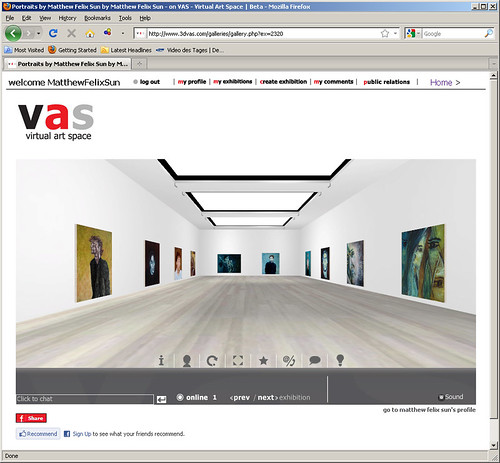
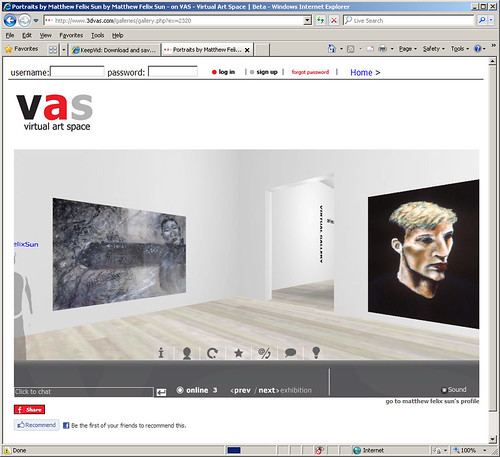
My first gallery features fourteen pieces of my portrait works and below are the screenshots of my 3D portrait gallery:

3DVas Portrait Gallery Screenshot

3DVas Portrait Gallery Screenshot 2

The dynamic gallery can be viewed if you download the software:


3D VAS - Portrait Gallery (Please use arrow keys to navigate)

Label: 3D Virtual Art Space