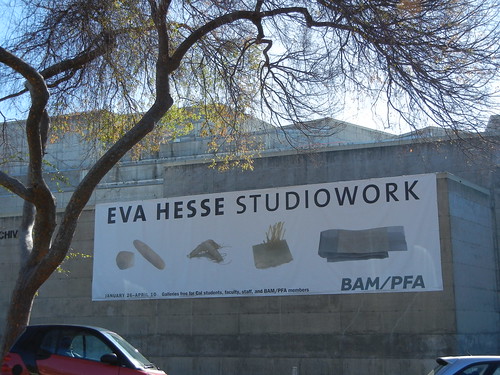
Though I am not a sculptor and have no affinity to conceptual art, I cannot deny that installations usually hold public's attention better than others nowadays, for better or for worse. Eva Hesse's work falls into that category. The two room exhibit Eva Hesse: Studiowork, which runs from January 26 through April 10, 2011 showcases her rarely seen small-scale works, many from Berkeley Art Museum (BAM)'s collection, according to BAM own description that they illuminate Hesse’s studio practice and capture moments of experimentation. BAM's website describes the exhibit as below:
Eva Hesse: Studiowork features works made from a diverse range of materials, such as plaster and latex, painted wood, metal, sculp-metal (a vinyl and resin suspension of aluminum powder that could be applied over objects), fiberglass, rubber, plasterboard, cardboard, cotton, polyester resin, cheesecloth, wire, string, paper, and nets. This exhibition also includes a series of largely papier mâché works never before shown in public. Hesse’s interest in using unconventional materials and in pushing the materials to their limits—in an attempt to achieve thinness and translucency, or formlessness and density—meant that she produced works that are both fragile and subject to deterioration. These transient materials make clear the temporal dimension of art: they have time built into them. Hesse’s focused and intricate actions and hand gestures can be imagined from the evidence of their production: folding, pinning, piercing, cutting, stapling, layering, threading, wrapping, molding, and casting. Her arrangements and rearrangements of the works were also important to the making of the work.I was not very taken by these small works, except for several translucent small objects made of perhaps fiberglass, grouped together on top of a large, square platform. They are like living creature and breath serenely. Otherwise, I didn't find the show very engaging. Comparing to her 1968 Sans II below, these objects look unfinished, perhaps that precisely they were and hold more interest for curators and researchers rather than general public.
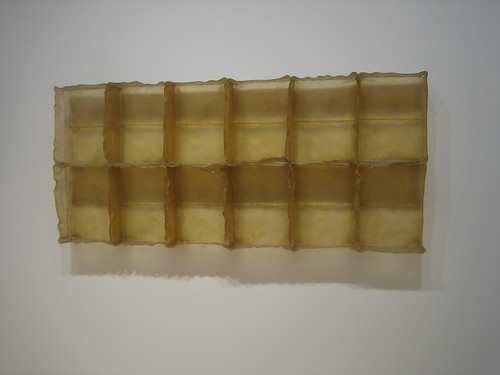
Sans II, 1968, Fiberglass and polyester resin see at 75th Anniversary Show, San Francisco Museum of Modern Art
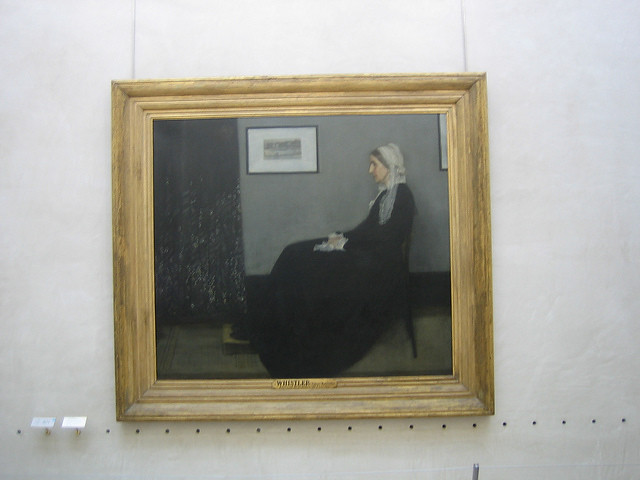
The other exhibit I stopped to see was Indeterminate Stillness: Looking at Whistler, which runs from January 26, 2011 - April 17, 2011. This exhibition, celebrating Sharon and Barclay Simpson’s gift to BAM/PFA of seventy-six prints by James McNeill Whistler, looks at how Whistler subordinated Realism to the Modernist concerns of design, color, and tonal variation.
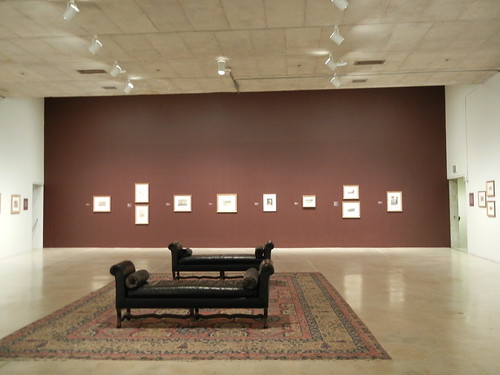
Again, BAM informed the public that "James McNeill Whistler (1834–1903), the expatriate American artist, was a prolific and innovative painter, watercolorist, and printmaker. Throughout his lively career Whistler was known as a discerning collector of Japanese prints and as a quick-witted, sharp-tongued advocate of “art for art’s sake.” Whistler’s roots were in Realism, but his approach Modernist; his brand of Realism eschewed narrative and sentimentality and instead set the incidents and characters of the everyday into compositions determined by design, color, and tonal variation. For example, Whistler uses prosaic details to serve design and composition in numerous images of life along the Thames River, such as Rotherhithe (1860). Similarly, in his Venetian works, the minutiae of daily activity on the canals and lagoons are subsumed by the atmospheric effects of mist and fog. Whistler approached portraits in the same vein, posing the figures in vague flattened spaces where they blend into harmonious environments of tone and color, composed intervals of stillness and veracity."
Many of the works shown were very fine and detailed and it was no denying the accomplishments here but they were also somewhat dull, due to the sameness of the large quantity work on display. I did particularly like the etchings he made during his stay in Italy - moody and other worldly. My fascination with graphic art has been revived recently and I am deeply convinced that the monochromatic chiaroscuro has boundless power to express whole range of emotions and feelings.



 Posts
Posts


