Showing posts with label Gustave Caillebotte. Show all posts

Monday, May 7, 2012

My Favorite Paintings from Musée d'Orsay, Paris

If Musée du Louvre was most unbelievable institution in Paris due to its sheer immensity, Musée d'Orsay was one of the most enchanting one due to its unique loveliness and accessibility.  This museum, converted from a train terminal, had beautiful exterior and interior, and boasted a collection encompassing the period of impressionism and post-impressionism, which had become so popular with audience, that it was hard for modern-day audience to imagine the furore surrounded these movements' emergencies.

When I was in Paris for the first time, in early October 2000, the summer tourist season had passed, therefore I was able to enjoy many museums in a more leisurely pace and spent wonderful hours at Musée d'Orsay.  There were so many famous and wonderful works there and it felt almost criminal not to include in my top picks great masters such as Van Gogh, Cézanne, etc.  Yet, it had to be done.

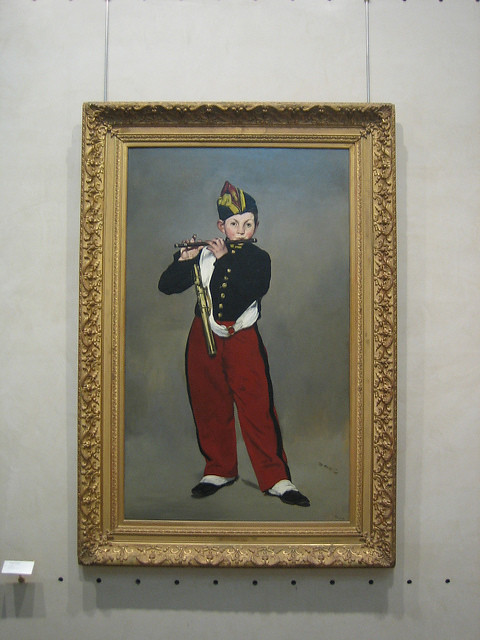
My first choice was Le fifre (The Fifer) by Édouard Manet, a full-length portrait of a little boy in bold black, red and white band uniform, playing a flute, in front of an abstract almost flat muted background.  The boy was determined to concentrate in his music-making and stay in his own world, and despite of his facing the viewers, he utterly ignored our presence.  His pose, rather peculiar, lent certain liveliness to this rather static scene.  The somewhat melancholic mood contrasted strongly with his rosy complexion, adding another layer of meaning to this mesmerizing painting.
photo
Le fifre (The Fifer), Édouard Manet, 1866

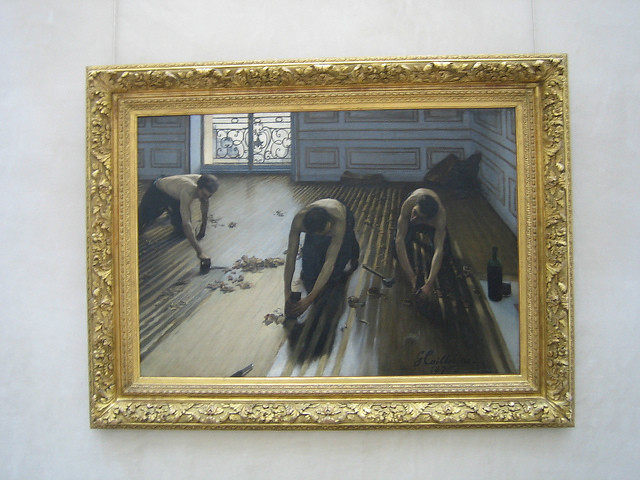
My second favorite was a painting full of actions - Les raboteurs de parquet (The Floor Scrapers), by Gustave Caillebotte. I always loved paintings depicting laborers and farmers, if they were not done for picturesque reasons.  Here, the painter lowered his gaze to the level of those laborers on the floor, and the bright back light gave them clearly defined and powerful silhouettes, and they reminded me of nimble and powerful leopards of all things.  Caillebotte had a masterful way of depicting different materials - paneled walls, wrought-iron balcony, wooden floor before and after being scraped, with varying sheen and changing reflections.  Yet, we always came back to those three working men, with their exposed upper torsos and outstretched long arms, clearly the focal points of the painting.  They were doing menial jobs, yet with great dignity.  They were also like willing offerings.  This painting, presented laborers in a way often reserved for noble characters in the past, therefore elevated those people to a new height, without being sentimental.  That was the eloquence of this masterpiece.
photo
Les raboteurs de parquet  (The Floor Scrapers), Gustave Caillebotte, 1875 


My Favorite Museum Collection Series

>> My Favorite Museum Collection Series 31:  My Favorite Art Works at Centre Pompidou, Paris
<< My Favorite Museum Collection Series 29: My Favorite Artworks at Musée du Louvre, Paris


List of My Favorite Artworks in the Museums I've Visited

Tuesday, July 13, 2010

Birth of Impressionism at De Young Museum, San Francisco

Last Sunday, I visited De Young Museum's Birth of Impressionism: Masterpieces from the Musée d’Orsay exhibit.

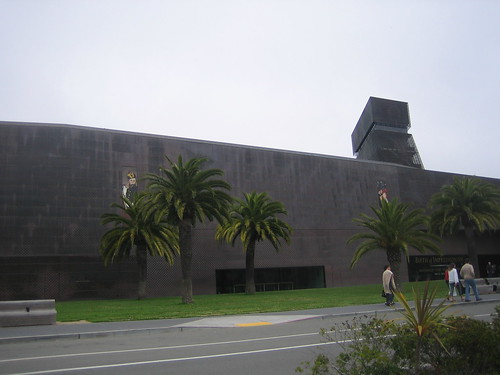
De Young Museum, San Francisco, 12 July 2010

The exhibit was very well curated and it was not designed with showcasing blockbusters only; rather, it went length to explain how Impressionism came into fruition. It was thoughtfully assembled and was deeply thought provoking. That said, it did not mean that the show didn't have enough lustre.

In deed, though far from incorporating every major work from Musée d’Orsay, it did boasted works by Manet, Monet, Renoir, Sisley, Pissarro, Degas, Cézanne and Coubert.

Notable works in this exhibition include:
  • The Fife Player by Edouard Manet (1866)
  • Racehorses Before the Stands by Edgar Degas (1866–1868)
  • Family Reunion by Frédéric Bazille (1867)
  • The Magpie by Claude Monet (1868)
  • The Cradle by Berthe Morisot (1872)
  • The Dancing Lesson by Edgar Degas (1873–1876)
  • The Floor Scrapers by Gustave Caillebotte (1875)
  • The Swing by Pierre-Auguste Renoir (1876)
  • Red Roofs, Corner of the Village, Winter Effect by Camille Pissarro (1877)
  • Saint-Lazare Station by Claude Monet (1877)
  • Rue Montorgueil, Paris. Festival of June 30, 1878 by Claude Monet (1878)
  • Snow at Louveciennes by Alfred Sisley (1878)
  • L’Estaque by Paul Cézanne (1878–1879)
  • Portraits at the Stock Exchange by Edgar Degas (1878–1879)
  • The Birth of Venus by William-Adolphe Bouguereau (1879)
I was lucky enough to have seen many of the works included in this exhibit in d'Orsay. Below are a sample of the pictures I took there two years ago. The show is deeply satisfying. Don't miss it. It's much cheaper than going to Paris.

photo
The Fifer, Édouard Manet, 1866

photo
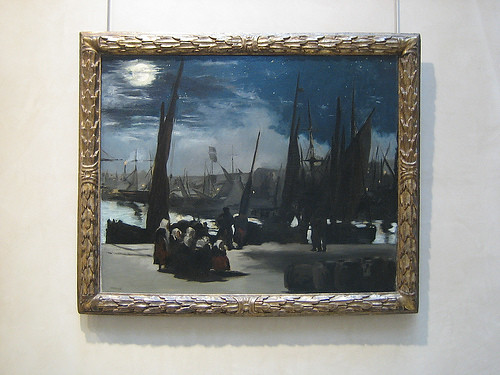
Moonlight over the port of Boulogne, Édouard Manet, 1866

photo
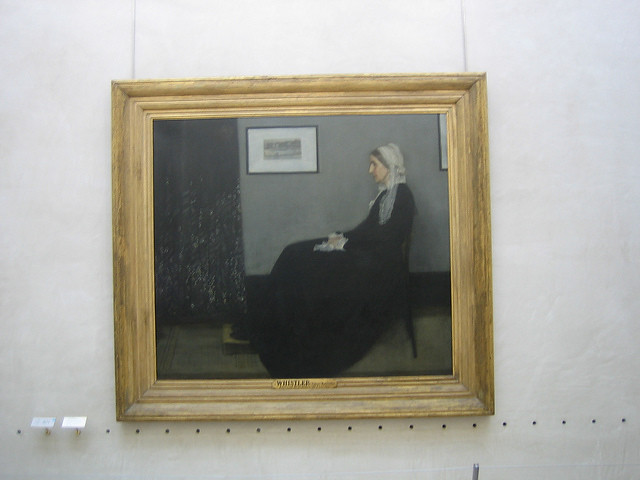
Arrangement in Gray & Black No. 1: Portrait of the Painter's Mother, James Abbott McNeill Whistler, 1871

photo
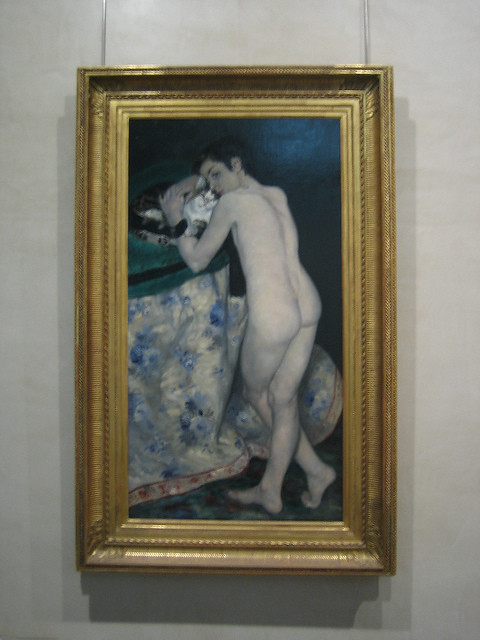
Boy with a Cat, Pierre-Auguste Renoir, 1868

photo
The Floor Scrapers, Gustave Caillebotte, 1875


Related posts on Art · 文化 · Kunst:
- Last Call - "The Girl With A Pearl Earring" in De Young Museum, San Francisco
- My Favorite Paintings in Mauritshuis, Den Haag, Netherlands
- "Compliments to Vermeer" - Controversial Solo Exhibition of the Renowned Chinese Painter JIN Shangyi
- Paintings As Pivotal Elements
- Last Chance to See Terracotta Warriors in San Francisco Asian Art Museum
- Venetian Masterpieces from Vienna at De Young Museum
- My Favorite Works at De Young Museum, San Francisco
- My Favorite De Young Museum Collections