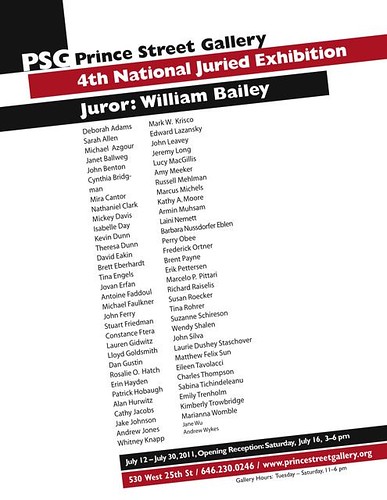
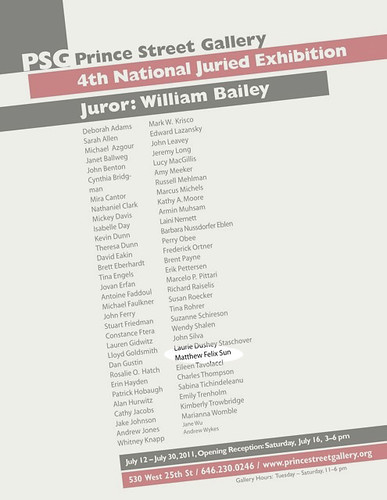
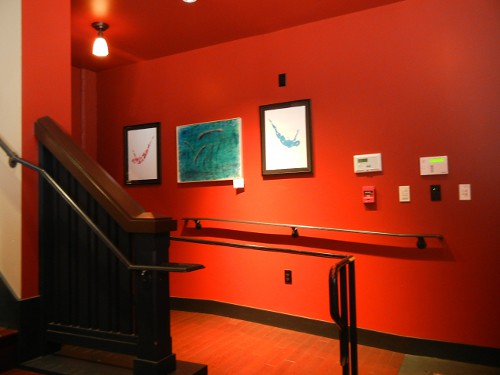
The 4th National Juried Exhibition in Prince Street Gallery, New York City, opens today. This year, out of 923 images submitted nation wide by 254 artists, the Juror, William Bailey, a distinguished artist and Professor Emeritus at the Yale School of Art, chose 65 works.
Unfortunately, I won't be able to attend the opening reception, which lasts from 3-6pm, July 16, Saturday. I'd be very grateful if you can send me a photo or two of the opening scene:
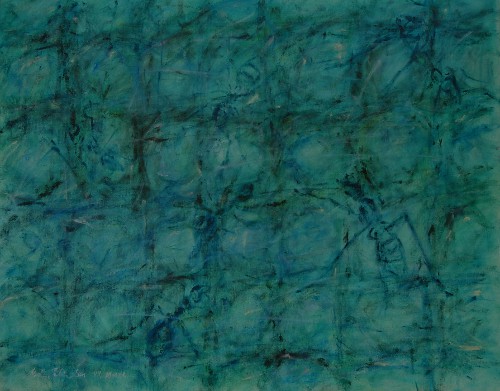
Continuing my fascination with patterns, I have worked on another painting predominated by interwoven patterns and actors in this intricate setting - ants.
They occupy a flattened space, waving their legs left and right, with just enough hints of menace. They don't really mean to be threatening. Rather, they occupy their space in the matter-of-fact way, doing about their own businesses, which to humans, are often meaningless and pointless.
Yet, zooming away from our own preoccupied daily routine, what differences are there between human species and an ant colony?
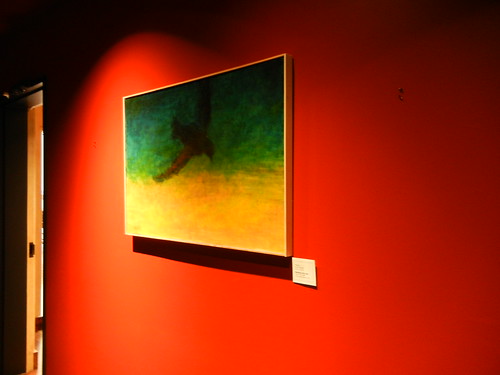
In April, upon request, I delivered several paintings to Studio Trilogy, a prestigious recording studio in San Francisco, but not until June, I found time to stop by to see my paintings after installation.
Most paintings were on the designated space but a few were shifted and all for the better, for example, the "Leisurely" below, changed its companions from other's works to mine:
The display will continue for another month or so. Please call Studio Trilogy for appointment, if you want to see them in person: 415.558.7100
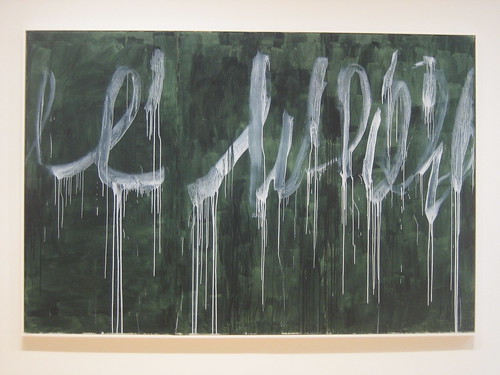
The passing of Cy Twombly was a sad event in the art world. We lost a giant.
Not very well-versed in contemporary art scene, particularly in abstract field, I only learned of this wonderful abstract painter very recently, during San Francisco Museum of Modern Art's Introduction to the Fisher Collections in last August.
His seemingly simple loops have endless variations and were actually very complex. The more one studies it, the more challenging it was to have a firm grasp of his methodology and results. I mentioned in my blog for the Fisher Collection as such:
Cy Twombly's abstract paintings worked like landscape. The 1971 Untitled [Rome] demonstrated his mastery perfectly. The endless strokes of the crayon looped like layers and layers of grass and the shapes and depth of the work was simply amazing.
Untitled [Rome], 1971, Oil-based house paint and crayon on canvas, Cy Twombly 1928-
Note I, from the series III Notes from Salalah, 2005-7, Acrylic on wood panel, Cy Twombly 1928-
Saturday night, I watched Woody Allen's toothache-inducing bonbon Midnight in Paris, whose protagonist took us back to Paris of 1920s and Belle Époque. The time-traveling of the modern-day writer and his encounters with the like of F. Scott Fitzgerald, Ernest Hemingway, Salvador Dalí, Gertrude Stein, and Pablo Picasso were as delicious as it was insane.
The musing of the characters over the best period of the history cast somewhat serious and melancholic shadow over the fun. I was struck by the fact that the so-called high points of history came in an alarmingly accelerated speed. The durations between the peaks of civilizations grew shorter and shorter and this crashing velocity seems to me only means the compression of our time and eventually, any new period would only be a tiny dot and would not leave any long-lasting mark. That's the saddest fact of our information-saturated present and future time. The time-capsule of our epoch was just a speck of dirty on a long scroll, which had recorded the Babylonian, Egyptian, Roman civilizations, and the great period of Renaissance, Industrial Revolution, Belle Époque, and then Information Explosion.
Time traveling, fun it must have been, also is very disorienting. As a matter of fact, I am experiencing some time-traveling while working on my computer. My neighbors are playing snappy patriotic American songs (it is Fourth of July after all) and I constantly try to understand the lyrics and what periods they represent.
Casting our eyes farther afield, say to eastern Asia. If I landed in North Korea now, I would have thought that I just traveled back to China in 1960, when the rule reigned as capricious and severe god.
On the other hand, if one wants to experience Mao's China - calmer period instead of the height of the Great Culture Revolution - one can taste it easily nowadays there, particularly around the time they celebrated the 90th birthday of their ruling party - Chinese Communist Party on 1 July 2011. "Red Songs" made a dramatic comeback in China and everywhere one can encounter choruses, large or small, scream at the top of their lungs, singing the paeans to the Party, to Mao, to the Great Benefactor, a rerun of the mass-hysteria of the era begone. The participants in various locations include Henry Kissinger and Buddhist nuns.
Quite disorienting.
100,000 people sang Red Songs in Chongqing (slide to 1:00 for Kissinger's participation)
Buddhist Nuns Sang Paens to Party's Benefactory (slide to 21:34 for the best segment: nuns shouting slogans: Ten-Thousands Years, Chinese Communist Party! Amitabha! Amitabha! Amitabha!)
Recently, I saw a beautiful video of Midsummer Night Lanterns in Poznań, Poland when countless lanterns flew into the night sky. It was a beautiful and moving sight:
Then, my friends and I share some similar videos of lanterns flying into sky or floating in the rivers. All of these videos were unbelievably enchanting and comforting:
This festival occurred on November 20th, 2010 just north of Chiang Mai, Thailand
Lantern floating on the Motoyasu River, Hiroshima, on the evening of August 6th, the anniversary of the atomic bombing of the city
Kawaguchi was held at the Lantern Park Ohishi mouth of the lake in Yamanashi Prefecture on August 16, 2010




 Posts
Posts


![Untitled [Rome], 1971, Cy Twombly // Calder to Warhol: Introducing the Fisher Collection, SFMOMA _6611](http://farm5.static.flickr.com/4101/4857556573_6d2808a10f.jpg)