Showing posts with label Matisse. Show all posts

Wednesday, December 28, 2016

My Favorite Paintings at Norton Simon Museum, Pasadena

What I enjoyed most at Norton Simon Museum in Pasadena near Los Angeles were paintings by masters old and relatively new.

My favorite painting was The Black Shawl (Lorette VII) (1918) by Henri Matisse. This Matisse was striking with his surprising color harmony, his usual motifs of exaggerated flowery patterns, and the strange sensuality he achieved. The lying figure, Lorette, we assumed, in her provocative yet pensive pose, looked like mermaid or a siren, thanks to her form-fitting sheen black gown laced with bold floral patterns resembling large scales, and an extra length of fabric around her bare feet, like a tumbling tail. The figure in black really stood out on the pale red bedding, covered with large pale green leafy patterns, whose color reflected on the slightly more yellow tinged walls wrapping around her bed and thrusting the sitter to the viewer. The siren, looking directly into the viewer, had a sad expression on her face, slightly accusative, for neglect, or boredom, perchance? One could easily imagine this Lorette as being in a harem. A strange work of understated and seductive beauty, and enigmatic sentiment.
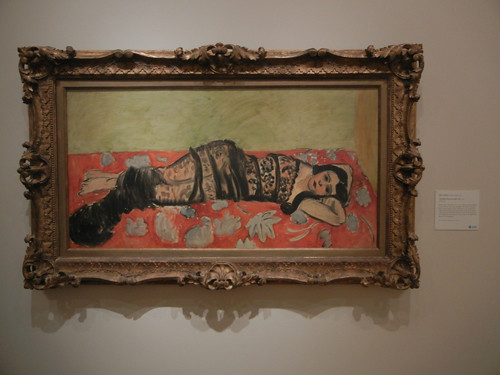
DSCN7830 _ The Black Shawl (Lorette VII), 1918, Henri Matisse (1869-1954), Norton Simon Museum, July 2013
The Black Shawl (Lorette VII), 1918, Henri Matisse (1869-1954)

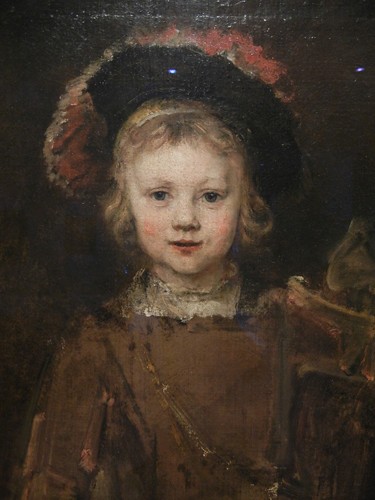
My second favorite was a portrait by Rembrandt van Rijn of his son Titus as a little boy, titled as Portrait of a Boy (1655-60). This unnamed boy, in his brown tunic, big black velvet hat with red feathery or flowery decoration, small band of white laced collar, with his soft blond hair, pink cheeks, gentle smile, was most angelic, adorable, and somewhat worrisomely vulnerable. The love, adoration, and worry from the doting father was most evident and touching.
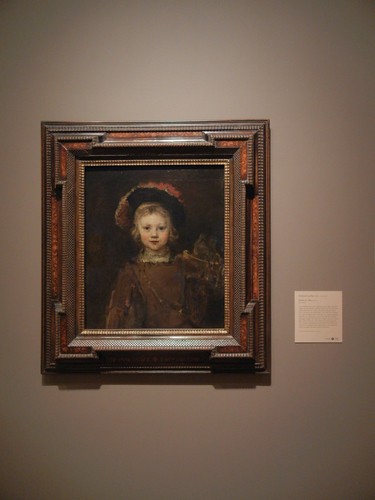
DSCN7591 _ Portrait of a Boy, 1655-60, Rembrandt van Rijn (1606-1669), Norton Simon Museum, July 2013

DSCN7598 _ Portrait of a Boy (detail), 1655-60, Rembrandt van Rijn (1606-1669), Norton Simon Museum, July 2013
Portrait of a Boy, 1655-60, Rembrandt van Rijn (1606-1669)


My Favorite Museum Collection Series
>> My Favorite Museum Collection Series 158: Blanton Museum of Art, The University of Texas at Austin
<< My Favorite Museum Collection Series 156: My Favorite Paintings at the Broad Museum, Los Angeles

List of My Favorite Artworks in the Museums I've Visited

Other Related posts on Art · 文化 · Kunst:
- LACMA - Los Angeles County Museum of Art
- Getty Villa in Los Angeles (Malibu)
- The Museum of Contemporary Art (MOCA) in Los Angeles
- Brand New Contemporary Art Museum - The Broad Museum in Los Angeles
- Urs Fischer Exhibit at MOCA, Los Angeles
- Revisiting Norton Simon Museum in Pasadena
- Anderson Collection at Stanford University
- Paintings at Cantor Arts Center, Stanford University
- Surprisingly Urbane Los Angeles


Monday, December 31, 2012

Last Trip to a Museum in 2012 - The William S. Paley Collection: A Taste for Modernism at De Young Museum in San Francisco

My museum visits in this year (2012) have been greatly augmented by my trips to China, Austria and Italy in May and October, especially the one to Europe, which I have sporadically discussed in my previous blog entries

DSCN5626 _ De Young Museum, San Francisco, 30 December 2012Yesterday, 30 December 2012, I returned to De Young Museum in San Francisco for The William S. Paley Collection: A Taste for Modernism, on the very last day of the exhibit, of which The De Young Museum website informed us was "A selection of major works from the William S. Paley Collection at the Museum of Modern Art in New York.. A pioneering figure in the modern entertainment, communication and news industries, Mr. Paley (1901–1990) was a founder of the Columbia Broadcasting System (CBS), and a dedicated philanthropist and patron of the arts. The Paley Collection, which includes paintings, sculpture and drawings, ranges in date from the late 19th century through the early 1970s. Particularly strong in French Post-Impressionism and Modernism, the collection includes multiple works by Paul Cezanne, Henri Matisse and Pablo Picasso, as well as significant works by Edgar Degas, Henri Toulouse-Lautrec, Paul Gauguin, Andre Derain, Georges Rouault and artists of the Nabis School such as Pierre Bonnard and Edouard Vuillard."

It was an astonishingly rich collection and one highlight succeeded another.  Though I've seen most of them in New York's MOMA, it was wonderful to see them again, in our home museum.  Amongst those wonderful works, I particularly love these below:

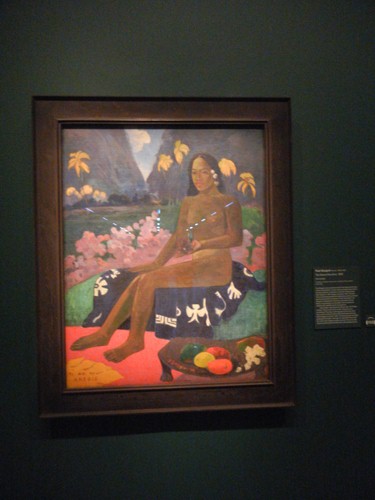
DSCN5627 _ The Seed of the Areoi, 1892, Paul Gauguin, NY MOMA at De Young
The Seed of the Areoi, 1892, Paul Gauguin

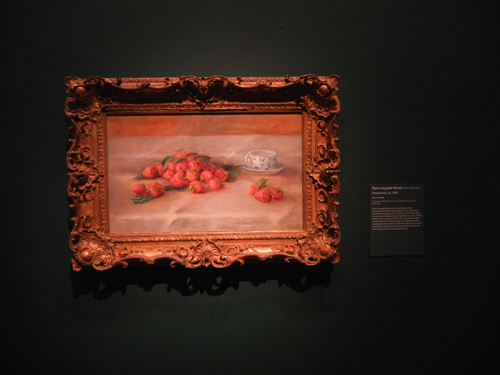
DSCN5629 _ Strawberries, c 1905, Pierre-Auguste Renoir, NY MOMA at De Young
Strawberries, c 1905, Pierre-Auguste Renoir

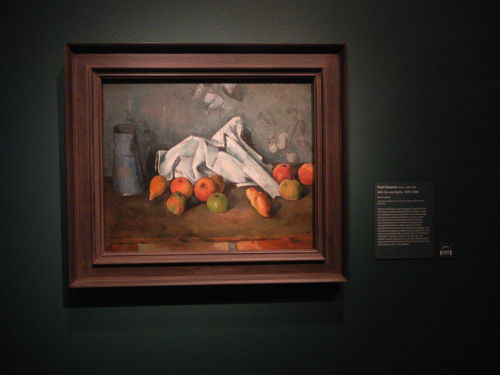
DSCN5638 _ Milk Can and Apples (1879-80), Paul Cezanne, NY MOMA at De Young
Milk Can and Apples (1879-80), Paul Cezanne
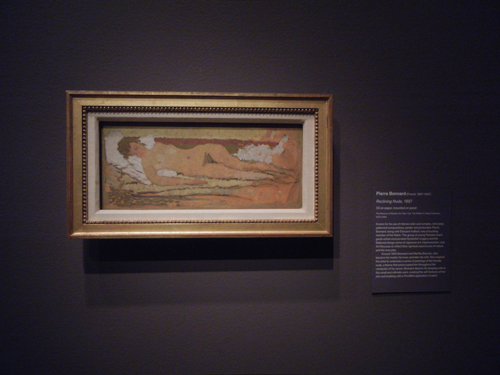
DSCN5645 _ Reclining Nude, 1897, Pierre Bonnard, NY MOMA at De Young
Reclining Nude, 1897, Pierre Bonnard

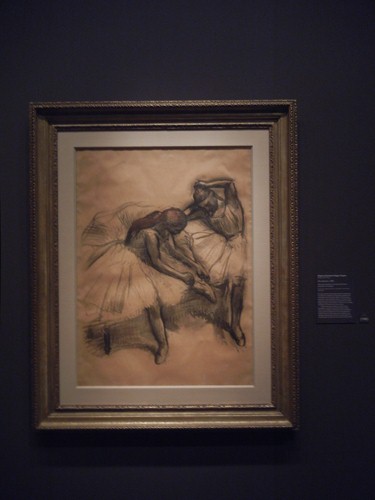
DSCN5653 _ Two Dancers, 1905, Edgar Degas, NY MOMA at De Young
Two Dancers, 1905, Edgar Degas

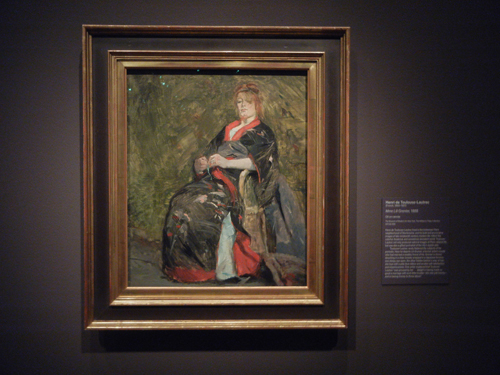
DSCN5652 _ Mme Lili Grenier, 1888, Henri de Toulouse-Lautrec, NY MOMA at De Young
Mme Lili Grenier, 1888, Henri de Toulouse-Lautrec

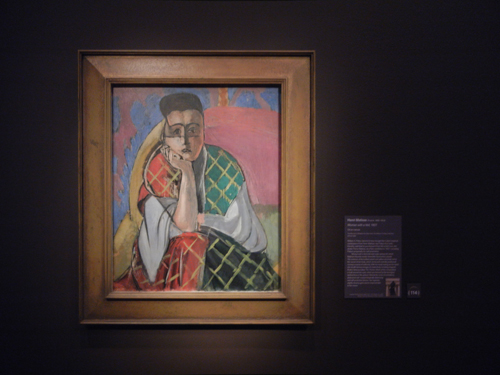
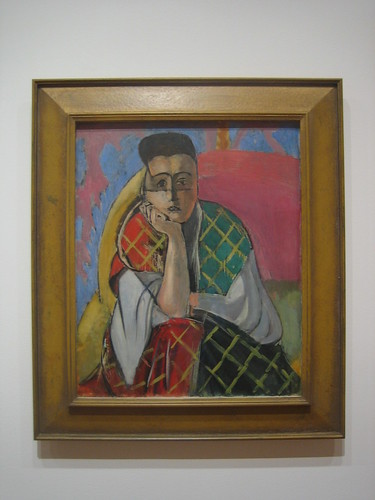
DSCN5659 _ Woman with a Veil, c 1907, Henri Matisse, NY MOMA at De Young
Woman with a Veil, c 1907, Henri Matisse

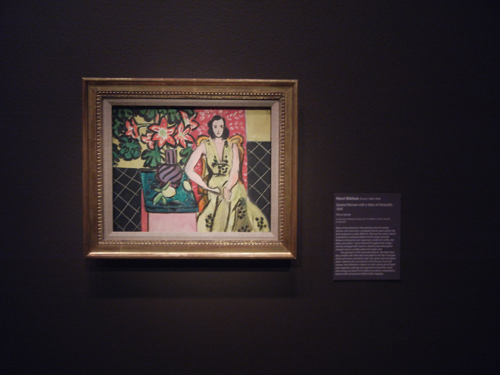
DSCN5661 _ Seated Woman with a Vase of Amaryllis, 1941, Henri Matisse, NY MOMA at De Young
Seated Woman with a Vase of Amaryllis, 1941, Henri Matisse

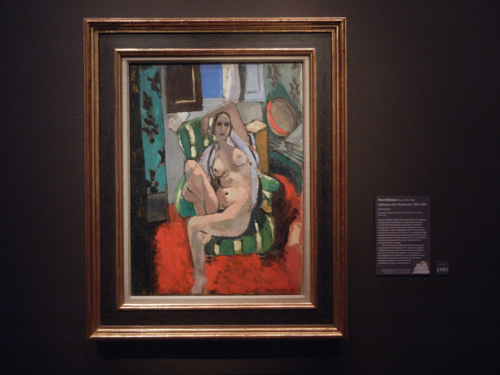
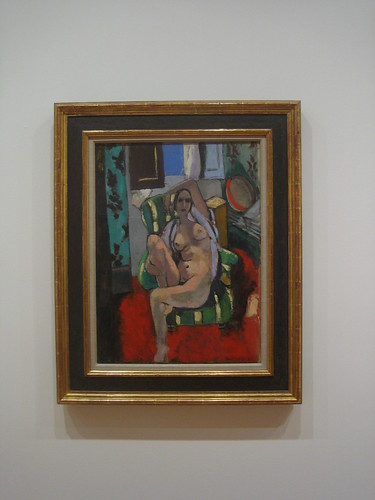
DSCN5663 _ Odalisque with a Tambourine, Matisse, NY MOMA at De Young
Odalisque with a Tambourine, Henri Matisse

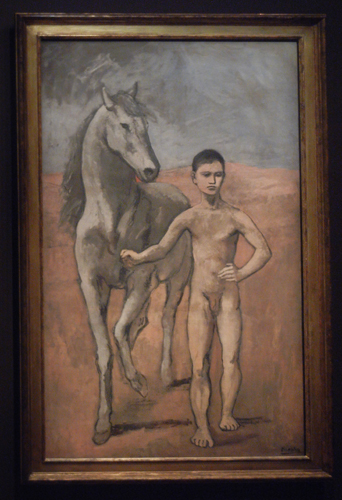
DSCN5676 _ Boy Leading a Horse, 1905-06, Pablo Picasso, NY MOMA at De Young - modified
Boy Leading a Horse, 1905-06, Pablo Picasso

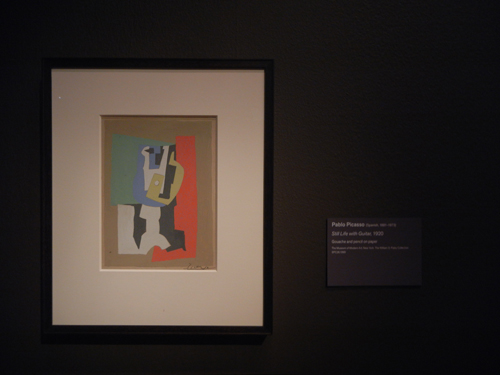
DSCN5686 _ Still Life with Guitar, 1920, Pablo Picasso, NY MOMA at De Young
Still Life with Guitar, 1920, Pablo Picasso

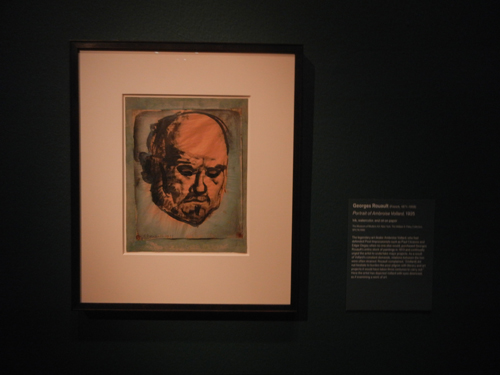
DSCN5715 _ Portrait of Ambroise Vollard, 1925, Georges Rouault, NY MOMA at De Young
Portrait of Ambroise Vollard, 1925, Georges Rouault

DSCN5721 _ Oasis (Mirage), 1944, Georges Rouault, NY MOMA at De Young
Oasis (Mirage), 1944, Georges Rouault

I also stopped by to see another special exhibit: Rudolf Nureyev: A Life in Dance, which featured photos, video clips and costumes of the great dancer, overwhelming in its opulence and extravagance with a tint of vulgarity, redeemed by his unapologetic conviction.


Thursday, September 23, 2010

"Matisse: Radical Invention, 1913-1917" at New York MOMA

Matisse -Radical Invention, 1913-1917 _7379

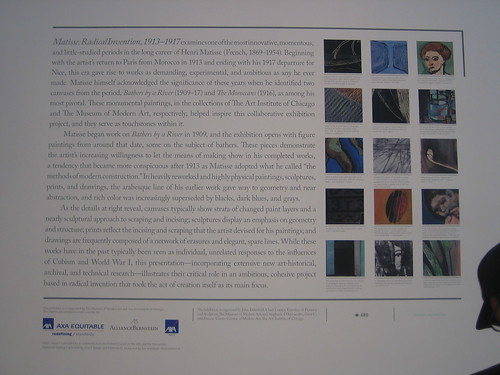
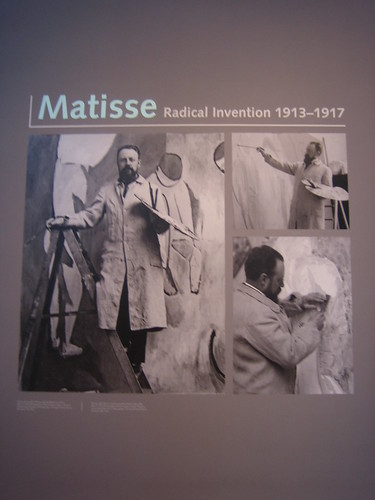
My next stop during my recent New York trip, after Guggenheim Museum, Frick Collection, and Morgan Library & Museum was The Museum of Modern Art (MOMA). The main attraction during the time was the special exhibit: Matisse: Radical Invention, 1913–1917, which runs from July 18 to October 11, 2010. MOMA sits informed us thus:
In the time between Henri Matisse's (1869–1954) return from Morocco in 1913 and his departure for Nice in 1917, the artist produced some of the most demanding, experimental, and enigmatic works of his career—paintings that are abstracted and rigorously purged of descriptive detail, geometric and sharply composed, and dominated by shades of black and gray. Works from this period have typically been treated as unrelated to one another, as an aberration within the artist's development, or as a response to Cubism or World War I. Matisse: Radical Invention, 1913–1917 moves beyond the surface of these paintings to examine their physical production and the essential context of Matisse's studio practice. Through this shift of focus, the exhibition reveals deep connections among these works and demonstrates their critical role in the artist's development at this time.
Matisse -Radical Invention, 1913-1917 _7381

This exhibit was very insightful and thought-provoking. Besides, the canvases presently here are almost universally beautiful, not flashy, but in a haunting and muted way. I actually prefer this period of Matisse to his later ones, when the vibrancy of colors became more predominant and he was more interested in presenting intricate patterns of fabrics or backgrounds, such as Large Seated Nude (1925-29) and Woman with a Veil (winter-spring 1927) shown below. Here, the simplicity and understated ecstasy of discovery was just palpable.

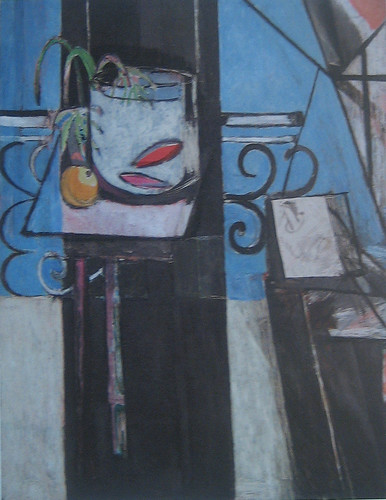
Goldfish and Palette, Henri Matisse, late November 1914-spring 1915
Goldfish and Palette, late November 1914-spring 1915

Gourds, summer-fall 1916, Henri Matisse
Gourds, summer-fall 1916

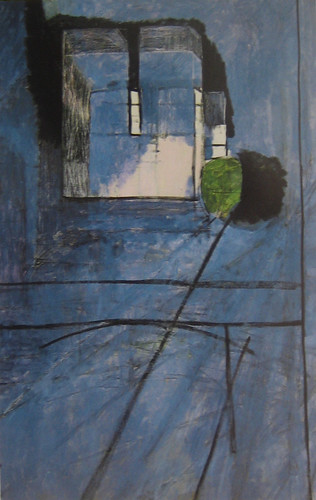
View of Notre-Dame, Henri Matisse, 1914
View of Notre-Dame, 1914

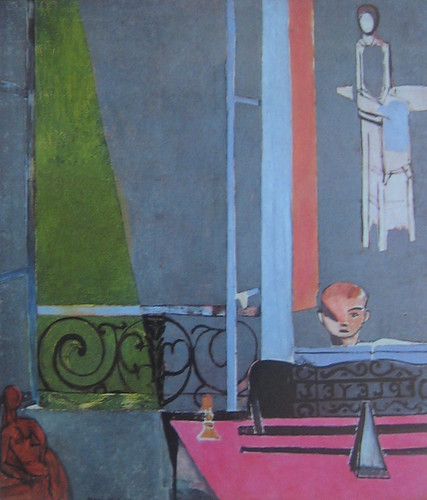
Piano Lesson, Henri Matisse, 1916
Piano Lesson, 1916

These above four pieces share same quietness, as if time stood still and we were in a bliss of eternity. They were also in turns, somber, playful and mysterious. But none of them exceed the fantastic Portrait of Yvonne Landsberg below, whose sitter was present with lines of glowing personal bubbles, as if she was one of the most alluring plant you might find in a Bosch's better mood paintings. I particularly love the economical dashes of orange in her face and the pale teal ribbons to her left. Bold and delicate painting!

Portrait of Yvonne Landsberg, Henri Matisse, 1914
Portrait of Yvonne Landsberg, 1914

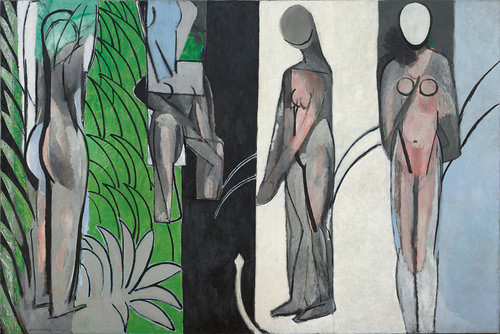
This exhibit's final piece was a presentation of the journey Matisse made, through the digital examination of a large canvas below, Bathers by a River, which he worked on during the periods of 1909-10, 1913, 1916-17.  New York Times had an in-depth analysis of this piece which included the timeline.

Bathers by a River, 1909-10, 1913, 1916-17, Henri Matisse.
Bathers by a River, 1909-10, 1913, 1916-17

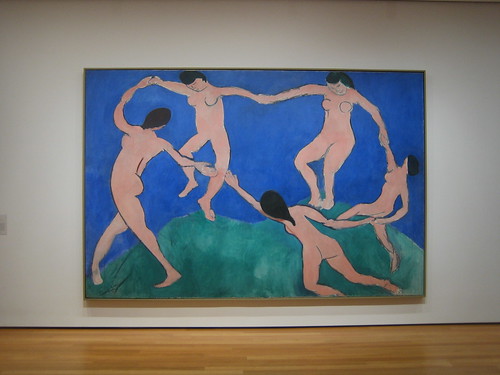
This painting started in the similar style to his iconic painting Dance (I) done in early 1909 and his sketch Music dated spring-summer 1907. Linear outlines of wonderful poses contains flat planes of bodies. I was able to see these two pieces later that day amongst MOMA's regular collections. They were evidences of his artistic achievement. Yet, Matisse did not stop developing and he, though didn't like the pure abstraction, didn't not shy away from that path altogether and his effort culminated in the finished Bathers by a River, with its curious balance between representation and abstraction. It perhaps was not as immediate as Dance (I) but was no less beautiful. The contrast between dark and light color patches, the bold postures and symbols, the cold yet delicate colors made it a marvel.

Dance (I), early 1909, Henri Matisse _7400
Dance (I), early 1909

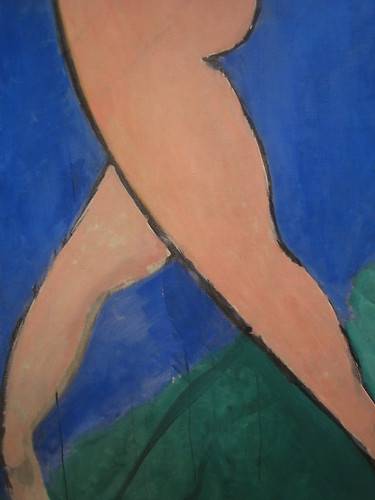
Dance (I) (details), early 1909, Henri Matisse _7403
Dance (I) (details), early 1909

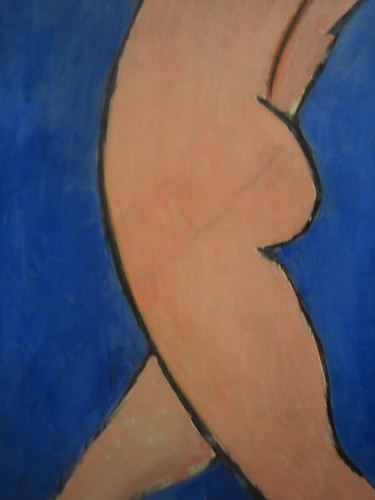
Dance (I) (details), early 1909, Henri Matisse _7404
Dance (I) (details), early 1909

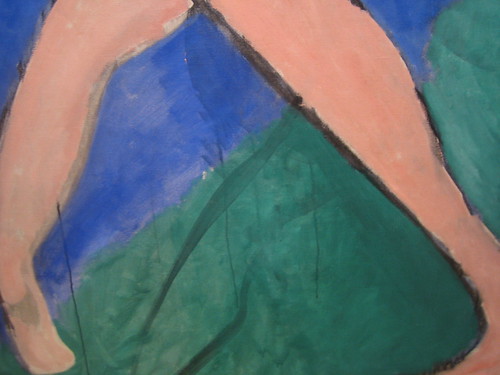
Dance (I) (details), early 1909, Henri Matisse _7405
Dance (I) (details), early 1909

Music (Sketch), spring-summer 1907, Henri Matisse_7407
Music (Sketch), spring-summer 1907

Below two paintings, viewed in MOMA's permanent collections, represented the later style of Matisse. It was fascinating to study them after the special exhibit.

Large Seated Nude, 1925-29, Henri Matisse _7411
Large Seated Nude, 1925-29

Woman with a Veil, winter-spring 1927, Henri Matisse _7414
Woman with a Veil, winter-spring 1927

>> New York City Report, September 2010, Part VII: The Museum of Modern Art, New York City << New York City Report, September 2010, Part V: Morgan Library and Museum in New York City

Saturday, April 24, 2010

Thoughts on Originality

I'm not the most original person in the world. I amuse myself with constantly shifting interests, which satisfies but deprives me the ability to dive deeper.

In the post-modern (whatever it means) world, originality seems to some the sole criteria of artistic achievement, which should not be. One can have much to say without falling into banality, even if not most original. Many of these works are to be treasured, meanwhile there are many people strive to achieve originality which often result in creating something best described as rubbish.

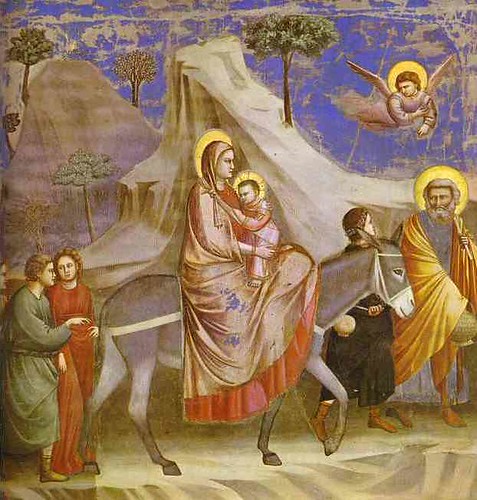
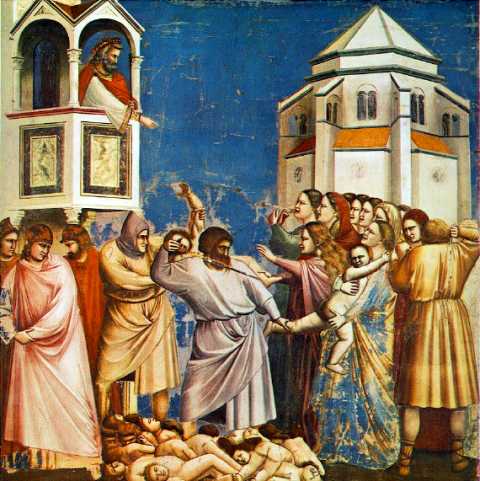
Truly great who broke boundary by leaps are rare. The best example is Giotto di Bondone.

Flight into Egypt by Giotto
Flight into Egypt, Giotto

The massacre of the innocents by Giotto di Bondone
The Massacre of the Innocents, Giotto

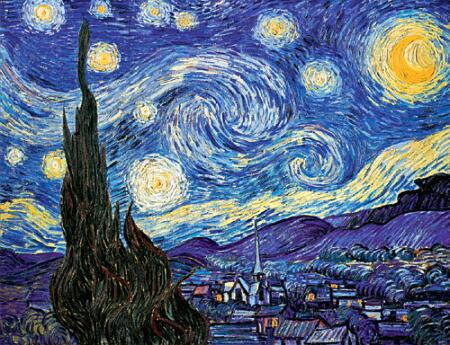
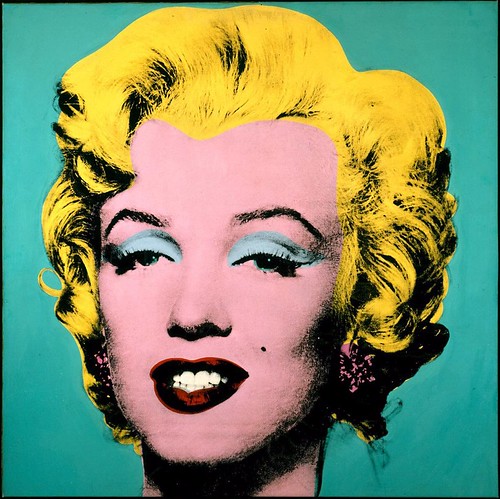
Once a boundary is broke, the greats had to follow the rules they laid out to create a body of work to make a statement - otherwise the instantly recognizable Van Gogh or Warhol are not to be, and their impact would be much smaller.

Starry Night by Van Gogh
Starry Night, Van Gogh

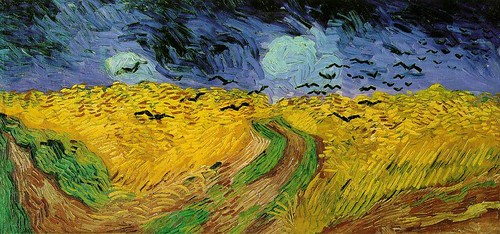
Wheat Field with Crows by Van Gogh
Wheat Field, Van Gogh

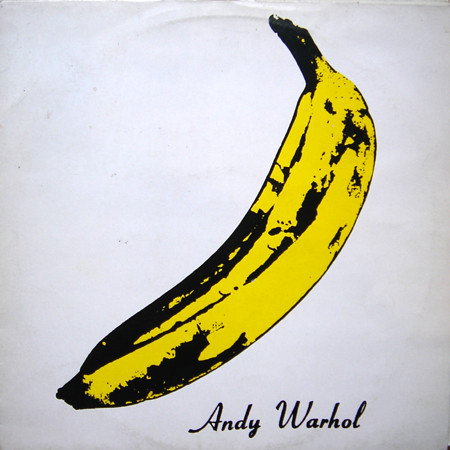
Banana by Andy Warhol
Banana, Andy Warhol

Turquoise Marilyn by Andy Warhol
Marilyn, Andy Warhol

Sometimes, the originality comes with the utilizing a new technique, new media, or new perspective.

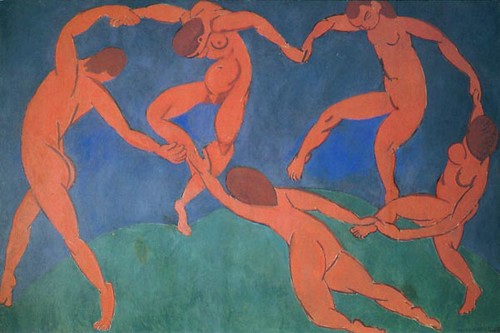
My painting Devils' Dance - created around the time George W. Bush was drumming up to invade Iraq and quashing civil liberties in the US - was not the most original painting depicting dance. Actually, the images of the dancers were borrowed from the famous Dance by Henri Matisse. My painting was also not the most original depicting book burnings with bonfire, neither was the attempt to modify existing iconic images to suit new messages or needs. But the specific way I deployed was unique to me at the particular moment for a particular message and mood I tried to convey. Despite the fact that large portion of these two paintings were similar, the stark contrast between the original message and the new one was pronounced and poignant, therefore, I dare say this painting was a success.

Devils' Dance / 魔鬼的舞蹈 / Teufels Tanz
Devils' Dance, Matthew Felix Sun

Dance by Matisse
Dance, Henri Matisse