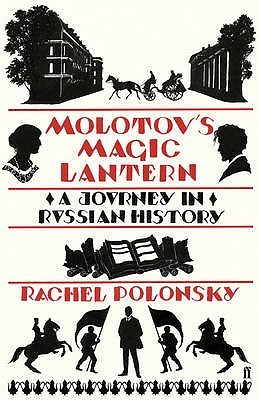
 In the midst of winter, I finished reading Molotov's Magic Lantern: A Journey In Russian History
by Rachel Polonsky. As if I didn't have enough of the Siberian chill, I picked up One Day in the Life of Ivan Denisovich by
Aleksandr I. Solzhenitsyn, translated by Ralph Parker, while recuperating from a nasty cold at my slightly heated apartment. These two books made a great pair of winter reading, for people like me who are not afraid of visiting and re-visiting harrowing terrains.
In the midst of winter, I finished reading Molotov's Magic Lantern: A Journey In Russian History
by Rachel Polonsky. As if I didn't have enough of the Siberian chill, I picked up One Day in the Life of Ivan Denisovich by
Aleksandr I. Solzhenitsyn, translated by Ralph Parker, while recuperating from a nasty cold at my slightly heated apartment. These two books made a great pair of winter reading, for people like me who are not afraid of visiting and re-visiting harrowing terrains.What attracted me to British journalist Polonsky's dreamy iteration in the Putin's Russia, with unbroken linkages to the Soviet history, particularly those from the 1910s through 1940s, was the panoramic tapestry she deftly waved together, with threads of ancient yarns she picked up in the old Bolshevik Vyacheslav Molotov's apartment library in Moscow, through historical stories and her travel journalistic reports, ranging "from Arctic to Siberia and from the forests around Moscow to the vast steppes" [Goodread]. Molotov was one of the most ruthless apparatchik who had condemned hundreds if not thousands people, many of those he had known and had called friends before, to their death marches. More poignantly, his library contained volumes of carefully preserved, thoroughly read and annotated books whose authors he had sent to the Gulags. Her book was a "condensed history of the country had suffered and is still suffering in certain degree from war, famine and totalitarianism" [Goodread].
 And who had captured the terror of the most brutal Stalinist era better than Aleksandr Solzhenitsyn, in his slim but heavy immortal volume, the above mentioned One Day in the Life of Ivan Denisovich?
The GoodReads gives such description of the novella: "A masterpiece of modern Russian fiction, this novel is one of the most significant and outspoken literary documents ever to come out of Soviet Russia. A brutal depiction of life in a Stalinist camp and a moving tribute to man's triumph of will over relentless dehumanization." Wikipedia summarizes the plot as this: "The themes of One Day in the Life of Ivan Denisovich center on authoritative oppression and camp survival. Specifically discussed is the cruelty and spite towards the fellow man, namely from prison officials. Solzhenitsyn explains through Ivan Denisovich that everything is managed by the camp commandment up to the point where time feels unnoticed; the prisoners always have work to do and never any free time to discuss important issues. Survival is of the utmost importance to prisoners. Attitude is another crucial factor in survival. Since prisoners were each assigned a grade it was considered good etiquette to obey. This is outlined through the character of Fetiukov, a ministry worker who let himself into prison and scarcely follows prison etiquette. Another such incident involves Buinovsky, a former naval captain, who is punished for defending himself and others during an early morning frisking."
The life in the Gulag was as bitter as Siberian winter, and I am very grateful to the author that we have such a vivid documentation of the human sufferings in the hands of tyranny in the name of the people.
Reading this book was hard for me, because it had many family resonances, which like most Chinese sufferings in the hands of Communist regime, still remain largely untold and undocumented.
While I was waiting to be born, my father was sent to a "Cadre School", a sort of labor camp. Unlike the Soviet system, it was not individuals who were sentenced to the camp during Cultural Revolution - that did take place in late 1950s when Mao and his Cadres were condemning "Rightists" - rather, it was wholesale internment of entire work units, small or large. Neighboring my father's camp, were similar "schools" for my maternal grandfather and his younger brother. Another close uncle of mine was sent to another camp several hundred kilometers from them and from home. Those camps were not prisons per se, and their inmates didn't wear numbers but the rest were not much different. Before they were able to build camps, they slept in the open during cold nights even when the temperature dropped to as low as Fahrenheit -25 to -30 degrees. They were made to work, some units and individuals light and others heavy. My great uncle slept on cold stone "bed" and my grandfather was so sick that he could not even climb back to his shed after a trip to outhouse. They were fed with pickles and preserved Chinese cabbages similar to sauerkraut which caused ulcers when cooked without oil or grease, meal after meal for six long-winter months every year.
Food in my Manchurian home city Shenyang had never been abundant and in winter days of Mao's era, we had only pickles, preserved and "fresh" Chinese cabbages as vegetables. Polonsky's following descriptions of Russia reminded me of those bitter days in Shenyang:
... an American bulldozer appears (bringing a new word into the Russian language) with the tractors and Studeakers and spam 'from beyond the ocean...' (Page 291)Yes. Vegetables were scarce so was meat. Even spam was great food when I grew up, and one could always find chunks of meat in the otherwise homogeneous mass, with their clear strands of meat filaments. One of the reasons I could tolerate school outings would be lunches of such spam sandwiches, which were quite a envy of some other kids.
"Anyone who has worked in the north knows the joy that every single leaf can give." (Page 292)
Naturally, many Chinese people don't have to suffer such food shortage nowadays - they traded it for bad air and bad water - and many kids have never heard of, let alone would understand the importance of winter Chinese Cabbages purchases, which were usually organized by residential committees and on the assigned purchase days, people could even get a day off from work, in order to purchase, transport, clear, store and pickle several hundred pounds of Chinese cabbages for the entire family for the whole winter, as documented in the pictures below, spectacular events of those days in Northern China:


Related posts on Art · 文化 · Kunst:
- Devastating Novel "The Land of Green Plums" by Herta Müller
- Ashamed of Oneself - Reading Book "Never Let Me Go" - Stores and Markets in Shenyang, China
- Devastating Novel "The Land of Green Plums" by Herta Müller
- Ashamed of Oneself - Reading Book "Never Let Me Go" - Stores and Markets in Shenyang, China


 Posts
Posts


