Showing posts with label Mao. Show all posts

Tuesday, January 29, 2013

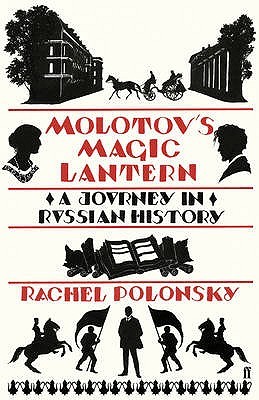
Molotov's Magic Lantern: A Journey In Russian History by Rachel Polonsky and Some Journeys of My Own


In the midst of winter, I finished reading Molotov's Magic Lantern: A Journey In Russian History by Rachel Polonsky.  As if I didn't have enough of the Siberian chill, I picked up One Day in the Life of Ivan Denisovich by , translated by Ralph Parker, while recuperating from a nasty cold at my slightly heated apartment. These two books made a great pair of winter reading, for people like me who are not afraid of visiting and re-visiting harrowing terrains.

What attracted me to British journalist Polonsky's dreamy iteration in the Putin's Russia, with unbroken linkages to the Soviet history, particularly those from the 1910s through 1940s, was the panoramic tapestry she deftly waved together, with threads of ancient yarns she picked up in the old Bolshevik Vyacheslav Molotov's apartment library in Moscow, through historical stories and her travel journalistic reports, ranging "from Arctic to Siberia and from the forests around Moscow to the vast steppes" [Goodread].  Molotov was one of the most ruthless apparatchik who had condemned hundreds if not thousands people, many of those he had known and had called friends before, to their death marches.  More poignantly, his library contained volumes of carefully preserved, thoroughly read and annotated books whose authors he had sent to the Gulags.  Her  book was a "condensed history of the country had suffered and is still suffering in certain degree from war, famine and totalitarianism" [Goodread].

And who had captured the terror of the most brutal Stalinist era better than Aleksandr Solzhenitsyn, in his slim but heavy immortal volume, the above mentioned One Day in the Life of Ivan Denisovich?

The GoodReads gives such description of the novella: "A masterpiece of modern Russian fiction, this novel is one of the most significant and outspoken literary documents ever to come out of Soviet Russia. A brutal depiction of life in a Stalinist camp and a moving tribute to man's triumph of will over relentless dehumanization."  Wikipedia summarizes the plot as this: "The themes of One Day in the Life of Ivan Denisovich center on authoritative oppression and camp survival. Specifically discussed is the cruelty and spite towards the fellow man, namely from prison officials. Solzhenitsyn explains through Ivan Denisovich that everything is managed by the camp commandment up to the point where time feels unnoticed; the prisoners always have work to do and never any free time to discuss important issues. Survival is of the utmost importance to prisoners. Attitude is another crucial factor in survival. Since prisoners were each assigned a grade it was considered good etiquette to obey. This is outlined through the character of Fetiukov, a ministry worker who let himself into prison and scarcely follows prison etiquette. Another such incident involves Buinovsky, a former naval captain, who is punished for defending himself and others during an early morning frisking."

The life in the Gulag was as bitter as Siberian winter, and I am very grateful to the author that we have such a vivid documentation of the human sufferings in the hands of tyranny in the name of the people.

Reading this book was hard for me, because it had many family resonances, which like most Chinese sufferings in the hands of Communist regime, still remain largely untold and undocumented.

While I was waiting to be born, my father was sent to a "Cadre School", a sort of labor camp.  Unlike the Soviet system, it was not individuals who were sentenced to the camp during Cultural Revolution - that did take place in late 1950s when Mao and his Cadres were condemning "Rightists" - rather, it was wholesale internment of entire work units, small or large.  Neighboring my father's camp, were similar "schools" for my maternal grandfather and his younger brother.  Another close uncle of mine was sent to another camp several hundred kilometers from them and from home.  Those camps were not prisons per se, and their inmates didn't wear numbers but the rest were not much different.  Before they were able to build camps, they slept in the open during cold nights even when the temperature dropped to as low as Fahrenheit -25 to -30 degrees.  They were made to work, some units and individuals light and others heavy.  My great uncle slept on cold stone "bed" and my grandfather was so sick that he could not even climb back to his shed after a trip to outhouse. They were fed with pickles and preserved Chinese cabbages similar to sauerkraut which caused ulcers when cooked without oil or grease, meal after meal for six long-winter months every year.

Food in my Manchurian home city Shenyang had never been abundant and in winter days of Mao's era, we had only pickles, preserved and "fresh" Chinese cabbages as vegetables.  Polonsky's following descriptions of Russia reminded me of those bitter days in Shenyang: 
... an American bulldozer appears (bringing a new word into the Russian language) with the tractors and Studeakers and spam 'from beyond the ocean...' (Page 291)

"Anyone who has worked in the north knows the joy that every single leaf can give." (Page 292)
Yes.  Vegetables were scarce so was meat.  Even spam was great food when I grew up, and one could always find chunks of meat in the otherwise homogeneous mass, with their clear strands of meat filaments.  One of the reasons I could tolerate school outings would be lunches of such spam sandwiches, which were quite a envy of some other kids. 

Naturally, many Chinese people don't have to suffer such food shortage nowadays - they traded it for bad air and bad water - and many kids have never heard of, let alone would understand the importance of winter  Chinese Cabbages purchases, which were usually organized by residential committees and on the assigned purchase days, people could even get a day off from work, in order to purchase, transport, clear, store and pickle several hundred pounds of Chinese cabbages for the entire family for the whole winter, as documented in the pictures below, spectacular events of those days in Northern China:


- Banned Books in Mao's China
- What to Expect from Record High Chinese Overseas Students
- What One Cannot See on Flickr in China
- My Two Christmases in China


Friday, December 23, 2011

Remembering Mao's Death

The death of the dictator of North Korea Kim Jong-Il triggered a wave of show of grief in that isolated country.  To many informed, Kim Jong-Il was a ruthless and heartless ruler who brought his people to calamities after calamities.  Yet, his people mourned his passing.


I suspect that their sorrow demonstrated in the pictures above is largely genuine.  It's not like they are stupid but they are deceived.

The power of propaganda and brain-wash cannot be underestimated.

The pictures above reminded me what happened in China, when their Chairman Mao Zedong died in September 1976.

Many people cried as if the world came to an end and as if they indeed had lost a most caring father, despite the fact that Mao's long reign had been very destructive and oppressive, which could only be topped by the cruelty of the Khmer Rouge in Cambodia.  Some historical pictures showed how Chinese people showed their collective grief.


I was very young and just started my school. The overwhelming showing off grieve by the adults made a great impression on me, with mixture of fear and joy.  It was the kind joy when a calamity we had often prayed for, say before an unprepared final exam, miraculously materialized.

However, I knew that such joy was not to be revealed.  At the time, I was not aware of the evilness of Mao therefore didn't harbor any hatred against him yet.

On the national mourning day, we were herded to some room lying between our make-shift classroom, rented in residential area by local government due to lacking classrooms in schools, and my home for a memorial service.  The grim atmosphere in the dark room again was impressive and if anyone in my class cried, I suspect it was mostly due to fear or hallucination.  But I didn't witness any because we had to bow our heads and look at our feet.  Or others' feet.  I heard a rumor that a girl spat on her cloth shoes to make them wet as if soaked by tears.  I suspected that this was just malicious gossip, but couldn't dismiss it with absolute confidence.  We first-graders were capable of playing many tricks to score over others, in order to wangle some praises from our teachers.

When I returned home, I rested in the hallway before I entered our flat, to ensure that any trace of schadenfreude smile be erased from my face.  Before I finished hiding my glee, my mother suddenly came out of our flat and startled me.  I must looked unnatural due to my inexperience and not having mastered the requisite art of deception.  She insisted on interpreting my abashment as the result of my being caught weeping out of grief and felt embarrassed by that and heaped upon me with extravagant praises which I tried to evade in vain.  She would not or refused to understand my explanation.  Perhaps, her version would have put her mind at better ease?

Anyway, during those days, kids had a little bit more leverage to do whatever we pleased.  Besides, after we'd witnessed how adults howling like wounded animals in the most ungainly ways, their collective authorities eroded quite a bit.

Sometimes, it was even comical.

The last picture above showed that all the mourners had a black band on their left arms - a sign for mourning in then China.  If the deceased were a woman, the band should be worn on the right arms by her mourners.

In one P.E. class in the following days, we were drilled repeated to turn left or right because some of my classmates had trouble in following the commands of "Left Turn" and "Right Turn".  Some of us were not quite able to tell left from right.  To make things simple, our P.E. teacher told us that it were our left arms wearing the black band, therefore, we ought to turn towards that direction when he called out "Left Turn".

Even so, one boy still turned to his right on such command.  Our P.E. teacher was furious and almost struck the poor boy before he realized that the boy was wearing his black band on his right arm.

I don't remember the name and the face of that poor boy.  But he must be a poor one.  I remember that most of us have beautiful shining new black band made of some nice, wrinkle-free material while his was a miserable looking one, trimmed out of an old pair of trousers or jacket.  Surely his parents did not purchase black cloth for the band despite the fact that all residents were given extra rations for cloth that month and for that we despised him and laughed at his mistake most heartily.


Friday, March 25, 2011

Politics and Profits

Thirty-five years after his death, Mao Zedong still enjoys respect or even reverence from many quarters in China. For example, in April 2010, Telegraph reported that Chinese protestor throws ink at portrait of Chairman Mao:
An angry Chinese protestor has attempted to throw ink over the famed giant portrait of Chairman Mao Zedong that hangs in Beijing's Tiananmen Square, police in China have confirmed.

Police wrestled the man to the ground last weekend after he threw a bottle of ink at the portrait, a potent symbol of Communist Party power which hangs on the Tiananmen gate tower where Chairman Mao declared a new republic 60 years ago.

"At around 13:35pm, April 5 2010, a man was put under control after he threw a plastic bottle of ink towards the Tiananmen gate tower," the Beijing Municipal Public Security Bureau confirmed in a statement faxed to The Telegraph.

The audacious attack echoes the 1989 Tiananmen Square protest when three young men threw ink-filled eggs at the portrait in a gesture of defiance against China' Communist ruling party that resonated around the world.

The three men, Lu Decheng, Yu Zhijian, and Yu Dongyue, received some of the harshest sentences in the crackdown that followed the violent crushing of the protests, being jailed for 16 years, 20 years and life respectively.

That kind of disrespect to the Mao could not be tolerated by Chinese government, if it was out of political motivation.

However, if it was done in the name of development, the story could have a different ending.

Technews reported that 
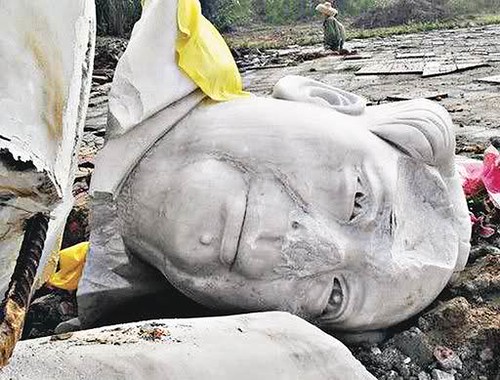
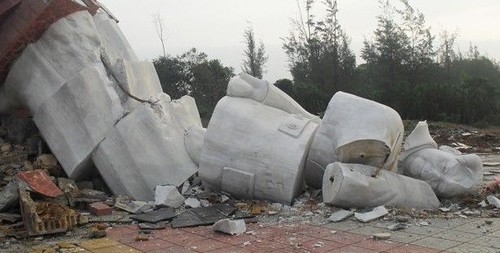
A real estate company wrecked the statue of the 'Great Helmsman' -- China's most powerful figure between 1949 and 1976 -- while re-developing a district in Longlou town in Wenchang region, reported Hong Kong's South China Morning Post.

Erected in 2008, the 9.9m white marble statue had attracted many visitors, China News Service (CNS) reported.

"Developers now wield the greatest power of destruction in China, tearing down houses and flattening martyrs' mausoleums in the name of development," another (Internet) post remarked on China.com."
Indeed, in the name of development, developers, often combined with power of unchecked government and ruthless mafia, wrecked homes for profit at well.

5042c531g9e043d3f387d&690

a5dfd10069f35345728b65ce

The demolition of Mao's statue earned some condemnation from China's leftist corners but it is doubtful any developers involved would suffer the fate of those angry protesters who "defaced" Mao's giant portrait.

Profits tramps politics.  Call it progress.

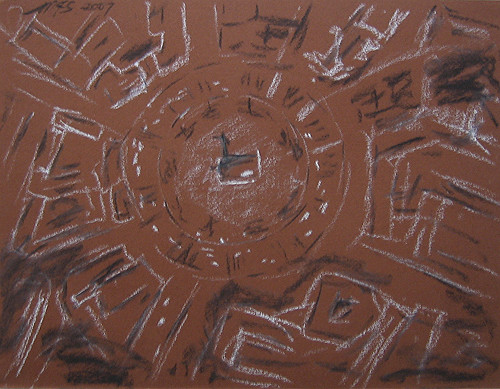
Mao Zedong Statue in Shenyang, China - Matthew Felix Sun's Drawing_7339
Mao's Statue in Shenyang

Wednesday, July 28, 2010

Mao's Last Dancer?

A friend of mine mentioned a movie he just saw - "Mao's Last Dancer". Since the protagonist shared the same heritage with me, my friend wondered if I would like the movie but when the credits started to roll, he realized that I would not like it, since the movie was too uplifting.

I have to admit that he was right. I am always leery of uplifting art creations.

I was vaguely aware of the story. In order to give it an unbiased account, here I copied the synopsis of the movie from IMDB.com "A drama based on the autobiography by Li Cunxin. At the age of 11, Li was plucked from a poor Chinese village by Madame Mao's cultural delegates and taken to Beijing to study ballet. In 1979, during a cultural exchange to Texas, he fell in love with an American woman. Two years later, he managed to defect and went on to perform as a principal dancer for the Houston Ballet and as a principal artist with the Australian Ballet. "

When I first heard of the story and learned the synopsis, I felt that the title, based on his autobiography, was misleading, sensational and masochistic.

Mao had died for three years when he defected and this insistence of linking himself to Mao is real troublesome. One can never be sure if how proud he is being Mao's dancer. If it is metaphoric speaking, Mao still commands legions of dancers in the world and he is hardly the last. Is he still Mao's dancer? Or simply retired? I wonder if the movie will answer.

To cap my mistrust, my friend told me that the real-life character, Li Cunxin, has become a motivational and inspirational speaker.

On his official website, Li claims:
As a motivational and inspirational speaker, Li’s unique real life story works so effectively with corporations and conferences’ various themes and objectives. It is a story that can touch people deep in their hearts.
Touching people's heart, perhaps. But how his story could motivate me? I honestly do not know.

Motivational and inspirational speaker as a career should never have existed. Human conditions and struggles are unique and chance opportunities often play tricks too. Pretending that everyone can aspire to and achieve same goal, claimed many such speakers, were deliberate cheats and sadomasochistic.

My friend was right. I would stay clear from such emotional manipulations.

Thursday, April 23, 2009

Statue of Mao Zedong in the Heart of Shenyang

Statue of Mao Zedong still stands firm in Dr. Sun Yat-Sen Square, the heart of Shenyang, China: