Showing posts with label The Hague. Show all posts

Wednesday, October 17, 2012

My Favorite Paintings in Prince William V Gallery, Den Haag

In Den Haag, beside the estimable Mauritshuis, I also made a stop at a smaller museum - Prince William V Gallery (Galerij Prins Willem V).  The Prince William V Gallery was the first public collection of paintings in the Netherlands dating back to 1774.  It showcased the eighteenth-century painting collection of the  Stadholder William V, Prince of Orange-Nassau (1748-1806), in its original setting of long and high-ceilinged room, cramped from top to bottom of the walls.  Many of the highlights from the original collections were moved to Mauritshuis in 1822 but it still contained some impressive paintings. There were about 150 paintings hang in the Gallery, mainly by Dutch and Flemish masters such as Steen, Potter, van Mieris, van Honthorst and Rubens.

I am very partial to Greek mythology so it was no surprise that I was attracted to the painting named Sisyphus, a king punished by being compelled to roll an immense boulder up a hill, only to watch it roll back down, and to repeat this action forever.


Sisyphus, c. 1660-1665, Antonio Zanchi (1631 - 1722)
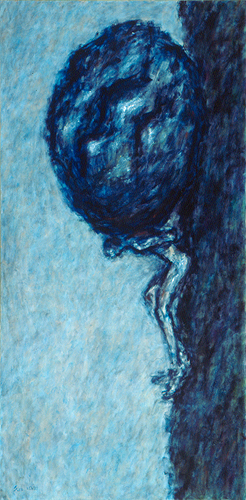
Sisyphus / 西西弗斯 / Sisyphus
Sisyphus, 2003
Matthew Felix Sun
I found the Sisyphus by Antonio Zanchi (above) startling in its direct confrontation to its viewers.  The view point zoomed into the condemned laborer, and omitted all of the other elements in the story.  We saw only half of the hero, carrying the large, but not outsized stone, in some flowing draperies, which gave him some modesty and dignity.  Burdened by not beaten, this Sisyphus held himself together, muscles flashing, strides steady.  This was a defiant tragic figure. 

I found it worth pointing out that Zanchi painted no slope where the boulder was to repeatedly roll down.  When I made a painting on the same subject three years before my trip to the Netherlands, I was more interested in the overall impression and narrative of the story, than depicting the character of Sisyphus.  My boulder was much larger, the slope vertical and Sisyphus tiny without details.  Very different take from Zanchi, whose version, if not for the title, it could be depicting any human being in such a struggle.  That was why a well-known classic story so fascinating to reinterpret. 

The other painting I liked very much from that Gallery was titled Argus, Mercurius and Io, by Jacob van Campen.  Io was, in Greek mythology, a priestess of Hera in Argos, a nymph who was seduced by Zeus, who changed her into a heifer to escape detection. His wife Hera sent ever-watchful Argus Panoptes, with 100 eyes, to guard her, but Hermes was sent to distract the guardian and slay him. Heifer Io was loosed to roam the world, stung by a maddening gadfly sent by Hera, and wandered to Egypt, thus placing her descendant Belus in Egypt; his sons Cadmus and Danaus would then "return" to mainland Greece. [wikipedia.com] 


Argus, Mercurius and Io, c.1630-1640, Jacob van Campen ( 1596 - 1657)

This painting was about disguise, deception and anticipation.  Here, Van Campen used the Roman name of the god, Mercury, who was a smooth and graceful youth, confidently lured the old Argus to sleep.  Argus was presented as a balding old man though with younger person's body, without his numerous extra eyes, which would adore Hera's peacock feathers.  I almost felt pity for Argus, knowing that he would be slay by the deceptive Hermes.  Also interesting to me were the two heifers in the background - one looked away indifferently, and the other peeping at the activity with intent interest - this one must be Io.  I also like the parallel poses Hermes/Mercury and Argus - their torsos and limps, formed a diamond shape - diagonal, dynamic, yet serene and sleepy.

Few dogs scattered across the painting enriched the setting and added some intrigue and nervous energy.  The gaze from Io/Heifer and from the black dog at the feet of Argus were full of anticipation and anxiety and I got a sense of upcoming storm, which was also reinforced by the dark clouds dramatically hanging high, again, in diagonal formation, added another touch of a high stake.


My Favorite Museum Collection Series

>> My Favorite Museum Collection Series 56: My Favorite Paintings in Groeninge Museum, Bruges (Brugge), Belgium
<< My Favorite Museum Collection Series 54: My Favorite Paintings in Mauritshuis, Den Haag, Netherlands


List of My Favorite Artworks in the Museums I've Visited
 

Saturday, October 13, 2012

My Favorite Paintings in Mauritshuis, Den Haag, Netherlands

In recent years, the main fine art museum in the Dutch capital city of Den Haag, gained additional renown for one of its particular painting - The Young Girl with Turban, a.k.a. Girl with a pearl earring, by Johannes Vermeer.


The Young Girl with Turban (Girl with a pearl earring)
c. 1665, 44.5 x 39 cm, Johannes Vermeer


This painting, portraying a very young girl at the threshold of womanhood, half-turning her head and gazed at the viewers, in a state of irresolute, hesitating, seductive and seduced, inviting and withdrawing simultaneously.  Her large eyes and half-open ripe lips betrayed passion underneath her alabaster pale skin.  A huge pearl, hanging from her half-hidden ear, echoing those soulful eyes, with a highlight too bright to stare at.  Adding exoticism to the painting was her blue and yellow turban, which completely concealed her hair and that made her appear bald and chaste; yet as if to negate such impression, part of the turban cascaded down her shoulder, therefore gave her a coquettish flair.

Furthermore, what was so remarkable about this painting were Vermeer's fresh colors, virtuoso technique and subtle rendering of light effects, such as the small highlights on the turban and the pearl, which was painted with economical brushstrokes, mainly a bright highlight at upper left and the soft reflection of the white collar below.

As reported in my previous entry, Paintings As Pivotal Elements, this painting and its imagined inception, was detailed in a lively novel Tracy Chevalier and an ensuring movie The Girl with a Pearl Earring.  The novel and the movie were so overwhelmingly popular that even the collector of this painting, Mauritshuis, was presumably forced to change its title to The Girl with a Pearl Earring.

After the subtle and sophisticated sensuality, I appreciated simplicity and charming innocence in Carel Fabritius's The Goldfinch below.


The goldfinch period ca. 1654, Oil on Panel, 33.5 x 22.8 cm
Carel Fabritius (bapt. 1622 - 1654)

Fabritius died young, in the explosion of the Delft powder magazine – a disaster which destroyed a large part of the city, and left a known body of work of only fifteen.  He painted this small panel of goldfinch, a kind of birds had long been popular as house pet and been taught to perform tricks, as a trompe-l'œil (deception of the eye), to be hung above the viewers, and aided by the metal perch, to trick the viewer to believe that they were seeing a real bird perching above, playing his own trick on us.

This bird was full of necessary details and remarkable vitality, though broadly painted and without fastidiousness which could have rendered such subject a zoology illustration.  A perhaps slight work but a whimsical and delightful one.


My Favorite Museum Collection Series

>> My Favorite Museum Collection Series 55: My Favorite Paintings in Prince William V Gallery, Den Haag 
<< My Favorite Museum Collection Series 53: My Favorite Paintings at Museum Boijmans Van Beuningen Rotterdam

List of My Favorite Artworks in the Museums I've Visited


Related posts on Art · 文化 · Kunst:
- Last Call - "The Girl With A Pearl Earring" in De Young Museum, San Francisco
- "Compliments to Vermeer" - Controversial Solo Exhibition of the Renowned Chinese Painter JIN Shangyi
- Paintings As Pivotal Elements
- Last Chance to See Terracotta Warriors in San Francisco Asian Art Museum
- Birth of Impressionism at De Young Museum, San Francisco
- Venetian Masterpieces from Vienna at De Young Museum
- My Favorite Works at De Young Museum, San Francisco
- My Favorite De Young Museum Collections