Showing posts with label Netherlands. Show all posts

Friday, May 31, 2013

Last Call - "The Girl With A Pearl Earring" in De Young Museum, San Francisco


The twin exhibitions - "The Girl with a Pearl Earring - Dutch Paintings from the Mauritshuis" and "The Rembrandt's Century" in De Young Museum, San Francisco are to be closed on June 2.  The second exhibit is a companion exhibition to Girl with a Pearl Earring featuring more than 200 rarely seen prints and drawings of the same era, all drawn from the permanent collections of the Fine Arts Museums of San Francisco.  These were wonderful exhibitions and I visited these two exhibitions twice in order to absorb as much as possible, despite the fact that I'd seen the marquee painting by Johannes Vermeer in the Mauritshuis before. 


Much have been said about this now household name painting and I would not repeat much here.  But I can list a few my other favorites.


The first one was a small bird painting, The Goldfinch (above), by Carel Fabritius, a painter of the 17th century Dutch Golden Age, studied with Rembrandt van Rijn. Other favorite paintings included one by Rembrandt,  Portrait of an Elderly Man, 1667 (below)

File:61044 Portrait of an Eldery Man.jpg

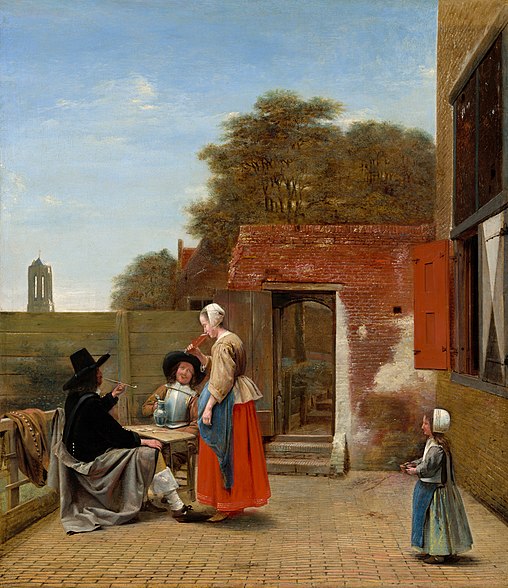
Another standout was a genre painting by Pieter de Hooch, titled A man smoking and a woman drinking in a courtyard (below). 

File:Pieter de Hooch 012.jpg

The most overwhelming and lasting effects were actually from the "Rembrandt's Century" painting, with much moody engravings, etchings and drawings. 

My favorite was  Rembrandt's etching, The Landscape with the Three Trees:

The Three Trees - Rembrandt

I also love the amazing The Shell (Conus Marmoreus), a combination of etching, drypoint and engraving by Rembrandt (below):


Then there were Medea, or The Marraige of Jason and Creusa, 1648 by Rembrandt and his Christ Crucified between Two Thieves (The Three Crosses), 1653, both highly dramatic and terrifying:

Medea or the marriage of Jason and Creusa - Rembrandt


File:Rembrandt The Three Crosses 1653.jpg

There were more paintings and prints by other masters in these amazing exhibitions.  Do try to see these works!


Related posts on Art · 文化 · Kunst:
- My Favorite Paintings in Mauritshuis, Den Haag, Netherlands
- "Compliments to Vermeer" - Controversial Solo Exhibition of the Renowned Chinese Painter JIN Shangyi
- Paintings As Pivotal Elements
- Last Chance to See Terracotta Warriors in San Francisco Asian Art Museum
- Birth of Impressionism at De Young Museum, San Francisco
- Venetian Masterpieces from Vienna at De Young Museum
- My Favorite Works at De Young Museum, San Francisco
- My Favorite De Young Museum Collections

Saturday, November 17, 2012

My Favorite Paintings in The Memling Museum The St. John's Hospital in Bruges

The St Johns Hospital in Bruges, Belgium (Sint-Janhospitaal, Memlingmuseum, Brugge), hosted the The Memling Museum, where six paintings by the 15th century painter Hans Memling can be seen.  The oldest known document with rules for the hospital dates from 1188 and the oldest part of the building (ward) below dated back to 13th century. 


Hans Memling (also spelled Memlinc; c. 1430 - 11 August 1494) was born as Jan van Mimnelinghe in Seiligenstadt (located on the river Maine in Germany) and became a citizen of Bruges in 1465.  He moved to Flanders and worked in the tradition of Early Netherlandish painting.  From the 1460s until the end of his life he became one of the leading artists, painting both portraits and several large religious works, continuing the style he learned in his youth from his masters such as Rogier van der Weyden.  Memling lived for a long time in the St. Johns hospital and died there.

Of the works collected by the Memling Museum, I like the below portrait, Portrait of a Young Woman (Sibylla Sambetha), most.  It was a most serene deferential portrait of a pale yet determined young woman, whose confidence and humbleness made a striking impression on me.  I loved the ethereal aura of her and the almost translucent presence.  Her gossamer hairpiece, her robe of strikingly contrasted black, red and white gave her strength, and the curves of her chin, her necklace echoed and reinforced the while stripe on her rope and bound them together.


Portrait of a Young Woman (Sibylla Sambetha)
1480
Oil on panel; 38 x 26.5 cm (without frame), 46.5 x 35.2 cm (with frame)
Bruges, Sint-Janhospitaal, Memlingmuseum 

The second favorite piece of mine there was a wooden shine, the Shrine of St. Ursula, a carved and gilded wooden shrine containing pictorial oil on panel inserts (87x33x91 cm) by Memling, dating to circa 1489.


Shrine of St. Ursula (1489). Memlingmuseum, Sint-Janshospitaal, Bruges.
Public Domain, source: Wikipedia

St. Ursula's story was one of the craziest and my favorite from the Catholic canons.  Ursula, a princess from Brittany in France, agreed to marry the son of King of England, on one condition, that she would be allowed to undertake a pilgrimage to Rome accompanied by 11,000 virgins. The troops passed by the city of Basel and the Alps until reaching Rome, where they were received by Pope Cyriacus. On the way back, they were stopped in Cologne by the Huns and killed because they refused to renounce their Christian faith.

The shrine had three painted tondoes on each side, depicting, on one side, the First Eleven Virgins with the Pope, a Cardinal, a Bishop and Etherius (characters of the saint's legend); on the other side, the Coronation of the Virgin with the Holy Trinity.  The two "façades" contain the representations of the Virgin and Child between Two Nuns (the two donors, including the abbess), and St. Ursula Protecting the Holy Virgins. Both the scenes are embedded within a painted niche which simulates a perspective interior of the shrine.  At the sides, under two small arcades, are six scenes of the life and martyrdom of St. Ursula, which resemble the style of the stained glasses in contemporary churches. They include:
  • Arrival in Cologne
  • Arrival in Basel
  • Arrival in Rome
  • Leaving from Basel
  • Martyrdom of the Pilgrims
  • Martyrdom of St. Ursula
These paintings, done in the typical Flemish style, though small, were full of wonderful details and bound together with same pictorial background of northern German cities (such as Cologne, with the unfinished Cathedral).  The multitudes of the people were painted with great care - all the postures, expressions and emotions were done with purpose and the modeling of the body, though slender, was done with sure hands and the coloration was both consistent and varied, and absolutely enchanting. The story was a gory one but the paintings were done in a serene and comforting style, very comforting, if this sad story could ever be.


Arrival in Rome
  
Virgin and Child


My Favorite Museum Collection Series

>> My Favorite Museum Collection Series 58: My Favorite Sculpture and Painting at Church of Our Lady, Bruges
<< My Favorite Museum Collection Series 56My Favorite Paintings in Groeninge Museum, Bruges (Brugge), Belgium


List of My Favorite Artworks in the Museums I've Visited

Monday, November 5, 2012

My Favorite Paintings in Groeninge Museum, Bruges (Brugge), Belgium

Bruges, Belgium was glittering jewel since medieval time and though its commercial activities has largely subsided, its glories can be seen from every corner of its old city, particularly in its rich museums.  The most important museum in Bruges is Groeninge Museum, which boasts some very fine examples of Flemish Primitive paintings, such as those by Jan van Eyck, which present in Bruges was like that of Botticelli in Florence, Italy.

To modern eyes, the elaborately wrought paints by Van Eyck could be too much a good thing - all those endless draperies, mind-boggling intricate patterns and infinite details vying with one another for attention.  Yet, it was an idiom what rendered Van Eyck's oeuvres so remarkable.  His paintings were sumptuous, but these details enhanced, instead of dwarfing the stories and characters.  His paintings were far more than just pageantry.  Rather, he used the rich background as auxiliary means to tell stories, to add meanings and layers, and more importantly, to add significance and status to his saints and donors, etc.  These details were exhaustive but not exhausting.  Together, they formed a very specific and special time and space, somewhat fantastic but really idealized. Van Eyck's colors were simply glorious and one could not praise it highly enough.  His figures might a tad stiff or mannered, but just as those by Botticelli, they didn't mean to be naturalistic.  They were stylized and became immortal in their fixed postures.

I chose the painting below, The Madonna with Canon van der Paele, as one of my very favorite paintings from the Groeninge Museum, Bruges.


Jan van Eyck's The Madonna with Canon van der Paele
Source: ginieland on Wikipedia

For my second favorite from that museum, I chose a copy after Rogier van der Weyden, another giant of the region in 15-16th century.


Copy after Rogier van der Weyden, Saint Luke drawing the Madonna, ca. 1491-1510


This painting, a copy after Rogier van der Weyden, showed Saint Luke, the patron saint of artists, drawing portrait of Mary breast feeding Jesus. The most striking aspect of this group portrait was the calmness of Mary, under close scrutiny, in a rather intimate and private moment, and the obvious pride and joy on her face, and the intensity on the keenly observant face of Saint Luke.  He obviously took his task seriously and he knew that he was recording a supremely important event for posterity.  To emphasis the status of Mary, Van der Weyden sat her under a brocade canopy, amidst a rather bourgeois interior.

Adding some visual interests were two persons in mid-distance, in typical Flemish dress, surveying a typical Flemish town, tranquil, imperturbable, sharing the same luminosity of the painting itself, a wonderful achievement of Van der Weyden and his copier.

According to Flemish Primitives, "the presentation is based on a legend from the 6th Century, in which it is said that Luke paints the portrait of Mary. For this reason, Saint Luke is the guardian saint of painters, and the guilds in which painters united were often named after him. This story is then also a cherished theme as altarpiece for the chapel of the Saint Luke's guild. The painting from which this Bruges work is a copy, is painted by Rogier van der Weyden before 1440. He probably makes it for the chapel of the Brussels Saint Luke's guild, of which he is a member. The original is preserved in the Museum of Fine Arts in Boston. In addition to the Bruges work, there are also two true copies known that are kept in the Alte Pinakothek in Munich and in the Hermitage in St. Petersburg. The Bruges painting is the best in terms of quality of these copies and was probably painted around 1500."


My Favorite Museum Collection Series

>> My Favorite Museum Collection Series 57: My Favorite Paintings in The Memling Museum The St. John's Hospital in Bruges
<< My Favorite Museum Collection Series 55: My Favorite Paintings in Prince William V Gallery, Den Haag


List of My Favorite Artworks in the Museums I've Visited

Wednesday, October 17, 2012

My Favorite Paintings in Prince William V Gallery, Den Haag

In Den Haag, beside the estimable Mauritshuis, I also made a stop at a smaller museum - Prince William V Gallery (Galerij Prins Willem V).  The Prince William V Gallery was the first public collection of paintings in the Netherlands dating back to 1774.  It showcased the eighteenth-century painting collection of the  Stadholder William V, Prince of Orange-Nassau (1748-1806), in its original setting of long and high-ceilinged room, cramped from top to bottom of the walls.  Many of the highlights from the original collections were moved to Mauritshuis in 1822 but it still contained some impressive paintings. There were about 150 paintings hang in the Gallery, mainly by Dutch and Flemish masters such as Steen, Potter, van Mieris, van Honthorst and Rubens.

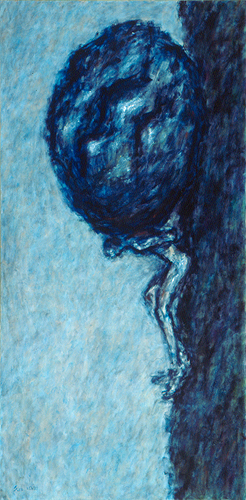
I am very partial to Greek mythology so it was no surprise that I was attracted to the painting named Sisyphus, a king punished by being compelled to roll an immense boulder up a hill, only to watch it roll back down, and to repeat this action forever.


Sisyphus, c. 1660-1665, Antonio Zanchi (1631 - 1722)

Sisyphus / 西西弗斯 / Sisyphus
Sisyphus, 2003
Matthew Felix Sun
I found the Sisyphus by Antonio Zanchi (above) startling in its direct confrontation to its viewers.  The view point zoomed into the condemned laborer, and omitted all of the other elements in the story.  We saw only half of the hero, carrying the large, but not outsized stone, in some flowing draperies, which gave him some modesty and dignity.  Burdened by not beaten, this Sisyphus held himself together, muscles flashing, strides steady.  This was a defiant tragic figure. 

I found it worth pointing out that Zanchi painted no slope where the boulder was to repeatedly roll down.  When I made a painting on the same subject three years before my trip to the Netherlands, I was more interested in the overall impression and narrative of the story, than depicting the character of Sisyphus.  My boulder was much larger, the slope vertical and Sisyphus tiny without details.  Very different take from Zanchi, whose version, if not for the title, it could be depicting any human being in such a struggle.  That was why a well-known classic story so fascinating to reinterpret. 

The other painting I liked very much from that Gallery was titled Argus, Mercurius and Io, by Jacob van Campen.  Io was, in Greek mythology, a priestess of Hera in Argos, a nymph who was seduced by Zeus, who changed her into a heifer to escape detection. His wife Hera sent ever-watchful Argus Panoptes, with 100 eyes, to guard her, but Hermes was sent to distract the guardian and slay him. Heifer Io was loosed to roam the world, stung by a maddening gadfly sent by Hera, and wandered to Egypt, thus placing her descendant Belus in Egypt; his sons Cadmus and Danaus would then "return" to mainland Greece. [wikipedia.com] 


Argus, Mercurius and Io, c.1630-1640, Jacob van Campen ( 1596 - 1657)

This painting was about disguise, deception and anticipation.  Here, Van Campen used the Roman name of the god, Mercury, who was a smooth and graceful youth, confidently lured the old Argus to sleep.  Argus was presented as a balding old man though with younger person's body, without his numerous extra eyes, which would adore Hera's peacock feathers.  I almost felt pity for Argus, knowing that he would be slay by the deceptive Hermes.  Also interesting to me were the two heifers in the background - one looked away indifferently, and the other peeping at the activity with intent interest - this one must be Io.  I also like the parallel poses Hermes/Mercury and Argus - their torsos and limps, formed a diamond shape - diagonal, dynamic, yet serene and sleepy.

Few dogs scattered across the painting enriched the setting and added some intrigue and nervous energy.  The gaze from Io/Heifer and from the black dog at the feet of Argus were full of anticipation and anxiety and I got a sense of upcoming storm, which was also reinforced by the dark clouds dramatically hanging high, again, in diagonal formation, added another touch of a high stake.


My Favorite Museum Collection Series

>> My Favorite Museum Collection Series 56: My Favorite Paintings in Groeninge Museum, Bruges (Brugge), Belgium
<< My Favorite Museum Collection Series 54: My Favorite Paintings in Mauritshuis, Den Haag, Netherlands


List of My Favorite Artworks in the Museums I've Visited
 

Saturday, October 13, 2012

My Favorite Paintings in Mauritshuis, Den Haag, Netherlands

In recent years, the main fine art museum in the Dutch capital city of Den Haag, gained additional renown for one of its particular painting - The Young Girl with Turban, a.k.a. Girl with a pearl earring, by Johannes Vermeer.


The Young Girl with Turban (Girl with a pearl earring)
c. 1665, 44.5 x 39 cm, Johannes Vermeer


This painting, portraying a very young girl at the threshold of womanhood, half-turning her head and gazed at the viewers, in a state of irresolute, hesitating, seductive and seduced, inviting and withdrawing simultaneously.  Her large eyes and half-open ripe lips betrayed passion underneath her alabaster pale skin.  A huge pearl, hanging from her half-hidden ear, echoing those soulful eyes, with a highlight too bright to stare at.  Adding exoticism to the painting was her blue and yellow turban, which completely concealed her hair and that made her appear bald and chaste; yet as if to negate such impression, part of the turban cascaded down her shoulder, therefore gave her a coquettish flair.

Furthermore, what was so remarkable about this painting were Vermeer's fresh colors, virtuoso technique and subtle rendering of light effects, such as the small highlights on the turban and the pearl, which was painted with economical brushstrokes, mainly a bright highlight at upper left and the soft reflection of the white collar below.

As reported in my previous entry, Paintings As Pivotal Elements, this painting and its imagined inception, was detailed in a lively novel Tracy Chevalier and an ensuring movie The Girl with a Pearl Earring.  The novel and the movie were so overwhelmingly popular that even the collector of this painting, Mauritshuis, was presumably forced to change its title to The Girl with a Pearl Earring.

After the subtle and sophisticated sensuality, I appreciated simplicity and charming innocence in Carel Fabritius's The Goldfinch below.


The goldfinch period ca. 1654, Oil on Panel, 33.5 x 22.8 cm
Carel Fabritius (bapt. 1622 - 1654)

Fabritius died young, in the explosion of the Delft powder magazine – a disaster which destroyed a large part of the city, and left a known body of work of only fifteen.  He painted this small panel of goldfinch, a kind of birds had long been popular as house pet and been taught to perform tricks, as a trompe-l'œil (deception of the eye), to be hung above the viewers, and aided by the metal perch, to trick the viewer to believe that they were seeing a real bird perching above, playing his own trick on us.

This bird was full of necessary details and remarkable vitality, though broadly painted and without fastidiousness which could have rendered such subject a zoology illustration.  A perhaps slight work but a whimsical and delightful one.


My Favorite Museum Collection Series

>> My Favorite Museum Collection Series 55: My Favorite Paintings in Prince William V Gallery, Den Haag 
<< My Favorite Museum Collection Series 53: My Favorite Paintings at Museum Boijmans Van Beuningen Rotterdam

List of My Favorite Artworks in the Museums I've Visited


Related posts on Art · 文化 · Kunst:
- Last Call - "The Girl With A Pearl Earring" in De Young Museum, San Francisco
- "Compliments to Vermeer" - Controversial Solo Exhibition of the Renowned Chinese Painter JIN Shangyi
- Paintings As Pivotal Elements
- Last Chance to See Terracotta Warriors in San Francisco Asian Art Museum
- Birth of Impressionism at De Young Museum, San Francisco
- Venetian Masterpieces from Vienna at De Young Museum
- My Favorite Works at De Young Museum, San Francisco
- My Favorite De Young Museum Collections

Monday, October 8, 2012

My Favorite Paintings at Museum Boijmans Van Beuningen Rotterdam

Rottderdam in Netherlands had a wonderful art museum - Museum Boijmans Van Beuningen, whose collections far surpassed my expectations, fresh after my stay at Amsterdam, where Rembrandt and Van Gogh were amongst the highlights in its world renown museums.

Since Rotterdam, two relatively small paintings haunted me ever since.  The first was one of the several versions of The Tower of Babel, by Pieter Bruegel the Elder. 


The tower of Babel c. 1565, Oil on Panel, 59.9 x 74.6 cm
Pieter Bruegel the Elder (Brueghel c. 1525 - Brussel 1569)


In Bruegel's eyes, the Tower of Babel was an imposing fortress, with a broad base and classical arches in rows atop rows, like the an ever-growing Colosseum in Rome.  The setting was seaside, common in the Netherlands, with ships swamping in the emerald green tranquil harbor. 

The imagination of the painter was astonishing.  His most intricate gargantuan structure not only had fantastic sense, but also quite logical and looked almost like a scientific sketch.  Zooming into the details, I was amazed and excited by many details he incorporated into the panorama.  You may see laborers of every trade and tool of every kind, schematically employed on all levels of the tower, reaching to the clouds, before a Babelonian confusion of tongues stopped their lofty endeavor.

The second favorite of mine was a painting with even more overt religious theme, The glorification of the Virgin by Geertgen tot Sint Jans (Leiden 1465? - Haarlem 1495?):


The glorification of the Virgin 1490 - 1495, Oil on Panel, 24.5 x 20.5 cm
Geertgen tot Sint Jans (Leiden 1465? - Haarlem 1495?)


This remarkable small panel was just as crowded with details as the Bruegel, but these details were larger and easier to see but just as hidden, by blinding light in this version.  The painting depicted an adoration of Mary.  In typical style of the time, Mary looked a typical European beauty, pale, and delicate, with an almost bald large forehead.  The baby looked strange too, with his outstretched thin arms and legs, he resembled the skeletal angels surround them, half hidden by light and darkness.  Mary, in magnificent red robe and wearing a huge crown, carrying Jesus in her elongated elegant hands, seated on the moon sickle and crushing the dragon under it, surrounded by angels with musical instruments and the instruments of the passion, all of which illuminated and silhouetted by the heavenly light surrounding mother and child. With the diminishing of the light away from Mary and the Jesus, these angles and the instruments took on a ghostly impression, and gave this painting a hallucinatory effect.  A most strange and beautiful depiction of enthroned Mary and Jesus. 

According to the Museum, "this depiction of Mary refers to the Revelations of St. John 12:1: 'And there appeared a great wonder in heaven; a woman clothed with the sun, and the moon under her feet, and upon her head a crown of twelve stars.' The panel was originally part of a diptych. The other panel is in Edinburgh and depicts the crucifixion of Christ. The panel in the National Museum of Scotland, Edinburgh."


My Favorite Museum Collection Series

>> My Favorite Museum Collection Series 54: My Favorite Paintings in Mauritshuis, Den Haag, Netherlands
<< My Favorite Museum Collection Series 52: My Favorite Paintings at Frans Hals Museum in Haarlem, Netherlands


List of My Favorite Artworks in the Museums I've Visited
 

Sunday, September 30, 2012

My Favorite Paintings at Frans Hals Museum in Haarlem, Netherlands

The Frans Hals Museum in Haarlem naturally had quite a few paintings by this Dutch master.  However, his paintings collected there were of sombre kind, unlike those more typical earthy figures of his such as The Laughing Cavalier in the Wallace Collection in London.  His paintings here were often group portraits of gloom looking men, sitting in rigid rows, in great contrast to Rembrandt's ground-breaking group painting, The Company of Captain Frans Banning Cocq, aka The Night Watch.  I yearned for something different and the painting below emerged as my favorite.


The Regentesses of the Old Men's Home in Haarlem, 1664
canvas, 170.5 x 249.5 cm
Frans Hals (Antwerpen ca 1582 - Haarlem 1666)


First, these people were women, though severe and somber, their delicate broad white lace collars softened their images and the sloping lines of their heads and hands giving us a sense of a close community and strong bond of sisterhood.  These were not ordinary women, rather, they were four four regentesses with the housemother standing behind.  They were somewhat severe and wise in their business like directness, and not without kindness, in their modesty and motherly nodding way.  The arrowhead shaped composition added a sense of movement and power to these serious though not without some motherly benevolence women.

According to Haarlem Museum, "the four regentesses of trustees of the Old Men's Alms House in 1664 were Adriaentje Schouten, Marijtje Willems, Anna van Damme and Adriana Bredenhoff. They are portrayed, with the housemother, in this group portrait by Frans Hals. The painting in the background may be of the Good Samaritan, a subject that illustrates the charity of the regentesses. The portraits of the regentesses and the regents have been both admired and reviled over the centuries - admired for the manner of their painting, which had a particularly marked impact on the Impressionists and Realists of the 19th century, and reviled because people thought that the portraits of the regentesses were not very flattering. For a long time it was believed that Frans Hals had lived in the Old Men's Alms House. It was said that this portrait of the regentesses and that of the regents were his way of taking his revenge on the strict trustees. But Frans Hals never lived in the Old Men's Alms House. We do, however, know that in the 1630s Frans Hals and his large family lived in Groot Heiligland, the street where the Old Men' s Alms House stood."

I did not feel this group portrait unflattering at all.  Rather, it elevated the status of women.  Applaud the painter and the regentesses as well.

My second choice from Frans Hals Museum contrasted markedly from the one above - a portrait of Mercury by Hendrick Goltzius (Mühlbracht 1558 - Haarlem 1617).


Mercury, 1611, canvas, 214 x 120 cm 
Hendrick Goltzius (Mühlbracht 1558 - Haarlem 1617) 

First, the subject of this painting was one of my favorite gods - Mercury, youthful, lithe, swift and elegant.  Second, he was the patron of the arts and god of rhetoric - the fields I valued highly.  The only reservation I had about this version of Mercury lay in the fact that he was more a man than a youth, even more so than Michelangelo's David, massive, yet not ungraceful.

The museum's website described the god as "recognizable by his winged helmet, the snake-entwined caduceus and a cockerel. In this version, his caduceus looks very much like a maulstick. At Mercury's feet He drawing attributes, a set square, compasses, a drawing and an album of drawing patterns. Behind him stands a girl sticking her tongue out and holding a rattle and a magpie. In this painting. too, wisdom and stupidity are united: the girl symbolizes foolish prattle."

What I liked most of the painting was the forward leaning pose of the god and his purposeful and determined look, and the wonderful rendering of his marvelous masculine body, if I could momentarily disassociate this powerful figure from the Mercury of my own concept.  I also found the cockerel at his feet very intriguing and its symbolism though escaped me.  Perhaps a reference to the dominating and warrior like nature of Greek gods?  Perhaps a reflection of Mercury, in its equally forward leaning pose?


My Favorite Museum Collection Series

>> My Favorite Museum Collection Series 53: My Favorite Paintings at Museum Boijmans Van Beuningen Rotterdam 
<< My Favorite Museum Collection Series 51: My Favorite Paintings at Van Gogh Museum, Amsterdam


List of My Favorite Artworks in the Museums I've Visited