Showing posts with label Rembrandt van Rijn. Show all posts

Friday, May 31, 2013

Last Call - "The Girl With A Pearl Earring" in De Young Museum, San Francisco


The twin exhibitions - "The Girl with a Pearl Earring - Dutch Paintings from the Mauritshuis" and "The Rembrandt's Century" in De Young Museum, San Francisco are to be closed on June 2.  The second exhibit is a companion exhibition to Girl with a Pearl Earring featuring more than 200 rarely seen prints and drawings of the same era, all drawn from the permanent collections of the Fine Arts Museums of San Francisco.  These were wonderful exhibitions and I visited these two exhibitions twice in order to absorb as much as possible, despite the fact that I'd seen the marquee painting by Johannes Vermeer in the Mauritshuis before. 


Much have been said about this now household name painting and I would not repeat much here.  But I can list a few my other favorites.


The first one was a small bird painting, The Goldfinch (above), by Carel Fabritius, a painter of the 17th century Dutch Golden Age, studied with Rembrandt van Rijn. Other favorite paintings included one by Rembrandt,  Portrait of an Elderly Man, 1667 (below)

File:61044 Portrait of an Eldery Man.jpg

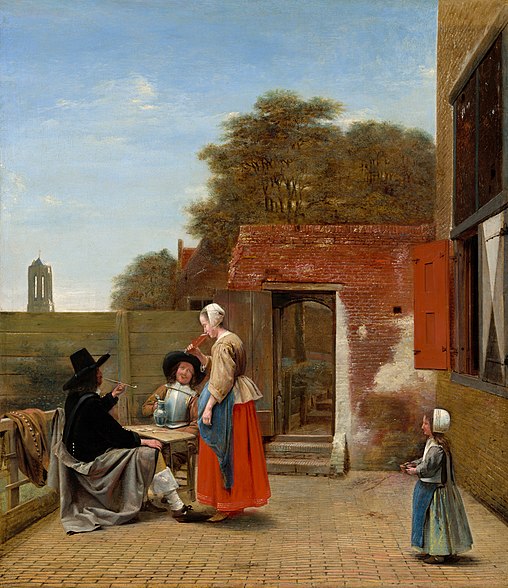
Another standout was a genre painting by Pieter de Hooch, titled A man smoking and a woman drinking in a courtyard (below). 
File:Pieter de Hooch 012.jpg

The most overwhelming and lasting effects were actually from the "Rembrandt's Century" painting, with much moody engravings, etchings and drawings. 

My favorite was  Rembrandt's etching, The Landscape with the Three Trees:

The Three Trees - Rembrandt

I also love the amazing The Shell (Conus Marmoreus), a combination of etching, drypoint and engraving by Rembrandt (below):


Then there were Medea, or The Marraige of Jason and Creusa, 1648 by Rembrandt and his Christ Crucified between Two Thieves (The Three Crosses), 1653, both highly dramatic and terrifying:

Medea or the marriage of Jason and Creusa - Rembrandt


File:Rembrandt The Three Crosses 1653.jpg

There were more paintings and prints by other masters in these amazing exhibitions.  Do try to see these works!


Related posts on Art · 文化 · Kunst:
- My Favorite Paintings in Mauritshuis, Den Haag, Netherlands
- "Compliments to Vermeer" - Controversial Solo Exhibition of the Renowned Chinese Painter JIN Shangyi
- Paintings As Pivotal Elements
- Last Chance to See Terracotta Warriors in San Francisco Asian Art Museum
- Birth of Impressionism at De Young Museum, San Francisco
- Venetian Masterpieces from Vienna at De Young Museum
- My Favorite Works at De Young Museum, San Francisco
- My Favorite De Young Museum Collections

Saturday, September 15, 2012

My Favorite Paintings at Rijksmuseum, Amsterdam

Six years ago, when I visited the great city Amsterdam, the Rijksmuseum was under renovation - it is set to re-open on 13 April 2013 after almost ten years's effort.  Mercifully, the museum put the cream of its collections to a wing and I was able to see some of the amazing works, amongst them, my Favorite Paintings are one Vermeer and one Rembrandt.  No surprise here.

To me, The Milkmaid or The Kitchen Maid by Johannes Vermeer, a tranquil domestic scene, was one of the most beautiful and enchanting paintings ever produced in the human history.  It was bold and delicate - look at the intense blue and yellow hues, so strongly contrasted and yet so harmoniously co-existed, furthermore, all the colors were luminous and glowing, without competing one another for dominance.  The details of the daily objects were meticulously done, not to show off the painter's skill, but to create a reality in suspended in time, and to depict the crystal clear northern light.


The Milkmaid, ca. 1660, Johannes Vermeer, Oil on CanvasHeight: 45.5 cm, Width: 41 cm

I could not say better than the description on the Museum's website: "One of Vermeer's most admired paintings is The Milkmaid. She stands in front of a window pouring milk into a bowl, deep in concentration, her head slightly tilted to one side. The daylight streaming in draws the viewer's attention automatically to the pouring milk. This is depicted so perfectly that you can practically see and hear the milk pouring. It is the only action taking place in the room."

The Vermeer painting was small scaled and intimate and the The Company of Captain Frans Banning Cocq, known as The Night Watch, by the master Rembrandt Harmensz. van Rijn was grand and public. 


The Company of Captain Frans Banning Cocq, 1642, Oil on Canvas
Height: 379.5 cm, Width: 453.5 cm

For this commissioned work by the militia company, Rembrandt didn't follow the convention of painting the gentlemen sitting or standing in rows facing the viewers like mannequins, rather, he positioned the figures in a lively scene - the captain issued command, flag raised, drum beat, horned blew, children running amongst the throng.  Nothing but static and boring.  Again, we are enchanted by the marvelous play of light and dark.  However, the painting was not so dark to begin with and it became a "night scene" only after the changing of the paints the master employed.

Night or day, it was one of the most memorable group portraits ever created. If some of the figures felt cheated because their full faces were not shown, we, the viewers, however, must be grateful for Rembrandt's confidence and courage.

I am very partial to this painting because I had the opportunity to see its full scale replica in San Francisco, in a private home turned museum.

Since I only sampled the highlights of the Rijksmuseum collection, a return to Amsterdam is a must once Rijks reopened.


My Favorite Museum Collection Series

>> My Favorite Museum Collection Series 51: My Favorite Paintings at Van Gogh Museum, Amsterdam
<< My Favorite Museum Collection Series 49: My Favorite Paintings in the Fitzwilliam Museum, Cambridge, UK


List of My Favorite Artworks in the Museums I've Visited