To many's surprises, Chinese government recently openly admitted some problems associated with the once much extolled
Three Gorges Dam on the
Yangtze River.
 Image source: Wikipedia
Chinese government admitted little and without much details of the environmental and ecological problems, and issues related to relocating millions of people. It was said that the total number of people to be relocated would reach 4 million. The second largest lake in China, downstream from the Dam,
Poyang Lake, slightly smaller than 1/6th of
Lake Erie, now has almost completely dried up. The admission was extremely measured and controlled, yet, the rippling effect it caused in China was like a tsunami.
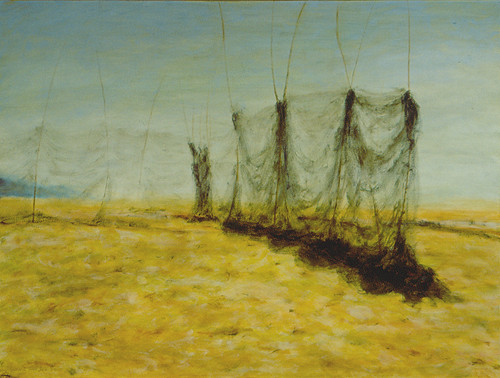 Lake © Matthew Felix Sun
The overwhelming reactions from Chinese citizens were very critical and some had floated the idea of the immediate demolition of the Dam.
Even the international mouthpiece of China's ruling Communist Party, the
Global Times, admitted that since there was little real debate when the Dam was being prepared for construction, it was necessary to let people to vent at least now. It conceded that the "debate" then was biased and implored people to make effort not to allow the current debate become "one-sided" again. It did not try to defend the Dam much, other than claiming that not all the problems could be attributed to the Dam.
The most striking passage from that article came from the second paragraph of the article
唾沫洗礼,三峡大坝逃不掉的课 (Spittle Baptism - Inescapable Lesson for the Three Gorges Dam):
三峡大坝作为人类历史上最大规模的水利工程,它的利与弊都一言难尽。它建设 于中国从计划经济向市场经济过渡的特殊时期,它的可行性研究在当时的中国堪称最认真的,争论也是当时相对最公开的,建设它的最终决定甚至经过了全国人大的投票,而且当时有反对票。但尽管如此,三峡大坝在充分民主的西方不可能被立项,仅从它造成了那么多移民,就不可能在西方社会被通过。
Three Gorges Dam as the largest water project in human history, whose benefits and disadvantages are hard to describe simplistically. It was built in China during a special period of transition from a planned economy to a market economy, its feasibility study can be called the most serious in China at that time, the argument at that time was also relatively the most open, the final decision on its construction was voted by National People's Congress, including many opposing votes. Nevertheless, the Three Gorges Dam project could not be approved in the fully democratic West; simply because it caused so many people's relocation, it was impossible to be accepted in Western society.
It also admitted that
三峡大坝 是中国体制的产物,但它绝非“拍拍脑袋就定”的工程。它使中国每年少烧大量煤炭,以及减少水害、有利通航的好处,到底能不能抵消它改变 生态带来的坏处,这不是我们今天就能下结论的。科学回答这个问题,至少需要观察一百年,反复对比长江流域的气候变化,以及水电在未来能源结构中的位置,现在的任何结论都是匆忙的。
Three Gorges Dam is the product of the Chinese system, but it was not a "pat on the head" project. It reduces a lot of coal burning per year in China, and reduces flooding damage, improves navigation, in the end we cannot conclude today if it can offset the ecological damage it causes. To answer it scientifically, we need to observe at least a hundred years, repeatedly compare climate changes in the Yangtze River basin, and the position of water energy in the future energy mix; any conclusions drawn now are too rushed.
Despite the apparent defense of the Dam, it made one more astonishing admission that the Dam was built before the important issues had been solved. It also curiously called the Western countries fully democratic.
Suddenly, the long-ignored experts, jailed journalists and activists found some outlets to express their important opinions regarding the Dam. People's criticism of the Dam poised to target further afield.
Therefore, almost overnight, the mainstream media started to make concerted effort to dissuade criticism against the dam and claimed that the current drought in the Yangtze River region would be worse without the Dam. Apparently, the government was startled by the spinning out of control criticism and started to clamp it down.
That, reminded me very much of the evolution of the events led to the
Anti-Rightists Campaign in late 1950s.
In mid- to late 1950s, strongman Mao believed that the Communist Party had lost its vitality and became corrupted and confidently invited people to help by constructively criticizing the Party, therefore, instigated the "
Hundred Flowers Campaign", which had promoted pluralism of expression and criticism of the government. Many naive people eagerly participated the movement and their criticism soon sounded to the Party like a challenge to their authority, and in rare cases, they did challenge the Party's legitimacy in power monopoly.
Outraged party cadres and Mao struck back with vengeance. Mao claimed that his invitation to criticizing the government was merely a ploy to "induce snakes out of their holes", and anyone who dared to criticize the government or the Party even over the most trivial matters would be branded Rightists. Quotas were assigned to all levels of organizations, factories, farming collectives and schools. People in charge became Rightists themselves if they failed to meet the quota. The campaigns eventually saw the political persecution of an estimated 550,000.
According to Wikipedia, the Campaign consisted of two waves:
The first wave of attacks began immediately following the end of the Hundred Flowers movement in July 1957. By the end of the year, 300,000 people had been labeled as rightists, including the writer Ding Ling. Future premier Zhu Rongji, then working in the State Planning Commission, was purged in 1958. Most of the accused were intellectuals. The penalties included informal criticism, "re-education through labour" and in some cases death.One main target was the independent legal system. Legal professionals were transferred to other jobs; judicial power was exercised instead by political cadres and the police.
The second part of the campaign followed the Lushan Conference of July 2 – August 16, 1959. The meeting condemned General Peng Dehuai, who had criticised the Great Leap Forward.
After Mao's death, many of the convictions were revoked in 1979. Many of those accused of rightism and who had been persecuted for that crime for 22 years were suddenly found never to have been labeled as rightists.
 Wikipedia photo: One of the many 1950s Chinese parade to show support to communist's political movement.
Actually, some of them had been slowly declared no longer Rightists after lengthy and harsh re-educations, and simply became "Rightists Without The Hats". Eventually, all of them were "rehabilitated" except for six of them who carried their "hats" into the end of their lives. The last of the six,
Ms. Lin Xiling, died in France in 2009. Most Chinese people, then and now, were genuinely appalled by their challenge to Communist Party's one party rule, my intellectual parents included.
Because the Campaign took place long before I grew up, I never had much impression of it and never thought about the movement much. However, I did have a high school English teacher who had been one of those Former-Rightist and his much contorted demeanor gave me a hint of what sufferings he had endured. Perhaps, I should talk about him in another blog entry.
The most unforgettable time when I heard mentioning of the Anti-Rightists Campaign was in late May of 1989, when my five roommates and I impatiently waited to learn the fate of our last roommate who stayed in Beijing, which had just been placed under martial rule, rather then coming back with the rest of us after a one-night and one-day sit-in. A local classmate's parent came and warned us the ruthlessness of Deng Xiaoping, who was till then, had charmed the west and was a most benevolent and grandfatherly figure to us. We laughed off the warning. The parent thus described in details whatever he knew about Deng's zeal during the Anti-Rightists Campaign, when Deng was the chief hit man of Mao and his cadres.
Only in less than two weeks, came the June 4th (六四) and then we realized indeed how naive and foolish we had been.
Growing up in post-Culture Revolution era, we utterly failed to appreciate how repulsive any instability was to our elders, and how brutal and determined the government could be so as to remain in power. The students also failed to connect to the masses, except for in Beijing, but eventually, it hardly matters. No people's power could withstand the crushing forces from those metal tracks of the roaring tanks.

Depression - Rebirth © Matthew Felix Sun



 Posts
Posts


