Saturday, August 14, 2010

Traditional is the New Avant-Garde

Artists often strive to be the unique one, the one who creates things new like no other and being avant-garde is a great honor.

Yet, there are so many styles and methods can be employed, if one wants to remain in the defined sphere, instead of creating a new form completely, e.g. Andy Goldsworthy's transient installations, dance combined ballet and martial arts.

For those who want to work in the conventional format, such as pure ballet dance making, it is quite challenging to stay new.

The consolation is that, like fashion, people's taste change and often in cycles. Therefore, things considered traditional, or conventional a few decades ago, now suddenly in vogue and become the new avant-garde.

New York Times recently published a fascinating article on narrative ballet (versus abstract, non-story telling ballet, like those created by Balanchine). The article quoted the retired ballerina Gelsey Kirkland wrote in an open letter on the Web site for the new Gelsey Kirkland Academy of Classical Ballet (gelseykirklandballet.org), "I have come to believe over the years that the future of ballet lies in the art of dramatic storytelling, drawing on the wellsprings of classical tradition."

The article continued: "Interestingly, Ms. Kirkland’s words come just as a wave of narrative dance drama has been gathering force. At New York City Ballet — the company that consistently did the most to propagate plotlessness in 20th-century classical ballet — the past season was mainly given over to full-evening story ballets. Of the eight new ballets produced by the company so far in 2010, each by different choreographers, four have been storytelling, while a fifth, Alexei Ratmansky’s “Namouna,” has arcane suggestions of narrative."

It also pointed out that "What’s more, it’s easier for audiences now to see that the 20th-century pure-dance ballet was never abstract. As Balanchine, Merce Cunningham and Mark Morris all observed, you cannot have abstraction where there are human beings on a stage. Put a man and a woman onstage, Balanchine liked to say, and you already have a story; it has been well said that his plotless ballets actually have more drama than most story ballets."

So, the line has never been cleanly drawn. The new is always a repackaging the old. The old fashioned often make a brilliant comeback as the new new.

It is the same in the music world. New operas are more lyrical and grateful to singers and listeners instead of relentless howling and wailing of later half of the twentieth century.

Novelists are gladly telling stories in more or less traditional way, and less obsessed with the manipulations of the book format and lengths of the lines.

Fine artists are making paintings with a clear stories, sometimes even in cycles like those in the Gothic and Renaissance time. Unabashedly.

What they are doing is refreshingly different from the abstraction tyranny of the near past, they are the new avant-garde.

Soon, people will crave for something less obvious, less easily understood pieces. They will crave for challenge again - both creators and audience.

Then, the pendulum will swing to other side and we are poised for another fascinating change of time.
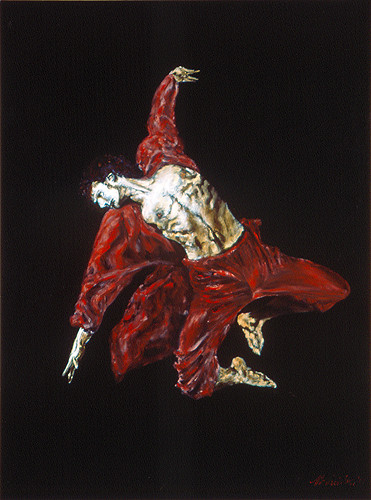

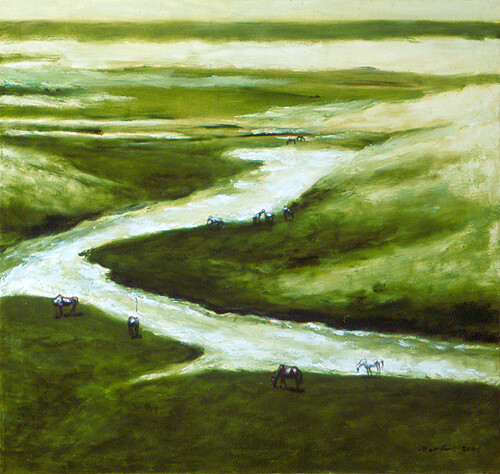
Leap / 躍 / Sprung
Leap © Matthew Felix Sun
Wednesday, August 11, 2010

Young Artist's Roles in Goethe's Time

In Goethe's Italienische Reise - Erster Teil (Italian Journey, Part One), he had such entry:
Den 18. November.

Es ist wieder schön Wetter, ein heller, freundlicher, warmer Tag.

Ich sah in der Farnesina die Geschichte der Psyche, deren farbige Nachbildungen so lange meine Zimmer erheitern, dann zu St. Peter in Montorio die »Verklärung« von Raffael. Alles alte Bekannte, wie Freunde, die man sich in der Ferne durch Briefwechsel gemacht hat, und die man nun von Angesicht sieht. Das Mitleben ist doch ganz was anders, jedes wahre Verhältnis und Mißverhältnis spricht sich sogleich aus.

Auch finden sich aller Orten und Enden herrliche Sachen, von denen nicht so viel Redens ist, die nicht so oft durch Kupfer und Nachbildungen in die Welt gestreut sind. Hievon bringe ich manches mit, gezeichnet von guten jungen Künstlern.

The translation is:

It is again beautiful weather, a bright, friendly, warm day.

I saw in the Farnesina, the story of Psyche, whose colorful replicas as long as my room, then to St. Peter in Montorio, the "Transfiguration" by Raphael. All these old acquaintances, like friends that have been made in the distance through correspondence, and you can now see face to face. The communal life is something quite different, every true relationship and incongruity express themselves immediately.

There are also beautiful things of all places and ends, of which is not so much talked about , not so often scattered in the world through engraving and replicas. I bring some of these things, drawn by good young artists.

Young artists at the time of Goethe could earn some living by doing copying of masters' works and learn their craft. Alas, that time is not with us anymore. When they have iPhone, who needs an apprentice artist?

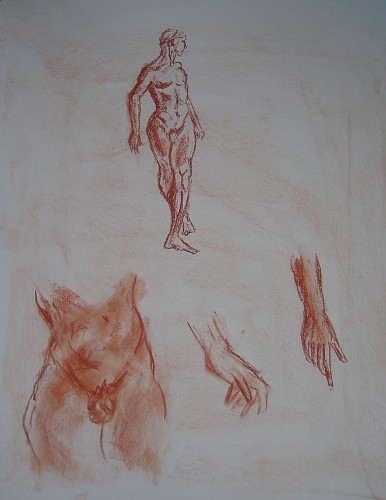
Matthew Felix Sun's Live Drawing_1367

Sunday, August 8, 2010

Art Buyers' Comfort Zone

1987 Man Booker Award winner - Moon Tiger by Penelope Lively had a brief description of an artist's struggle.

On page 179 (Grove Press paperpack), it says:
I can quite understand why few people want to buy his paintings; they are too uncomfortable to live with. They howl of malaise; they jar the eye; they are discordant and disturbing. Nightmare creatures stalk through surreal landscapes; things fall apart; anguished people scurry in broken cities. They hang on my (Claudia H) walls, but then I have no choice: if I won't honour them, who will? Anyway, I'm used to them.
I'm afraid that this description is all too true. Considering nowadays smaller living spaces art buyers have, versus castles and manor in the past, I can hardly blame people who don't want to hang disturbing images on their limited walls.

My landscapes sell much better than my portraits, precisely because my portraits tend to be more jarring and disturbing, either in your face or challenging. I know if I "modify" a little of my approaches or subjects, I will have better commercial success. Yet, I will not.

I only need to find my Claudia Hampton.

Source / 源 / Quelle
Source © Matthew Felix Sun
Sold

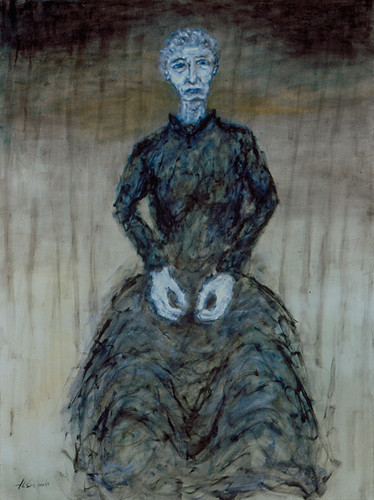
Grandma / 祖母 / Oma
Grandma © Matthew Felix Sun

Sometimes, I did meet my Hampton.

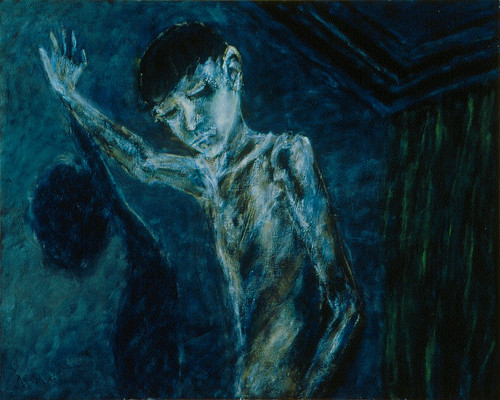
Companion / 夥伴 / Begleiter
Companion © Matthew Felix Sun
Sold!

PS:
The synopsis on Man Booker's website: Claudia Hampton has lived a full life as historian, reporter, lover, mother. Now she is dying in a London hospital, where she remembers the events in her life, particularly a romance with a tank commander during World War II, a passion that defined much of the rest of her life.

Wednesday, August 4, 2010

SFMOMA's 75th Anniversary Show

SFMOMA is celebrating its 75th anniversary. My visit to the 75th Anniversary Show confirmed my impression of this important yet provincial institute.

SFMOMA has accumulated a relatively impressive body of works from many important artists but the depth is rather shallow. The main draw to the locals in this anniversary show mostly lie on their relatively unknown collections, such as a semi-abstract Pollock and a very early Picasso. Interesting works by Max Ernst, Paul Klee to Elmer Bischoff and Eva Hesse were included as well.

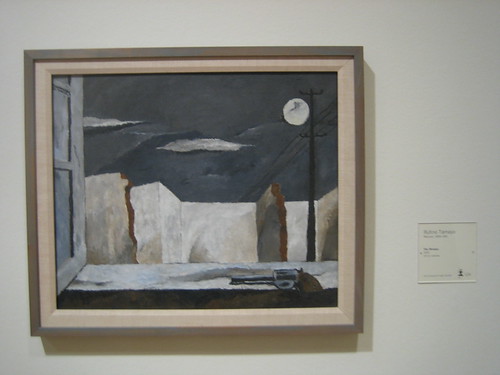
I love The Window by Rufino Tamayo below. The handing of the paint is masterly and the atmosphere was economically created. The pistol on the window sill added several layers of emotions.

IMG_6713
The Window, 1932, Oil on canvas, Rufino Tamayo 1899-1991

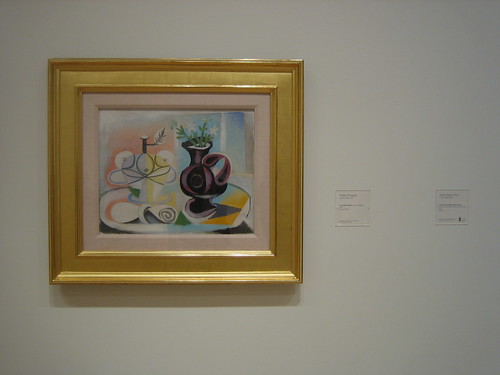
This piece of Picasso is quite whimsical and can be mistaken for a Matisse or a Paul Klee. Rather too decorative for my taste but is interesting to I'm still glad to learn that aspect of the Spanish master.

IMG_6714
La Cruche fleurie (Jug of flowers), 1937, Pablo Picasso 1881-1973

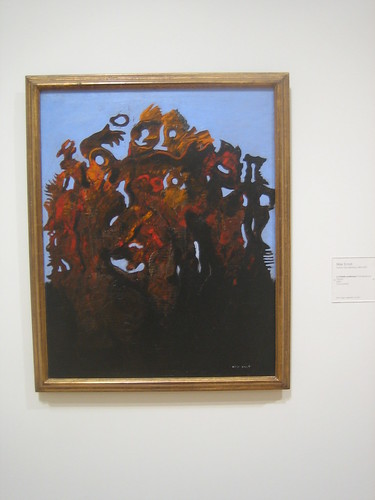
I haven't gotten much chance to see a Max Ernst and was delighted to encounter the La famille nombreuse (The Numerous Family). The twisted world can be applied to nowadays easily. The misery of human kind is timeless and universal.

IMG_6716
La famille nombreuse (The Numerous Family), 1926, Max Ernst 1891-1976

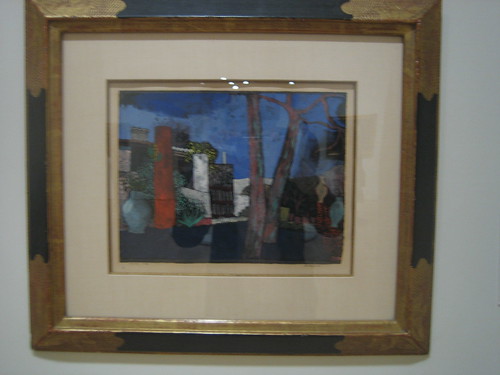
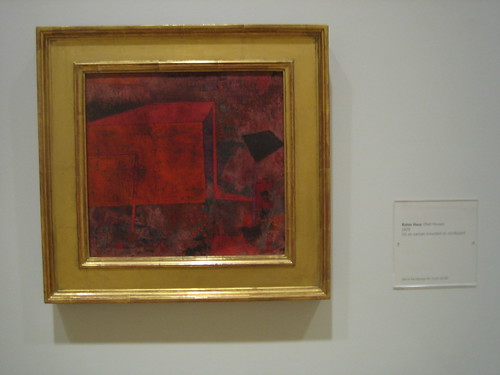
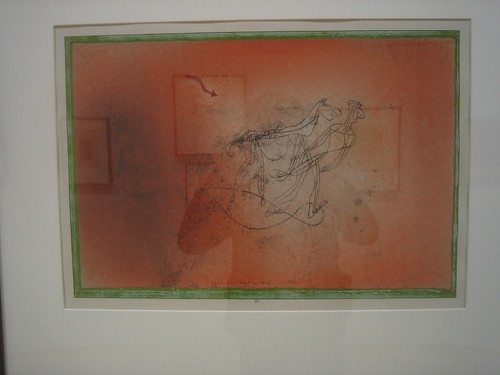
A dozen of small formatted Paul Klee from the Djerassi Collection were included and many of them are very beautiful indeed:

Mazzaró, 1924, Gouache and watercolor on paper mounted on board // 75th Anniversary Show, SFMOMA _6717
Mazzaró, 1924, Gouache and watercolor on paper mounted on board, Paul Klee 1879-1940

IMG_6719
Rotes Haus (Red House), 1929, oil on canvas mounted on cardboard, Paul Klee 1879-1940

IMG_6721
Pferd und Mann (Horse and Man), 1925, Oil transfer, ink, and watercolor on paper mounted on board, Paul Klee 1879-1940

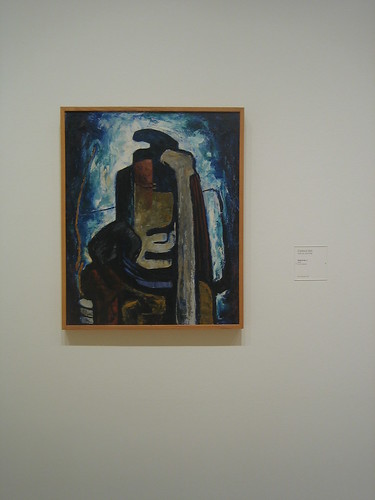
A painting by Clyfford Still almost constituted a companion piece the the aforementioned Max Ernst.

IMG_6725
Clyfford Still 1904-1980

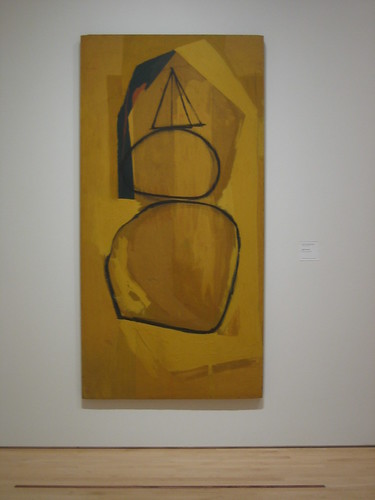
I usually don't care much for geometrical pattern play. But the piece by Robert Motherwell has much more to offer and the color palette was quick subtle and delicious. I love it very much.

IMG_6726
Untitled (Figuration), 1948, Oil and sand on Masonite, Robert Motherwell 1915-1991

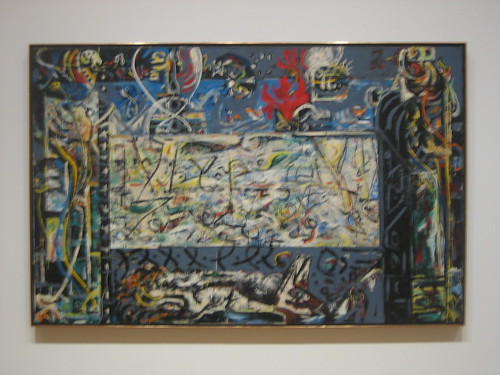
Jackson Pollock was represented by this semi-abstract work. It has a very rich palette which is quick different from what he was best known for. Yet, the universally accepted mastery of his later period didn't take of the luster of this earlier one.

IMG_6728
Guardians of the Secret, 1943, Oil on canvas, Jackson Pollock, 1912-1956

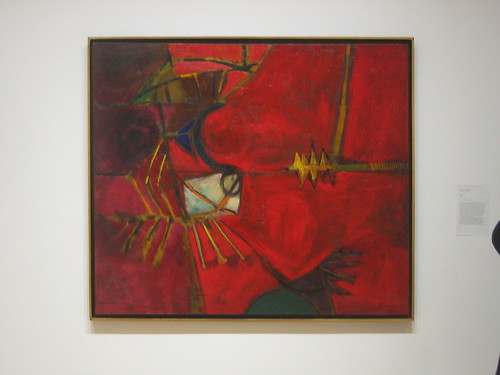
Elmer Bischoff provided us another rich painting. The vibrant and rich red colors were literally dancing in front of my eyes. However, the dance is not the kind of joyous expression. It was sliced and smudged by many bold and intrusive strokes. A world has gone mad again.

IMG_6731
Untitled, 1948, Oil on canvas, Elmer Bischoff 1916-1991

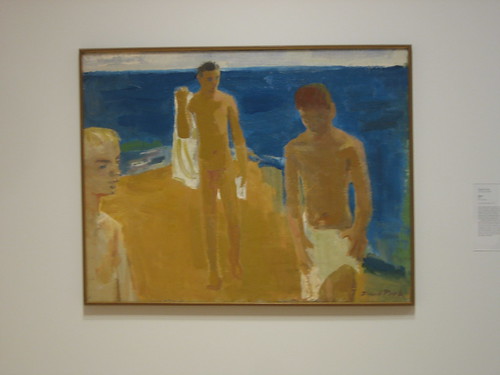
Coming out of Germanic gloom, we were comforted by idyllic seaside picture of The Bathers by David Park. The high view point, stylized figures and beautifully contrasted color blocks elevated this painting above hidden eroticism or pictorial pleasantry.

IMG_6736
Bathers, 1954, Oil on canvas, David Park 1911-1960

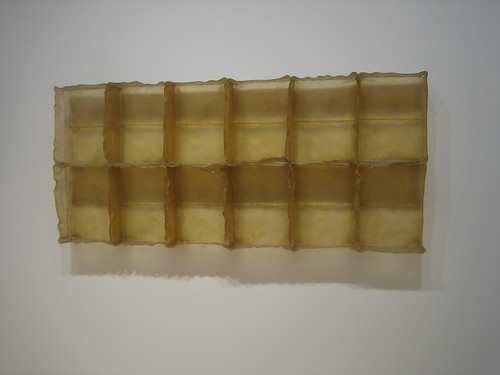
More stylized is the abstract sculpture by Eva Hesse. It is orderly yet free. It contains a universe. Dignified and sober. All Apollonian. Sans Dionysian?

IMG_6737
Sans II, 1968, Fiberglass and polyester resin, Eva Hesse, 1936-1970

This is a very interesting survey of SFMOMA's endeavors over seventy-five years. With the addition of the amazing Fisher Collection, SFMOMA is poise to the a heavy weight amongst contemporary art museums.

Tuesday, August 3, 2010

Introduction to Fisher Collection and the 75th Anniversary Exhibit at SFMOMA

Last Saturday, I visited San Francisco Modern Art Museum for the Calder to Warhol: Introducing the Fisher Collection exhibit. There are 160 pieces from the 1,000 plus Fisher Colletions on display. There were many impressive works and the profile and prestige of SFMOMA will increase dramatically once a new wing is build for this incredibly rich modern art collection.

Several of my favorite artists are included and I am glad that I am able to share a sample of their works here:

IMG_6588
Alexander Calder 1898-1976

I love Agnes Martin's subtle sense. All her works exuded delicacy and mystique.

Night Sea, 1963, Agnes Martin // Calder to Warhol: Introducing the Fisher Collection, SFMOMA _6601
Night Sea, 1963, Oil and gold leaf on Canvas, Agnes Martin 1912-2004

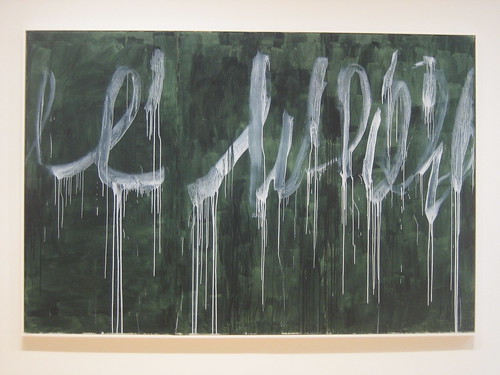
Cy Twombly's abstract paintings worked like landscape. The 1971 Untitled [Rome] demonstrated his mastery perfectly. The endless strokes of the crayon looped like layers and layers of grass and the shapes and depth of the work was simply amazing.

Untitled [Rome], 1971, Cy Twombly // Calder to Warhol: Introducing the Fisher Collection, SFMOMA _6611
Untitled [Rome], 1971, Oil-based house paint and crayon on canvas, Cy Twombly 1928-

IMG_6612
Note I, from the series III Notes from Salalah, 2005-7, Acrylic on wood panel, Cy Twombly 1928-

The explosive energy and great color harmony on Lee Krasner's Polar Stampede was incredible.

IMG_6602
Polar Stampede, 1961, Oil on canvas, Lee Krasner 1908-1984

Georg Baselitz, on the other hand, dazzled the viewer with brutal force and beauty.
Elke im Lehnstuhl (Elke in Armchair), 1976, Georg Baselitz // Calder to Warhol: Introducing to Fisher Collection, SFMOMA _6619
Elke im Lehnstuhl (Elke in Armchair), 1976, Oil on canvas, Georg Baselitz 1938-

Several large formatted works by Sigmar Polke were all amazing. I like the one below most:
IMG_6626
The Spirits That Lend Strength Are Invisible I (Tellurium Terrestrial Material), 1988, Sigmar Polke, 1941-2010

Though I was never a fan of Warhol, I had to concede that his Mao was incredibly rich and beautiful, made more disturbing by the subject of the work, the cr
Mao, 1972, Silkscreen ink on canvas, Andy Warhol, 1928-1987 // Calder to Warhol: Introducing to Fisher Collection, SFMOMA _6630
Mao, 1972, Silkscreen ink on canvas, Andy Warhol, 1928-1987

Several Richard Serra were included and the simplicity of the work below was the most beguiling.
IMG_6643
Richard Serra, 1939-

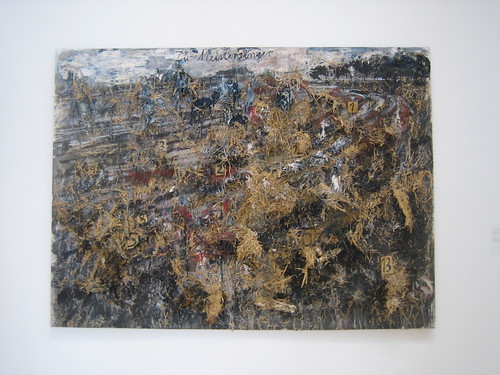
Lastly, I was treated by several large works by the great Anselm Kiefer. Amongst the living artists, Andy Goldsworthy creates a universe, while Anselm Kiefer decimates a universe. Every piece of his included was an incomparable masterpiece.

IMG_6650
Welundlied (Wayland's Song), 1982, Anselm Kiefer 1945-

IMG_6651
Die Meistersinger, 1982, Anselm Kiefer 1945-

Sulamith, 1983, Anselm Kiefer 1945-

IMG_6664
Unternehmen Seelöwe (Operation See Lion), 1983-84, Anselm Kiefer 1945-

IMG_6661
Margarethe, 1981, Oil and straw on canvas, Anselm Kiefer 1945-

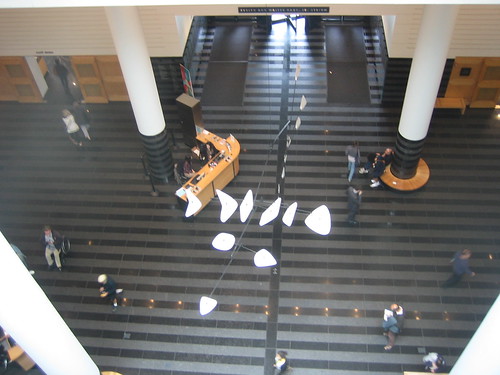
There were also witty and whimsicle works. I love this sculpture in the cafe:
IMG_6694

Sometimes, visitors contributed to art creation:

Calder to Warhol: Introducing to Fisher Collection, SFMOMA -- Inspecting "Blue Green Black Red" by Ellsworth Kelly, 1996, oil on canvas _6639

Finally, I rate the most haunting piece as the eleven-minute video "Passage" by Shirin Neshat:


Passage, 2001, Single-channel video projection with sound, 11:30 min., Shirin Neshat, 1957-


The show ends on September 19, 2010. Don't miss it!

SFMOMA is also showcasing its own collection in their The 75th Anniversary Show. I'll discussion that exhibit in my later entry.

Sunday, August 1, 2010

Weep for Ancient City Walls of Xi'an

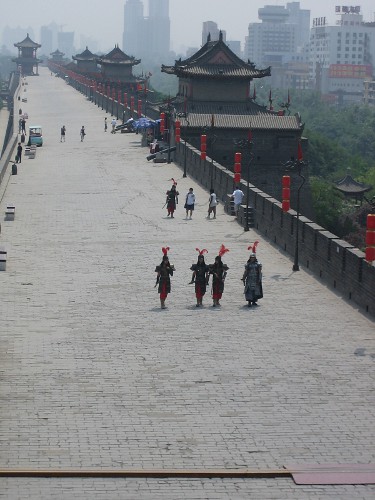
A disturbing news rattled many people in China. A developer has put forward a vaguely worded plan to "improve" the ancient city walls of Xi'an, built in the Ming Dynasty (Renaissance time in the west), with price tag of 12,000,000 Yuan (1,770,960 USD). Their plan includes installing life-sized sculptures atop on the fortification and along, posing as attackers and defenders of the fortress, and adding laser lights to add colors to the somber gray bulk of the fortification.

Xi'an City Walls New Plan

This plan had met storm of criticism in China yet if the developer is well connected, one can be sure to see the dismaying modernization of the city wall.

China has a habit of tearing down authentic old relics and build grandiose replica of the old, such as the Liulichang, a famous district in down-town Beijing that is known for a series of traditional Chinese stone dwellings housing that sells various craftwork, artistry, and antiques. It was one of Beijing's traditional old quarters. Yet, after a major modernization effort, nothing authentic was left. It is plain forgery.

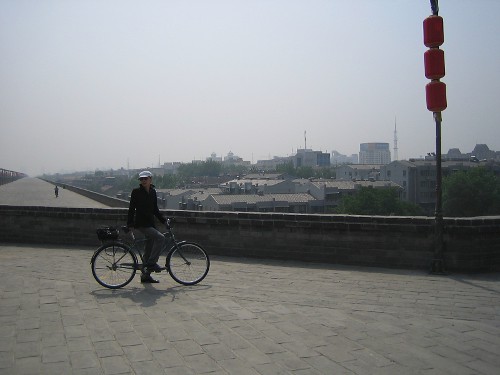
The ancient city wall of Xi'an will be a theme park, one can find in any movie studio. Instead of the timelessness one might fee as in the following pictures,

Xi'an_5838_500

Xi'an_5817_500

You will see more of this, I'm afraid:

Xi'an_5846_500

According to Wikipedia:
The fortifications of Xi'an, an ancient capital of China, represent one of the oldest and best preserved Chinese city walls. Construction of the first city wall of Chang'an began in 194 BCE and lasted for four years. That wall measured 25.7 km in length, 12–16 m in thickness at the base. The area within the wall was ca. 36 km². The existing wall was started by the Ming Dynasty in 1370. It encircles a much smaller city of 14 km². The wall measures 13.7 km in circumference, 12 m in height, and 15–18 m in thickness at the base.

Related posts on Art · 文化 · Kunst
- Last Chance to See Terracotta Warriors in San Francisco Asian Art Museum
Famed Terracotta Warriors and Their Intriguing Successors
- Ruins in Sanxingdui (Three-Star Mound) and Jinsha (Gold Sands), Sichuan, China