Showing posts with label Blanton Museum of Art. Show all posts

Tuesday, January 3, 2017

My Favorite Painting and Installation at Blanton Museum of Art, The University of Texas at Austin

The Blanton Museum of Art of the University of Texas at Austin was a wonderful museum showcasing collection with impressive depth and breadth.

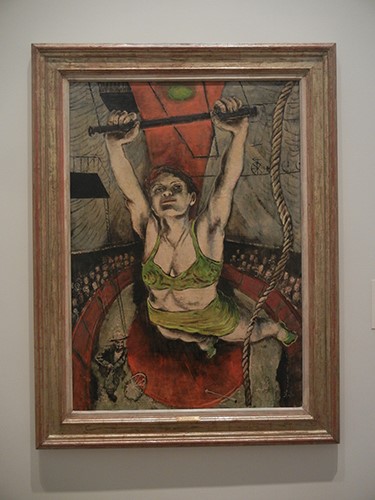
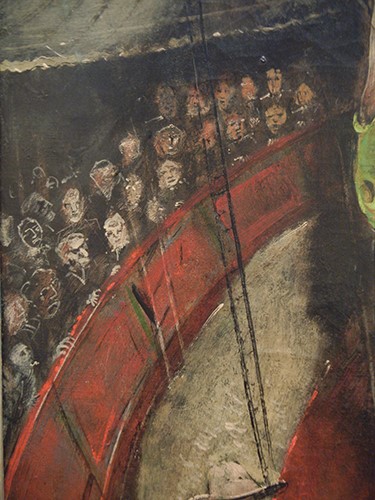
A painting, Woman on Trapeze (1946), by German-born American painter Karl Zerbe (1903-1972) was among one of my favorites there, depicting a circus act, a popular subject in early 20th century, but his woman on trapeze was a different specie from other circus troupers recorded by Picasso, who had left us a considerable volume of his observations and thoughts on that particular group of people. Though tinged with desolation and pensiveness, the Spaniard's circus players were often graceful in forms and poses, often seen resting and meditating between acts, and at most practicing as if for self-amusement, and they congregate in packs; the German artist's circus performer was caught at her most strenuous moment, and despite her lovely dress, her determined and concentrated face with slightly twisted facial features, her perspective-distorted large hands, fearful shadows on her face, her flying away legs, all contributed to a sense of danger and instability, and her corpse like pale skin, muted further by streaks of dark shadow, conspired to make her look surreal. And she was all alone. The audience, in horseshoe seats, behind circular red panels, was seen as faceless mass; a single bicyclist, parked in the edge of the central stage, paid no apparent heed to the swinger in the air. A thick rope, slightly curved leftwards, in parallel to her swinging body, counterbalancing her slightly right-curving shape, managed to augment the sense of instability and transience. Though silent, this woman, seemed to be the personification of a barely contained scream, insistent, somewhat helpless, and angry.  Though pretty to behold, this painting was terrifying.
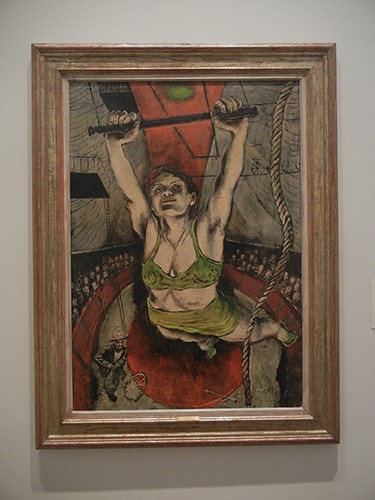
DSCN1310 _ Woman on Trapeze, 1946, Karl Zerbe, Blanton Museu, Austin
Woman on Trapeze, 1946, Karl Zerbe


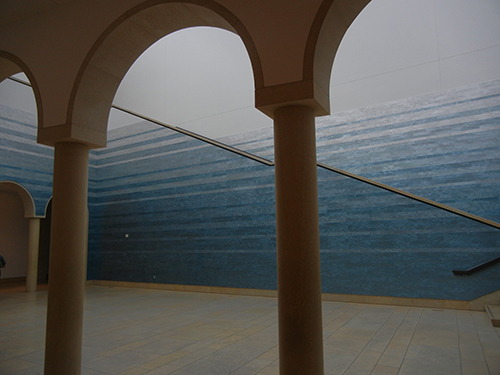
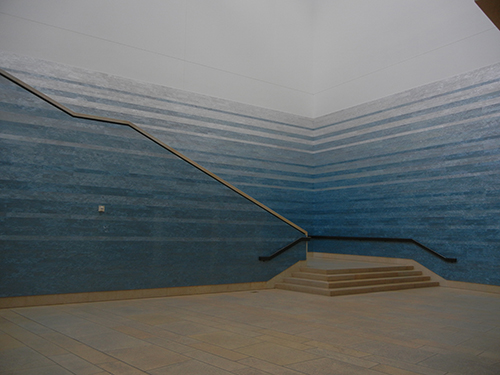
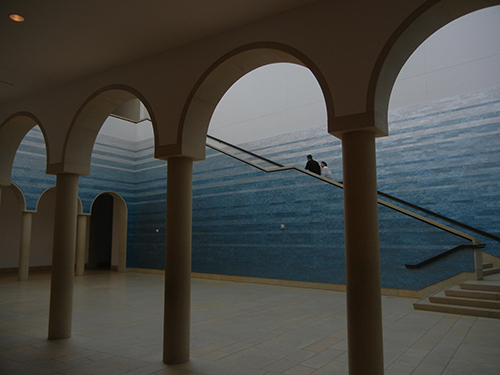
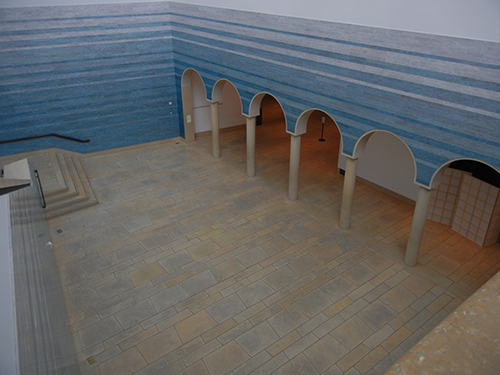
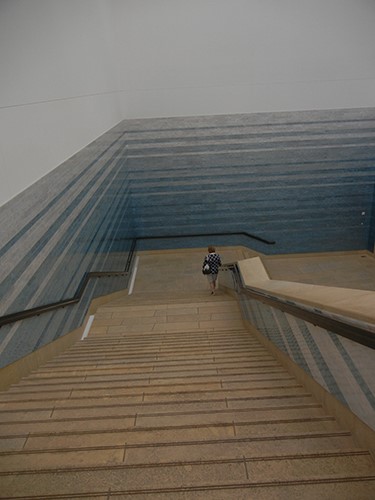
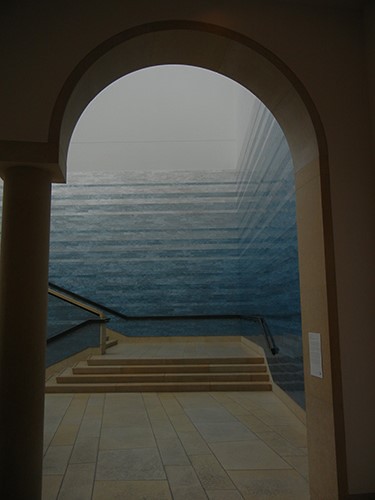
My second favorite, the raison d'être for my visit to this museum, was a site-specific installation by Teresita Fernández (born 1968), Stacked Waters (2009), tiles on the four walls of a large rectangular hall with some loggia arches at the base of one of the long walls, and it was as becalming as Woman on Trapeze was disturbing.

DSCN1117 _ Stacked Waters, 2009,  Teresita Fernández, Blanton Museum of Art, Austin, TX
Detail of Stacked Waters, 2009, Teresita Fernández

Upon close inspection, those tiles had a look of shining plastic, with patterns of swirling clouds or waves, or like a glimpse of deep sea or the germinating universe. Those tiles, banded together to form horizontal layers in alternately greenish blue and various shades of pale gray colors, and as a whole, looked like cross-section of geological deposits, but with candy-like luminosity. Liquid deposits. Those layers also had different heights, with darker layers grew taller as they approached to the base of the walls, created a vision of gradually settling down, yet never completing such process.

Surrounded by such four shimmering walls, one felt breathless, as if immersed in the depth of cool and hushing water, soundless, motionless, and one would finally be deeply moved, as if some truth of universe had been revealed in front of the incredulous eyes.

It was wonderful to be there alone, to feel the refreshing emptiness; and it was great to be with other visitors, friends or strangers alike, to see how people glad about, like oblivious fish, utterly at home, yet strangely out of place, and utterly entranced.
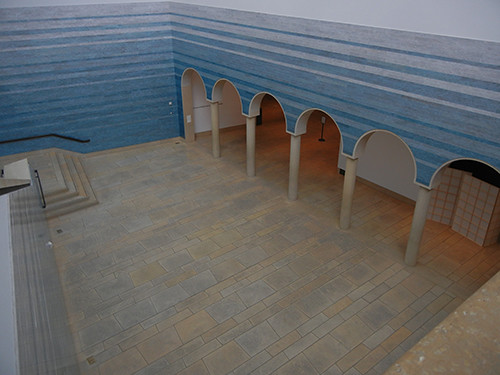
DSCN1143 _ Stacked Waters, 2009, Teresita Fernández, Blanton Museum of Art, Austin, TX
Stacked Waters, 2009, Teresita Fernández
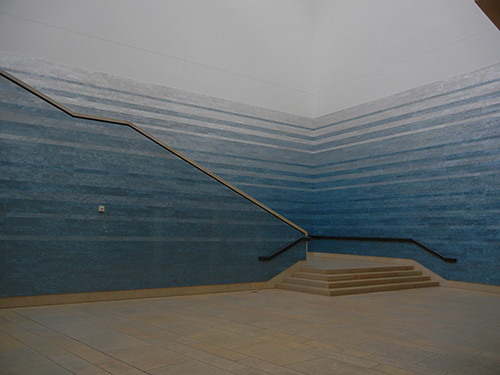
DSCN1121 _ Stacked Waters, 2009, Teresita Fernández, Blanton Museum of Art, Austin, TX

 DSCN1132 _ Stacked Waters, 2009, Teresita Fernández, Blanton Museum of Art, Austin, TX


My Favorite Museum Collection Series
<< My Favorite Museum Collection Series 157: My Favorite Paintings at Norton Simon Museum, Pasadena

List of My Favorite Artworks in the Museums I've Visited

Other Related posts on Art · 文化 · Kunst:
- Blanton Museum of Art, The University of Texas at Austin
- Wonderful Food Experiences in Austin, Texas
- Texas State Capitol in Austin
- My Favorite Sculptures at Institut für Klassische Archäologie, Karl-Franzens-Universität Graz
- The Museum of Contemporary Art (MOCA) in Los Angeles
- Brand New Contemporary Art Museum - The Broad Museum in Los Angeles

Monday, August 4, 2014

Blanton Museum of Art, The University of Texas at Austin


DSCN1018 _ Blanton Museum of Art, Austin, TX DSCN1019 _ Blanton Museum of Art, Austin, TX

In June, I visited Blanton Museum of Art of The University of Texas at Austin and was delighted to encounter many amazing art works, including vessels from ancient Greece, paintings dating back to early 15th century to installations completed just a few years ago.

The first major work to greet the visitors was the site-specific installation, Stacked Waters, by Teresita Fernández, in 2009, who "transforms The Blanton's Rapoport Atrium into a place of welcome that surrounds visitors with color and illusion. One of the most accomplished artists of her generation, she is known for her evocative large-scale sculptures and immersive installations that address space, light, and perception." [source: Blanton Museum of Art]

DSCN1127 _ Stacked Waters, 2009, Teresita Fernández, Blanton Museum of Art, Austin, TX

DSCN1121 _ Stacked Waters, 2009, Teresita Fernández, Blanton Museum of Art, Austin, TX

DSCN1136 _ Stacked Waters, 2009,  Teresita Fernández, Blanton Museum of Art, Austin, TX

DSCN1143 _ Stacked Waters, 2009, Teresita Fernández, Blanton Museum of Art, Austin, TX

DSCN1132 _ Stacked Waters, 2009, Teresita Fernández, Blanton Museum of Art, Austin, TX DSCN1437 _ Stacked Waters, 2009,  Teresita Fernández, Blanton Museum of Art, Austin, TX

DSCN1117 _ Stacked Waters, 2009,  Teresita Fernández, Blanton Museum of Art, Austin, TX

The scope and vision of the installation were breathtaking and it offered viewers endless angles to appreciate the layers of blue washes.  Below is a compilation of several videos I shot on site:


Stacked Waters, 2009, Teresita Fernández
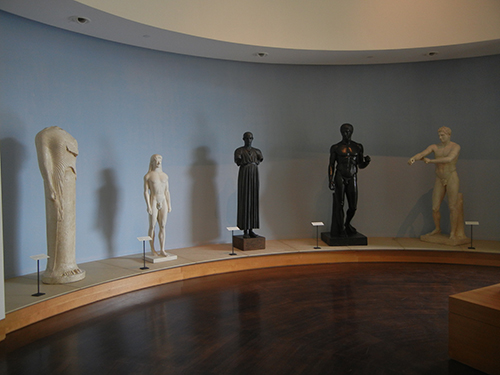
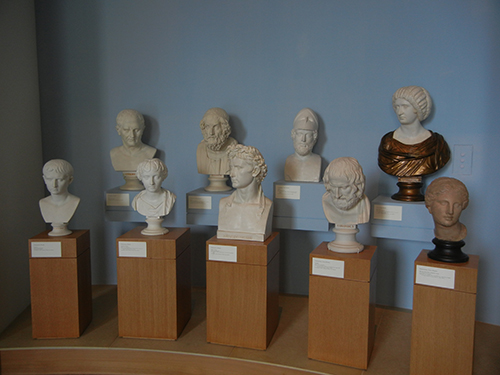
Before I dive into the vast painting and modern installation collection of the museum, I want to address another singular collection - William J. Battle Collection of Plaster Casts, which consisted of "some of the finest examples of Greek and Roman sculpture and architectural elements, the originals of which date from the 6th century B.C. to the 3rd century A.D. The casts were purchased with funds from the University's Department of Classical Languages between 1894 and 192.  The majority of the works were cast in the late 19th century by August Gerber in Cologne , Germany, and the Caproni Brothers in Boston."[source: Blanton Museum of Art]

Sure, they were not originals, but it was deeply satisfying and gratifying to see so many wonderful works at the same setting, a similar experience I had at the Archeology Department of the University of Graz, Austria.

The center of this collection was housed in an oval room, whose middle was the Dying Gaul:

DSCN1378 _ Dying Gaul, late 200s BCE, Epigonos of Pergamon (?), Greco-Roman, 19th cen. reproduction, Blanton Museum
Dying Gaul, Epigonos of Pergamon (?), Greco-Roman, late 200s BCE


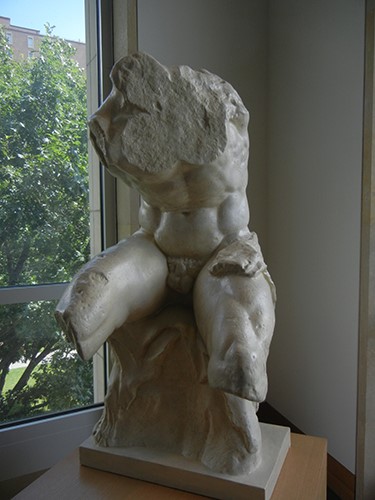
Surrounding this wonderful sculpture, were casts of other famous works such as Belvedere Torso, Apollo Belvedere, and Aphrodite from Melos, plus other busts of famed personalities of ancient Greece and Rome.

DSCN1375 _ Belvedere Toro, Attributed to Apollonios, Greek, 2nd cen. BCE, 19th cen. reproduction, Blanton Museum
Belvedere Torso, Attributed to Apollonios, Greek, 2nd cen. BCE

DSCN1427 _ The William J. Battle Collction of 60 19th cen plaster castes, reproduction of ancient Greek and Roman sculptures, Blanton Museum

DSCN1426 _ The William J. Battle Collction of 60 19th cen plaster castes, reproduction of ancient Greek and Roman sculptures, Blanton Museum

DSCN1425 _ The William J. Battle Collction of 60 19th cen plaster castes, reproduction of ancient Greek and Roman sculptures, Blanton Museum

DSCN1402 _ Demosthenes, Anonymous, Greco-Roman, c 280BCE, 19th cen. reproduction, Blanton Museum DSCN1400 _ Kouros (from Tenea), Anonymous, Greek, mid-6th cen. BCE, 19th cen. reproduction, Blanton Museum
Demosthenes, Anonymous, Greco-Roman, c 280BCE & Kouros (from Tenea), Anonymous, Greek, mid-6th cen. BCE

DSCN1391 _ Apollo Belvedere, Anonymous, Greco-Roman, c 330BCE, 19th cen. reproduction, Blanton Museum DSCN1393 _ Aphrodite from Melos (Venus de Milo), Anonymous, Greek, 2nd cen. BCE, 19th cen. reproduction, Blanton Museum
Apollo Belvedere, Anonymous, Greco-Roman, c 330BCE & Aphrodite from Melos (Venus de Milo), Anonymous, Greek, 2nd cen. BCE

To wrap up the ancient world, I also saw other interesting vessels from Greece and these were genuine antiquities:

DSCN1366 _ Polychrome Lebes Gamikos (Marriage Vessel), Sicilian (Centuripe), c 300-289 BCE, Blanton Museum
Polychrome Lebes Gamikos (Marriage Vessel), Sicilian (Centuripe), c 300-289 BCE

DSCN1363 _ Statuette, Polychrome Oinochoe (Wine Pitcher), Pelike (Jar), Red-Figure Fish Plate, Greek-Italy 3rd Cen.-200 BCE, Blanton Museum
Statuette, Polychrome Oinochoe (Wine Pitcher), Pelike (Jar), Red-Figure Fish Plate, Greek-Italy 3rd Cen.-200 BCE

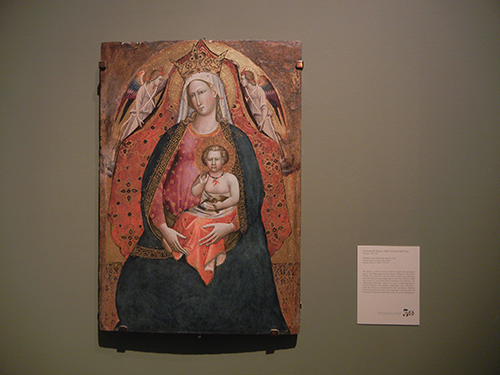
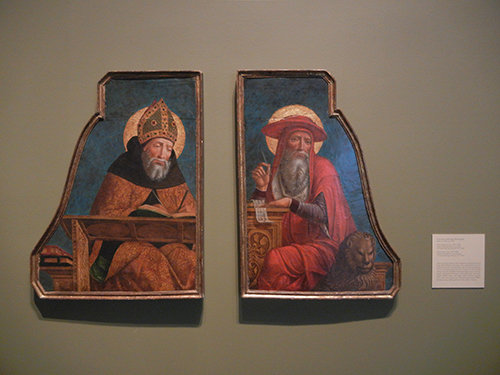
As usual, my focus in an art museum would be on paintings and here the vast painting collections, dating back to early 15th century, really shone. The range of these works were so broad, here, I choose to present them in general chronological order.

15th Century - medieval, a bit stiff, but otherworldly and brilliant:

DSCN1163 _ Madonna and Child with Angels, 1410s, Giovanni di Marco, called Giovanni dal Ponte, Blanton Museum, Austin
Madonna and Child with Angels, 1410s, Giovanni di Marco, called Giovanni dal Ponte

DSCN1161 - Saints Augustine & Jerome, c 1495-1500, Giovanni Ambrogio Bevilacqua, Blanton Museum, Austin
Saints Augustine & Jerome, c 1495-1500, Giovanni Ambrogio Bevilacqua

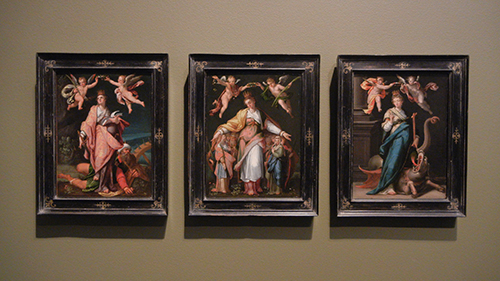
16th Century - flesh and blood figures, best represented here by Luca Cambiaso and Tintoretto:

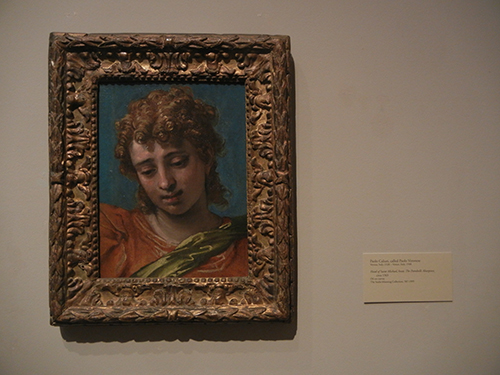
DSCN1167 _ Head of Saint Michael, from the Petrobelli Altarpiece, c 1563, Paolo Caliari, called Paolo Veronese, Blanton Museum
Head of Saint Michael, from the Petrobelli Altarpiece, c 1563, Paolo Caliari, called Paolo Veronese

DSCN1360 _ Portrait of a Man, c 1516, Sebastiano Luciani, called Sebastiano del Piombo, Blanton Museum, Austin DSCN1351 _ Suicide of Lucretia, c 1565, Luca Cambiaso, Blanton Museum, Austin
Portrait of a Man, c 1516, Sebastiano Luciani, called Sebastiano del Piombo & Suicide of Lucretia, c 1565, Luca Cambiaso

 DSCN1166 _ Saint John the Baptist, c 1542-45, Jacopo da Ponte, called Bassano, Blanton Museum
Saint John the Baptist, c 1542-45, Jacopo da Ponte, called Bassano

DSCN1154 _ Esther and Ahasuerus, c 1565-70, Luca Cambiaso, Blandon Museum, Austin
Esther and Ahasuerus, c 1565-70, Luca Cambiaso

DSCN1156 _ Ecce Homo, early 1570s, Luca Cambiaso, Blandon Museum, Austin
Ecce Homo, early 1570s, Luca Cambiaso

DSCN1355 _ Saint Catherine, Saint Ursula, and Saint Margaret, c 1583, Bartholomaeus Spranger, Blanton Museum, Austin
Saint Catherine, Saint Ursula, and Saint Margaret, c 1583, Bartholomaeus Spranger, Blanton Museum, Austin

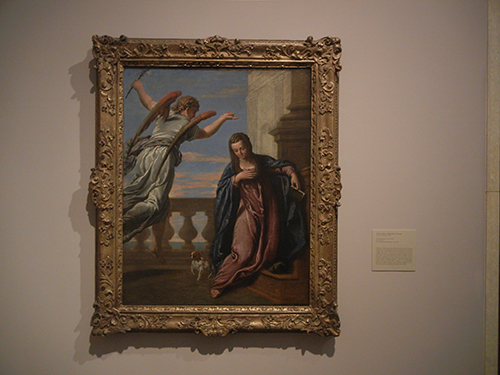
DSCN1168 _ The Annunciation, c 1585, workshop of Paolo Caliari, called Paolo Veronese, Blanton Museum, Austin
The Annunciation, c 1585, workshop of Paolo Caliari, called Paolo Veronese

DSCN1165 _ Portrait of a Gentleman, c 1585-90, Domenico Robusti, called Domenico Tintoretto, Blanton Museum, Austin
Portrait of a Gentleman, c 1585-90, Domenico Robusti, called Domenico Tintoretto

DSCN1152 _ Portrait of a Man in Armor, 1590s, Gervasio Gatti, Blanton Museum, Austin
Portrait of a Man in Armor, 1590s, Gervasio Gatti

DSCN1183 _ The Holy Family, late 16th century, Circle of Hendrick Goltzius, Blanton Museum, Austin
The Holy Family, late 16th century, Circle of Hendrick Goltzius

17th Century - somewhat more stylish and mannered than the previous century, and often provocatively dramatic:

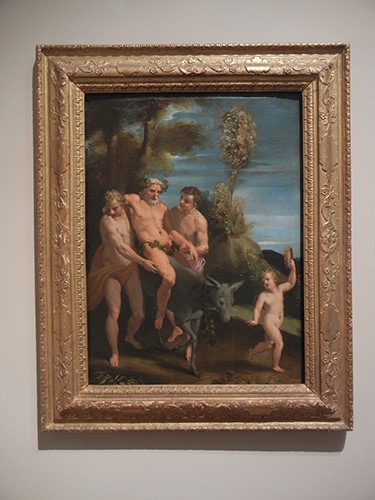
DSCN1174 _ Drunken Silenus on an Ass, 1600s, Attributed to Giulio Cesare Amidano, Blanton Museum
Drunken Silenus on an Ass, 1600s, Attributed to Giulio Cesare Amidano

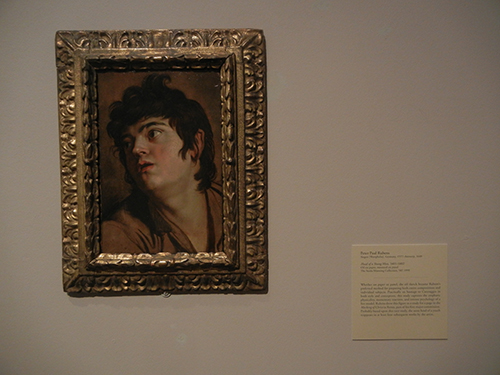
DSCN1180 _ Head of a Young Man, 1601-02, Peter Paul Rubens, Blanton Museum, Austin
Head of a Young Man, 1601-02, Peter Paul Rubens

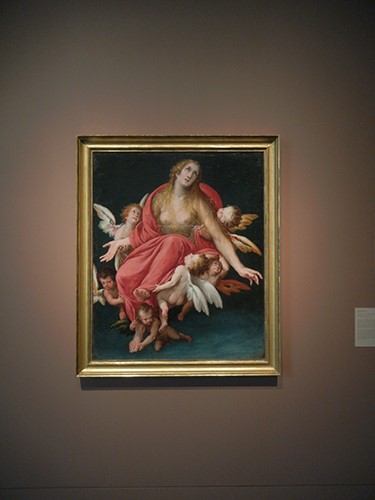
DSCN1201 _ The Visitation, c 1602, Camillo Procaccini, Blanton Museum, Austin DSCN1197 _ The Assumption of Mary Magdalene, 1630s, Riccardo Taurini, Blanton Museum, Austin
The Visitation, c 1602, Camillo Procaccini & The Assumption of Mary Magdalene, 1630s, Riccardo Taurini

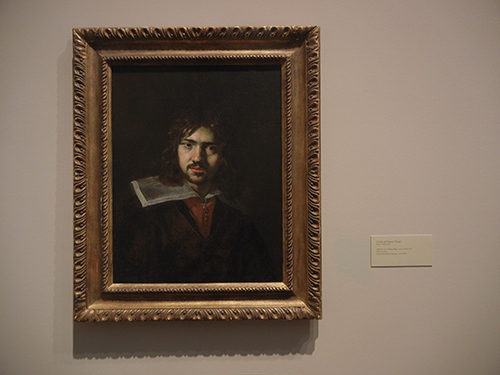
DSCN1179 _ Portrait of a Young Man, c 1618-19, Circle of Simon Vouet, Blanton Museum
Portrait of a Young Man, c 1618-19, Circle of Simon Vouet

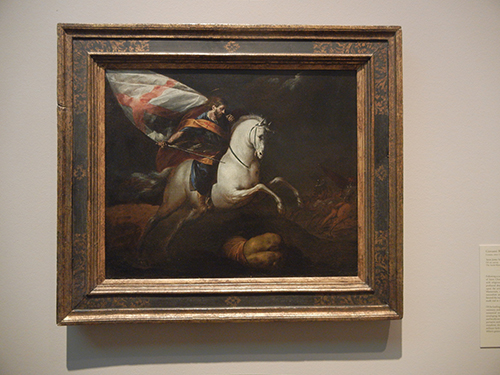
DSCN1212 _ Saint James Vanquishing the Moors, c 1630, Giovanni Battista Crespi, called Cerano, Blanton Museum
Saint James Vanquishing the Moors, c 1630, Giovanni Battista Crespi, called Cerano

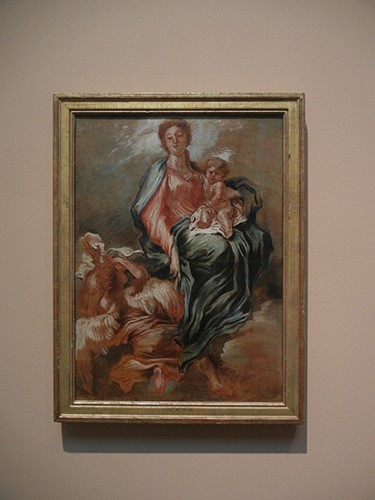
DSCN1216 _ The Angelic Consolation of Saint Francis, c 1645-49, Valerio Castello, Blanton Museum DSCN1214 _ Madonna and Child in Glory with an Angel, c 1654-55, Giovanni Benedetto Castiglione, Blanton Museum
The Angelic Consolation of Saint Francis, c 1645-49, Valerio Castello & Madonna and Child in Glory with an Angel, c 1654-55, Giovanni Benedetto Castiglione

18th Century - art became more decorative and mannered, thus less engaging.  Highlights included work by Tiepolo:

DSCN1231 _ A Miracle of Saint Dominic, c 1750, Blanton Museum, Austin
A Miracle of Saint Dominic, c 1750

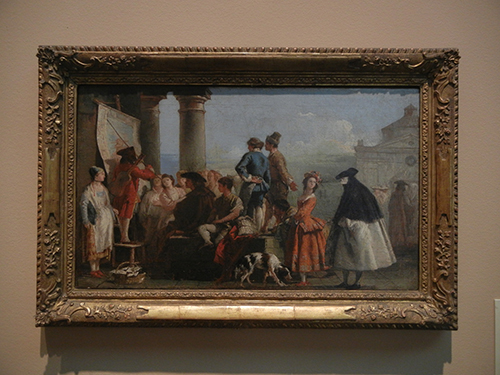
DSCN1221 _ The Storyteller, mid 1770s, Giovanni Domenico Tiepolo, Blanton Museum, Austin
The Storyteller, mid 1770s, Giovanni Domenico Tiepolo

19th Century - I recorded no paintings from this period in this museum.  Perhaps there was an interesting story behind this omission.

20th-21st Century - many impressive modern paintings and installations and my favorites included works by Karl Zerbe, Hans Hofmann, Franz Kline and Anselm Kiefer below:

DSCN1310 _ Woman on Trapeze, 1946, Karl Zerbe, Blanton Museu, Austin

DSCN1314 _ Woman on Trapeze and details, 1946, Karl Zerbe, Blanton Museu, Austin DSCN1315 _ Woman on Trapeze (detail), 1946, Karl Zerbe, Blanton Museu, Austin
Woman on Trapeze (detail), 1946, Karl Zerbe

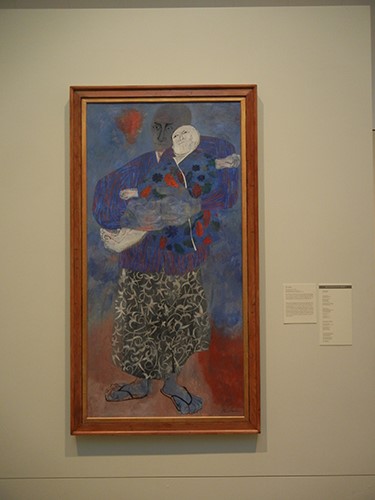
DSCN1304 _ From That Day On, 1960, Ben Shahn, Blanton Museu, Austin
From That Day On, 1960, Ben Shahn

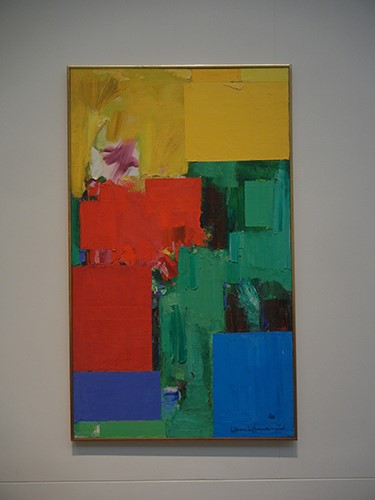
DSCN1283 _ Elysium, 1960, Hans Hofmann, Blanton Museum, Austin DSCN1281 _ Black and White No. 2, 1960, Franz Kline, 
Blanton Museum, Austin
Elysium, 1960, Hans Hofmann & Black and White No. 2, 1960, Franz Kline

DSCN1265 _ Missão_Missões [Mission_Missions] (How to Build Cathedrals), 1987, Cildo Meireles, Blanton Museum
Missão_Missões [Mission_Missions] (How to Build Cathedrals), 1987, Cildo Meireles


DSCN1248 _ Summer Circle, 1991, Richard Long, Blanton Museum, Austin

DSCN1256 _ Summer Circle (detail), 1991, Richard Long, Blanton Museum, Austin
Summer Circle (detail), 1991, Richard Long

DSCN1261 _ 2244 Módulos [2244 Modules], 1997, Isabel Del Río & Seepage, 2007, El Anatsui, Blanton Museum
2244 Módulos [2244 Modules], 1997, Isabel Del Río & Seepage, 2007, El Anatsui

DSCN1250 _ Sternenfall (Falling Stars), 1998, ANselm Kiefer, Blanton Museum, Austin
Sternenfall (Falling Stars), 1998, ANselm Kiefer

DSCN1439 _ Passage, 2011, Paul Villinski, Blanton Museum, Austin, TX

DSCN1149 _ Passage, 2011, Paul Villinski, Blanton Museum, Austin, TX

DSCN1147 _ Passage (detail), 2011, Paul Villinski, Blanton Museum, Austin, TX
Passage and the detail, 2011, Paul Villinski


More on Austin, Texas Trip, June 2014

Related posts on Art · 文化 · Kunst
- Wonderful Food Experiences in Austin, Texas
- BAM/PFA New Building Topping Out Celebration
- Revisiting Norton Simon Museum in Pasadena
- The Museum of Contemporary Art (MOCA) in Los Angeles
- Industrial Museum of China in Manchurian Shenyang
- Late Night of Jewish Museum in Vienna