Showing posts with label Eugène Delacroix. Show all posts

Friday, April 11, 2014

My Favorite Artworks at Musée National Eugène Delacroix, Paris

Musée National Eugène Delacroix (Musée Delacroix) in Paris is a modest museum which though contains works from nearly every phase of Delacroix’s career, covering many of his themes, along with some of his memorabilia.

According to the museum, "Magdalene in the Desert, exhibited at the 1845 Salon and one of the museum’s major paintings, is a most unusual religious composition, as compared to Education of the Virgin, painted in Nohant in 1842. The museum also boasts the artist’s only three attempts at fresco, which were done in Valmont (1834)."

These paintings, sketches and other works were intimate and quite personal, comparing to his more monumental works often encountered in more exalted institutions, such as Musée du Louvre. Incidentally, one of my two favorite artworks in Musée Delacroix was a preparation work for his gigantic La Mort de Sardanapale (Death of Sardanapalus), collected by Louvre. 
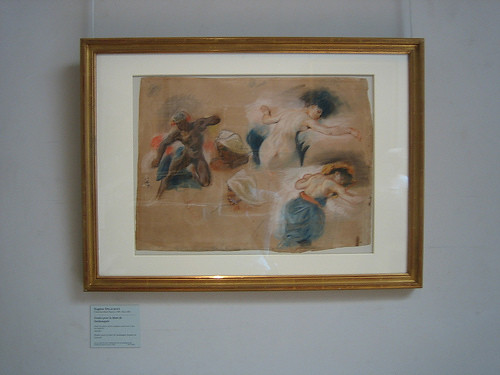
IMG_9000 - Study for La Mort de Sardanapale, Eugène Delacroix, Musée Delacroix, Paris, 2008

Though concentrating on a small slice of the huge final composition, this study conveyed the same strange mix of terror and abandon.  With its exceptionally delicate coloration, its figures looking like exotic birds in strange poses, this study was eerily beautiful and even evoked the calm world of Albrecht Dürer's meticulous watercolor still life.  Being a romanticist, Delacroix's work though was naturally more sweeping in execution; being a study, it also carried impressionistic traits.

My second favorite work there was another study for another historical moment - Study for Mirabeau Confronts the Marquis de Dreux-Brézé, during the French Revolution, over the procedure therefore substance of the congress of three estates.
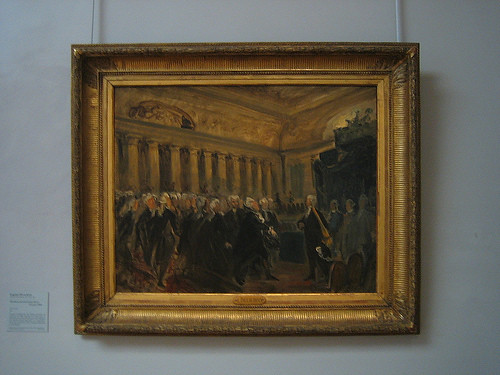
IMG_9004 - Study for Mirabeau Confronts the Marquis de Dreux-Brézé, Eugène Delacroix, Musée Delacroix, Paris, 2008

This study was both energetic and economic.  The eloquence of the painting lay in the restrained bod languages of the grandees, whose multiplying dark frocks and gray wigs foreshadowed the mob scenes soon to come, and the gilded panels and roof of the interior clashed violently with the somber and unsmiling figures of the confronting parties.  Despite being a sketch, it was a masterpiece, similar to many very revealing and satisfying study sketches by Pieter Paul Rubens. 

The final composition of this work is in the Ny Carlsberg Glyptotek in Copenhagen.  One day I'd love to see it there, and to see whether it would be one of my two favorites there or not.


My Favorite Museum Collection Series
>> My Favorite Museum Collection Series 74: My Favorite Artwork at Musée de Cluny - Musée national du Moyen Âge, Paris

<< My Favorite Museum Collection Series 72: My Favorite Artworks at Maison de Victor Hugo, Paris 

List of My Favorite Artworks in the Museums I've Visited  

Other Related posts on Art · 文化 · Kunst:
- My Favorite Paintings at Musée Marmottan Monet
- My Favorite Sculptures at Musée Rodin, Paris
- Revisiting Norton Simon Museum in Pasadena
- My Favorite Paintings from Musée Picasso, Paris
- The Museum of Modern Art, New York City
- My Favorite Sculptures at Cimetière du Père-Lachaise, Paris
- My Favorite Paintings in the Courtauld Gallery at Somerset House, London
- My Favorite Paintings in Cathedral of Our Lady, Antwerp (Antwerpen), Belgium

Wednesday, June 5, 2013

My Favorite Paintings at Église Saint-Sulpice, Paris

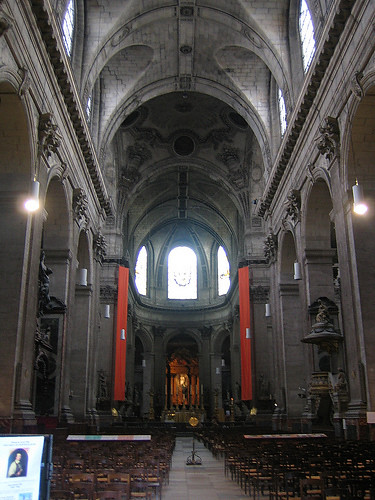
Old European churches are often art treasure troves and Église Saint-Sulpice in Paris is just on of such amazing institutions. 

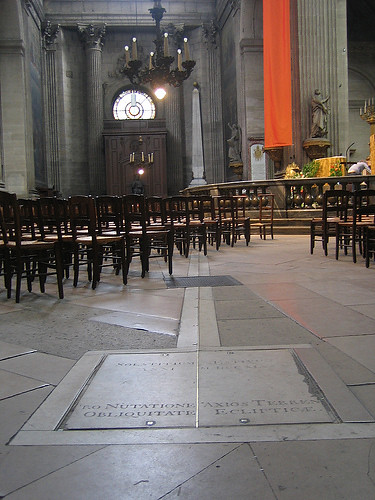
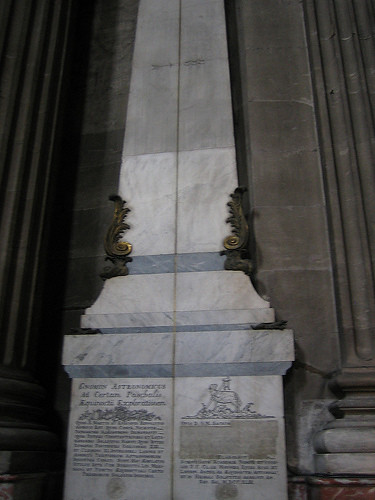
According to Wikipedia, at 113 metres long, 58 metres in width and 34 metres tall, it is only slightly smaller than Notre-Dame and thus the second largest church in the city. It is dedicated to Sulpitius the Pious. During the 18th century, an elaborate gnomon (part of a sundial that casts the shadow), the Gnomon of Saint-Sulpice, was constructed in the church.

Many people learned of this cathedral through Dan Brown's bestseller, The Da Vinci Code, while I through a French opera, Jules Massenet's Manon. In both works, pivotal scenes took place in this cathedral, therefore it earned a few paragraphs before I narrate on my favorite paintings it housed.

Saint-Sulpice, Paris, June 2008 - IMG_8115 The gnomon, Saint-Sulpice, Paris, June 2008 - IMG_8142

The above pictures showed the interior of the church and the gnomon (in the background) and the brass line on the floor.  You can see the detail of the gnomon in the larger picture below:

Saint-Sulpice, Paris, June 2008 - IMG_8123

Constructed by the English clock-maker and astronomer Henry Sully, the gnomon was also used for various scientific measurements: This rational use may have protected Saint-Sulpice from being destroyed during the French Revolution.

The sight of this gnomon in the obelisk shape was unusual but it couldn't hold my interest long and soon I wandered away to see many magnificent stained glasses and then, in the Chapel of the Holy Angels, some unforgettable mural paintings by Eugène Delacroix, who painted scenes from The Bible, in the effort to repair the extensive damages the church suffered during the Revolution.  

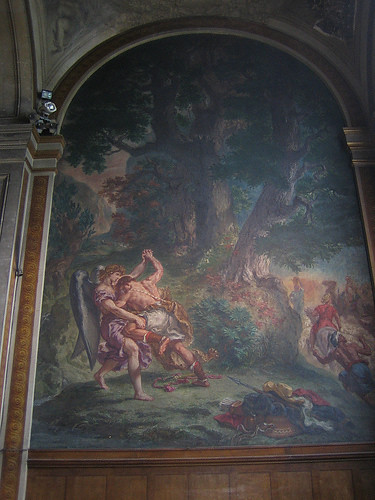
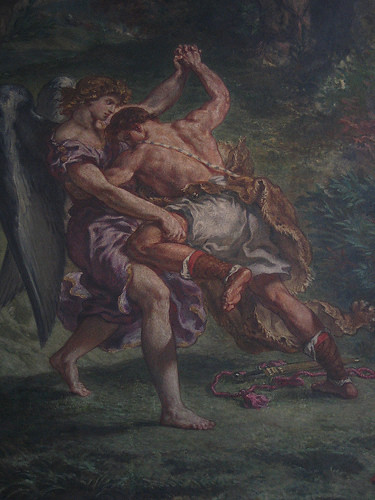
My favorite mural there was the Jacob Wrestling with the Angel, dynamic in composition, romantic in scene setting and the result was both somewhat unsettling and absolutely beautiful.

Jacob Fights with the Angel, Eugène Delacroix, Saint-Sulpice, Paris, June 2008 - IMG_8145

Jacob Fights with the Angel (Detail), Eugène Delacroix, Saint-Sulpice, Paris, June 2008 - IMG_8151

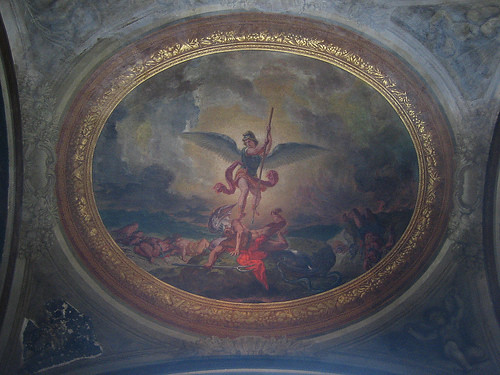
My second favorite painting in Saint-Sulpice was St Michael defeats the Devil, again by Delacroix.  This painting had the similar atmosphere and dynamism as Wrestling.  The major difference was that St Michael was mounted on the ceiling therefore the St Michael's triumph was presented as a brilliant celestial vision and his victory had a cosmic feeling versus the more intimate and personal one of the Wrestling.  The colors in this painting was more brilliant and the Archangel occupied the absolute center of the painting, being the unchallenged center focus of this celebratory and lovely painting.

St Michael defeats the Devil, Saint-Sulpice, Paris, June 2008 - IMG_8148

My Favorite Museum Collection Series

>> My Favorite Museum Collection Series 67: My Favorite Sculptures in Basilique Saint-Denis (Paris)
<< My Favorite Museum Collection Series 65: My Favorite Sculptures in Jardin du Luxembourg, Paris

List of My Favorite Artworks in the Museums I've Visited


Other Related posts on Art · 文化 · Kunst:
- Grand Palais in Paris
- Musée de Cluny - Musée national du Moyen Âge, Paris
- Travel Inspired Paintings
- Get Ready for the Treasures from Musée d’Orsay
- Picasso: Masterpieces from the Musée National Picasso, Paris - De Young Museum, San Francisco
- Birth of Impressionism at De Young Museum, San Francisco