
Showing posts with label Getty Museum. Show all posts

Monday, December 5, 2016

My Favorite Sculptures at J. Paul Getty Museum - Getty Villa, Los Angeles (Malibu)

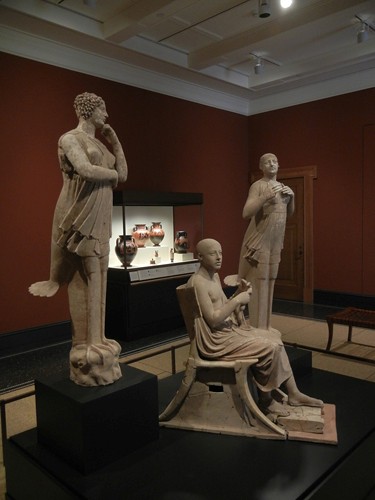
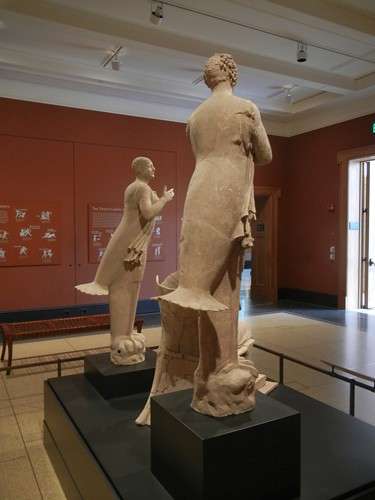
Getty Villa by the sea was a heaven for lover of antiquities.  Among many Egyptian giants and Greek gods, I found most memorable a group of sculpture of a seated man and the flanking sirens, creatures of part bird and part woman. The real focal points were those ladies, whose careful postures belied their nature, as if they were in break from their fatal performance, and their nature was just a goodie goodie matron, or some prim figures from Victorian era, though they were from ancient Greece, dating to 350 - 300 B.C. The seating figure was a very plain and passive figure, therefore, my attention was fully on those two standing sirens, who on two legs, and large claws, instead of feet, looked very upright, though became a bit comical, when viewed on profile, with their stiff little tail stuck out below their hips, resembling ill-fitting coats, as if they were campaigning politicians in tails, during one of their eloquent and disingenuous speeches. Perhaps, that was what being sirens meant.

DSCN7360 _ Sirens, Getty Villa, July 2013

DSCN7362 _ Sirens, Getty Villa, July 2013
A Seated Poet and Sirens, Greek (Tarantine), Tarentum (Taras), South Italy (Place created), 350 - 300 B.C.

My second favorite was an even more ancient sculpture, titled Harp Player, from Early Cycladic, around 2700-2300 B.C. What so remarkable about this lucid rendition was how wonderfully proportioned and abstracted the little sculpture was and how poetic his or her postures were. There were a few wonderful dialogues, such as the contrasts between smooth and rounded curves and straight and abrupt angles, and between elements of thin and delicate, and that of thick and sturdy. The most memorable aspect, perhaps due to the ravage of time, was the small and ill-shaped head and the player's face, which was like a piece of cloud, with barely discernible features, as if the player had disappeared into an aural world of his/her own creation.
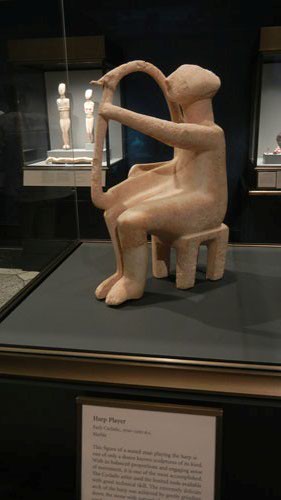
DSCN7550 _ Harp Player, Early Cycladic, 2700-2300 B.C., Getty Villa, July 2013
Harp Player, Early Cycladic, 2700-2300 B.C.


My Favorite Museum Collection Series
>> My Favorite Museum Collection Series 154: My Favorite Paintings at Los Angeles County Museum of Art (LACMA)
<< My Favorite Museum Collection Series 152: My Favorite Paintings at J. Paul Getty Museum - Getty Center, Los Angeles

List of My Favorite Artworks in the Museums I've Visited

Other Related posts on Art · 文化 · Kunst:
- Getty Villa in Los Angeles (Malibu)
- The Museum of Contemporary Art (MOCA) in Los Angeles
- Brand New Contemporary Art Museum - The Broad Museum in Los Angeles
- Urs Fischer Exhibit at MOCA, Los Angeles
- Revisiting Norton Simon Museum in Pasadena
- Anderson Collection at Stanford University
- Paintings at Cantor Arts Center, Stanford University
- Surprisingly Urbane Los Angeles

Thursday, December 1, 2016

My Favorite Paintings at J. Paul Getty Museum - Getty Center, Los Angeles

What I found most interesting at J. Paul Getty Museum - Getty Center in Los Angels were European paintings, and my top choice was Portrait of the Marquesa de Santiago (1804) by Spanish painter Goya — a formal portrait of an aristocratic lady in dramatically contrasting black dress with golden braids, pink shoes, and white lacy mantilla, with provocatively exaggerated makeup, standing atop a hill, a closed fan in hand, and holding herself like a seasoned stage trooper.

Goya employed broad and quick brushstrokes to establish her black dress and rustic cottages in the low lying village at distance, seen behind tilting ground, which, along with stormy sky, contributed to establish a personality prone to self-dramatization. Despite Goya's loose brushstrokes, this full length portrait was still very realistic, though the sitter's face was curiously plastic and devoid of personality. Maybe Goya did capture his sitter rather too well.

Portrait of the Marquesa de Santiago by Francisco de Goya, 1804, Getty Center
Francisco Goya [CC0], via Wikimedia Commons
Portrait of the Marquesa de Santiago, 1804, Francisco José de Goya y Lucientes (Francisco de Goya) (Spanish, 1746 - 1828)

I was also very impressed by Edvard Munch's Starry Night (1893), whose sweeping atmospheric sky, mysteriously-shaped mound and other objects on the shore, and the mirror-like glinty sea, often basked in a blue wash, gave us a sense what the beginning of everything might have looked like, and we were in the presence of some celestial phenomenon recorded with quick brushstrokes and varying thickness of paints of blue, green, maroon, and brilliant white, interlaced with some eloquent patches of almost naked canvas, where the paints thinned out. Altogether, those loosely applied pigments and vaguely suggested elements not only generated a shimmering atmosphere, but gyrating slow movements as well, and the viewers were dazzled by that.

'Starry Night' by Edvard Munch, 1893, Getty Center
Edvard Munch [Public domain], via Wikimedia Commons
Starry Night, 1893, Edvard Munch (Norwegian, 1863 - 1944)


My Favorite Museum Collection Series
>> My Favorite Museum Collection Series 153: My Favorite Sculptures at J. Paul Getty Museum - Getty Villa, Los Angeles (Malibu)
<< My Favorite Museum Collection Series 151: My Favorite Paintings at Yale University Art Gallery

List of My Favorite Artworks in the Museums I've Visited

Other Related posts on Art · 文化 · Kunst:
- LACMA - Los Angeles County Museum of Art
- Getty Villa in Los Angeles (Malibu)
- The Museum of Contemporary Art (MOCA) in Los Angeles
- Brand New Contemporary Art Museum - The Broad Museum in Los Angeles
- Urs Fischer Exhibit at MOCA, Los Angeles
- Revisiting Norton Simon Museum in Pasadena
- Surprisingly Urbane Los Angeles