Showing posts with label Giorgione. Show all posts

Sunday, August 5, 2012

A Dream of Labor

I often had vivid dream- from blooming meadow to swinging corpse behind a door, either comforting or upsetting, with great visual impacts and sometimes served as starting point of my painting projects.

Last week, I had another strange dream and I am still trying to determine its meanings, if any, and if I should treat it as a painting object or not.

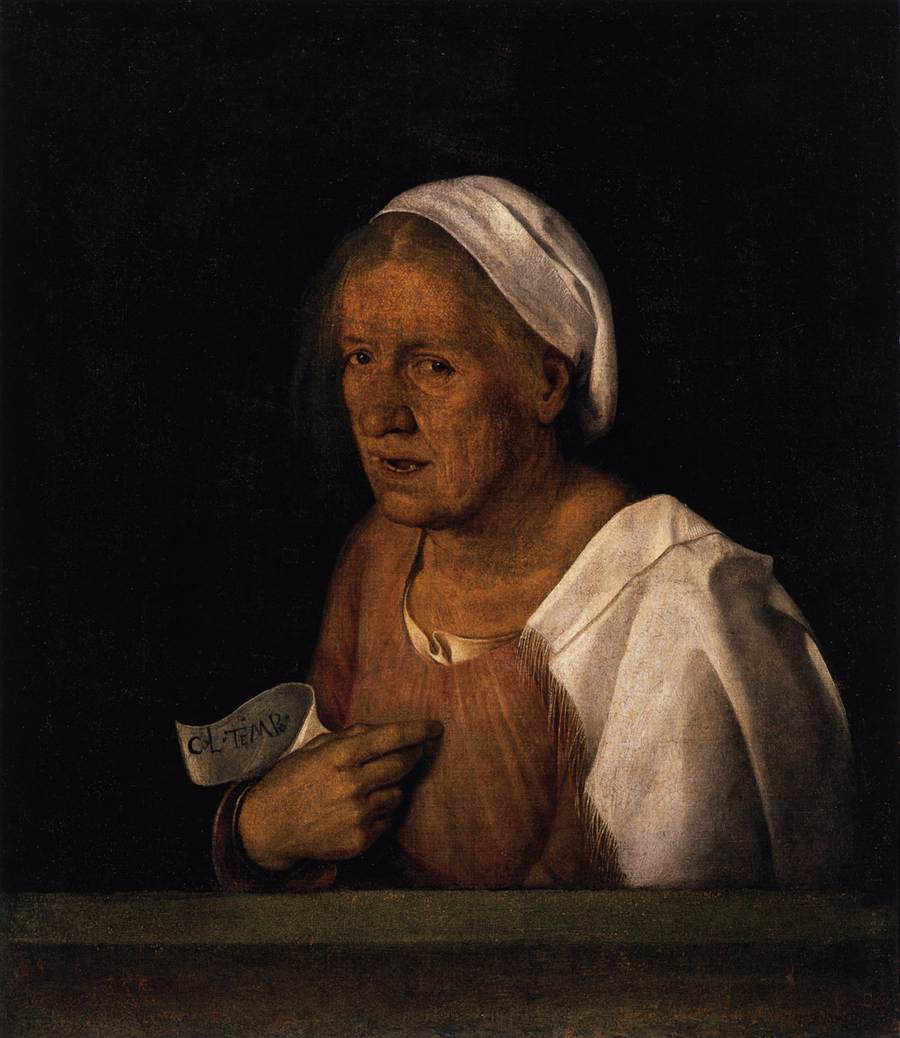
Ritratto di vecchia, Giorgione
I dreamed that I was in a restaurant, only by concept, without any visualizing of the specifics, and realized that our server was a very old woman - in her eighties or nineties, I somehow knew it in my dream sequence.  I was not alone, but couldn't tell whom I was with.  One of my companions voiced his or her concern for the old server and we were assured, perhaps by the restaurant's cheerful management, that we needed not to worry.  "She just performed a feat the other day and served a large party of eighty or ninety people by herself."

We were impressed and felt better.

Then, our old server tottered in, with her bend back absolutely parallel to the ground.  Several fully loaded large plates crowded on her stoic back

Quite an image, isn't it?  Perhaps, I should work on it?

Saturday, April 28, 2012

My Favorite Paintings at Galleria dell'Accademia, Venezia (Venice Academy)

My second day trip from Firenze (Florence) was to Venezia (Venice). This is much more challenging than a trip to Sienna, due to the much longer distance between the cities, and the fact that Venice had much more to offer than Sienna.

We departed by train in the early morning and near mid-day, we arrived at Venice.  We spent a decently short time to marvel at the canals and the took river taxi (much cheaper than gondola) to the St Marco Square and saw the amazing Romanesque cathedral.  Afterwards, we marched through the intricate alleys, canals and bridges, in order to spend some time at Galleria dell'Accademia, Venice (Venice Academy).

My main goal was to inspect and admire two incredible Venice School paintings, along side wit many other wonderful works.  But these two pieces were indeed my main goal.

One was "Tempest" by Giorgione. Perhaps, this one is even more mysterious and intriguing than the more famous "Mona Lisa" by Leonardo Da Vinci. This painting was full of symbols whose meanings largely lost to modern minds.  On its foreground, on the left, was a young man in fanciful dress, not quite a knight but not your common city or country folks either.  He gazed at the far right, but not at the woman sitting in the bush, nursing her baby.  She looked towards the left, but not quite at the young man either.  Most mysterious element was that she had only some short cape over her should and completely nude down below.  She seemed sitting on the rest of her clothes.  The background was a city/country scene rather reminiscent of more medieval Sienna.  Above the cityscape, lightening flashed across stormy sky, in the same lovely green/blue hue, which actually was the signature of Giorgione to me.

In regardless whatever the symbolism this painting held, it was a lovely painting, with charged dramatic gestures and held the viewers in complete enthrallment.


United States public domain tag

My second focus was an incredibly ambitious painting by Paolo Veronese, "The Feast in the House of Levi", with measuring of 555 x 1280 cm (18 x 42 feet).  It was ambitious, showy, and bursting with activities in a feast and splendid colors, dominated by various hues of red and green/yellow.  It was indeed that the Venice School paintings were most excelled in their amazing colors.  The way Veronese painted many sorts of fabrics was truly virtuosic as well.  The tableau of the feasting table, was quite similar to the "Last Supper" by Da Vinci, again.  No artist had monopoly on ideas. The overall composition was quite solemn, befitting to its biblical theme and the monumental size, with activities framed under immense classical arches, and contrasted with somewhat menacing sky, and enlivened by the aforementioned activities and lively colors.  

This was a very stagey tableau and it sheer immensity made it a marvel to see. 


Wikipedia Commons, source: Ghirlandajo


My Favorite Museum Collection Series
>> My Favorite Museum Collection Series 29: My Favorite Artworks at Musée du Louvre, Paris
<< My Favorite Museum Collection Series 27: My Favorite Paintings in Palazzo Pubblico, Sienna


List of My Favorite Artworks in the Museums I've Visited

Related posts on Art · 文化 · Kunst: 
- Il Ghetto di Venezia and Museo Ebraico (Jewish Museum) in Venice
- San Giorgio Maggiore, Il Redentore, Scuola e Chise Grande di San Rocco, Venezia
- Magical Piazza San Marco in Venice
- Boy With Frog Sculpture and Punta della Dogana, Venice
 

Wednesday, January 11, 2012

Venetian Masterpieces from Vienna at De Young Museum


Last December, I visited the Masters of Venice: Renaissance Painters of Passion and Power from the Kunsthistorisches Museum, Vienna at De Young Museum in San Francisco.

I have visited the Kunsthistorisches Museum in Vienna many years ago but the biggest impressions I gained from that visit were made more by the collections from Dutch, Flemish and German masters such as Albrecht Dürer, Lucas Cranach, Pieter Bruegel the Elder, Jan van Eyck, Rogier van der Weyden, Vermeer, Rembrandt, etc. and the salt cellar, Saliera, by Benvenuto Cellini, which was stolen on May 11, 2003and was covered on January 21, 2006, according to Wikipedia.  That of course, did not mean that I wasn't moved or impressed by 16th-century Venetian paintings (Titian, Veronese, Tintoretto), or 17th-century Flemish painting (Peter Paul Rubens, Anthony Van Dyck).  If my chief impression was on those northern masters, it was due to the incredible richness of the collection that museum boasted.

I was deeply grateful that I had an unhurried experience of viewing their collections of Venetian Masters.  There are too many wonderful paintings at De Young but if I attempt, I would name Titian, Giorgione, Tintoretto and Veronese as my favorites, naturally, all those usual suspects.

De Young Museum provided a nice online preview of the exhibit.  Since some images they lists are my favorites, I'll cite them below:


Tiziano Vecellio, called Titian. Danaë, ca. 1560. Oil on canvas


Titian. Portrait of Isabella d'Este, Marchioness of Mantua, ca. 1534-1536. Oil on canvas


Titian, Portrait of Johann Frederich, Elector of Saxony, 1548-1551. Oil on canvas


Paolo Caliari, called Veronese, Lucretia, ca. 1580–1583. Oil on canvas


Paolo Caliari, called Veronese. Judith with the Head of Holofernes, ca. 1580. Oil on canvas


Jacopo Robusti, called Tintoretto, Susanna and the Elders, ca. 1555-1556. Oil on canvas

 
Giorgio da Castelfranco, called Giorgione. Youth with an Arrow, ca. 1508–1510. Oil on panel

True to their reputations, the sense of colors and the freedom of their painterly brushes were exhilarating and ravishing to behold.  

A few more thoughts: 

1) I love Veronese's Lucretia but Titian outdid him.  Veronese's was too calm and demur while Titian's were absolutely wounded and grieving, which was also included in this exhibit:


 2) I made a day-trip to Venice from Florence in 2000, especially to see Giorgione's The Tempest (c. 1507-1508, 82 x 73 cm, Oil on Canvas), in the Gallerie dell'Accademia, Venice, which was as enigmatic as it was beautiful:


[Wikipedia image, in US public domain]

3) I have seen so many Titian paintings and I cannot remember where I saw which wonderful pieces.  For Veronese, I will always associate him with "The Feast in the House of Levi", which also locates in the Gallerie dell'Accademia:
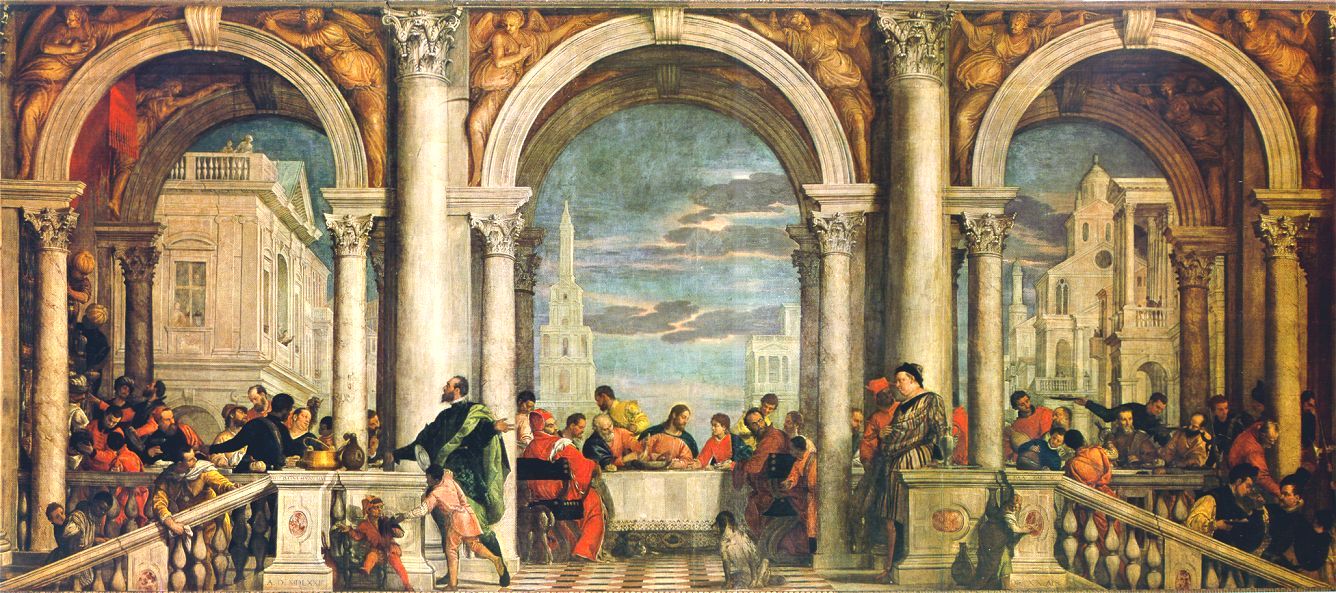

The Feast in the House of Levi (1573), 555 cm x 1280 cm (219 in x 500 in), Oil on canvas
[Wikipedia image, in US public domain]

This special exhibit will end on 12 February 2012 and I strongly recommend it.  It's an unforgettable exhibit.