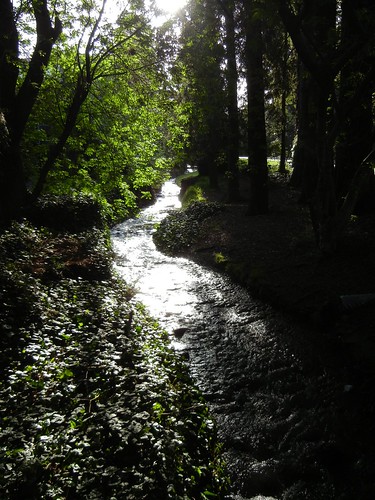
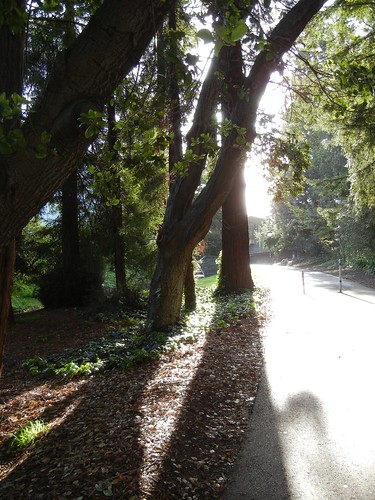
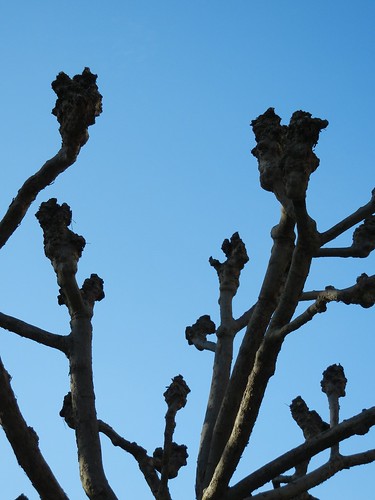
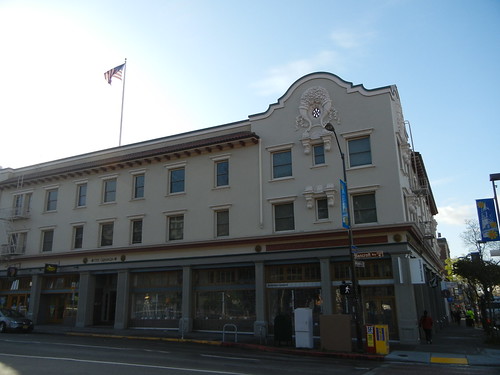
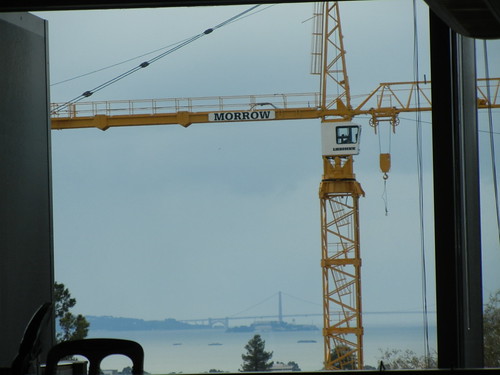
Berkeley writer Steve Masover's new blog Flowery front yards in Berkeley, caused me to remember a find day in March when I walked across the campus of University of California, Berkeley and took some pictures and video below:
The reason why Ai Weiwei, the best known Chinese artists, was detailed by Chinese authority since last weekend before boarding a Hong Kong bound flight has not been officially declared, though through various channels, connected to the authority, had hinted on reasons ranging from incomplete exiting documentation to economic crimes, such as tax evasion.
Tax evasion has been used applied to prosecute another top artist, though largely domestic fame, actress Liu Xiaoqing, whose nonconformist images had made many people uncomfortable. In the 1980s, she largely left film industry and became a very successful businesswoman and later on, she was accused of tax evasion and was put into prison, before the auditing had been concluded. While she languished in prison (2002-2003, totally 422 days), her business and real estate properties were auctioned off at far below market value and it turned out later that the determined amount she owned to the state was less than value of one of her many houses. However, some resources put the amount much higher. After her release from the prison, she went back to business and acting and once again, established herself on stage, movie and television. Her case was a curious one, because many people, even artists, had been accused of tax evasion and none received punishment as severe.
If the rumor that Ai Weiwei will be accused of tax evasion, we can only hope that the trial would be a public and fair.
However, it is difficult to believe that was the real motive behind his disappearance. New York Times profiled him after his detention "An Artist Takes Role of China’s Conscience", detailing how he might have generated displeasure in certain powerful sector:
In a 30-year career he has combined, often at calculated personal risk, both aspects of his persona to create a role as an outspoken critic of the Chinese government, delivering his most stinging rebukes from within China itself. In light of his detainment, however, his ability to sustain this role, in China at least, would seem to be in serious doubt.
From a Western perspective, Mr. Ai’s career fits a familiar profile. We tend to like our contemporary Chinese artists to come across as aesthetic tradition-busters. (This is one reason that Pop-style Mao paintings by the likes of Wang Guangyi remain big-selling auction items.) In this regard Mr. Ai has not disappointed. In the 1990s he painted Coca-Cola logos on ancient Chinese pots, broke up classical Chinese furniture and photographed himself making a single-digit rude gesture in front of the White House, the Eiffel Tower and Tiananmen Square.
But gradually such Duchampian moves have given way to large-scale, socially critical projects. For a conceptual piece called “Fairytale” at the 2007 Documenta in Kassel, Germany, he placed 1,001 antique Chinese chairs, available for use, throughout the exhibition. He built an outdoor structure from 1,001 doors salvaged from Ming and Qing houses that had been eliminated by rampant development in Chinese cities. Through the Internet he recruited 1,001 Chinese citizen-volunteers to come to Kassel to live for the duration of the show.
In short, he brought a sense of China that was at once inviting, puzzling and pathetic. The chairs were nice to sit in. It was hard to know what to make of the mini-army of temporary residents, who seemed equally uncertain of why they were there. The structure built from old doors finally just collapsed. Over all, “Fairytale” was not a winning picture of his homeland.
Ai is a brave man for sure. However, there is another reason he could have been able to push so far, that is his famous father, Ai Qing (1910-1996), a poet with status similar to Walt Whitman or Alan Ginsberg.
Incidentally, Ai Qing started as a painter. When he was imprisoned by Nationalist government, he took up writing and became a famous poet.
Now, the great opponent of Nationalist government, the Communist China, is detaining Ai Weiwei and perhaps, we are witnessing another great poet in the making?
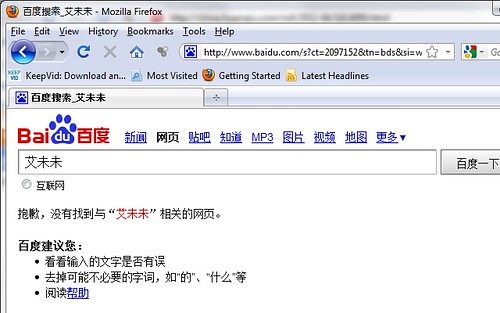
By the way, Chinese Communist Party newspaper People's Daily had cited an article from Global Times (Chinese Communist Party's overseas propaganda outlet) speculating on why Ai's detained. However, when I tried to find the article on Global Times (Chinese edition) myself, the search result, via Baidu (the largest search engine in China), there was no search result for the term of "艾未未" (Ai Weiwei):
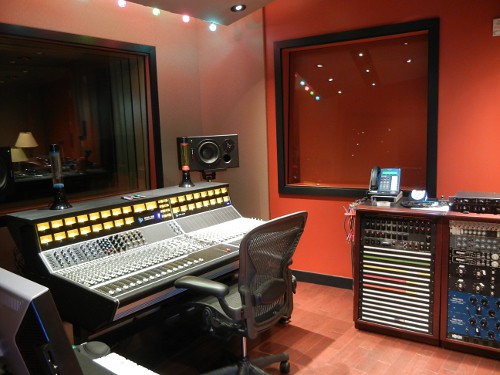
Located in South of Market area in San Francisco, Studio Trilogy is a big player in recording company. The company's website states:
Located in the creative heart of San Francisco, Studio Trilogy furnishes engineers, producers and artists with one of the world’s finest recording studio environments. Three state-of-the-art control rooms, four integrated isolation booths, one of San Francisco’s most versatile large tracking rooms, the unique very live Gallery space, an experienced staff and a great network of award winning engineers and producers.
Designed by John Storyk of WSDG, Studio Trilogy features Pro Tools|HD 3 systems and classic Studer analog 2" tape, Ampex ATR 1" and 1/2" 2 Track, an 80-channel SSL 9000K mix console with Ultimation; A 32 Channel API 1608; A Digidesign ICON D-Control, ISDN, Video link and monitoring for scoring to picture, overdubbing, voice-over, sound design, a large collection of microphones; a full complement of vintage and modern instruments and gear. Check out our News & Events page for current press and updates!
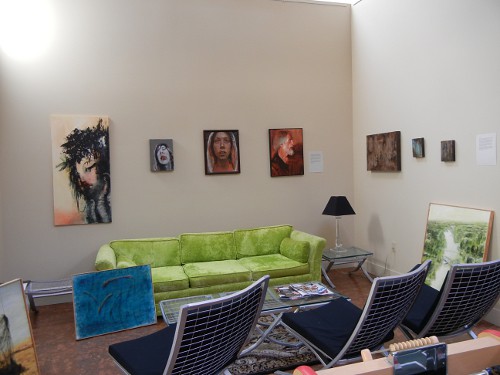
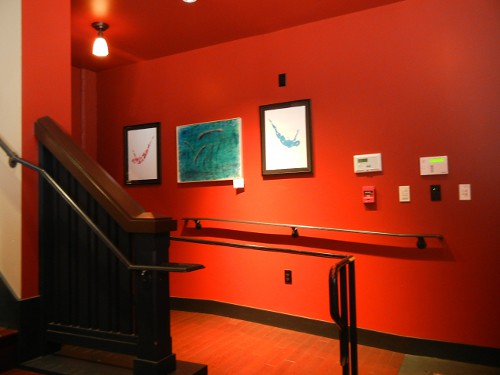
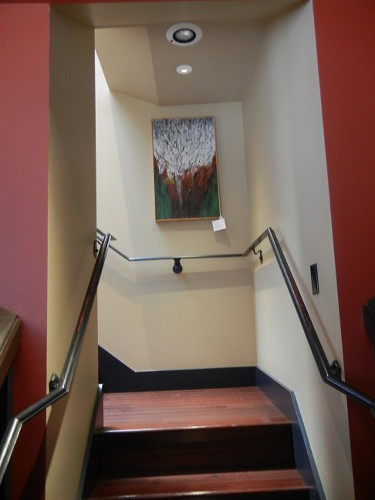
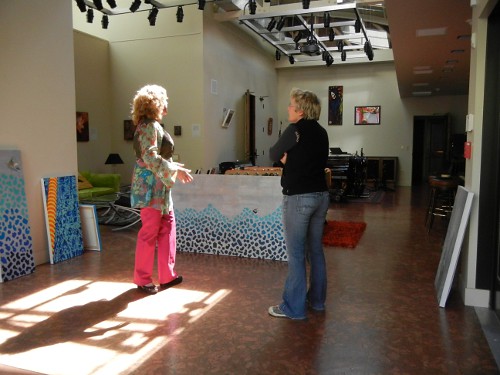
Recently, Studio Trilogy reached me for loaning them some paintings for their above-mentioned Gallery space. When I visited their studio, I was deeply impressed by the space and was happy to comply. After some discussions, I brought fourteen paintings to studio Trilogy on Monday, 4 April. After some trials, we found niches for eight pieces of these paintings. Three would be in the main Gallery, around their most beloved couch. The rest of my paintings would be display at the main entrance, the stunning hall way, the reception room, and the landing to the second floor.
The paintings will remain with Studio Trilogy for about three months.
Trying out space
Trying out space - my "Lake", "Bombed Bridge, I" and "Birches" will replace the current paintings
Trying out space
Designated space for "Falling"
Designated space for "Mackerel"
Designated space for "Leisurely"
Designated space for "Crow"
Designated space for "Hindrance"
Studio Trilogy curator and another artist discussed choices
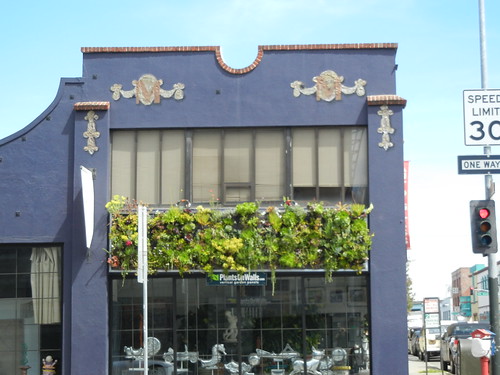
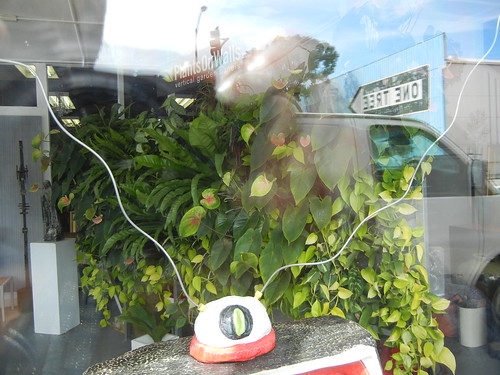
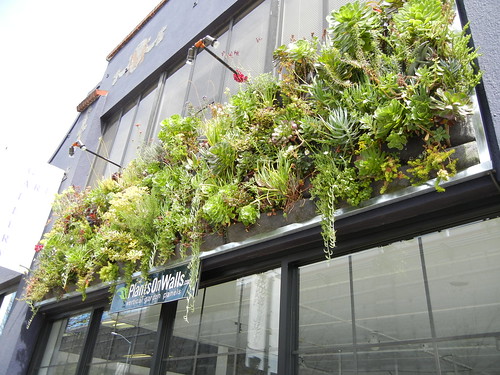
Vertical gardens, which can occupy a small area in a living room, or a giant facade of an department store, have become increasingly popular. Smaller ones suit the contemporary life style of limited living space very well, while the more ambitious ones fit into our desire to create spectacles everyone.
Above and below are a few samples of this art form.
Last week, I passed by this designing studio in San Francisco - Plants On Walls, which has designed some very impressive vertical gardens. I took some snap shots from outside the design studio. The 10th/Harrision Street studio also has a very informative website, such as the last picture of this blog:
It took about a year's time for Apple to come up with the second generation of its popular iPad. That fact reminded me of what it took for a communist China to develop and produce its second generation truck - thirty years!
In 1956, the first Liberation truck was produced in Changchun, in Manchurian China. This model ever since monopolized truck market in China and only in 1986, more than one million trucks later, the second generation of Liberation truck, came down from assembling line.
Chinese industrial and political leaders were so proud that they even managed to make a featured film out of this - "Liberation".
Following the footsteps of "The Social Network", a film about producing something can be interesting. Therefore, I suppose that a movie "iPad 2" is eminently desirable and marketable.
China has taught us how to manufacture, how to develop, how to squeeze civil liberties, and it would not be too humiliating to learn from them on how to make an industrial movie.
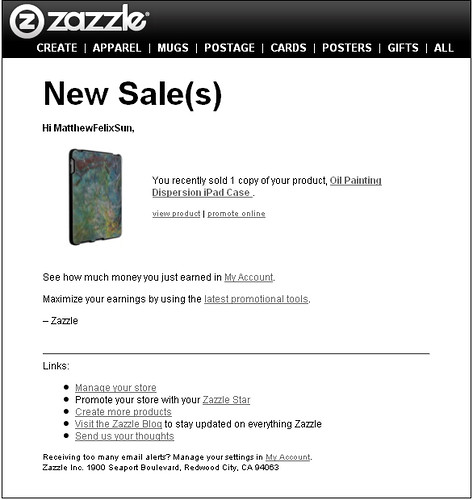
Late February, a San Francisco Chronicle article called my attention to a website which allows people to upload images to design various products, ranging from personalized stamps, stationary, to T-shirts, shoes and skating boards. The "designers" would received a royalty based on the percentage the designer specified, with the default as 10%. The royalty would be built into the total prices.
I created some products with my paintings, drawings and photographs. The products I enjoy "designing" the most are cases for iPhones and iPads, and canvas shoes. The initial enthusiasm and novelty worn thin fast, however, and I quickly lost interest and didn't bother to check the activities of my "Store" for a while, then, out of blue, I received an email - I had made the first sale via Zazzle:
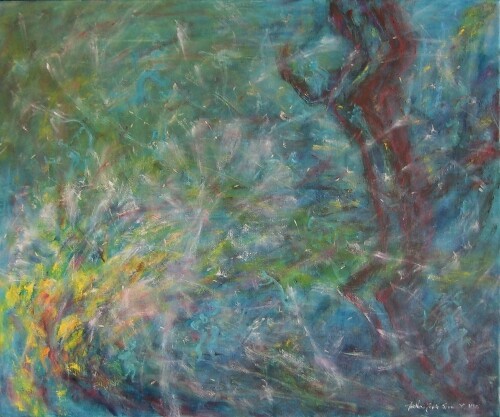
It was an iPad case with my oil painting "Dispersion", whose popularity had exceeded my expectation.
Well, I sure hope this little venture is the harbinger of many royalties to come.











 Posts
Posts


