Wednesday, August 31, 2011

Not Enough Drama, Love to Rescue - on San Francisco Opera's Commissions "Heart of A Soldier"

"Not Enough Drama, Love to Rescue" was widely used in late 1980s in China to ridicule unwarranted love plot twist.  The relaxed political atmosphere just allowed love to be depicted in movies and consequently there was rampant overdose, particularly when drama became tepid, a love scene was duly inserted to keep the audience engaged, often to the detriment of the overall dramatic arc.

What made me think of this phrase was the San Francisco Opera's new commission, "Heart of a Soldier", to be presented on the eve of the 10th anniversary of the September 11 attack on the World Trade Center.

The opera was set to music by Christopher Theofanidis to Donna di Novelli's libretto, which was in turn based on James Stewart's book of the true story of Rick Rescorla.

SFOpera's website summarized the opera thus:
What makes a hero? The question was never an academic one for Rick Rescorla, a British-born adventurer who fought in Vietnam before settling in New York as head of security for a brokerage firm based in the World Trade Center. On September 11, 2001, his extraordinary courage and calmness in a crisis paid off: Rescorla led all of the 2,700 people under his care to safety—literally singing them down the stairs—before heading back into the burning building for one last check. He never emerged.
The opera covered vast ground - not only Rick Rescorla's heroic deeds on that fateful day, but also his long friendship with Dan Hill who served with him in Vietnam and helped to devise an evacuation plan for Rescorla's company in World Trade Center, and Rescorla's late found love with Susan.

The creative team argued that this is not just a hero's story, but intense love story.  I sincerely believe that all three strands - hero's growth and deeds, friendship and love are interesting in their own rights, but however I examine the story and the synopsis on SFOpera's website, I see them as separate strands.  They hardly mingle.  They refuse to merge.

Not once the friendship endangered or strengthened the love, or vice versa.  The love between Rick and Susan did not interfere with his duty, nor facilitated it.  The only connection was the joint effort of Dan and Rick's effort to create an evacuation plan but then Dan had largely remained in the background on the final day of Rick.

Therefore, I became suspicious of the over-reaching of the librettist.

San Francisco Chronicle reported this:
Stewart, an amateur pianist himself, heard about the opera project from director Francesca Zambello.

"I'm not an opera fanatic, but I have a subscription to the Metropolitan Opera and I do love music. And I started thinking, 'If this was "La Bohème," what would the acts be?' Suddenly it didn't seem so far-fetched."

When he saw DiNovelli's libretto, Stewart says, he was surprised and impressed at how much it included. "In my 'Bohème' version I'd had to cut a lot of the story out. I'd given up the whole Africa section, and Rick's childhood experiences on D-Day. But she got all that in there."
It seemed to me that the inclusion of so many events only made the opera episodic without much focus.  The love story here seems to me just as (ir)relevant to that in John Adams' Doctor Atomic, another San Francisco Opera commission, which was meandering, tedious and lacked confrontation, struggle and drama, a fault should be squarely put on the librettist's shoulders.  In that opera, there was long love scene between Dr. Oppenheimer and his wife, touching but entirely dispensable. There was no competing, conflicting motivations.

If love is to be included, it ought to have purpose.  People sneered at the improbability of the plot in Verdi's Il Trovatore, but it presented easy-to-grasp emotional motivations and competing love, and the love interest caused calamity, therefore, we had a riveting theater.  His Don Carlos had many love interests, often competing, and each of these propelled the march of the drama.  Not so in the cases of Doctor Atomic or Heart of a Soldier.

My biggest misgiving regarding Heart of a Soldier is that there is no clear dramatic arc and no coherent dramatic situation.  Take the friendship between Rick and Dan, which the opera's instigator and director Francesca Zambello had compared to the Greek tragedy-Orestes and Pylades.  However, Pylades and Orestes were vying to be sacrificed so their friend could live, while there was no such conflict existed in this new opera.  The comparison doesn't stand.

Ultimately, all those three strands compete with one another and the sum would come out less than parts.  Such was the case with Doctor Atomic - despite its masterful orchestral music and one powerful aria, it was a very boring night at theater.

For a ruminating opera, only Wagner managed to succeed with his hypnotically chromatic writing.  As for the music we are to have, we can get a glimpse from what Opera News reported that San Francisco Opera's general director David Gockley wanted "a legitimate composer, one with 'a big emotional sweep, who's not afraid to write a popular melody but still can deal with a big arc and complexity and breadth.'"

I hope that Mr. Theofanidis will succeed.  But if the opera does falter due to lacking of a coherent dramatic curve, it can at best offer colorful music episodes, some blinding color bursts, which were not enough.  Ever pessimistic, I'm dreading this cinematic stirring sweep already.

Gockley had a strong record of presenting new operas.  But most of them are non-threatening, sleek but without a strong dramatic or aural profile.  Gockley, Zambello and Theofanidis had all worked at Houston before.  I'm afraid some less inbreeding might have brought much more fresh ideas and intellect into any new enterprises.  Sometimes, it is much more rewarding to work with someone who's not always readily to agree with you.  Beside, Gockley cannot keep giving us Gershwins, Barbers or Menotis; we need some Bergs, Schoenbergs or Bartóks!


Related articles:
--> A Wasted Opportunity - on San Francisco Opera's New Commission "Heart of A Soldier"
--> World Premiere Opera "Heart of A Soldier" and What Is a Tragedy
--> San Francisco Opera's New Commission - Heart of a Soldier 

Tuesday, August 30, 2011

Two Abstract Paintings In Progress

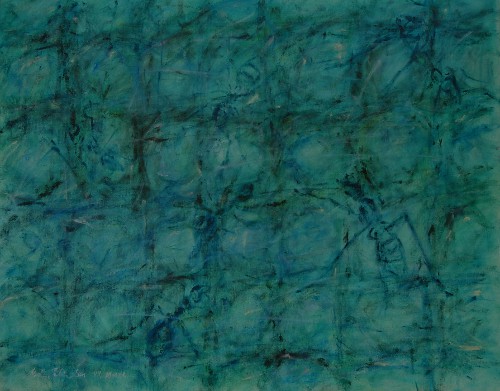
Inspired by a large dirty oil smear on the road, I started to work on a series (two so far) of abstract paintings.  Recently, I have been entranced by patterns, such as my recent painting "Colony" which though was not strictly abstract, fell into my current exploration:

Colony / 屬地 / Kolonie

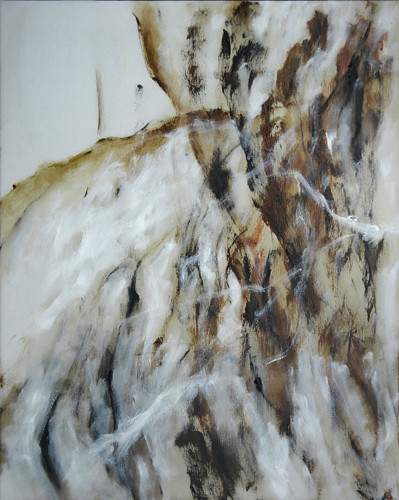
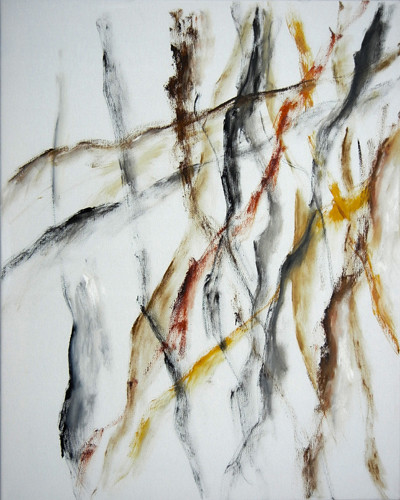
The two abstraction in progresses are really near complete and I not titled them yet:

Untitled Abstract in Progress 1

Untitled Abstract in Progress 2

Related article: Two Abstract Paintings Completed

Monday, August 29, 2011

Blue, Yellow & Red

Though I don't consider myself a colorist, I do appreciate striking color combinations.  Below are a group photos with striking blue, yellow and red glows:

Balcony of San Francisco Opera House _9875
Balcony of San Francisco War Memorial Opera House

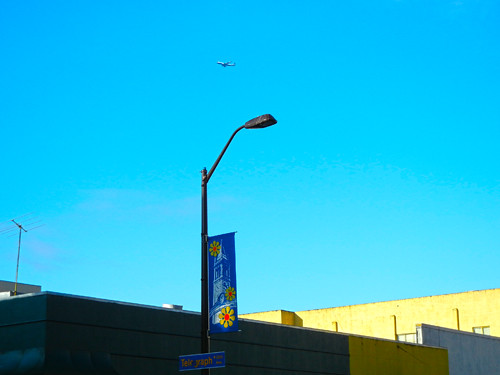
Plane over Berkeley _ 2304
Berkeley near Campus

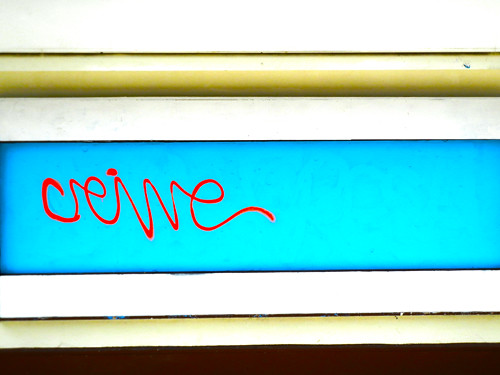
Neo Griffities in Berkeley _ 2189 _ 500
Berkeley near Campus

Blue & Red _ 1506
Lawrence Hall of Science, University of California, Berkeley

Creek in Berkeley _ 2293
Creek in University of California, Berkeley

Sunday, August 28, 2011

Princess Turandot

San Francisco Opera is to open its new season with Puccini's Turandot, which was based on the great Italian dramatist Carlo Gozzi's play, which also had source from Persian.  Wikipedia stated that "Turandot is a Persian word and name meaning "the daughter of Turan", Turan being a region of Central Asia which used to be part of the Persian Empire."  The location of the story moved from Central Asian to Mongol (a 1710 fable by French scholar François Pétis de La Croix) and finally China (Gozzi, 1762).  Turandot was used as the name of the princess in Puccini's opera.

The story in Puccini's version was a deposed blind Tartar King Timur and slaved Liù came to China.  Unknown to them, his son Calaf arrived in Peking as well.  Princess Turandot, in the dark shadow of her female ancestor was brutally slain by a conquering prince, was determined not to be conquered by any male.  She posed three riddles for prince suitors.  Whoever could solve the riddles would win her and the throne, or lose his head if failed.  Calaf entered the race and solved the riddles.  In a moment of bravado, he gave Turandot another chance - if she could guess his name, he would be at her disposal.  Turandot tortured Liù for answer.  Liù, in love with Calaf killed herself and Turandot learned what love was through her sacrifice and Turandot and Calaf sang a love-duet over Liù's neglected body.

Fairy tale stuff.

I saw it once, several years ago, in the same David Hockney production, which was as fantastic as it was gaudy.  The costumes and makeups, particularly that of Turandot, was heavily influenced by the stylized Beijing Opera, and made a very poor princess - she looked definitely more like a Beijing Opera singer than a ethereal princess of China.  During imperial time, folk opera singers were no better than street beggars, social standing wise, therefore, it was quite ridiculous a sight of her to me.  No self-respecting princess in China would allow herself to dress up as a Beijing Opera Singer.  It just would not fly.


The male conquering a half-willing female with a great kiss was quite silly as well.  I also had trouble to sympathize with another little woman of Puccini, Liù, who sacrificed herself for an obvious cad.

I didn't believe that I'd see it again in the same production.  However, I had a new understanding of the opera and that made me eager to see it again.

Very recently, I realized that this is an allegory or prophecy about the history of China, written by foreigners.

Turandot can be seen as the embodiment of the Chinese people, who was keenly aware of the history of being invaded by barbaric - the Huns, the Mongols, the Manchus and the Japaneses and was determined to fend them off by all means, however cruel.

Seeing through lens of modern history, Calaf, the foreign prince suitor, can be seen as the seductive Communist ideas, personified by a Lenin, or better still a Stalin figure, who, not without struggle, conquered the half-reluctant, half-willing nation.

Or, seen through even more contemporary history, Calaf can be seen as a capitalist, say like Micheal Jackson, armed with Coca Cola, won the heart of the people of China and the feeble, aging emperor is the omnipresent portrait or bust of Mao Zedong.  For people who enjoy anachronism, a Steve Jobs armed with an iPad to tame the daughter of China is not out of line at all.

I never knew that western prophet could have such keen insight of China, and its history and people.  But I might only be dreaming.  When the opera is presented on the stage of War Memorial Opera House, it would be again, that gaudy and bombastic chinoiserie.

Friday, August 26, 2011

Dr. Martin Luther King's New Statue in Washington D.C.


The unveiling of the new Dr. Martin Luther King's memorial designed and created by sculptor Lei Yixin was a major event in Washington D.C. and it had generated much discussions and even debates.  The debates took place largely when the project announced the chosen sculptor, largely due to his Chinese origin.  The the debut of the sculpture, the discussion now shifted to the representation of Dr. King, the merit of the sculpture as memorial and artistic achievement.  New York Times published a long article on this project and the highlights are as follow:

That figure is the Rev. Dr. Martin Luther King Jr., and this Sunday, when his four-acre, $120 million memorial on the edge of the Tidal Basin is to be officially dedicated, it will be adjacent to Franklin D. Roosevelt’s, across the water from Thomas Jefferson’s, and along an axis leading from that founding father directly to Abraham Lincoln’s. There are few figures in American history with similar credentials who would have even a remotely comparable claim for national remembrance on the Washington Mall.

Perhaps, though, it was the presence of such company that led to the kind of memorial that now exists. There is always an element of kitsch in monumental memorials, a built-in grandiosity that exaggerates the physical and spiritual statures of their human subjects.

So it should be no surprise that something similar happens to Dr. King. But his statue goes even further. Those of Jefferson and Lincoln are a mere 19 feet tall; Dr. King looms 30 feet up, staring over the Tidal Basin. And he isn’t decorously posed in a classical structure; he isn’t contained in an ordered space with Greek or Roman allusions. His form emerges halfway out of an enormous mound of granite so heavy that 50-foot piles had to be driven into the ground to provide support.

We don’t even see his feet. He is embedded in the rock like something not yet fully born, suited and stern, rising from its roughly chiseled surface. His face is uncompromising, determined, his eyes fixed in the distance, not far from where Jefferson stands across the water. But kitsch here strains at the limits of resemblance: Is this the Dr. King of the “I Have a Dream” speech? Or the writer of the 1964 Nobel Peace Prize acceptance speech?


But do these mounds of granite, which are given an almost artificial appearance with their sketchy, cartoonish contours — do they evoke anything at all like a “mountain of despair”? And the unattractive slice supposedly pushed into the center of the memorial: is that really a “stone of hope”? Certainly not, judging from the expression on Dr. King’s face.

The metaphor is not one of Dr. King’s best, anyway, but to center an entire memorial on it, and then to do so in a way that makes no real sense, is baffling. Moreover, the original context of the line from the speech is quite different. Dr. King, after the demonstration in Washington, was going back to the South, his faith intact.

And the mound’s isolation from any other tall objects, its enormity and Dr. King’s posture all conspire to make him seem an authoritarian figure, emerging full-grown from the rock’s chiseled surface, at one with the ancient forces of nature, seeming to claim their authority as his. You don’t come here to commune with him, let alone to attend to the ideas the memorial’s Web site insists are latent here: “democracy, justice, hope and love.” You come to tilt your head back and follow; he, clearly, has his mind elsewhere.

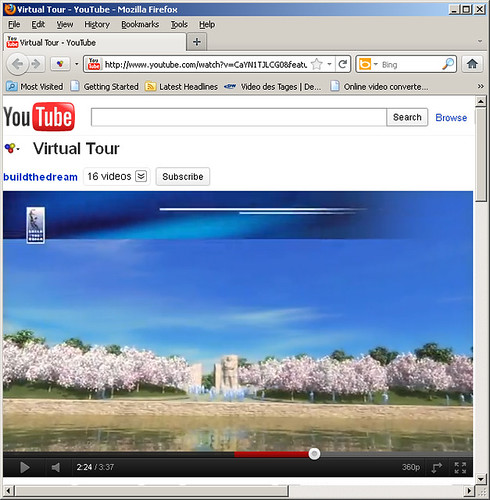
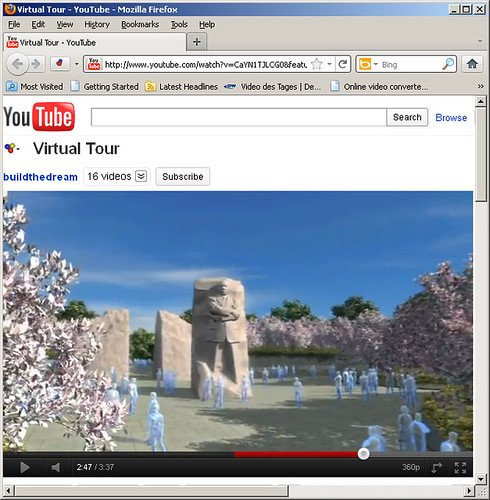
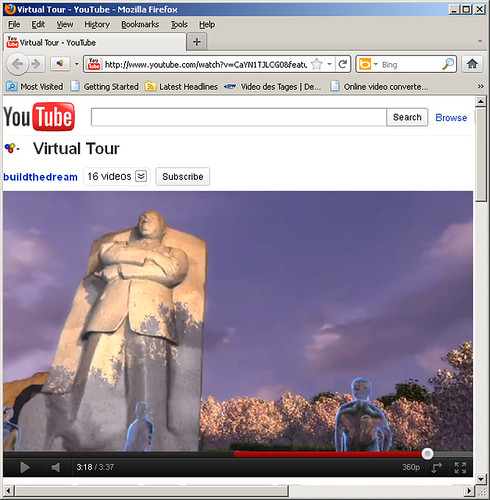
The still photo above gives us a close up of that face hoovering in the clouds which the video below from the official website give us some idea of what they want us to see. I think some shots at below moments are very representative: 2:24, 2:47 and 3:18:


Dr Martin Luther King by Lei Yixin - 2'24Dr Martin Luther King by Lei Yixin - 2'47Dr Martin Luther King by Lei Yixin - 3'18

Thus we can see much more vividly, almost in situ.  The unrealistically polished folds of his impeccably suit, his haughtily crossed arms, his stern facial expression all conspired to make him as authoritative and aloof as possible, rather than a fiery and compassionate man who has a deep connection to the time, the people and their sufferings.  To me, it invokes the unpalatable feelings of encountering those always-correct Communist leaders on high horses, such as the Stalin statue below:


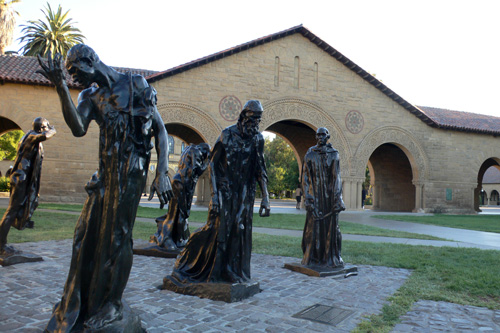
I think to make the appropriate tribute to Dr. King, a statue in the style of Rodin's "The Burghers of Calais" would be much more proper:

The Burghers of Calais, Stanford University
The Burghers of Calais, Auguste Rodin, Stanford University

Or the Memorial in Berlin to all victims of war and violence by Käthe Kollwitz, which was just as stylized and sleek bu full of emotion and compassion:


This Dr. Martin Luther King's statue by Mr. Lei - with a startlingly similar facial features to the artist and a grandiose profile to that of an Egyptian deity - failed to measure up to the essence of Dr. King and what he represented for and is not a successful addition to the capital where he delivered his important speech, I Have a Dream, surrounded by people he had been fighting for:


The greatness of Dr. King is not to be judged by the size of his pedestal.

Thursday, August 25, 2011

赠书和赠画 Buying Books and Paintings from Friends or Asking for Free

Recently I read some comments online saying that amongst Chinese people, when one has a book published, many friends and acquaintances would ask for a free copy.  The comments saying that in the West, people recognize the time and energy authors put into the work and usually would not ask for such free copy.

The comment was, though a bit sweeping, more or less on the mark.  Indeed, recalling my life in China, I remembered that many people I know who had published something usually gave free copies.  It would be insulting to ask friends to buy one of the books.

This is the same as painters, mostly in Chinese style water color on rice paper, and calligraphers.  People would make great efforts to ask accomplished painters and calligraphers to give them something.  Considering the execution time in that style is rather short - they practice hours upon hours to perfect a stoke, usually they would oblige, after some deflection.  This kind of obligation is very hard not to comply.

In order not to devalue their commercial works, usually they would state explicitly on the painting or calligraphy that the work was given to such and such exalted person and that little statement usually greatly dent the price of this work if it ever reached market.

In the US, I did give something away to great friends but not often.  My family members and friends insist on paying me for my labor.  I have attended book-signing events when my friends had books published and we  buy a copy of the book at full price and have our published friends sign the books.  Nowadays, even have a book or two published doesn't improve one's financial standing.  It's also our humble way of supporting our friends. 


Originally posted on This Shore, That Shore ..., including Chinese translation.