
The contrasts between illusions and realities are too stark to believe, yet, due to people's follies, they can often surpass the widest imaginations.
The Americans, who don't want the government to tax the super-rich more, because they had imaged that they belong to that most exclusive club, or that their grandsons might join it one day, while suffering the ever greater income inequality, is the prime example of that folly.
Last Tuesday, 26 September 2011, two such events took place in my immediate sphere, one in the place I live, Berkeley, California, and the other, on the stage of Angus Bowmer Theatre, Ashland, Oregon, as part of the Oregon Shakespeare Festival 2011, which I was visiting for the first time.
The former was a widely reported "bake sale" on the campus of University of California, Berkeley, - "Increase Diversity Bake Sale" hosted by the Berkeley College Republicans, who claimed that the minorities pay smaller share of tuition and fees to the university, and to the society, while white men shoulder the biggest burden. In regardless if this sale was a racist, or sexist, event, their argument was full of holes.
The easiest argument is that the inequality between male and female workers - not just the costs but their income as well. Let's look at the chart below (source:
Wikepedia):

In every ethnic group in the US, men make way more than women. This is not due to the nature of the jobs men or women hold. For same jobs, men make more than their female counterparts. In 2009, women's median weekly earnings were lower than men's median weekly earnings in all industries:

Therefore, the $0.25 off for all women did not reflect reality. Instead, someone argued, white men need to pay way less than $2.00 to reflect the reality that their wealth-expense ratio was way greater than any other groups mentioned in this Bake Sale:
 image source: L.A. Times
If the right-wing Republican student groups had their skewed illusions, so did the left. On the same day of the Bake Sale, I arrived in Ashland, Oregon for the Oregon Shakespeare Festival. That night, I attended a performance of a new adaptation of Molière's "Imaginary Invalid" (
Le Malade imaginaire) at the Angus Bowmer Theatre.
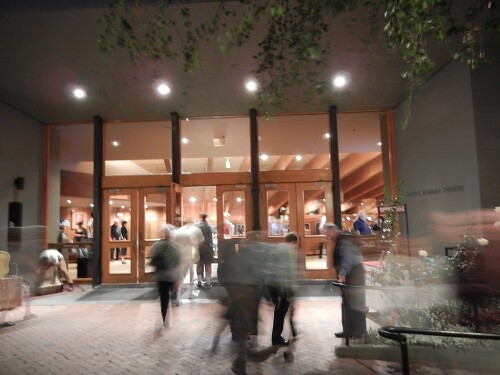 Angus Bowmer Theatre
The play was heavily re-written and many contemporary references were thrown in. The adapters, Oded Gross and Tracy Young, with the latter as director as well, changed Molière's naughtily humorous
comédie-ballet into a grossed-out farcical musical. Not entirely inappropriate. However, the new version significantly changed one of the daughters (Louison) of the protagonist, from a healthy ten year old to an old maid with a hemp and pigeon-toed. The adapters and director also gave another character, young Thomas Diaforious, a large belly and so they could heap endless humiliating jokes upon these two helpless characters, and every time they were ruthlessly laughed at, the audience roared with approvals. I, however, winced every time.
In case my readers mistake the Festival and the audience for adherents of social Darwinism, I need to point out that they took great pride in their progressiveness - the adaptation made many references to the health care reform and pined for a public option, in ways not entirely inappropriate but utterly gratuitous, and the audience gave such references most hearty cheers and applauds.
Therefore, emerged the great divide of the illusion and the reality. In reality, the creative team of this play, and the audience, behaved as the most heartless and cruel gang; yet, they congratulated themselves as the most compassionate. It was beyond sickening.
In the next night, I saw Shakespeare's Henry IV, Part II, in which Sir John Falstaff and the gaggle of other tavern dwellers were laughed at constantly. But, they were laughed at because of their "bad" deeds, and their being "bad" persons; which here, in the updated Molière, poor Louison and the Thomas, were laughed at purely for their physical deformity which did not grow out of their fault at all. Through Thomas's mouth, we learned that he was not even a glutton, like Falstaff, rather he absorbed fat in an abnormal rate.
I am not a prude. I am not allergic to comedy and farce. I enjoy great farces as much as grand tragedies like
Julius Caesar, which I saw three days later and was deeply moved and excited by it, and I will discuss it later, and appreciate the difficulties in staging a comedy. I am also familiar with the idiom of
commedia dell'arte, and can tolerate some crude jokes, like the endless body function jokes employed here to wring laughter out the guileless audience. But laughing at weak characters' physical weakness really made me nauseated.
In the end, I was deeply offended by the heartless and the crassness of the production team and detested this update very much, in contrast to the uproarious approvals from the majority audience members who gave it an enthusiastic standing ovation.
There are two well-known hunchbacks in literature - Verdi's
Rigoletto in the eponymous opera (based on Victor Hugo's
Le roi s'amuse) and Quasimodo in Hugo's
Notre Dame de Paris.
Rigoletto was a twisted character, but Verdi did not dwell on his
physical deformity, rather, it was the deformity of his soul Verdi
concentrated upon. Being compassionate, Verdi presented Rigoletto as a
passionate and selfless father, thus redeemed him from condemnation.
Hugo did not shy away from describing Quasimodo's ugliness but he used
this physical monstrosity to offset his inner kindness. Here, the
adapters (not Molière), invented the physical deformities so as to
invite the audience to laugh at them for no other reason other than
being deformed. Progressive? No. Regressive for sure.
On the OSF's official website, it stated such about the play, "set in the 1960s, this satiric comedy will be best enjoyed by playgoers 13 and up who can handle the potty humor, yucky medical remedies, and a few instances of suggestive gesture, innuendo and costuming."
I think it would be most sensible to require playgoers to be also 15 and below to enjoy the potty humor, yucky medical remedies, and a few instances of suggestive gesture, innuendo and costuming.






 Posts
Posts


