As I mentioned before, comparing to the wonderful painting collections in
the National Gallery, the British Museum in London was instead famous for its amazing antiquities - covering the vast span from far east, Asia Minor, to the cradle of the western civilization - Greece.
In order to name just two wonderful objects from the British Museum, I had to overlook many marvels such as the Rosette Stone, a modest sized stone with same inscriptions in several ancient languages, therefore the key to the deciphering of them, and some monumental and fantastic Assyrian and Egyptian sculptures.
As an artist with a particular appreciation to figurative works, however moved I was by the Rosette Stone, I was even more moved by the beauty of the sculptures originated in the ancient Greece. One of such incredibly moving figures was a Caryatid from the Erechtheion, an ancient Greek temple on the north side of the
Acropolis of Athens in Greece.
A caryatid
is a sculpted female figure serving as an architectural support taking the place of a column or a pillar supporting an
entablature on her head
[wikipedia]. The term was probably derived from the young women of Sparta who danced
every year in honor of Artemis Karyatis ('Artemis of the Walnut Tree').
First, she was truly beautiful, with a most noble face and wonderfully formed breasts, whose forms were not hindered by her thin, flowing priestess robe. She was a pillar, solid, strong, yet feminine. She was also a seer, a prophetess, but also a sufferer. She embodied mothers' all-giving nature, and the burdened social hierarchy of women in that society when daughter could be sacrificed by father and mother could be slaughtered by son if she dared to murder her murderous husband. This Caryatid was holy, admired and much put-upon. I found such image incredibly moving and she brought shivers to me.
Further more,
the British Museum informed us that "this is one of six caryatids that held up the roof of the temple on the
Acropolis known as the Erechtheion. She wears a
peplos, a
simple tunic pinned on each shoulder. Her hair is braided and falls in a
thick rope down her back. She probably held a sacrificial vessel in one
of the missing hands."
"She carries an architectural capital like a basket on her head.
From the side, her burden seems to bear down upon her; the weight is
taken on the right leg, encased in perpendicular folds arranged like the
fluting of a column shaft. The other leg is flexed with the drapery
moulded to it."
From the same origin, as part of the controversial "
Elgin Marbles", a group of three marble sculpture goddesses from the east pediment of the Parthenon - Hestia, Dione and Aphrodite - moved me with their more conventional flowing beauty, sensuality and verisimilitude, if we can say that of goddesses. Their forms were strong, solid, massive, dignified yet seductive. The endless folds of their soft draperies belied the rigid stone material they were made of.
This sculpture came from the Acropolis as well and dated about 438-432 BC, 12-18 years older than my beloved Caryatid above. There were some debates regarding which goddesses these figures represented.
The British Museum believed that "they are perhaps, from left
to right, Hestia, goddess of the hearth and home, Dione, and her
daughter Aphrodite. However, another suggestion is that the two figures
on the right are the personification of the Sea (Thalassa) in the lap of
the Earth (Gaia)."
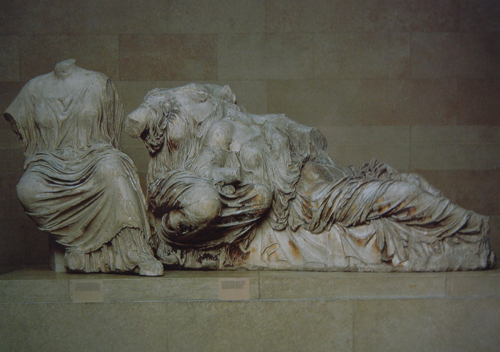
The east pediment of the Parthenon depicted the birth of Athena from the head of Zeus. These three goddesses were only peripheral figures surrounding the now lost central scene. Whoever they were, they dazzled the viewers with their endlessly evolving curves, their naturalistic anatomy and their wonderfully transient poses. Look at the figure on the left - she was about to rise and leaned forward to her right so as to to lever herself up. To the right, another figure rested herself comfortably and trustfully on the lap of her companion, whose torso in turn bent slightly backwards to accommodate the invisible head of her companion, and we could also imagine her own missing arms and hands, perhaps playing with some curls on that radiant invisible resting head.
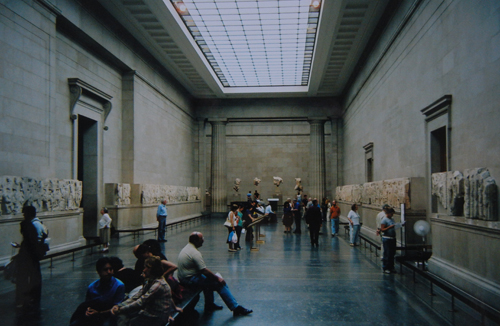
Below is a partial view of the Parthenon Gallery (Elgin Marbles) and it can give my readers some sense of what treasures that particularly gallery and by extension the Museum held:
 My Favorite Museum Collection Series
>> My Favorite Museum Collection Series 44: My Favorite Portraits at National Portrait Gallery, London
<< My Favorite Museum Collection Series 42: My Favorite Paintings in the National Gallery, London
My Favorite Museum Collection Series
>> My Favorite Museum Collection Series 44: My Favorite Portraits at National Portrait Gallery, London
<< My Favorite Museum Collection Series 42: My Favorite Paintings in the National Gallery, London




 Posts
Posts


