Showing posts with label Tragedy. Show all posts

Sunday, July 20, 2014

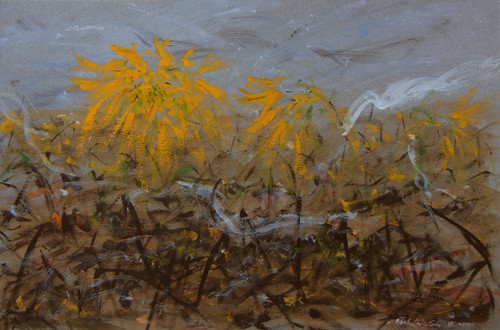
The Innocents - Dedicated to the Victims of Malaysia Airlines Flight MH17

The magnitude of the unspeakable tragedy of the downing of the civilian Malaysia Airlines Flight MH17 by a mission in the war-torn region of eastern Ukraine was hard to fathom and absolutely cannot be accepted in a civil global society.  Everyone with righteous mind mourns the loss of near 300 people, on their way to return to their homes, to see their friends and families, to go to work, or to make holidays.

I was deeply touched by the tragedy and channeled my feeling into a gouache painting, commemorate this utterly senseless tragedy.

The Innocents - Dedicated to the victims of Malaysia Airlines Flight MH17


Other Related posts on Art · 文化 · Kunst:
- Britten's War Requiem at San Francisco Symphony
- Humanity and War
- 25 Years Later, Smell of Exhausted Tian'anmen "Warriors" Lingered
- My Favorite Paintings at Österreichische Galerie Belvedere, Vienna
- "Boule de Suif" and "The Flowers of War" - on Sacrificing the Prostitutes for the "Greater Good"
- Art and Politics
- A Striking Film - "The White Ribbon"

Tuesday, April 3, 2012

Oil Painting "Oedipus" Completed

Continuing my abstraction of well-known Greek tragedies, I completed an oil painting "Oedipus".  For this most wrenching story, I incorporated several important elements of his life into this rather subdued rendering of this very dramatic and intense story.

The colors I used were mostly subdued and pale, in order to counterbalance the overwrought and sensational story I was trying to present.  The footprints, the thorns, snow-capped mountain, the crossroads, and the scarfs, framed the round and sad face of Oedipus, whose bleeding eyes and screaming mouth further repeated the round shape of his rather blank face.

I came to the final composition fairly easily, except for the details around the crossroads which at the beginning was too much detailed and was in conflict with the overall style and only after obscuring the definitions of some objects, I managed to a better balance.

Oedipus / 俄狄浦斯 / Ödipus


Matthew Felix Sun's Paintings Completed in 2012 by Matthew Felix Sun photoset

Wednesday, March 21, 2012

A Pastel Paris and an Oil Helen

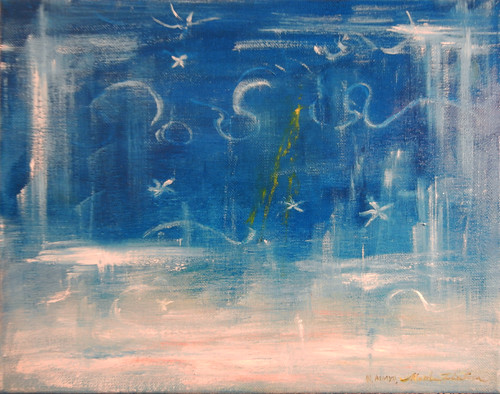
Continuing my effort to present emotions of the familiar Greek tragedies in more abstract terms, I recently completed a pastel drawing, Paris and Three Goddesses and an oil painting, Helen of Troy.

Again, I am not trying to give a narrative account of the stories; rather, I wanted to capture what immediate reaction I had once their immortal names were invoked:

Paris and Three Goddesses / 帕里斯和三位女神 / Paris und drei Göttinnen
Paris and Three Goddesses
Pastel on Paper
Completed in 2012

Helen of Troy / 特洛伊的海倫 / Helena von Troja
Helen of Troy
Oil on Canvas
11" x 14"
Completed in 2012

Matthew Felix Sun's Abstract - 抽象 - Abstrakt photoset


Matthew Felix Sun's Drawing - 素描 - Zeichnung photoset


Tag: Greek Abstract

Thursday, March 8, 2012

The Eyes of Electra - A New Semi-Abstract Painting Completed

Last weekend, I finished my new painting - "The Eyes of Electra".  This is a series of small paintings on the theme of Greek mythology.

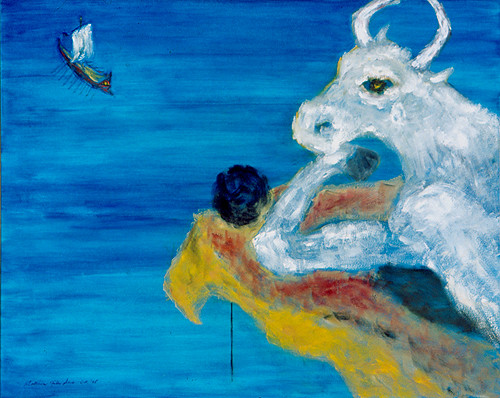
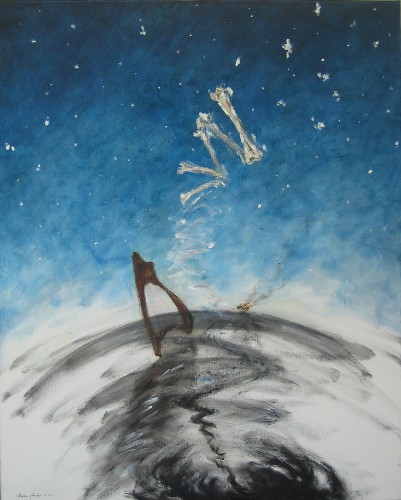
I have done a few such paintings - narrative and more or less traditional, such as Minotaur, or The Song of Orpheus:

Minotaur / 牛頭怪 / Minotaur  The Song of Orpheus / 奧菲厄斯的歌 / Das Lied des Orpheus

However, it seemed to me that I wanted to rid myself of the narrative shackle and want to present the raw emotion or the undercurrent of those stories in its rawest terms - flashes of impressions.  Considering that last year I had been exploring the expressive power of patterns and spatial relationships, this new approach was a natural path to me, at this juncture.

The Eyes of Electra, the first of this series I completed, was probably the darkest one - I wanted to present the claustrophobic poisonous atmosphere Electra insisted on the palace, where her mother murdered her father, aided by her mother's lover, who was actually revenging for his own family who had suffered in the hands of her father.

Electra, who gave name to a psychological complex, ever vengeful, stalked her besieged and frightened mother, day and night, beneath every archway, behind every wall.  Her blood-shod eyes flashing, her look terrible.  She, became a sister of furies.  She morphed from victim to victimizer, a serpent.  That, was the theme of my "The Eyes of Electra".

The Eyes of Electra / 伊萊克特拉的眼睛 / Die Augen von Electra
The Eyes of Electra
Oil on Canvas
14" x 11"
Completed in 2012
© Matthew Felix Sun
www.matthewfelixsun.com


Matthew Felix Sun's Paintings Completed in 2012 by Matthew Felix Sun photoset


Matthew Felix Sun's Abstract - 抽象 - Abstrakt photoset


Tag: Greek Abstract

Sunday, August 21, 2011

Tragedies of Our Time

Following my discussion of the new opera "Heart of a Soldier" and tragedy, I would name some contemporary political figures as protagonists in their respective tragedies.

The most obvious one in last century was Richard Nixon.  He was a brilliant and bold man and enacted many important rules and laws in this land and opened a new chapter of geo-politics by shaking hands with Communist Chinese.  Yet, he resigned from his office not long after his easy re-election as president and that disgrace ever overshadowed his undeniable achievements.  His downfall was due to his personal weakness therefore his story was the perfect form of classic tragedy when an able and powerful politician was come undone by his personal defection.

Another recent president who suffered due to personal weakness and undermined his own achievement was Bill Clinton, whose insatiable taste for tasteless women, had cause the agony of his family and the nation, and the entire trajectory of his presidency and the subsequent officeholder of the Oval Office was affected greatly, to the detriment of almost everyone on earth.

Both tragedies were beyond personal scope; they were tragedy of the entire nation.

The most tragic period of our country in the recent memory was eight long years of George W. Bush's  nightmarish reign.  On his personal level, his miserable record as president was farcical; however, for the people who had "elected" him to the office and stuck to him during those eight years, their still keenly felt sufferings formed a collective tragedy with the people as the collective protagonists. 

It is still to be seen what history would say of our current President, Barak Obama.  However, so far, his presidency has proved a tragedy for those who blinded believed in "Hope" and "Change" mantra without bothering to figure out what those hope and changes might have been, or figure out if the man they elected to trust had the mentality, adroit and audacity to carry them out.  To them, it is definitely a tragedy unfolding.

Shadow / 影子 / Schatten
Shadow, Oil on Canvas © Matthew Felix Sun

Wednesday, August 17, 2011

World Premiere Opera "Heart of A Soldier" and What Is a Tragedy

San Francisco Opera (SFOpera) is to present the World Premiere Production of Heart of a Soldier, with libretto by Donna di Novelli and music by Christopher Theofanidis, and was based on James Stewart's book of the true story of Rick Rescorla.  The opera is scheduled to be premiered on the eve of the 10th anniversary of the September 11th attacks on the World Trade Center, New York City, in 2001.  It is to be staged by Francesca Zambello, who just triumphantly staged Wagner's Ring Cycle for SFOpera.

SFOpera's website summarized the opera thus:
What makes a hero? The question was never an academic one for Rick Rescorla, a British-born adventurer who fought in Vietnam before settling in New York as head of security for a brokerage firm based in the World Trade Center. On September 11, 2001, his extraordinary courage and calmness in a crisis paid off: Rescorla led all of the 2,700 people under his care to safety—literally singing them down the stairs—before heading back into the burning building for one last check. He never emerged.
This paragraph is a quiet philosophical musing.  I remembered that it was called a tragedy before but I cannot find the word on their website any more.  Online search led me to their cached earlier press release, which did describe the story as a tragedy:
A story of war, love, friendship and heroism, Heart of a Soldier reflects on the extraordinary true story of Rick Rescorla, a man trained to be a consummate warrior who gave up his own life saving thousands in the attacks on September 11, 2001. Inspired by the American soldiers he saw as a boy in Cornwall, England preparing to launch the Normandy invasion on what became D-Day, and his adult friendship with American fighting man Dan Hill, whom he meets in war-torn Rhodesia, Rescorla emigrates to the United States in the early 1960s to become a soldier and a “Yank,” ultimately becoming a decorated platoon leader during the Vietnam War.

On September 11, 2001, as head of security for Morgan Stanley at Two World Trade Center, Rescorla is thrown to the floor when United Airlines Flight 175 crashes into the South Tower.  Amidst the unimaginable chaos that ensues, Rescorla uses his commanding presence and booming voice to literally sing his colleagues down smoke-filled stairs and out of the building. While he successfully evacuates all of his company’s 2,700 employees from the South Tower before it collapses, Rescorla makes the ultimate sacrifice when he goes back into the building to search for stragglers. Heart of a Soldier is an opera about a hero who disdains that very term, and about his deep friendship with an American soldier, so unlike him in approach and yet so similar in dedication and bravery.

“For nearly a decade I have been hoping to commission an opera from the brilliantly talented Christopher Theofanidis,” stated David Gockley. “When there finally was a window of opportunity at Houston Grand Opera, I changed jobs and preliminary plans for Heart of a Soldier had to be put on hold.  Once in San Francisco, I felt the opportunity to commission this work in observation of the tenth anniversary of the tragic events of 9/11—and the commitment of Tom Hampson to create the lead role—gave the project critical mass.  On the surface the piece is about what it takes to be a true hero, but what will drive the music is the passion, the suspense and the ultimate tragedy.” [I changed the font to bold and italic so my reader can find it.]

Perhaps, it was with good reason that SFOpera stopped to describe the opera as a tragedy.  To me, Mr. Rescorla's story is moving, sad and with a heartbreaking and unhappy ending.  But is it tragedy and what is a tragedy?

Typically, in a loose sense, we call all sad stories tragedy.  But I prefer to limit the use to a narrower sense.

There are many definitions of tragedy but I think the first definition used by Dictionary.com is the most pertinent:  

  1. a dramatic composition, often in verse, dealing with a serious or somber theme, typically that of a great person destined through a flaw of character or conflict with some overpowering force, as fate or society, to downfall or destruction.
  2. the branch of the drama that is concerned with this form of composition.
  3. the art and theory of writing and producing tragedies.
  4. any literary composition, as a novel, dealing with a somber theme carried to a tragic conclusion.
  5. the tragic element of drama, of literature generally, or of life.
To me, tragedy is the destruction of something good, noble and/or beautiful, something people recognize as good, and ought to through the flaw(s) in character(s), otherwise, the stories can be sad and touching but hardly tragic.
Wagner's Ring Cycle is the tragic story of the gods, because due to their greediness, they brought disaster onto themselves and the world. 

Shakespeare wrote many tragedies.  Take his most famous ones such as Hamlet, Othello, Macbeth, or Romeo and Juliet for example. The first three plays arrived their sad endings through the fatal flaws of the main characters, who were basically good and noble, but Hamlet was hesitate and indecisive, Othello was insecure and jealous, Macbeth was ambitious and easily manipulated.  Romeo and Juliet themselves perhaps had no such overt flaws, but taking their clans as a whole, we can see clearly that this is rather a conventional tragedy due to their inflexible hatred and thirst for revenge, they destroyed these two children they love, therefore the play was a tragedy for them collectively.

Back to the opera "Hear of A Soldier".  The more I read about it, the more I am convinced that it is a story of reassurance in humanity, and celebration of friendship, love and heroism, rather than the bemoaning a sad fate and event.

That is quite appropriate and it is how we should observe the event and honor the people who perished due to no fault of their own as individuals.

It we insist on treating 9/11 as a tragic event, then we have to examine ourselves collectively.  The event was the result of some religious zealot who bore obvious hatred of the U.S. for certain.  But, had we, the American people and the American government done something in the past contributing to the poverty, economic and environmental disasters, political corruptions and other humiliations to other parts of the world?  Couldn't we see something of ourselves in Wagner's chief god Wotan?  The answer can be nothing but yes.  Therefore, in a certain sense, the September 11 event in New York City could be partially, however significantly or insignificantly, be attributed to the flaws of our collected characters or behaviors, and that made the loss of so many lives on that fateful day tragic.


Related articles:
--> A Wasted Opportunity - on San Francisco Opera's New Commission "Heart of A Soldier"
--> Not Enough Drama, Love to Rescue - on San Francisco Opera's Commissions "Heart of A Soldier"
--> San Francisco Opera's New Commission - Heart of a Soldier
Tuesday, July 26, 2011

Aftermath of the Wenzhou Train Collision in China

According to ChinaSmack,

Domestic journalists are already used to receiving this kind of garbage/junk text messages

ChinaSmack - Collision Reaction

Translation of the text in the above photograph:
Propaganda notice: The Wenzhou train accident will be uniformly referred to as the “7.23 Yong-Wen Line Exceptionally Serious Railway Accident”.
The Wenzhou train accident from now on will be reported with “great love in the face of great disaster” as the main theme. Don’t question, don’t expand, don’t associate, and don’t repost [about the matter] on individual/personal microblogs! Appropriate service [charity/volunteer] information may be provided during television programs, but be careful of the atmosphere created by music selection!
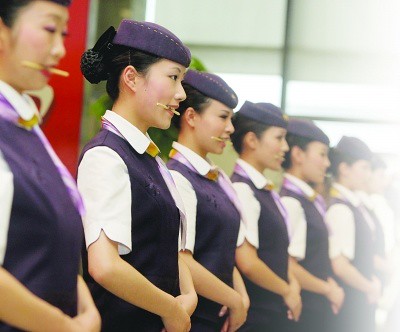
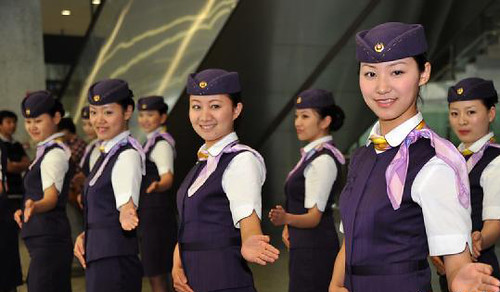
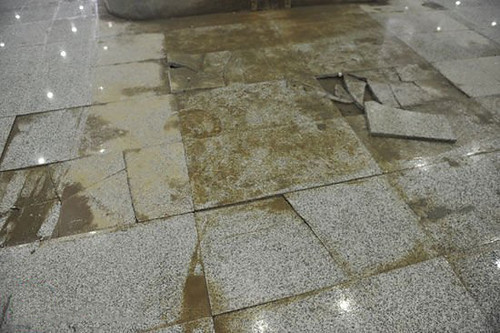
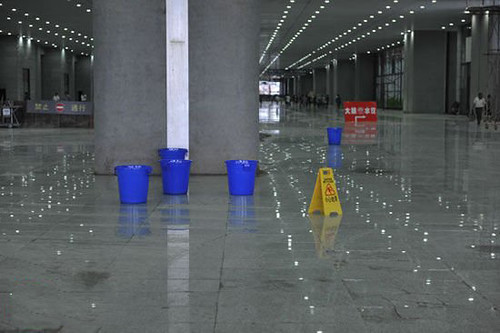
China has spent measureless amount of resources to brush up its images.  But instead of trying to make the train attendants pretty, they really ought to solve real problems big and small.

Train Attendants Practicing Smiling

Train Attendants Practicing Giving Directions

Nanjing Railroad Station 12 July 2011_2
Newly built Nanjing Railroad Station after a storm

Nanjing Railroad Station 12 July 2011_1
Newly built Nanjing Railroad Station after a storm

But the aftermath is not promising. It seems that after the immediate sacking of some officials, Chinese authorities went back on the same tactics as reported by ChinaSmack.  Many appalling things happened after the collision.  Rescue efforts prematurely ended; trains were dismantled and even buried before real evidence collection could possibly have taken place.  Now, turning tragedy into comedy is in order again.  We can only hope the tragedy in this magnitude won't happen again:

We only wish the tragedy in the


Collision caught by video camera

Saturday, October 23, 2010

Nobility of the Bailliage of Blois, George Soros and Wen Jiabao

When I examined certain terrible political situations, I was often struck by the inability and ineffectual of some enlightened insiders' attempt to improve the situation and the great weight of societal inertia.

Before the French Revolution, a group nobles, Nobility of the Bailliage of Blois, saw the unsustainable nature of the absolutism and petitioned to grant more rights and voices to the commoners but they failed to prevent the social eruption and perhaps losing their own heads.  Their tragedies were the most poignant amongst that upheaval.  Before the Russian Revolution, nobles like Leo Tolstoy had the notion of enlightening people and sharing wealth amongst all, but, their efforts were just as feeble in the face of selfish or short-sighted political oppositions, indifference and collective inertia.

In modern days, Former Chinese Communist Party Chief Zhao Ziyang and current Chinese Premier Wen Jiabao, championed or is championing, gingerly, a more democratic society with real freedom of speeches, but the hindrances proved as sturdy as the fortress of the Bastille.

The ever-larger income inequality in the US is marching the entire nation towards a precipice.  In the face of a clear and present danger, someone in the upper crest of the society, such as George Soros, Bill Gates and Nancy Pelosi are trying valiantly to stem the redistribution of wealth from the middle- and lower- class to the supremely rich, in order to create a more sustainable social structure.  But the oppositions from deceptive figures like Meg Whitman and Sarah Palin, some ignorant members of Tea Party, and indifferent "independent voters", thwarted their efforts repeatedly and at the brink of decimate such attempts.  If that happens, it would be tragic for the people those enlightened insiders trying to help, and it would be even more tragic for these enlightened insiders if the order of the society collapses and they become personal victims to the situations they had tried to change, either out of selfless compassion or calculated long-term view.  Then the scale their tragedy would mount to Shakespearean.

Leisurely / 悠然 / Gemächlich
Leisurely © Matthew Felix Sun