Wednesday, June 8, 2011

From Trash to Art, or From Trash to Elevated Trash

San Francisco prides in itself for being progressive and forward looking.  It also would like to think itself as the vanguard in contemporary art world, particularly in the public art commissioned by the city itself.

In the past years, San Francisco has commissioned some public sculptures, mostly controversial, such as the Cubid's Arrow or the Hearts, littered or adorned the west coast city, depending on one's reaction to them.


However controversial, it was hard to deny the visions of the creators of those pieces and hard to deny their definition as artworks.

Pushing the envelope further, San Francisco's Transbay Joint Powers Authority (TJPA) announced on March 10, 2011- that it
approved the concept design of a 41-foot sculpture by acclaimed contemporary artist Tim Hawkinson for the new Transbay Transit Center. The sculpture will be located on the corner of Mission and Fremont streets in downtown San Francisco. Described by the artist as a guardian figure marking the intersection or transition of a journey, the large-scale sculpture will be fabricated from recycled materials, including reinforced concrete pillars, jersey barriers and a street light pole, all reclaimed from the old Transbay Terminal building.

"We are extremely pleased that incredible public art will be a crucial part of this transportation project," said Nathaniel P. Ford Sr., Chairman, TJPA Board of Directors.  "Like the forms of transit that will utilize the new Transit Center itself, this public art will connect communities in the Bay Area and California."

The sculpture is the final piece in the Transbay Transit Center's $4.75 million, five-piece public art program established in partnership with the San Francisco Arts Commission (SFAC) for Phase 1 of the Transit Center Program. This piece will be Hawkinson's largest work to date and his first public art commission in San Francisco. Hawkinson is one of five artists to be selected by a Steering Committee to create large-scale public art works for the new Transit Center. Other artists include: Jenny Holzer, San Franciscan Ned Kahn, James Carpenter, and San Franciscan Julie Chang.
In its press release, it stated that
Rising from the rubble of the old building, the sculpture pays homage to the past while serving as a beacon to the future. It was inspired by historical markers that signified to travelers that they were on the right path. The artist cites as inspiration Inukshuks, stacked stone forms created by Native Americans for navigational purposes, and Greek Telamon or Caryatids, which are figures of support found on the facades of important buildings from the ancient world. According to the artist, "This journey is underscored by the sculpture’s original incarnation as a bus ramp, reminding us that life is composed largely of transitions. Its contrapposto gesture recalls classical sculpture, but its raw and immediate form speaks of the primitive and archetypal."

What I see from this "concept" is that it values social message more, far more, than artistic value.  Art without message is an empty shell; but art for message's sake is propaganda.  Besides, this sketch is ugly without a purpose.  Its concept is very lazy and cheap as well.  As the so-called classical pose, it reminded me in turns of Black Panther, ET, or Stalin.  Does an all-powering, threatening figure represent the best spirit of San Francisco?  


Image source: San Francisco Art Commission

Commissioned public art, usually have political or religious messages but they don't have to be so mind-bogglingly crude and ugly. 

In 1401, a competition was announced by the Arte di Calimala (Cloth Importers Guild) to design doors which would eventually be placed on the north side of the baptistry. Lorenzo Ghiberti won the competition and his creation had been known as the "Gates of Paradise":


Image Source: Wikipedia

It will be hard pressed to image that several hundreds years later, people would continue to flock to San Francisco Transbay Terminal to admire this concept of Tim Hawkinson.

San Francisco seeks to create a heart-warming story of "From Trash to Art", but it is quite likely to be "From Trash to Elevated Trash".

Tuesday, June 7, 2011

Censorship, and Behind the Kitchen Door

 A Hong Kong made movie, Empire of Silver, directed by Christina Yao just opened in the U.S.  The director Yao talked to San Francisco Chronicle on the themes of her movie and some issues she had had when the movie was distributed in mainland China:
Yao believes there are four elements of entertainment value. "The first is visceral," she says. "Like 'Transformers.' The second is voyeurism: You're a peeping Tom. The third is vicarious experience, which is quite often love affairs. The fourth is spectacle. So I chose as the two elements of my film voyeurism - how people lived - and vicarious experience: the love affair. Then I tried to use spectacle also, with some fighting scenes to spice it up. But from day one I knew I couldn't do it as an action film, even though I know that's what sells a movie now."

Chinese censors OKd the script, but told her to be careful about the sex scene. Then when they saw the film, they cut the scene down to 10 seconds and insisted she take out all the dialogue because since they have no rating system, there may be 6-year-olds in the audience.

"What can you do?" Yao says. "You deal with the system."
It is true that there is no film rating system in China and a kid can "enjoy" any scene an adult audience can see in the cinema.  Sometimes I wonder if that was a deliberate decision so as to give an excuse to censor  without raising any eyebrow.

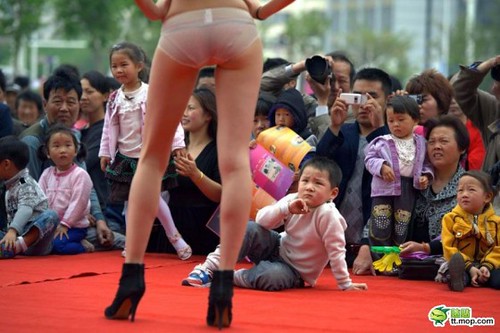
This reminds me a story I read very recently: Children Watch Revealing Lingerie Show, Netizens Unfazed.  The article reported a lingerie show in the open air stage with several kids gawking with wonder and puzzlement:

lingerie-models-modelling-for-Chinese-children-on-runway-01-560x373
Image source: Chinasmack.com

It is very interesting to notice what they shield from children and what not.  When I grew up, sex or sexy images were not even available to adults, therefore I was spared or deprived of such wonderment.

What I do remember were the whispers behind our kitchen door.  My sister and I, like typical children, didn't pay much attention to our parents when they spoke in audible decibels.  However, once their voices dropped to a thread, and particularly when those whispers were escaping from the closed kitchen door, my sister and I would rush in and demand to know what they were talking about.

Usually, it was my father and my mother exchanging political rumors du jour - the political campaigns and intrigues of 1970s and 1980s, dangerous stuff if my sister and I heard their whispers and started to boast them amongst our peers.  What they whispered was branded by the government as 小道消息, Google translation called it Gossip, which was not accurate.  Literally, it was Alley News, stories the government preferred to keep hidden from the people they ruled -- many of them could be false, but many true.

A couple years before Mao's death, the Alley News, and the attempt to weed them out was at their zeniths.  The term of Alley News faded out of daily vocabulary since the eventually death of Mao  in 1976.

However, the Alley News seems to have made a comeback.

The English Edition of People Daily Online reported in article, Why CPC resolutely safeguards political discipline, that
People's Daily, the flagship newspaper of the Central Committee of the Communist Party of China, released an article titled "Resolutely Safeguarding the Party's Political Discipline" on May 25, which attracted wide attention from various overseas media.

This article pointed out that the Party's political discipline is the rule of safeguarding the Party's political principles, political orientation and political line, and regulating political speech, political actions and the political stand of Party organizations and members. It is the most important discipline of the CPC. The article lists recent incidents of certain Party members and cadres who violated the Party's political discipline.
The central demand from that article was that Chinese Communist Party Members
决不允许在群众中散布违背党的理论和路线方针政策的意见,决不允许公开发表同中央的决定相违背的言论,决不允许对中央的决策部署阳奉阴违,决不允许编造、传播政治谣言及丑化党和国家形象的言论,决不允许以任何形式泄露党和国家的秘密,决不允许参与各种非法组织和非法活动

(must not be allowed to spread among the masses theories and views against the Party line, must not be allowed to publish remarks in contrary the Party Center's decisions, must not be allowed to be double-faced in regard of Party Center's decisions and planning, must not be allow to fabricate, spread political rumors and speeches vilifying the Party's and the national image, and never be allowed to disclose party and state secrets any form, and must not be allowed to participate in various illegal organizations and illegal activities.)
There you go.  The Party Center admitted itself the emergence of political rumors.

If only the kitchen doors were large enough.

Monday, June 6, 2011

Most Fortunate Chinese - Beijing Residents, on Drought and Water Project in China

Beijing is the absolute center of China - in a country spanning of over four time zones, only time used there is Beijing standard time.  Either the number of a train is even or odd, depends on if it goes to or fro Beijing.  When I grew up, one resident in my home city got a ration of about one pound meat, 7 oz. cooking oil, etc. per month, while Beijing residents could purchase almost everything, with no real quantitative limits.  The only inconvenience was the limit they could buy at one time.  As long as they went back to the queues, they were allowed to buy as much to their hearts' content.  Dad had many opportunities of going to Beijing on business trips and every time, he would brought back large amount of amazing food, unknown or unfamiliar to the people in the desolate Manchuria, such as deep fried doughs, and twists soaked in honey.  Dad called himself of of those "Manchurian Tiger" charging into Beijing, a favorite term Beijing residents disparagingly called people from materially challenged bitter cold Manchuria.  Beijing residents were very privileged indeed.

That tradition has survived to the new century.  The first Chinese Olympic took place in no other city than Beijing.  People from all corners spent vast amount of money to sustain a month-long inflated pride of Beijing residents, with no benefits to other places whatsoever.

When Beijing residents are thirsty, millions people lose their homes in the provinces.

Beijing and several other northern cities are suffering from thirst.  Yet, Beijing has built many golf courses and ski resorts, all notorious for water consumption.  Instead, Chinese government, after the controversial Three Gorges Dam, is now embarking on an even more ambitious, and more controversial water project - South-North Water Diversion Project.

Guardian reported that
The dam is not the only hydro-engineering project that has come under scrutiny as a result of the drought. The state's massive south-north water diversion project, which aims to tap the normally moist Yangtze basin to supply arid northern cities like Beijing, is also being called into question because one of its source reservoirs at Danjiangkou has fallen 4m below the minimum requirement for its operation.

"This is bound to have an impact on the diversion project," said Zhang Junfeng, an environmental activist with Green Earth Volunteers. "Water storage at Danjiangkou reservoir is already at a dead level and I think the situation will get worse year by year because this is partly due to climate change."

New York Times reported that 
Beijing has about 100 cubic meters, or 26,000 gallons, of water available per person. According to a standard adopted by the United Nations, that is a fraction of the 1,000 cubic meters, or 260,000 gallons, per person that indicates chronic water scarcity.

The planning for Beijing’s growth up to 2020 by the State Council already assumes the water diversion will work, rather than planning for growth with much less water, said Mr. Wang, the former official.

City planners see a Beijing full of golf courses, swimming pools and nearby ski slopes — the model set by the West.

“Instead of transferring water to meet the growing demand of a city, we should decide the size of a city according to how much water resources it has,” Mr. Wang said. “People’s desire for development has no end.”
Yangtze region is suffering the worst drought in fifty years - The Three Gorges Dam upstream had been blamed by many quarters - and the second largest lake in China, with the size of 1/6th of Lake Erie, has dried up.  There will be up to four million people relocated due to Three Gorges Dam and the Water Diversion Project would affect more people, in almost unimaginable scale.

If the Three Gorges Dam was crazy, this new project is pure insanity.

The more I think about it, the more I resent the fact that entire China population sacrifice themselves for the benefit of several million privileged residents in the most indulged Beijing.

However, whenever I complained too much, I remembered their heroic deeds in the trying time of May and June of 1989, then, my antipathy towards Beijing residents would dissipate, somewhat.

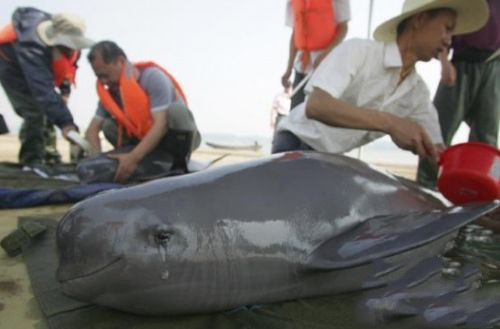
Weeping Water Dolphin

Saturday, June 4, 2011

Twenty-Two Years Later - on the Fourth of June (1989.6.4)

It is hard to believe that twenty-two years have passed since that fateful fourth of June. It was a most disturbing day I've ever lived and but the memory of it was rather hazy now. Perhaps, I have tried to suppress the trauma?

I cannot help wondering now that since that day, how many people have passed away and how many have been born. How many still have memories of that day or any knowledge of it at all and how many have totally forgotten or are ignorant of it?

How many have become richer and how many poorer? How many have lost their humanity, courage, conscious and reason and how many have traded their innocence for advancement?

How many have been troubled by conscious and how many remained gleeful of the pain of the others? How many have been trying to remember and remind and how many have tried to erase any trace of it from their own minds and history? How many have been mute and how many have been speaking with almost no audience?

I do not know. Probably I will never know. In the end, i hardly matters. What matters is that someone will remember and remind.

It is raining in Berkeley, California - unseasonable and unreasonable - rationality seems to do not belong to this day. I have nothing to offer, except for my dimming memory and some images of flowers - pictures of flowers in May - to the suffering souls.

May Flowers in Berkeley, California _ 3094

May Flowers in Berkeley, California _ 3058

May Flowers in Berkeley, California _ 3110

May Flowers in Berkeley, California _ 3099

May Flowers in Berkeley, California _ 3102

May Flowers in Berkeley, California _ 3106

May Flowers in Berkeley, California _ 3108

May Flowers in Berkeley, California _ 3091

May Flowers in Berkeley, California _ 3060

May Flowers in Berkeley, California _ 3059

May Flowers in Berkeley, California _ 3112

Thursday, June 2, 2011

Three Gorges Dam and Anti-Rightists Campaign in China

To many's surprises, Chinese government recently openly admitted some problems associated with the once much extolled Three Gorges Dam on the Yangtze River.


Image source: Wikipedia

Chinese government admitted little and without much details of the environmental and ecological problems, and issues related to relocating millions of people. It was said that the total number of people to be relocated would reach 4 million. The second largest lake in China, downstream from the Dam, Poyang Lake, slightly smaller than 1/6th of Lake Erie, now has almost completely dried up. The admission was extremely measured and controlled, yet, the rippling effect it caused in China was like a tsunami.
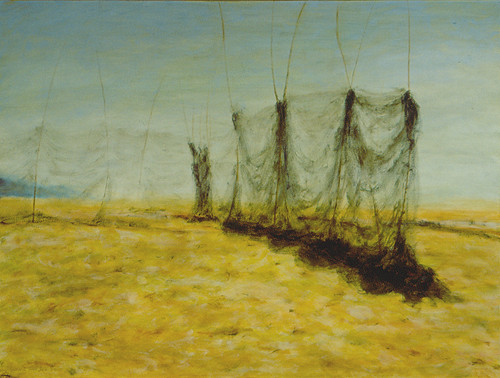
Lake / 湖 / See
Lake © Matthew Felix Sun

The overwhelming reactions from Chinese citizens were very critical and some had floated the idea of the immediate demolition of the Dam.

Even the international mouthpiece of China's ruling Communist Party, the Global Times, admitted that since there was little real debate when the Dam was being prepared for construction, it was necessary to let people to vent at least now. It conceded that the "debate" then was biased and implored people to make effort not to allow the current debate become "one-sided" again. It did not try to defend the Dam much, other than claiming that not all the problems could be attributed to the Dam.

The most striking passage from that article came from the second paragraph of the article 唾沫洗礼,三峡大坝逃不掉的课 (Spittle Baptism - Inescapable Lesson for the Three Gorges Dam):
三峡大坝作为人类历史上最大规模的水利工程,它的利与弊都一言难尽。它建设 于中国从计划经济向市场经济过渡的特殊时期,它的可行性研究在当时的中国堪称最认真的,争论也是当时相对最公开的,建设它的最终决定甚至经过了全国人大的投票,而且当时有反对票。但尽管如此,三峡大坝在充分民主的西方不可能被立项,仅从它造成了那么多移民,就不可能在西方社会被通过。

Three Gorges Dam as the largest water project in human history, whose benefits and disadvantages are hard to describe simplistically. It was built in China during a special period of transition from a planned economy to a market economy, its feasibility study can be called the most serious in China at that time, the argument at that time was also relatively the most open, the final decision on its construction was voted by National People's Congress, including many opposing votes.  Nevertheless, the Three Gorges Dam project could not be approved in the fully democratic West; simply because it caused so many people's relocation, it was impossible to be accepted in Western society.
It also admitted that
三峡大坝 是中国体制的产物,但它绝非“拍拍脑袋就定”的工程。它使中国每年少烧大量煤炭,以及减少水害、有利通航的好处,到底能不能抵消它改变 生态带来的坏处,这不是我们今天就能下结论的。科学回答这个问题,至少需要观察一百年,反复对比长江流域的气候变化,以及水电在未来能源结构中的位置,现在的任何结论都是匆忙的。

Three Gorges Dam is the product of the Chinese system, but it was not a "pat on the head" project.  It reduces a lot of coal burning per year in China, and reduces flooding damage, improves navigation, in the end we cannot conclude today if it can offset the ecological damage it causes. To answer it scientifically, we need to observe at least a hundred years, repeatedly compare climate changes in the Yangtze River basin, and the position of water energy in the future energy mix; any conclusions drawn now are too rushed.

Despite the apparent defense of the Dam, it made one more astonishing admission that the Dam was built before the important issues had been solved.  It also curiously called the Western countries fully democratic.

Suddenly, the long-ignored experts, jailed journalists and activists found some outlets to express their important opinions regarding the Dam.  People's criticism of the Dam poised to target further afield.

Therefore, almost overnight, the mainstream media started to make concerted effort to dissuade criticism against the dam and claimed that the current drought in the Yangtze River region would be worse without the Dam.  Apparently, the government was startled by the spinning out of control criticism and started to clamp it down.

That, reminded me very much of the evolution of the events led to the Anti-Rightists Campaign in late 1950s.

In mid- to late 1950s, strongman Mao believed that the Communist Party had lost its vitality and became corrupted and confidently invited people to help by constructively criticizing the Party, therefore, instigated the "Hundred Flowers Campaign", which had promoted pluralism of expression and criticism of the government.  Many naive people eagerly participated the movement and their criticism soon sounded to the Party like a challenge to their authority, and in rare cases, they did challenge the Party's legitimacy in power monopoly.

Outraged party cadres and Mao struck back with vengeance. Mao claimed that his invitation to criticizing the government was merely a ploy to "induce snakes out of their holes", and anyone who dared to criticize the government or the Party even over the most trivial matters would be branded Rightists.  Quotas were assigned to all levels of organizations, factories, farming collectives and schools.  People in charge became Rightists themselves if they failed to meet the quota.  The campaigns eventually saw the political persecution of an estimated 550,000.

According to Wikipedia, the Campaign consisted of two waves:
The first wave of attacks began immediately following the end of the Hundred Flowers movement in July 1957. By the end of the year, 300,000 people had been labeled as rightists, including the writer Ding Ling. Future premier Zhu Rongji, then working in the State Planning Commission, was purged in 1958. Most of the accused were intellectuals. The penalties included informal criticism, "re-education through labour" and in some cases death.One main target was the independent legal system. Legal professionals were transferred to other jobs; judicial power was exercised instead by political cadres and the police.

The second part of the campaign followed the Lushan Conference of July 2 – August 16, 1959. The meeting condemned General Peng Dehuai, who had criticised the Great Leap Forward.

After Mao's death, many of the convictions were revoked in 1979. Many of those accused of rightism and who had been persecuted for that crime for 22 years were suddenly found never to have been labeled as rightists.


Wikipedia photo: One of the many 1950s Chinese parade to show support to communist's political movement.

Actually, some of them had been slowly declared no longer Rightists after lengthy and harsh re-educations, and simply became "Rightists Without The Hats".  Eventually, all of them were "rehabilitated" except for six of them who carried their "hats" into the end of their lives.  The last of the six, Ms. Lin Xiling, died in France in 2009.  Most Chinese people, then and now, were genuinely appalled by their challenge to Communist Party's one party rule, my intellectual parents included.

Because the Campaign took place long before I grew up, I never had much impression of it and never thought about the movement much.  However, I did have a high school English teacher who had been one of those Former-Rightist and his much contorted demeanor gave me a hint of what sufferings he had endured.  Perhaps, I should talk about him in another blog entry.

The most unforgettable time when I heard mentioning of the Anti-Rightists Campaign was in late May of 1989, when my five roommates and I impatiently waited to learn the fate of our last roommate who stayed in Beijing, which had just been placed under martial rule, rather then coming back with the rest of us after a one-night and one-day sit-in.  A local classmate's parent came and warned us the ruthlessness of Deng Xiaoping, who was till then, had charmed the west and was a most benevolent and grandfatherly figure to us.  We laughed off the warning.  The parent thus described in details whatever he knew about Deng's zeal during the Anti-Rightists Campaign, when Deng was the chief hit man of Mao and his cadres.

Only in less than two weeks, came the June 4th (六四) and then we realized indeed how naive and foolish we had been.

Growing up in post-Culture Revolution era, we utterly failed to appreciate how repulsive any instability was to our elders, and how brutal and determined the government could be so as to remain in power.  The students also failed to connect to the masses, except for in Beijing, but eventually, it hardly matters.  No people's power could withstand the crushing forces from those metal tracks of the roaring tanks.

Depression - Rebirth / 抑鬱 - 重生 / Tiefstand - Wiedergeburt
Depression - Rebirth © Matthew Felix Sun
Wednesday, June 1, 2011

Happy International Children's Day

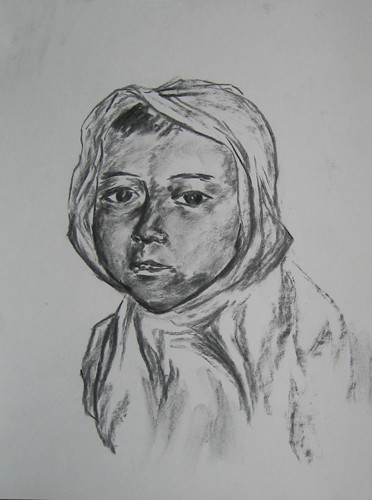
Matthew Felix Sun's Drawing_7269

Happy International Children's Day, everyone, and happy birthday, my little cousin.  I made a drawing of him, unfortunately, he will not be able to see it in China, since part of the Flickr files are blocked by the "Great Firewall of Golden Shield" software.

I can only hope, however in vain, that all children would be happy.