Friday, November 18, 2016

My Favorite Paintings at Anderson Collection at Stanford University

Anderson Collection at Stanford University was built to showcase an Anderson family's modern art collection.

I found Theophrastus' Garden (1982) by Terry Winters very enchanting. This ethereal garden, in pleasing shades of burnt umber and blended and mingled with white tint, was at the same time earthy, solid, airy, and unreal. The strange, insect-looking flora, in shades of steely blue, scattered around into the depth, like the dispersing dandelion seeds, animated this fenced in paradise.
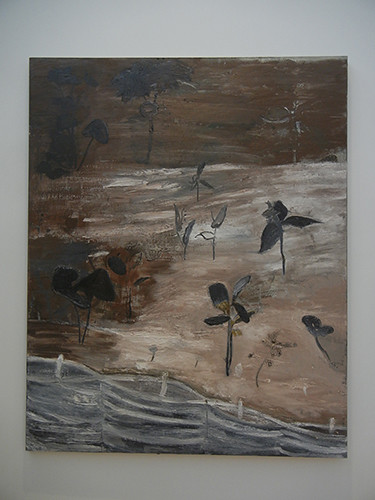
DSCN9139 _ Theophrastus' Garden, 1982, Terry Winters, Anderson Collection
Theophrastus' Garden, 1982, Terry Winters

Another favorite of mine was a monochromatic, semi-abstract parting by Susan Rothenberg, Wishbone (1979). In the center of the motley black canvas, "stood" an elongated blue black wishbone, a forked bone (the furcula) between the neck and breast of a bird, often chicken from our tables. To its right, a lean horse, in charcoal black shade, occupied the right one-third of the canvas. The shape of the horse, viewed absolutely frontal, seen only it's head, triangle-shaped torso, and two legs, echoed that of the wishbone, or could be its filled-out shadow. The meaning of this painting was quite opaque. Perhaps, the swift horse, might be the agent to accomplish one's wish? Though employed almost only one color, Rothenberg managed to created a world full of shifting changes of shades and moods, and charged with vigor and emotion.
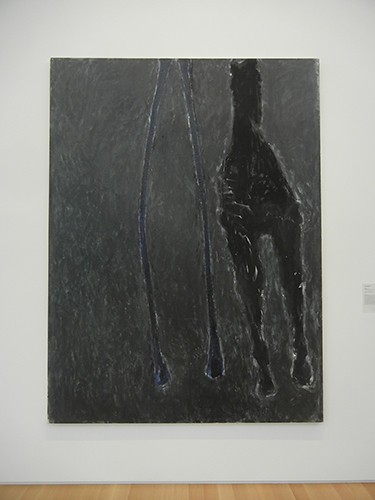
DSCN9146 _ Wishbone, 1979, Susan Rothenberg, Anderson Collection
Wishbone, 1979, Susan Rothenberg

My Favorite Museum Collection Series
>> My Favorite Museum Collection Series 150: My Favorite Paintings at Oakland Museum of California
<< My Favorite Museum Collection Series 148: My Favorite Paintings at Iris & B. Gerald Cantor Center for Visual Arts at Stanford University

List of My Favorite Artworks in the Museums I've Visited

Other Related posts on Art · 文化 · Kunst:
- Anderson Collection at Stanford University
- Paintings at Cantor Arts Center, Stanford University
- Rodin and Richard Serra in Cantor Arts Center, Stanford University
- Inside Richard Serra's Sculpture "Sequence" at Cantor Arts Center, Stanford University
- Auguste Rodin at Cantor Arts Center, Stanford University
- Andy Goldsworthy's Stone River in a Lush Setting
- Four Chinese Masters's Works at Cantor Arts Center, Stanford University
- Second Thoughts on the Sculpture "The Blind" by Lorado Taft
- Richard Serra Drawing and 2010 SECA Art Award at SFMOMA
- My Favorite Sculptures at Institut für Klassische Archäologie, Karl-Franzens-Universität Graz

Tuesday, November 15, 2016

My Favorite Paintings at Iris & B. Gerald Cantor Center for Visual Arts at Stanford University

Iris & B. Gerald Cantor Center for Visual Arts at Stanford University was known for its amazing Rodin sculpture collections, but its painting collections were also remarkable.

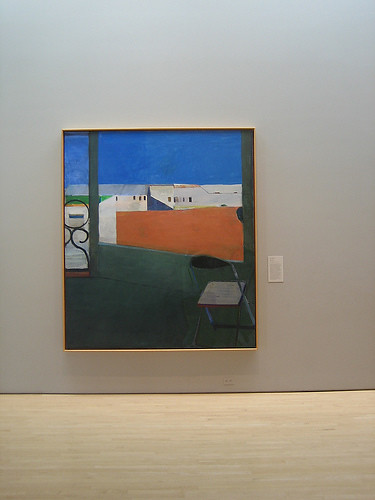
My favorite was a semi-abstract by Richard Diebenkorn, titled Window. This painting was striking in its bold division of the canvas into several flat areas of brilliantly contrasting colors - bright blue, neutral orange and muted green, plus a narrow stretch of varying gray. Some details of depicted objects, large or small, helped to break otherwise monotonousness of each area, and artfully joined them together. The painting also drew viewers in with its many shapes and forms, and enigmatic relationships of planes, and trickery of view points. Those objects, seemingly readily identifiable, but upon closer examination, tended to shift away from the initial impressions. This painting's evocative atmosphere, intriguing composition, and strategic placement of objects, reminded me of mature Matisse in similar interior/exterior setting. This painting was exemplary in both representational and abstract worlds.

Window, Richard Diebenkorn _ 1887
Window, Richard Diebenkorn

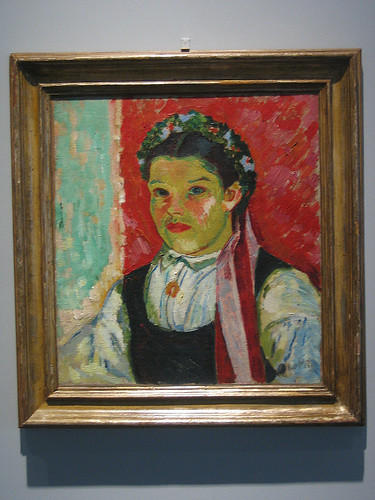
My second favorite was a portrait by Max Pechstein, Kurish Bride, I.  This was a boldly outlined and modeled portrait of a lovely young woman, in a simple black and white dress or blouse, adorned with wildflower garland and red and pink scarf, high-cheeked and wide eyed, solid yet sensual, sedated yet hopeful, and almost joyous. One particularly striking aspect was that her face was painted in unnatural and even sickly green, but it complimented well of her dark eyes, ruddy cheeks and scarlet lips. Furthermore, against deep red backdrop, and offset by pale green over light brown, the colors clashed dramatically and excitingly, and made her face commend all the attention. The large area of red background echoed and contrasted her ruddy cheeks and scarlet lips, and the scarf, thus firmly connected to the central figure. A riotously outburst of colors and emotions.

Kurish Bride, I, Max Pechstein _ 1909
Kurish Bride, I, Max Pechstein


My Favorite Museum Collection Series
>> My Favorite Museum Collection Series 149: My Favorite Paintings at Anderson Collection at Stanford University
<< My Favorite Museum Collection Series 147: My Favorite Engravings at Seattle Art Museum

List of My Favorite Artworks in the Museums I've Visited

Other Related posts on Art · 文化 · Kunst:
- Anderson Collection at Stanford University
- Paintings at Cantor Arts Center, Stanford University
- Rodin and Richard Serra in Cantor Arts Center, Stanford University
- Inside Richard Serra's Sculpture "Sequence" at Cantor Arts Center, Stanford University
- Auguste Rodin at Cantor Arts Center, Stanford University
- Andy Goldsworthy's Stone River in a Lush Setting
- Four Chinese Masters's Works at Cantor Arts Center, Stanford University
- Second Thoughts on the Sculpture "The Blind" by Lorado Taft
- Richard Serra Drawing and 2010 SECA Art Award at SFMOMA
- My Favorite Sculptures at Institut für Klassische Archäologie, Karl-Franzens-Universität Graz
Friday, November 11, 2016

My Favorite Engravings at Seattle Art Museum

What impressed me most in Seattle Art Museum were two amazing engravings, both by the great German artist Albrecht Dürer (1471-1528).

The first was titled Ritter, Tod und Teufel (Knight, Death and Devil) (1513). This allegorical piece zoomed in on a weary-looking knight amounting a sturdy steed, accompanied by two goat-like strange creatures, one on an exhausted horse to the knight's right — Death, identifiable by the hourglass in his hand reminding the knight of the shortness of life, and the other one following behind on foot, even more hideous looking than Death — the Devil, joining in hearty taunting. Underneath the knight's horse, a hound resolutely ran along on that narrow range of a waste land, as steadfast as the master, who maintained his proud posture and stony countenance in the company of danger, could be seen either as symbol of courage, or foolhardiness.

Dürer's technical virtuosity was astounding, not only in the tense subject and well-planned composition, but particularly also in many fine details, such as the majestic muscles and shining pelt of the horse, the menacing cliffs pressing on the travelers, and the castles seen through barren branches atop the jagged ridge, all through flowing lines, endlessly varied types of fine hatching, the subtle modulations of light and shadow, and the absolute confidence in rendering of minutiae details.

Knight, Death and the Devil
Albrecht Dürer [Public domain], via Wikimedia Commons
Ritter, Tod und Teufel (Knight, Death and Devil), 1513, Albrecht Dürer, 1471-1528

The second Dürer was Das Meerwunder (The Sea Monster, or The Sea Wonder), ca. 1498. This engraving depicted a naked maiden, lying on the back of a scaled creature with human head and fish body, being led or dragged away from shore into broad water body, though it was curiously narrow, more an estuary than an open sea. The background featured a steep hill and a castle on top, and a grander castle at the foot of the hill, just above the shore, onto which maidens clambered several naked in great haste, ostensibly fleeing from danger, the sea monster, and nearby, an old man gesticulating his alarm, next to a collapsed woman lamenting on the ground.

Despite all the drama on the distant shore, the central figures, both the sea creature and the abducted maiden, were rather curiously calm and almost nonchalant save for a few traces of sadness, resignation, and slight distress on the maiden's face, which was in turn betrayed by her body's eloquent pose in a reclined pose often associated with voluptuous and seductive Venus. This contradiction created a fascinating though somewhat sad enigma.

Comparing to the dark tone of Knight piece, this one was much brighter, almost ironically sunny, dominated by more white space due to far less hatching, and result was airy and quite suitable to the sea setting, though no necessarily the obviously disturbing story. These main figures and landscape though were no less three-dimensional, due to energetic and graceful lines, and subtle suggestions of shades and volumes, as in a very fine line drawing. 

Albrecht Dürer - Sea Monster (Das Meerwunder) (NGA 1943.3.3483)
Das Meerwunder (The Sea Monster, or The Sea Wonder), ca. 1498, Albrecht Dürer
Albrecht Dürer [Public domain], via Wikimedia Commons


My Favorite Museum Collection Series
>> My Favorite Museum Collection Series 148: My Favorite Paintings at Iris & B. Gerald Cantor Center for Visual Arts at Stanford University
<< My Favorite Museum Collection Series 146: My Favorite Artifacts in Phoebe A. Hearst Anthropology Museum, UC Berkeley

List of My Favorite Artworks in the Museums I've Visited

Other Related posts on Art · 文化 · Kunst:
- Crescat Graffiti, Vita Excolatur by Quinn Dombrowski
- My Favorite Paintings at Musée Marmottan Monet
- Museum of Modern Art (MOMA), New York City
- Max Beckmann's Paintings in MOMA and MET
- Gustav Klimt and Egon Schiele in Wien (Vienna)

Tuesday, November 8, 2016

My Favorite Artifacts in Phoebe A. Hearst Anthropology Museum, UC Berkeley

Phoebe A.  Hearst Museum of Anthropology of University of California, Berkeley has a huge trove of wonderful and sometimes strange artefeacts from all over the world and many of its prized collections are those from the ancient civilizations.

The most amazing pieces are a group of Egyptian mummy portraits. These ancient works astonished with their verisimilitude. Perhaps, there were some customary beautification, but these portraits really strove to capture the likeliness of the deceased, and their living spirits and personalities. Another interesting aspect of these portraits was that the deceased were all portrayed as quite at peace, and devoid of any traces of sadness, often seen in latter-day cemetery monuments.

Egyptian Mummy Portrait

Another amazing piece was also from ancient Egypt — an Egyptian iconography relief found at Tebtunis, a town or city located in the present-day village of Tell Umm el-Baragat, in the Al Fayyum Governorate, Lower Egypt. This stone carving fragment featured some commonly seen, fantastic ancient Egyptian deities in the shape of wondrous beasts and humans, or maybe simply princes. These beautifully rendered relief profiles dazzled with fluid lines, and economic yet rich details, and they immediately evoked the world full of grace, mystery and spirituality beyond our feeble comprehension.

Egyptian iconography at Tebtunis - Hearst Anthropology Museum


My Favorite Museum Collection Series
>> My Favorite Museum Collection Series 147: My Favorite Engravings at Seattle Art Museum
<< My Favorite Museum Collection Series 145: My Favorite Artefacts at Magnes Collection of Jewish Art and Life in Berkeley

List of My Favorite Artworks in the Museums I've Visited

Other Related posts on Art · 文化 · Kunst:
- New Berkeley Art Museum / Pacific Film Archive Opened
- In Berkeley Art Museum, California
- Il Ghetto di Venezia and Museo Ebraico (Jewish Museum) in Venice
- Art from Ancient Worlds at The Metropolitan Museum of Art, New York
- My Favorite Sculptures at Museo Nazionale Romano, Roma
- My Favorite Sculptures from The British Museum

Friday, November 4, 2016

My Favorite Artefacts at Magnes Collection of Jewish Art and Life in Berkeley

Like many Jewish museums, the Magnes Collection of Jewish Art and Life of UC Berkeley focuses on artefacts of Jewish culture accumulated through centuries sedimentation and diaspora.

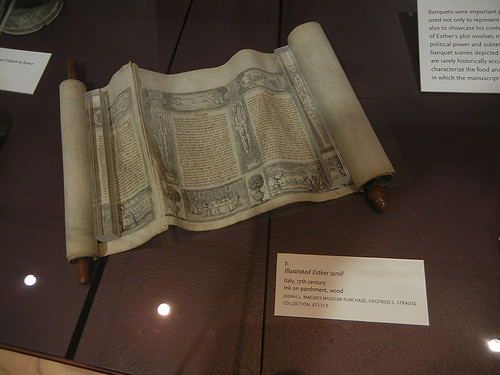
One of the very interesting objects was an illustrated Esther scroll tracing back to the 17th Century Italy - a beautifully illustrated and calligraphed document, whose black figurative images and decorative borders framed pale red texts wonderfully. The simple cherry-colored wooden handles added proper weight to this ancient object.

DSCN1055 - Illustrated Esther scroll - Italy, 17th Century, Magnes Museum
Illustrated Esther scroll - Italy, 17th Century

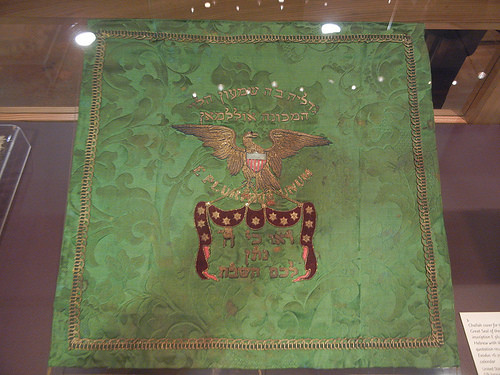
My second favorite was a piece of dark green silk cloth with embroidery of an eagle and banner beneath its claws, plus some Hebrew circling above the eagle and inside the nook of the hanging banner. This solemn and rather grand piece of fabric was identified as a Challah cover, and it must be intended for important occasions, and it rightfully reflected the richness of Jewish culture. 

DSCN1050 _ Magnes Museum, Berkeley
Embroidered Challah cover

My Favorite Museum Collection Series
>> My Favorite Museum Collection Series 146: My Favorite Artifacts in Phoebe A. Hearst Anthropology Museum, UC Berkeley
<< My Favorite Museum Collection Series 144: My Favorite Paintings at Berkeley Art Museum / Pacific Film Archive

List of My Favorite Artworks in the Museums I've Visited

Other Related posts on Art · 文化 · Kunst:
- New Berkeley Art Museum / Pacific Film Archive Opened
- In Berkeley Art Museum, California
- Il Ghetto di Venezia and Museo Ebraico (Jewish Museum) in Venice
- Late Night of Jewish Museum in Vienna

Tuesday, November 1, 2016

My Favorite Paintings at Berkeley Art Museum / Pacific Film Archive


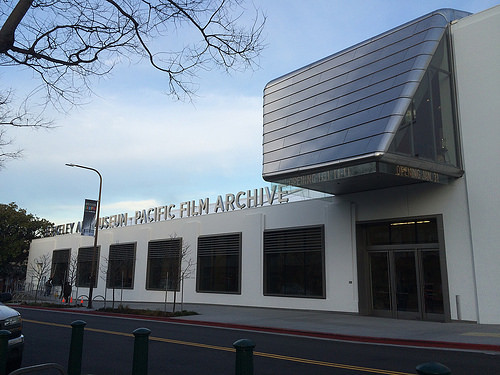
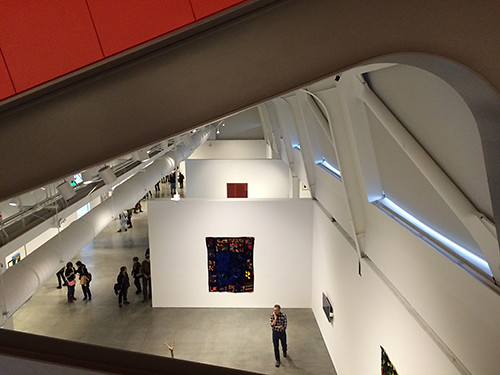
IMG_3528 _ BAM PFA January 2016 (md)

IMG_3506 _ BAM PFA January 2016

IMG_3600 _ BAM PFA Pre-Opening, 30 January 2016

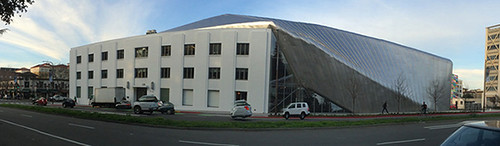
BAMPFA, the UC Berkeley Art Museum and Pacific Film Archive, is the visual arts center of the University of California, Berkeley, with a proclaimed mission to inspire the imagination and ignite critical dialogue through art and film. 

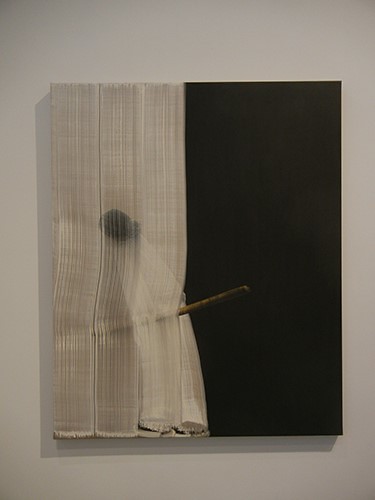
One of the most striking paintings I saw in their inaugural exhibition at the new downtown location was 4 Brushstrokes over Figure by Hyun-Sook Son, a painting of a woman half-hidden behind a gauzy white curtain on the left half of the painting, contrasting greatly to the very dark background on the right, bound together by a perhaps broom held by the protagonist. The painting invoked essence of traditional Korean paintings or perhaps the golden age porcelains, with its sparseness and cleanness and the light-handed and deft rendition. There was a great sense of mystery and somewhat sadness to a very ordinary yet almost ritualistic chapter of life. In front of this near monochromatic painting, people felt like eavesdropping and automatically be hushed by its overwhelming quietude.

DSCN1447 _ 4 Brushstrokes over Figure, Hyun-Sook Song, BAM PFA Pre-Opening, 30 January 2016
4 Brushstrokes over Figure, Hyun-Sook Song

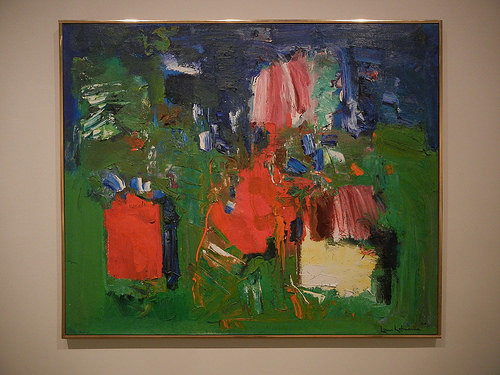
For a contrast, my second favorite was a combustive color burst — Summer Bliss (1960) by Hans Hofmann, whose initial donations kickstarted the founding of this museum. This wonderful pure abstract featured bold color blocks, primarily in red, yellow and blue, over a large expanse of green. The most striking part was the color contrast and harmony, and above all, the kineticism of the painting, a overwhelming sense of constant movements as all those colors and color blocks seemed forever shifted, pulsated and moved in many directions, according to the relationships of adjacent colors and shades, and ultimately formed a great choral symphony, full of combustive life and energy.

DSCN9379 _ Summer Bliss, 1960, Hans Hofmann, BAM Closing, 21 December 2014
Summer Bliss, 1960, Hans Hofmann

My Favorite Museum Collection Series
>> My Favorite Museum Collection Series 145: My Favorite Artefacts at Magnes Collection of Jewish Art and Life in Berkeley
<< My Favorite Museum Collection Series 143: My Favorite Paintings at Art Institute of Chicago

List of My Favorite Artworks in the Museums I've Visited

Other Related posts on Art · 文化 · Kunst:
- New Berkeley Art Museum / Pacific Film Archive Opened
- Crescat Graffiti, Vita Excolatur by Quinn Dombrowski
- My Favorite Paintings at Musée Marmottan Monet
- Museum of Modern Art (MOMA), New York City 
- New Berkeley Art Museum / Pacific Film Archive Readying for Opening
- BAM/PFA New Building Topping Out Celebration
- Farewell, Berkeley Art Museum (BAM) at Bancroft Way
Getting Ready for Barry McGee at Berkeley Art Museum
- In Berkeley Art Museum, California
- Silke Otto-Knapp at Berkeley Art Museum